
GAS-340 · Lesson 11 of 12 · 23 min
Preventive maintenance programs
▶ Video coming soon A video version of this lesson is on the way.
In the spring of 2026, after the winter of calls in Rosa's pile, Hank and Priya sat down with the records and counted. Of Bayline's residential no-heat calls between December and March, about a third were on equipment that had not been serviced for more than two years, and nearly all of those were faults a routine service would have caught: blocked condensate traps, loaded filters, weak flame signals, dirty burners, low-hanging terminations. On the commercial side, Maureen's figures told the same story about rooftop units. Hank's conclusion went into Bayline's planning for the 2026–27 season: sell fewer emergencies and more maintenance. This lesson is about what a maintenance program is, what the law requires, and how to plan and carry one out.
Preventive maintenance is work done on a schedule to keep equipment safe and efficient and to find problems before they become breakdowns. It is different from service, which responds to a fault, but it uses the same skills and the same instruments. Done well, it is the best safety work a gas technician does, because it finds the cracked connector or the spilling water heater before anyone is hurt.
What the law requires
Ontario's Gaseous Fuels regulation puts the duty on the owner: an owner or user must ensure that every appliance, piping system and vent used for gas is maintained in a safe operating condition. The regulation does not set a fixed service interval for ordinary appliances in houses. For appliances in industrial, institutional and assembly buildings, it goes further: the owner must maintain them according to the manufacturer's recommended procedures, have those procedures evaluated at least once every 10 years, and have an inspection at least once every 10 years to confirm safe operation and compliance, by a person with the right certificate. Appliance makers' instructions almost always call for an annual inspection by a qualified technician, and warranties often depend on it.
Commercial kitchens, rooftop units serving occupied buildings and process equipment also come under fire codes, mechanical codes and insurance requirements, and many owners' insurers ask for maintenance records. A maintenance program is how a contractor helps an owner meet all of these at once.
The residential annual service
Bayline's residential annual service follows a written checklist, one for each appliance type, built from the makers' instructions and the lessons of this program. For a furnace, the core items are:
- Safety first: door check with the CO monitor; CO alarms in the house present, in date and working; nothing stored against the appliance.
- Venting and air: vent connector, chimney or plastic venting, slope, supports and joints; terminations and their clearances; combustion air openings; spillage test on any natural draft appliance in the space.
- Burners and ignition: burners clean and aligned; igniter condition and resistance; flame signal measured; sequence watched through a full cycle.
- Heat exchanger: inspected as lesson 8 describes, with flame watched at blower start.
- Gas: inlet pressure static and running, manifold pressure set to the plate, input clocked where practical, leak test of the appliance's gas connection.
- Air side: filter, blower wheel and motor, temperature rise, external static pressure.
- Condensate on condensing models: trap cleaned and refilled, drain and pump checked, neutralizer checked.
- Controls: limit and rollout circuits, pressure switch, thermostat operation.
- Combustion analysis: CO air-free, O₂ and flue temperature, recorded.
- Record and talk to the customer: readings as found and as left, recommendations in writing.
Water heaters, boilers, fireplaces and other appliances have their own checklists. The water heater check covers venting and spillage, the burner and pilot, the thermal relief valve and its discharge line, and the anode and sediment where the maker calls for it. The fireplace check covers the glass and gasket, the log set placement, the vent, the pilot and its safety, and the barrier screen.
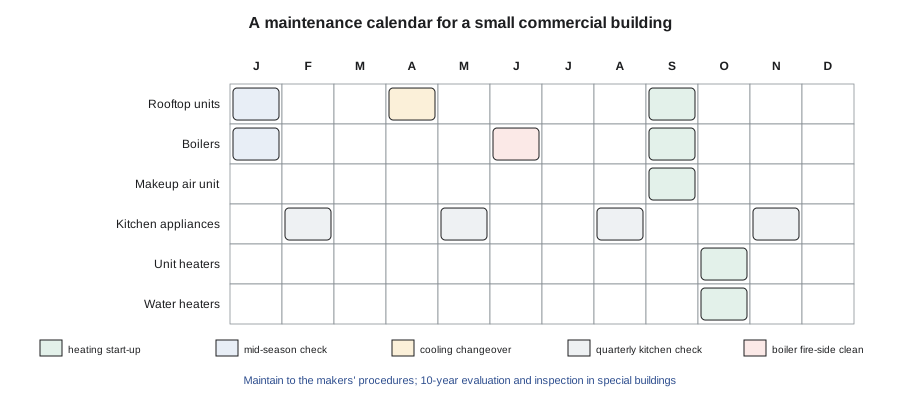
Commercial maintenance programs
A commercial program is built around the equipment list, the makers' instructions, the codes and the building's use. Maureen builds one in four steps:
- Inventory. Every gas appliance in the building, with its make, model, serial number, input, age, location and condition, as in her Ferguson Place inventory in GAS-320.
- Tasks and intervals. For each appliance, the maker's maintenance tasks and their intervals, plus code-required tests and the owner's insurer's requirements. Some tasks are seasonal, such as heating start-ups and shutdowns; some monthly, such as filter changes in busy buildings; some annual, such as combustion tuning; and some longer, such as boiler internal inspections.
- Schedule. The tasks arranged into visits that suit the building: heating start-ups before the first cold weather, rooftop unit changeovers in spring and autumn, kitchen equipment when the restaurant is closed, boilers before the state or insurer inspection.
- Records. A log for each appliance that shows every visit, the readings and the findings, which the owner can show an inspector or insurer.
| Equipment | Typical tasks | Typical interval |
|---|---|---|
| Rooftop units | Heat section start-up, heat exchanger inspection, combustion, filters, belts, economizer | Spring and autumn changeovers; filters more often |
| Commercial boilers | Combustion tuning, safety control tests, low-water cutoff test, relief valve check, fire-side cleaning | Annual tune; control tests as the maker and code require; cleaning as needed |
| Makeup air units | Burner, flame safeguard, airflow switch, interlocks with exhaust | Before heating season; interlocks each visit |
| Commercial kitchen appliances | Burners, pilots, valves, connectors and restraints, flue passages | Quarterly in busy kitchens |
| Unit and infrared heaters | Burners, venting, clearances, reflectors and tubes | Before heating season |
| Commercial water heaters | Venting, combustion, relief valves, condensate on condensing models | Annual |
Efficiency and the case for maintenance
Maintenance also saves gas, which is how many owners are persuaded to pay for it. A boiler whose fire side is fouled with soot, or whose burner has drifted out of tune, passes less heat to the water and sends more up the stack. A rough rule used by many technicians, and labelled as a rule of thumb rather than a law, is that a rise in stack temperature of about 22 °C (40 °F) above the clean, tuned value costs about one point of efficiency.
Worked problem
How much gas does a fouled boiler waste?
A school boiler's stack temperature, clean and tuned, was 177 °C. At this autumn's start-up it read 221 °C at the same firing rate. Using the rule of about one point of efficiency per 22 °C, and an efficiency of 82 when clean, estimate the efficiency now. If the boiler burns 40,000 m³ of gas in a season when clean, how much more would it burn at the lower efficiency to deliver the same heat?
Show solution
- Rise in stack temperature:
- \[221 - 177 = 44 \text{ °C}\]
- Efficiency points lost:
- \[44 \div 22 = 2\]
- Efficiency now:
- \[82 - 2 = 80\]
- Gas to deliver the same heat:
- \[40000 \times \frac{82}{80} = 41000 \text{ m}^3\]
- Extra gas:
- \[41000 - 40000 = 1000 \text{ m}^3\]
Answer: About 1,000 m³ of extra gas in a season, around 2.5 in 100 more, for a fouled fire side that a cleaning and tune-up would fix. The estimate is rough, because the rule of thumb is rough, but it is the kind of figure that persuades an owner.
Running a program well
A maintenance program only works if it is done properly every time. Bayline's rules for its technicians are simple. Use the checklist, every item, every visit, and record the readings, not ticks. Treat a maintenance visit as a safety inspection, so that an unsafe condition found on a maintenance call gets the same response as on a service call. Recommend repairs in writing with the reason, and do not invent work. And look beyond the appliance on the list: the water heater in the corner, the CO alarm in the hallway, the dryer duct, the range hood that depressurizes the house.
For the customer, the program is a promise: that someone qualified will look at their equipment before the cold weather and tell them honestly what they find. Bayline's plan for the 2026–27 season was to offer every residential customer an autumn service reminder by text and every commercial customer a written program with a calendar. The first autumn visits under the new plan started in September 2026, and the results, good or bad, will be in next spring's count.
Planning the work
A maintenance program has to fit the hours a company actually has. Before Bayline offered its 2026–27 plan, Priya worked out how many technician hours the autumn start-up season would need, using Bayline's own records of how long each kind of visit took.
Worked problem
How many technician hours does the autumn season need?
Bayline expects 420 residential furnace services at about 1.25 hours each, 90 water heater checks done on the same visits at about 0.25 hours each, and 30 commercial buildings averaging 6 hours each for their heating start-ups. Travel adds about 0.5 hours to each residential visit and 1 hour to each commercial building. How many technician hours does the season need, and how many weeks would it take four technicians working 32 hours a week on maintenance?
Show solution
- Residential services:
- \[420 \times (1.25 + 0.5) = 735 \text{ h}\]
- Water heater checks:
- \[90 \times 0.25 = 22.5 \text{ h}\]
- Commercial start-ups:
- \[30 \times (6 + 1) = 210 \text{ h}\]
- Total:
- \[735 + 22.5 + 210 = 967.5 \text{ h}\]
- Weeks for four technicians at 32 hours each:
- \[967.5 \div (4 \times 32) = 967.5 \div 128 \approx 7.6 \text{ weeks}\]
Answer: About 968 hours, or roughly eight weeks for four technicians. Starting in early September finishes the autumn work by about the end of October, before the first cold snap fills the board with emergencies.
Plans like this are rough, but they stop a company from promising more maintenance than it can deliver. They also show why the timing matters: the autumn start-up season has to finish before the heating season's first cold weather, because once the emergency calls begin, maintenance visits get pushed aside and the faults they would have caught become the emergencies.
| Residential annual service: what to give the customer | Why |
|---|---|
| A copy of the checklist with readings | Shows what was checked and found |
| Written recommendations with reasons | Lets them plan repairs honestly |
| CO alarm status | Many are past their replacement date |
| Filter size and change interval | The most common cause of airflow faults |
| When to call, and what not to touch | Pressure switches, rollout switches and tags |
Seasonal shutdown and changeover
Maintenance is not only an autumn job. In spring, rooftop units change over from heating to cooling, and their heat sections are checked for damage from the winter before they sit idle; boilers that serve only heating can be shut down, their fire sides cleaned while they are cold, and their controls tested before the summer. Commercial kitchens are serviced when the restaurant is closed, often early in the morning. A program spreads the work across the year so that the busiest months are not crowded with visits that could have been done earlier, and so that the summer becomes the time for the repairs the winter's inspections found.
Measuring whether the program works
A maintenance program should pay for itself in fewer emergencies, safer equipment and lower gas bills, and the only way to know whether it does is to measure. Bayline's plan for the 2026–27 season is to compare, for customers on the program and customers not on it, the number of no-heat calls between December and March, the number of unsafe conditions found on emergency calls rather than maintenance visits, and the number of callbacks. Those figures come straight from the service records described in lesson 10. If the program works, maintenance customers should have fewer emergencies and fewer surprises; if it does not, the records will show which checks are missing from the checklist.
A program also needs an owner inside the company. At Bayline, Priya keeps the calendar, sends the reminders and flags overdue visits, and Maureen reviews each commercial program once a year with the customer, adding new equipment and dropping retired equipment so that the inventory stays true.
Common mistakes
MistakeTicking checklist boxes without recording readings.
InsteadRecord the actual readings, as found and as left.
MistakeTreating a maintenance visit as less serious than a service call.
InsteadRespond to unsafe conditions the same way on every visit.
MistakeBuilding a commercial program from memory.
InsteadStart from an inventory and each maker's instructions, codes and insurer requirements.
MistakeServicing the furnace and ignoring the water heater beside it.
InsteadLook at everything gas-fired in the space.
MistakeRecommending repairs without saying why.
InsteadPut recommendations in writing with the reason and the evidence.
MistakeAssuming special buildings need nothing more than an annual tune-up.
InsteadMaintain them to the makers' procedures, with the 10-year evaluation and inspection the regulation requires.
Summary and key terms
- Preventive maintenance is scheduled work that keeps equipment safe and efficient and finds problems before they become breakdowns or hazards.
- In Ontario the owner must keep gas appliances, piping and vents in safe operating condition, and in industrial, institutional and assembly buildings must maintain them to the makers' procedures, with those procedures evaluated and the installation inspected at least every 10 years.
- Makers' instructions usually call for an annual inspection.
- A residential annual service follows a written checklist covering safety, venting, burners and ignition, heat exchanger, gas pressures and input, the air side, condensate, controls and combustion, with readings recorded.
- Commercial programs start from an inventory, add each maker's tasks, code and insurer requirements, and arrange them into a calendar with a log for each appliance.
- Fouling and drift waste gas; a stack temperature rise of about 22 °C is a rough sign of one point of efficiency lost.
- Preventive maintenance
- Work done on a schedule to keep equipment safe and efficient and find problems early.
- Maintenance program
- A written plan of tasks, intervals and visits for a building's equipment, with records.
- Equipment inventory
- A list of every appliance with its make, model, serial number, input, age, location and condition.
- Stack temperature
- The temperature of flue gas leaving an appliance, which rises when heat transfer falls.
- Heating start-up
- The visit that prepares heating equipment for the season, with safety checks and tuning.
- Manufacturer's recommended procedures
- The maker's written maintenance tasks and intervals, which owners of industrial, institutional and assembly buildings must follow.
Practice problems
Work each problem on paper first, then reveal the answer to check.
What does Ontario's regulation require of owners of gas appliances in houses?
Show answer
That they are maintained in a safe operating condition; it sets no fixed interval.
What extra duties apply in industrial, institutional and assembly buildings in Ontario?
Show answer
Maintenance to the makers' procedures, those procedures evaluated at least every 10 years, and an inspection at least every 10 years.
Name five items on a furnace annual service checklist.
Show answer
Door check and CO alarms, venting and terminations, burners and ignition, heat exchanger, pressures and input, filter and rise, condensate, controls, combustion analysis.
What are the four steps in building a commercial program?
Show answer
Inventory, tasks and intervals, schedule, records.
A boiler's stack temperature has risen 66 °C. Roughly how many efficiency points are lost?
Show answer
About three, using the rule of thumb.
Lesson quiz · 5 questions
Score 60% or more to complete this lesson.
Create a free account to save your progress, take quizzes and earn a certificate.