
GAS-340 · Lesson 8 of 12 · 21 min
Heat exchanger inspection
▶ Video coming soon A video version of this lesson is on the way.
In March 2026 Rosa was called to a church hall on Kenilworth Avenue North where the caretaker complained of a "hot dusty smell" when the furnace started and of headaches on Saturday mornings, after the hall's two furnaces had run all evening for a youth group. One furnace, a 22-year-old standard-efficiency unit, had been serviced in the autumn by another company and passed. Rosa's monitor read 9 ppm in the furnace room and 6 ppm at a supply register in the hall, with nothing else burning in the building. She did not need to guess where the carbon monoxide was coming from, but she did need to prove it, because the church's board would be asked to pay for two new furnaces in a hard year.
A furnace's heat exchanger is the wall that separates the flame and its flue gas from the air the blower sends through the building. A boiler's or water heater's heat exchanger separates flue gas from water. When that wall cracks, corrodes through or separates at a seam, flue gas can leak into the air stream, or, more commonly on a running furnace, the blower's air can be pushed into the combustion side and disturb the flame. Either way it is a serious condition. This lesson covers how heat exchangers fail, how to inspect them using the maker's procedures and a combustion analyzer, how to tell real evidence from suspicion, and what to do when a breach is found.
How heat exchangers fail
Heat exchangers fail from heat, stress and corrosion, usually over many years:
- Overheating. Low airflow from dirty filters, closed registers, undersized ductwork or a slow blower makes a furnace's heat exchanger run hot. Repeated overheating and cooling fatigues the metal at its bends and welds until it cracks. A furnace that has tripped its limit often for years is a candidate.
- Overfiring. Wrong orifices or a manifold set high put more heat into the heat exchanger than it was designed for, with the same result.
- Corrosion. Condensation on a non-condensing heat exchanger, from an oversized furnace that short-cycles or a cold return-air supply, rusts it from the flue side. Chlorine and fluorine compounds in the combustion air, as in lesson 7, make it far worse.
- Mechanical damage and seam failure. Crimped seams on clamshell heat exchangers can open; tubes in rooftop units can be split by freezing water or damaged by service tools.
On boilers and water heaters, the equivalent failures are cracked cast-iron sections, which leak water into the combustion chamber, and corroded tanks or tubes. Those usually show up as water on the floor, steam in the flue, or soot and rust in the combustion chamber.
What counts as evidence
A heat exchanger is condemned on evidence, not on age or a hunch. The evidence comes in three kinds, and the strongest finding uses more than one:
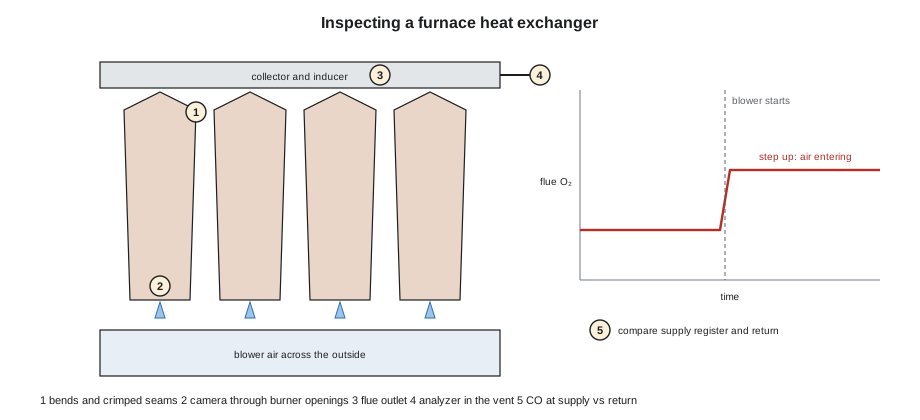
- Visual evidence. A crack, a hole, an open seam or a rusted-through area seen with a light and mirror or, better, an inspection camera passed into the heat exchanger through the burner openings or flue outlet, as the maker's instructions allow. Photographs or video are taken for the record. Some makers publish their own inspection procedures, which may call for removing the burners or the inducer to get a clear view.
- Flame behaviour. On a furnace, the burner flames are watched closely as the blower starts and stops. A flame that lifts, flickers, rolls or changes colour when the blower starts, and settles when it stops, means air from the blower is getting into the combustion side. That is strong evidence of a breach.
- Combustion readings. A combustion analyzer probe in the flue is read with the burner at steady fire before the blower starts, then again after. A significant rise in oxygen or in CO when the blower starts points to air entering the combustion side. CO measured at supply registers above what is measured at the return, with no other source in the building, points to flue gas entering the air stream.
Bayline's rule is that a technician needs either a breach they can see and photograph, or a clear change in flame or combustion readings when the blower starts that they can repeat, before calling a heat exchanger failed. Smell, age, soot alone or rust on the outside of the heat exchanger are reasons to look harder, not proof.
Worked problem
What do the combustion readings show?
At the church hall, Rosa's analyzer in the vent connector read 45 ppm CO and 7.2 in 100 O₂ with the burner at steady fire before the blower started. One minute after the blower started, it read 70 ppm CO and 9.0 in 100 O₂. Calculate the air-free CO before and after the blower started. Air-free CO is the measured CO multiplied by 20.9 divided by 20.9 less the measured O₂.
Show solution
- Before the blower started:
- \[45 \times \frac{20.9}{20.9 - 7.2} = 45 \times \frac{20.9}{13.7} \approx 68.6 \text{ ppm}\]
- After the blower started:
- \[70 \times \frac{20.9}{20.9 - 9.0} = 70 \times \frac{20.9}{11.9} \approx 122.9 \text{ ppm}\]
- Change in oxygen:
- \[9.0 - 7.2 = 1.8 \text{ points}\]
Answer: When the blower started, oxygen in the flue gas rose by 1.8 points and the air-free CO nearly doubled. Air from the blower was getting into the combustion side, and the flame was being disturbed. Together with what Rosa saw next, it was clear evidence.
The church hall furnace
Rosa repeated the test three times with the same result, watching the burners through the sight opening: when the blower started, the flames on the third and fourth burners leaned and flickered. With the gas and power off and the burners pulled, as the maker's instructions allowed, she passed her inspection camera into the third clamshell and found a crack about 40 mm (1 1/2 in.) long along the crimped seam at the top bend, with a dark soot line along it. She photographed it, and photographed the flame disturbance on her phone.
She also looked for the cause. The hall's return air came through a single grille that someone had partly blocked with a stack of folding chairs, and the furnace's filter was badly loaded. With the chairs moved and a clean filter, the temperature rise fell from 47 °C (85 °F), well above the plate's maximum of 39 °C (70 °F), to 33 °C (60 °F). Years of low airflow had overheated the heat exchanger at the bend where it cracked. The second furnace, which shared the same return, showed no evidence when Rosa tested it the same way, but she recommended moving the chairs permanently and fitting a second return grille before its heat exchanger went the same way.
The cracked furnace was shut off and tagged, and Rosa gave the church's board her photographs, the readings and a written explanation, which lesson 9 discusses. The board approved a replacement the same week. Rosa's written report made the point that mattered for them: the failure was proved by readings and pictures anyone could check, not by her opinion.
Boilers, water heaters and rooftop units
The same idea, evidence rather than suspicion, applies to other appliances, with different methods:
- Boilers. Cast-iron sections are checked for water leaks into the combustion chamber, scale and soot in the flue passages, and cracks visible with the burner removed. A boiler that needs frequent topping-up with water, or that has white or rust streaks on its sections, may have a leaking section. The maker's inspection procedure, often including a pressure test of the boiler's water side, is followed.
- Water heaters. Tank water heaters are inspected through their combustion chamber access; water dripping onto the burner, heavy rust, or sooting can mean a leaking tank or a flue baffle problem. A tank that leaks is replaced.
- Rooftop units. Tube-type heat exchangers in rooftop units are inspected with a camera through the tube ends or flue box, and CO is measured in the supply air downstream of the heat section, as in the GAS-320 dental office case. Some makers' procedures call for checking for flame disturbance when the unit's fan starts, as on a furnace.
| Finding | Is it evidence of a breach? |
|---|---|
| Visible crack, hole or open seam, photographed | Yes |
| Flame lifts or rolls when the blower starts, repeatably | Yes |
| O₂ or CO rises clearly when the blower starts, repeatably | Yes |
| CO at supply registers above the return, no other source | Yes, and it is urgent |
| Age of the furnace | No: a reason to look |
| Rust on the outside of the heat exchanger | No: a reason to look |
| Soot in the burner area alone | No: find its cause; look harder |
Explaining it to the customer
Few service findings upset customers more than a failed heat exchanger, because it usually means a new appliance in the middle of winter. It is also a finding some companies have abused to sell furnaces, and customers know that. The technician's protection, and the customer's, is evidence. Showing the customer the crack on the camera screen, or the flame moving when the blower starts, explains it better than any words. The technician explains the hazard, what the law requires them to do, and the options: replacement of the appliance, or, where the maker offers one and it is economic, replacement of the heat exchanger. If the customer wants a second opinion, the technician offers the readings and photographs to whoever gives it.
Doing the inspection safely and well
A heat exchanger inspection takes the appliance apart, and the usual safety rules from lesson 1 apply: power off and locked out, the gas valve closed, and the appliance cool enough to handle. Burners are removed only as the maker's instructions show, with their positions marked so they go back exactly where they came from, and gaskets that are damaged on removal are replaced, not reused. An inspection camera is passed in gently; a crack is easier to see with the light angled across the metal than shining straight at it. Every view that shows a defect is recorded, with a note of which clamshell or tube it is in, counted from the left as you face the appliance.
After the inspection, the appliance is reassembled and tested as it would be after any repair: a leak test of any gas joint disturbed, a full sequence of operation, a combustion analysis and a check that the flames sit properly on the burners. An inspection that leaves a burner misaligned can cause the very flame problems it was looking for.
When the evidence is not clear, the honest answer is to say so. A heat exchanger that shows no crack on camera, no flame disturbance and no change in the readings, but on which the technician still has a concern, such as heavy rust or a history of overheating, is reported as a concern with a recommendation to monitor it, check it again at the next service, or have the maker's representative look at it. It is not condemned. The customer is given the readings and the photographs either way.
| Inspection step | Purpose |
|---|---|
| Power off, locked out; gas valve closed; appliance cool | Safety |
| Burners removed as the maker shows, positions marked | Access without damage; correct reassembly |
| Camera with light angled across the metal | Cracks show as shadows |
| Each defect photographed and located | Evidence anyone can check |
| Reassembly with new gaskets where needed | No leaks, no misalignment |
| Full sequence, leak test, combustion and flame check | Prove the appliance is right after the inspection |
When the cause is airflow
The church hall case is typical: most furnace heat exchanger cracks are caused by overheating, and most overheating is caused by low airflow. Whenever a heat exchanger has failed, or is suspected, the technician measures the temperature rise and the external static pressure and compares them with the rating plate, as GAS-210 explained. A rise above the plate's maximum, or a static pressure well above the maker's figure, means the new furnace or heat exchanger will fail the same way unless the duct system, the filter arrangement or the blower setting is corrected. The customer is told so, in writing, as part of the recommendation. Replacing a cracked furnace without fixing the airflow that cracked it sells the customer the same failure twice.
Common mistakes
MistakeCondemning a heat exchanger because of the furnace's age.
InsteadCondemn it only on evidence you can show.
MistakeLooking for a crack without watching the flame as the blower starts.
InsteadWatch the flames and read the flue gas before and after the blower starts.
MistakeTaking one reading and calling it proof.
InsteadRepeat the test and get the same result.
MistakeIgnoring the cause of the crack.
InsteadFind the low airflow, overfiring or corrosion that caused it, especially if another appliance shares the cause.
MistakeFailing to record what you found.
InsteadPhotograph the crack and the flame, and write down the readings.
MistakeLeaving an appliance with a proven breach in service.
InsteadShut it off and follow the unsafe-condition duties in lesson 9.
Summary and key terms
- Heat exchangers fail from overheating, overfiring, corrosion and seam or tube damage.
- A breach is condemned on evidence: a crack, hole or open seam seen and photographed with a light, mirror or camera under the maker's procedures; flames that lift or roll when the blower starts; a repeatable rise in O₂ or CO in the flue gas when the blower starts; or CO at the supply registers above the return with no other source.
- Age, outside rust and soot alone are reasons to look harder.
- Air-free CO is the measured CO times 20.9 divided by 20.9 less the measured O₂.
- The cause of the failure is found, the customer is shown the evidence, and an appliance with a proven breach is shut off and dealt with as an unsafe condition.
- Heat exchanger
- The wall that separates the flame and flue gas from the air or water being heated.
- Clamshell heat exchanger
- A furnace heat exchanger made of two pressed steel halves crimped together.
- Breach
- A crack, hole or open seam through which flue gas and air can mix.
- Flame disturbance
- A visible change in the burner flame when the blower starts, a sign of air entering the combustion side.
- Air-free CO
- CO in flue gas corrected to what it would be with no excess air, for comparison with limits.
- Inspection camera
- A small camera on a flexible probe used to see inside a heat exchanger.
Practice problems
Work each problem on paper first, then reveal the answer to check.
Name three kinds of evidence of a heat exchanger breach.
Show answer
A visible, photographed crack; flame disturbance when the blower starts; a repeatable rise in O₂ or CO when the blower starts; CO at the supply registers above the return.
What is the air-free CO if the analyzer reads 60 ppm CO and 10.0 in 100 O₂?
Show answer
60 × 20.9 ÷ 10.9, about 115 ppm.
What caused the church hall furnace's crack?
Show answer
Years of low airflow from a blocked return grille and a loaded filter, which overheated the heat exchanger.
Why is age alone not evidence?
Show answer
Many old heat exchangers are sound; age is a reason to look harder, not proof.
How should a breach be shown to a customer?
Show answer
With the camera image, the flame disturbance and the readings, which anyone can check.
Lesson quiz · 5 questions
Score 60% or more to complete this lesson.
Create a free account to save your progress, take quizzes and earn a certificate.