
GAS-230 · Lesson 9 of 12 · 27 min
Combustion analyzers and what they measure
▶ Video coming soon A video version of this lesson is on the way.
On Monday evening, October 5, Hank gathered the apprentices around the demonstration furnace in the back of Bayline's shop. On the bench beside it lay three combustion analyzers: Rosa's, Luis's, and a new one still in its case that Priya had just booked out to Jonah's van for the winter, with a calibration certificate dated the week before. "Most of what you've learned so far, you can check with your eyes and your ears and a manometer," Hank said. "Combustion you can't. A flame can look perfect and be making 300 ppm of carbon monoxide. This tool is how you see inside the flame. But it only tells the truth if you treat it right, and that's what tonight is about."
GAS-110 introduced the combustion analyzer and air-free carbon monoxide, and GAS-210 used one during annual service. This lesson looks inside the instrument: what it actually measures, what it calculates, how its sensors work and fail, how to take a sample in the right place, and how to keep the readings honest.
What an analyzer measures and what it calculates
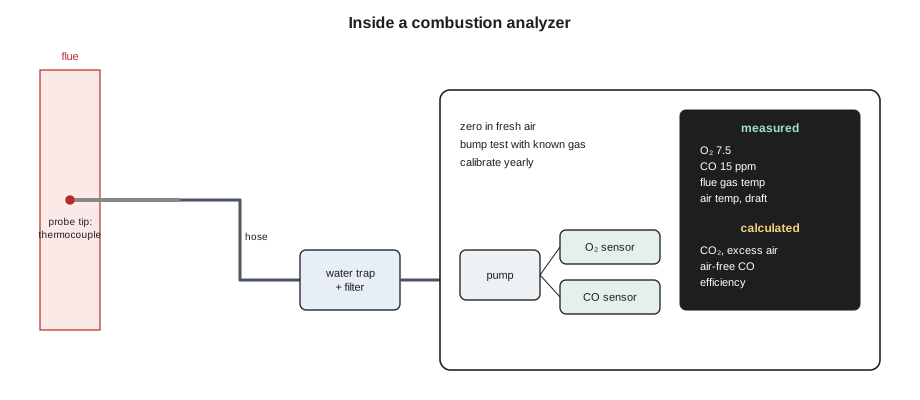
A portable combustion analyzer draws a small, steady sample of flue gas through a probe and hose with a built-in pump, removes the water and soot from it, and passes it over a set of gas sensors. Most analyzers used by gas technicians measure four things directly. Oxygen, as a fraction of the dry flue gas by volume, with an electrochemical sensor. Carbon monoxide, in parts per million, with a second electrochemical sensor. Flue gas temperature, with a thermocouple in the tip of the probe. And combustion air temperature, with a separate sensor or the instrument's own internal sensor. Many also measure draft or pressure with a built-in pressure sensor and a second hose, and some add sensors for nitric oxide, nitrogen dioxide or combustible gases.
From the measurements and the fuel the user selects, the analyzer calculates everything else: carbon dioxide, excess air, air-free carbon monoxide, the ratio of CO to CO₂, the stack loss, and the steady-state combustion efficiency. This is the most important thing to understand about an analyzer. Its carbon dioxide reading is not measured; it is worked out from the oxygen reading and the maximum CO₂ the chosen fuel can produce. If the oxygen sensor is wrong, or the wrong fuel is selected, every calculated number is wrong too, however many decimal places the screen shows.
| Reading | Measured or calculated | How |
|---|---|---|
| Oxygen (O₂) | Measured | Electrochemical sensor |
| Carbon monoxide (CO) | Measured | Electrochemical sensor |
| Flue gas temperature | Measured | Thermocouple at the probe tip |
| Combustion air temperature | Measured | Separate or internal sensor |
| Draft or pressure | Measured (if fitted) | Pressure sensor and second hose |
| Carbon dioxide (CO₂) | Calculated | From O₂ and the fuel's maximum CO₂ |
| Excess air | Calculated | From O₂ |
| Air-free CO | Calculated | From CO and O₂ |
| Combustion efficiency and stack loss | Calculated | From O₂, flue and air temperatures and the fuel |
How the sensors work
An electrochemical sensor is a small cell, a little like a battery, with electrodes in a liquid or gel electrolyte behind a membrane. The target gas diffuses through the membrane and reacts at an electrode, producing a tiny current in proportion to how much gas is present. The analyzer turns that current into a reading. Because the sensor is consumed slowly as it works, it has a limited life: oxygen sensors typically last a few years whatever you do, and carbon monoxide sensors last longer if they are not overloaded with very high readings or left soaking in flue gas. As a sensor ages, its output falls and its response slows, which is why analyzers need regular checking against a known gas.
Electrochemical sensors also have weaknesses a technician has to know. They respond slowly, taking tens of seconds to settle after a change. They can be saturated by very high concentrations: many CO sensors are damaged or must be protected above a stated limit, so analyzers either shut their pump off, switch in dilution air, or warn the user when the reading climbs past it. Some are cross-sensitive: a CO sensor without filtering can respond to hydrogen or nitric oxide as if they were carbon monoxide. And all of them are affected by temperature, which is why the analyzer warms up and zeroes itself before use.
Start-up: zeroing in fresh air
When an analyzer is switched on, it runs fresh air over its sensors for a minute or two and sets its zero: it assumes the air it is breathing has 20.9 parts in 100 oxygen and no carbon monoxide, and adjusts its sensors to read exactly that. This is why the analyzer must be started outdoors, or at least well away from any appliance, before the probe is put anywhere near a flue. An analyzer zeroed in a basement where an appliance has been spilling will subtract that basement's carbon monoxide from every later reading.
Worked problem
Zeroed in the wrong place
An apprentice switches on an analyzer in a basement where the air contains 12 ppm of carbon monoxide from a spilling water heater, and the analyzer zeroes there. Later it shows 30 ppm in the water heater's flue gas. What is the actual reading?
Show solution
- The analyzer has treated 12 ppm as zero, so every reading is 12 ppm low:
- \[30 + 12 = 42 \text{ ppm}\]
Answer: The flue gas actually contains about 42 ppm, and the basement air itself contains 12 ppm that the analyzer cannot now see. Hank's rule: turn it on in the driveway, and let it finish its zero before you walk in.
After zeroing, the analyzer should be checked against fresh air again from time to time during a long day: with the probe out of any flue, it should return to 20.9 for oxygen and zero for CO. If it does not, the sensor is drifting or something is wrong with the sample line.
Calibration and bump tests
An analyzer's sensors drift as they age, so the instrument must be calibrated by its maker or an authorized service centre at the interval the maker gives, usually once a year, against certified test gases. The calibration certificate records the date and the results. Between calibrations, Bayline's apprentices do a bump test: they apply a cylinder of test gas with a known CO concentration to the probe through the maker's adapter and check that the reading comes up to the cylinder's value within the tolerance Bayline sets. An analyzer that fails a bump test goes back for service, and its readings since the last good test are treated with suspicion.
Worked problem
A failed bump test
Jonah's bump test uses a cylinder of 100 ppm CO. Bayline's tolerance for this test is 5 ppm either way. The analyzer reads 92 ppm. Does it pass, and by how much is it reading low as a fraction of the true value?
Show solution
- Difference from the cylinder:
- \[100 - 92 = 8 \text{ ppm} > 5 \text{ ppm} \quad \text{fails}\]
- As a fraction:
- \[\frac{8}{100} = 0.08 = 8 \text{ in } 100\]
Answer: The analyzer is reading about 8 in 100 low and fails. A flue reading of 380 ppm air-free might really be over 400, so the analyzer goes back for service before it is used to pass or fail an appliance.
The sample line: probe, hose and water trap
Flue gas from natural gas is full of water vapour. As the sample cools in the hose, the water condenses, and if it reached the sensors it would damage them. Analyzers therefore have a water trap, a small clear chamber where condensate collects, and a particle filter that stops soot and dust. Both must be checked and emptied or changed as the maker says, often several times a day in condensing-furnace season. The hose should hang so the water runs toward the trap, and the instrument should be held or stood the way the maker shows.
The sample line must also be airtight. A loose probe connection, a cracked water trap bowl or a split hose lets room air into the sample, diluting it. Diluted flue gas reads higher oxygen and lower CO than the real flue gas, which makes a bad burner look better. Most analyzers let you check the line by blocking the probe tip and watching for the pump's flow to stop or for a leak warning.
Worked problem
A leak in the sample line
Suppose the true flue gas contains 6.0 parts in 100 oxygen and 80 ppm CO, and a split in the hose lets in room air so that 1 part in 10 of the sample is room air with 20.9 oxygen and no CO. What do the oxygen and CO read, and what air-free CO does the analyzer calculate from them?
Show solution
- Measured oxygen:
- \[0.9 \times 6.0 + 0.1 \times 20.9 = 5.40 + 2.09 = 7.49\]
- Measured CO:
- \[0.9 \times 80 = 72 \text{ ppm}\]
- Air-free CO from the diluted readings:
- \[72 \times \frac{20.9}{20.9 - 7.49} = 72 \times 1.559 = 112 \text{ ppm}\]
- Air-free CO from the true readings:
- \[80 \times \frac{20.9}{20.9 - 6.0} = 80 \times 1.403 = 112 \text{ ppm}\]
Answer: The leak makes the oxygen look higher and the CO look lower, but the air-free CO comes out the same, because the air-free calculation is designed to cancel out dilution. The excess air, CO₂ and efficiency readings, which depend on oxygen, are wrong, so a leak still has to be found and fixed.
That example shows why the trade uses air-free CO rather than the raw CO reading to judge an appliance. Raw CO falls whenever a sample is diluted, by excess air in the burner, by a draft hood, by a leak, or by sampling in the wrong place. Air-free CO corrects every reading back to what it would be with no oxygen left in the gas, so readings from different appliances, and from the same appliance on different days, can be compared fairly.
Where to sample
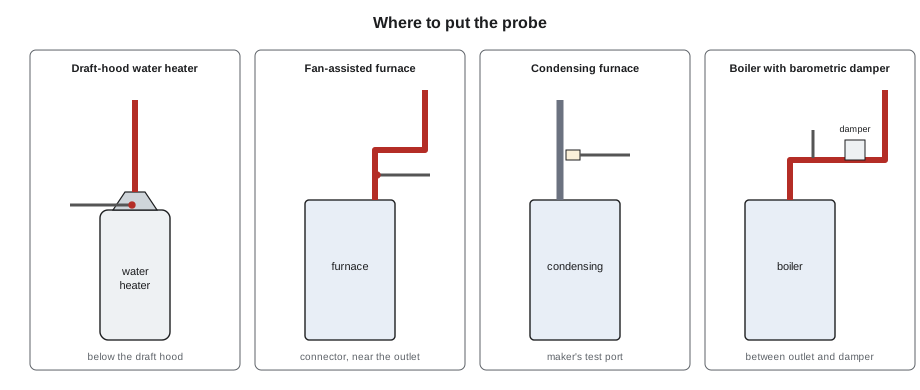
An analyzer can only measure the gas it is given. The sample must be undiluted flue gas, taken where the gas from the burner is well mixed and before any dilution air has been added, with the probe tip in the hottest part of the stream so the temperature reading is the true flue gas temperature. The appliance's instructions are the first authority, because many furnaces, boilers and water heaters say exactly where to sample, and some provide a test port. Where they do not, Bayline follows these rules.
| Appliance | Where to sample |
|---|---|
| Draft-hood water heater | In the flue outlet below the draft hood, before dilution air enters |
| Draft-hood furnace or boiler | Below the draft hood, at each flue outlet or heat exchanger section if there are several |
| Fan-assisted furnace | In the vent connector a short distance from the flue outlet, through a test hole the instructions allow, sealed afterwards |
| Condensing furnace or boiler | At the test port the maker provides, or where the instructions say; never drill plastic vent unless the instructions allow it |
| Appliance with a barometric damper | Between the appliance outlet and the barometric damper |
| Range oven | At the oven vent, as an as-measured reading, after the oven has heated |
Readings are taken once the appliance has reached steady state, which means the flue gas temperature has stopped rising, usually after five minutes or more of firing, and longer for boilers with cold water. Taking a reading too early gives low temperatures and often high CO from a cold burner, and flatters the efficiency. For two-stage and modulating appliances, readings are taken at each stage or at high and low fire, because an appliance can burn cleanly on high and badly on low.
Safety while using the analyzer
The analyzer is also a personal safety tool. Most can display ambient CO when the probe is in room air, and many have an alarm. Bayline technicians also carry a separate personal CO monitor clipped to their collar, because an analyzer sampling a flue cannot watch the air you are breathing at the same time. Before testing appliances, the technician checks the ambient CO in the living space and the appliance area, as lesson 8 described, and acts on what it shows before going further. The probe tip and the first part of the hose get very hot in a flue and can burn skin or melt a glove, and the probe must not be left in a flue for long periods once the readings are taken, because condensate and heat wear the sensors.
Recording the results
Every analyzer reading Bayline takes goes on the service record with the conditions that produced it: the appliance, the firing rate or stage, where the sample was taken, the outdoor temperature, and the time the appliance had been running. Most current analyzers print or send a report to a phone, which is attached to the job. A reading without its conditions cannot be compared with next year's, and comparison is where an analyzer is most useful: an appliance whose air-free CO has crept up from 25 ppm to 90 ppm over three years is telling the technician something long before it fails. Lesson 10 shows how to read the numbers and what they mean.
At the end of the evening, Hank had each apprentice zero their analyzer in the parking lot, bump test it, check the sample line for leaks, and then test the demonstration furnace on high and low fire with the probe in the correct test hole. Jonah's analyzer passed its bump test at 99 ppm against the 100 ppm cylinder, and his readings matched Rosa's to within a few ppm.
Common mistakes
MistakeSwitching the analyzer on in the basement.
InsteadZero it in fresh outdoor air before going near an appliance.
MistakeTrusting the CO₂ and efficiency figures without checking the fuel setting.
InsteadThey are calculated; select the correct fuel and check the oxygen sensor.
MistakeLetting the water trap fill.
InsteadEmpty it and change the filter as the maker says; water ruins sensors.
MistakeSampling above a draft hood.
InsteadSample undiluted flue gas below the draft hood or in the connector before any dilution air.
MistakeTaking a reading a minute after the burner lights.
InsteadWait for steady state, usually five minutes or more, and test each stage.
Summary and key terms
- A combustion analyzer measures oxygen and carbon monoxide with electrochemical sensors, flue gas temperature with a thermocouple, combustion air temperature and often draft, and calculates CO₂, excess air, air-free CO and efficiency from those measurements and the selected fuel.
- Electrochemical sensors wear out, respond slowly, can be saturated and can be cross-sensitive.
- The analyzer must be zeroed in fresh outdoor air, calibrated at the maker's interval and bump tested against a known gas.
- The sample line must be airtight and the water trap and filter kept clean; leaks raise the oxygen and lower the CO readings, though air-free CO corrects for dilution.
- Sample undiluted flue gas where the instructions say, or below the draft hood or in the connector before dilution air, with the tip in the hottest part of the stream, after steady state and at each firing stage.
- Watch ambient CO with a personal monitor, and record every reading with its conditions.
- Combustion analyzer
- An instrument that samples flue gas and measures its oxygen, carbon monoxide and temperature.
- Electrochemical sensor
- A gas sensor that produces a small current in proportion to the target gas.
- Zeroing
- Setting an analyzer's sensors to the readings of clean fresh air.
- Bump test
- A check of an analyzer against a cylinder of known test gas.
- Calibration
- Adjustment and certification of an instrument by its maker or an authorized centre against certified gases.
- Water trap
- A chamber in an analyzer's sample line where condensate collects.
- Steady state
- The condition reached when an appliance's flue gas temperature has stopped rising.
- Air-free CO
- A CO reading corrected to the value it would have with no oxygen in the flue gas.
Practice problems
Work each problem on paper first, then reveal the answer to check.
Which readings does a typical analyzer measure directly?
Show answer
Oxygen, CO, flue gas temperature and combustion air temperature, and often draft.
Why must the analyzer be zeroed outdoors?
Show answer
It treats the air it zeroes in as having no CO; indoor CO would be subtracted from every reading.
What does a leak in the sample line do to the readings?
Show answer
Raises the oxygen and lowers the CO; air-free CO still comes out about right.
Where is a draft-hood water heater sampled?
Show answer
In the flue outlet below the draft hood, before dilution air enters.
When is a reading taken?
Show answer
At steady state, usually after five minutes or more, at each firing stage.
Lesson quiz · 5 questions
Score 60% or more to complete this lesson.
Create a free account to save your progress, take quizzes and earn a certificate.