
GAS-230 · Lesson 2 of 12 · 24 min
Natural draft, fan-assisted and direct vent appliances
▶ Video coming soon A video version of this lesson is on the way.
The next day, Tuesday, September 22, Rosa had a quote to prepare in Ainslie Wood, near McMaster University. The owners of a 1994 two-storey, Martin and Celeste Okafor-Lind, wanted to replace their 32-year-old furnace before winter and asked whether they could also finish the basement around the mechanical room. In one unfinished corner of the basement Jonah counted three gas appliances: a mid-efficiency furnace with an inducer fan on its side, a 151 L atmospheric water heater with a draft hood, and, upstairs in the family room, a gas fireplace with a glass front whose vent went straight out through the wall. "Three appliances, three different ways of getting rid of flue gas," Rosa said. "Before you quote anything, you have to know which kind each one is, because that decides what you're allowed to connect it to and what happens to the others when you change one."
This lesson sorts gas appliances by how they move combustion air in and flue gas out. The categories in lesson 3 describe the vent's pressure and temperature; the appliance types here describe the hardware: whether there is a draft hood, a fan, a sealed combustion chamber, and where the air comes from.
Natural-draft appliances with draft hoods
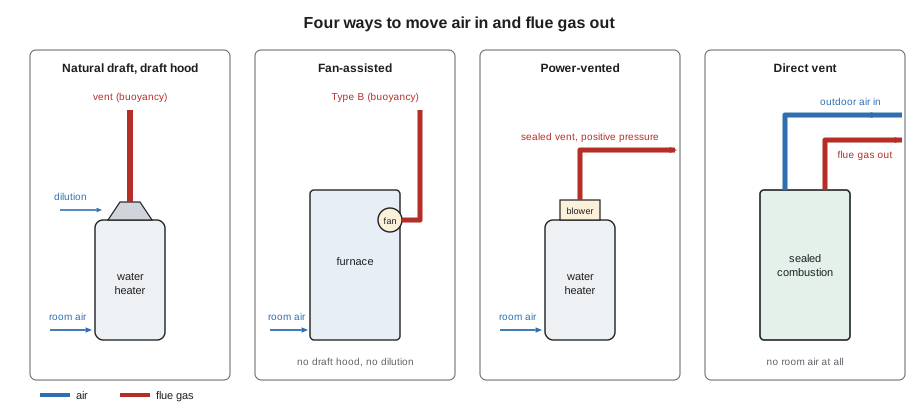
The water heater was a natural-draft appliance: its burner sat in an open combustion chamber at the bottom of the tank, drawing air from the room, and its flue gas rose through a central flue tube by buoyancy alone. At the top of the tank sat the draft hood, a short cone or box open to the room around its lower edge. Flue gas rising from the tank flows up into the vent connector, and room air, the dilution air, is drawn in through the relief opening along with it. As lesson 1 explained, the draft hood isolates the burner from changes in chimney draft and gives flue gas somewhere to go if the vent is blocked or a downdraft blows in. It also means that a natural-draft appliance always draws more air from the room than it burns.
Natural-draft appliances are the oldest and simplest kind: older furnaces and boilers, most standard tank water heaters, many older unit heaters and some ranges and dryers. They need a vent that will produce enough draft on its own, sized for the appliance and with the right height, as lesson 4 shows, and they are the most sensitive of all appliance types to a depressurized house. Many have a spill switch at the draft hood, as GAS-220 described, which shuts the burner off if hot flue gas keeps spilling.
Worked problem
How much room air does the water heater use?
The water heater is rated 11.7 kW. Natural gas has a heating value of about 37.5 MJ/m³ and needs about 9.57 m³ of air for each cubic metre burned, giving about 10.57 m³ of flue products. Assume the burner runs with half as much air again as it needs (50 in 100 excess air), and, for this example only, that the draft hood draws in about as much dilution air as there is flue gas. Estimate the room air the water heater uses each hour.
Show solution
- Gas burned per hour:
- \[11.7 \text{ kW} \times 3.6 = 42.1 \text{ MJ/h} \qquad \frac{42.1}{37.5} = 1.12 \text{ m}^3\text{/h}\]
- Theoretical air and combustion air with 50 in 100 excess:
- \[1.12 \times 9.57 = 10.7 \text{ m}^3\text{/h} \qquad 10.7 \times 1.5 = 16.1 \text{ m}^3\text{/h}\]
- Flue gas leaving the burner: products plus the unused excess air:
- \[1.12 \times 10.57 + 0.5 \times 10.7 = 11.8 + 5.4 = 17.2 \text{ m}^3\text{/h}\]
- Dilution air, taken as equal to the flue gas:
- \[17.2 \text{ m}^3\text{/h}\]
- Total room air:
- \[16.1 + 17.2 = 33.3 \text{ m}^3\text{/h} \approx 9.3 \text{ L/s}\]
Answer: A small water heater draws about 33 m³ of room air an hour, roughly twice what it burns with. A direct-vent appliance of the same size would draw none.
Fan-assisted appliances
The furnace was a fan-assisted appliance, the most common mid-efficiency furnace design from the late 1980s until condensing furnaces took over. Its draft inducer pulls combustion air through the burners and flue gas through the heat exchanger, then pushes it into the vent connector. There is no draft hood and no dilution air: the flue gas leaves the furnace undiluted, hotter and wetter than the mixture above a draft hood. The inducer overcomes the resistance of the heat exchanger, but the vent itself still works by buoyancy. Its pressure is at or slightly below the room's, so the vent can be Type B gas vent or a lined masonry chimney, sized from the fan-assisted columns of the sizing tables the vent maker or the code provides.
Because there is no dilution air, a fan-assisted appliance needs a vent that stays warm enough to keep its water vapour from condensing. That is why the code and the instructions limit fan-assisted appliances in cold or oversized chimneys, why single-wall connectors are restricted for them, and why sizing tables give a minimum as well as a maximum capacity for each vent size. Condensation inside a vent that was never meant to drain is the slow killer of chimneys and B-vent, and lesson 5 shows what it does to masonry.
Power-vented appliances
A power-vented appliance has a blower that pushes flue gas through the vent under positive pressure. The most common examples are power-vent water heaters, which have a blower on top of the tank and send their flue gas horizontally through a side wall, often in plastic pipe, and some commercial appliances. Because the vent is pressurized, any leak in it pushes flue gas into the building, so a power-vented appliance needs a sealed vent system of the type its maker lists, joined exactly as the instructions say. Most power-vented water heaters still draw their combustion air from the room around them, so they need the room's air supply like any other appliance, and they can still be affected by a depressurized house, though much less than natural-draft appliances.
Direct-vent and sealed-combustion appliances
The fireplace was a direct-vent appliance. Its combustion chamber is sealed from the room by the glass front and gaskets. It takes all its combustion air from outdoors and sends all its flue gas outdoors, through a pair of pipes, often one inside the other in a concentric or coaxial vent: the inner pipe carries the flue gas out and the space between the pipes brings the outdoor air in. Many direct-vent fireplaces work by natural draft through this sealed system; others have a fan. The intake and exhaust usually terminate close together, so wind affects both about equally and the appliance stays balanced.
Condensing furnaces and boilers are usually installed as direct-vent or sealed-combustion appliances too, with two plastic pipes, one for combustion air from outdoors and one for flue gas out, or a concentric termination. Some are allowed to take combustion air from the room instead, which the instructions call a single-pipe or non-direct installation; the room then needs its air supply just as for an open appliance. Direct-vent appliances draw no air from the house, use none for dilution, and are almost immune to house depressurization, which makes them the first choice in tight, modern houses.
| Type | Combustion air from | Dilution air | Vent pressure | Typical examples |
|---|---|---|---|---|
| Natural draft, draft hood | Room | Yes | Negative (buoyancy) | Standard tank water heaters, older furnaces and boilers |
| Fan-assisted | Room | No | Negative or neutral (buoyancy) | Mid-efficiency furnaces, many boilers |
| Power-vented | Room | No | Positive (blower) | Power-vent water heaters |
| Direct vent, natural draft | Outdoors | No | Balanced, sealed | Many direct-vent fireplaces and wall furnaces |
| Direct vent, fan | Outdoors | No | Positive, sealed | Condensing furnaces, boilers and tankless heaters |
| Power burner | Room or ducted | Sometimes, by barometric damper | Varies | Commercial boilers, some older residential boilers |
Barometric dampers and power burners
Two other devices appear on larger and older equipment. A barometric damper, or draft regulator, is a hinged, weighted flap in the side of a vent connector. When the chimney draft gets too strong, the room's pressure pushes the flap open and lets in dilution air, keeping the draft at the burner steady. It does for a power-burner boiler roughly what a draft hood does for an atmospheric appliance, but it does not give flue gas a relief path if the chimney is blocked, so the appliance needs its own spill or flue gas safety control where the maker or the code requires one. Barometric dampers are common on oil equipment, and gas technicians meet them on commercial boilers and on gas conversions of oil boilers. A power burner has its own fan that blows combustion air into the burner at a controlled rate; GAS-310 covers these in detail.
What changing one appliance does to the others
Back in the Okafor-Lind basement, Rosa traced the vents. The furnace and the water heater joined at a tee into a single Type B vent that rose through the house to a cap on the roof. The two were common-vented: their flue gas shared one vent, sized for both. If the old furnace were replaced with a condensing furnace vented through the wall, the water heater would be left alone in a vent sized for two appliances, an orphaned water heater, exactly the situation that had caused Glenda's cold-start spillage the day before. "The quote isn't just a furnace," Rosa said. "It's a furnace and a fix for whatever we leave behind."
Rosa gave the owners three options for the water heater. They could resize the existing vent for the water heater alone, if the sizing tables showed the remaining B-vent would work, which lesson 4 shows how to check. They could replace the water heater with a power-vented or direct-vent model and seal off the old vent. Or they could leave it and reline, if the vent had been a masonry chimney. Because the basement was going to be finished, with the mechanical room made smaller and the door closed, she recommended replacing the water heater with a direct-vent model as well, so that neither appliance would depend on room air or on a weak vent. That also meant the new mechanical room would not need large air supply openings, which lesson 7 explains.
Worked problem
Room air before and after
The old furnace is a fan-assisted 26 kW model with no draft hood, running with about 60 in 100 excess air. The water heater, as worked out above, uses about 33.3 m³/h of room air. Estimate the room air the two appliances use together each hour now, and how much would be used if both were replaced with direct-vent models.
Show solution
- Furnace gas use:
- \[26 \times 3.6 = 93.6 \text{ MJ/h} \qquad \frac{93.6}{37.5} = 2.50 \text{ m}^3\text{/h}\]
- Furnace combustion air, with no dilution air:
- \[2.50 \times 9.57 \times 1.6 = 38.3 \text{ m}^3\text{/h}\]
- Both appliances now:
- \[38.3 + 33.3 = 71.6 \text{ m}^3\text{/h} \approx 19.9 \text{ L/s}\]
- Both direct vent:
- \[0 \text{ m}^3\text{/h of room air}\]
Answer: The two appliances draw about 72 m³ of air an hour from the basement while running, and that air has to come in from outdoors somewhere. Two direct-vent appliances would draw none of it.
Identifying the type on site
The rating plate and the installation instructions are the authority on what kind of appliance it is and what it may be vented into. On site, a few quick checks help. A draft hood or a barometric damper means room air is drawn in for dilution. An inducer on a furnace with a round metal flue outlet and no draft hood usually means a fan-assisted Category I furnace. A blower on top of a water heater, with a plastic or sealed vent leaving through the wall, means power vent. Two pipes or a concentric pipe to the outdoors, with a sealed combustion chamber, means direct vent; check that the intake really is connected, because a single-pipe installation of a direct-vent-capable appliance needs room air. Plastic vent pipe on any appliance means a positive-pressure or condensing vent that must be the type the maker lists, which lessons 3 and 6 explain. If what is on site does not match what the plate and the instructions say, the installation is wrong and must be corrected.
Rosa sent the quote that evening with a note at the top in plain language: what each appliance was, what would change, and why the water heater was part of the job. The owners accepted it a week later. Lessons 4 and 6 return to how such a job is vented.
Common mistakes
MistakeAssuming any appliance with a fan pushes its vent under positive pressure.
InsteadA fan-assisted Category I furnace's vent still works by buoyancy at negative or neutral pressure.
MistakeVenting a power-vented appliance into B-vent or a chimney.
InsteadPositive-pressure vents must be the sealed type the maker lists.
MistakeTreating a single-pipe condensing furnace as if it used no room air.
InsteadWithout an outdoor intake, it draws combustion air from the room.
MistakeReplacing one common-vented appliance without checking the other.
InsteadChanging one appliance can orphan the other; resize, reline or replace.
MistakeForgetting dilution air.
InsteadA draft-hood appliance draws roughly twice the air it burns with.
Summary and key terms
- Natural-draft appliances with draft hoods burn room air and draw in dilution air, and vent by buoyancy; they are the most sensitive to a depressurized house.
- Fan-assisted appliances use an inducer to move gas through the heat exchanger, have no dilution air, and still vent by buoyancy at negative or neutral pressure, which makes them prone to condensation in cold or oversized vents.
- Power-vented appliances push flue gas through a sealed vent under positive pressure but usually burn room air.
- Direct-vent appliances have sealed combustion chambers, take air from outdoors and send flue gas outdoors, and use no room air.
- Barometric dampers add dilution air on power-burner and oil equipment.
- Common-vented appliances share one vent, so replacing one can orphan the other, which must then be resized, relined or replaced.
- Natural-draft appliance
- An appliance that vents by buoyancy alone, usually with a draft hood.
- Draft hood
- An opening at an appliance outlet that admits dilution air, isolates the burner from the chimney and relieves spillage.
- Fan-assisted appliance
- An appliance with an inducer that moves gas through the heat exchanger, venting by buoyancy without dilution air.
- Power-vented appliance
- An appliance whose blower pushes flue gas through a sealed vent under positive pressure.
- Direct-vent appliance
- A sealed-combustion appliance that takes all combustion air from outdoors and vents all flue gas outdoors.
- Concentric vent
- A vent with one pipe inside another, the inner carrying flue gas out and the outer bringing air in.
- Barometric damper
- A weighted flap in a vent connector that admits dilution air to steady the draft.
- Common vent
- A single vent serving two or more appliances.
Practice problems
Work each problem on paper first, then reveal the answer to check.
Which appliance type draws dilution air from the room?
Show answer
A natural-draft appliance with a draft hood, or one with a barometric damper.
What moves the flue gas in the vent of a fan-assisted Category I furnace?
Show answer
Buoyancy; the inducer only moves it through the heat exchanger.
Why must a power-vented appliance's vent be sealed?
Show answer
It is under positive pressure, so any leak pushes flue gas into the building.
What happens to the water heater when a common-vented furnace is replaced by a direct-vent model?
Show answer
It may be orphaned in a vent too large for it.
How can you tell a direct-vent installation from a single-pipe installation?
Show answer
A direct-vent installation has an outdoor intake connected to a sealed combustion chamber.
Lesson quiz · 5 questions
Score 60% or more to complete this lesson.
Create a free account to save your progress, take quizzes and earn a certificate.