
GAS-230 · Lesson 3 of 12 · 23 min
Vent categories and materials
▶ Video coming soon A video version of this lesson is on the way.
On Tuesday, September 29, Priya sent Rosa and Jonah to a rented semi-detached house in Gibson, in Hamilton's east end. The tenant's carbon monoxide alarm in the basement had been showing a low reading for two days, and that morning it had sounded. The landlord's handyman had replaced the water heater in August with a power-vent model, and he had vented it himself. The exhaust left the blower on top of the tank in grey plastic pipe that Jonah recognized from the plumbing course: drain pipe, left over from a bathroom job, glued together with the cement used for drains. It ran 7 m, or about 23 ft, across the basement ceiling, strapped every 2 m or so, and sagged between the straps. At the second sag, one joint had pulled half out of its fitting. With her analyzer probe Rosa read 140 ppm of carbon monoxide right at the joint. "This pipe was never made to carry flue gas," she said. "It's the right colour and the wrong everything else."
Rosa shut the water heater off, tagged it out of service, and opened the basement windows. The landlord agreed by phone to have Bayline install the vent the water heater's maker specified, and the job was done the next day. This lesson explains why the material matters so much: how vents are classified into categories by the pressure and temperature of the gas they carry, and which materials are certified for each.
Two questions: pressure and condensation
Every vent system answers two questions. The first is whether the gas inside it is at a negative or positive pressure compared with the space around it. A vent under negative pressure, drawing by buoyancy, tends to suck room air in through any leak; it does not have to be gas-tight, only sound. A vent under positive pressure, pushed by a fan, forces flue gas out through any leak, so it has to be sealed at every joint. The second question is whether the flue gas will condense in the vent. Natural gas flue gas contains a lot of water vapour, about two volumes of water for every volume of gas burned, and it condenses into an acidic liquid when it cools below its dew point, roughly 55 °C for undiluted natural gas flue gas, less when it is diluted with excess air. A vent that is meant to stay dry must keep the gas above its dew point all the way out; a vent that is meant to condense must resist the acid and drain the water.
The appliance certification standards combine these two questions into four vent categories. The category is a property of the appliance as tested and certified, and it is stated in the installation instructions and often on the rating plate. The installer does not choose it; the installer chooses a vent material that is certified for that category.
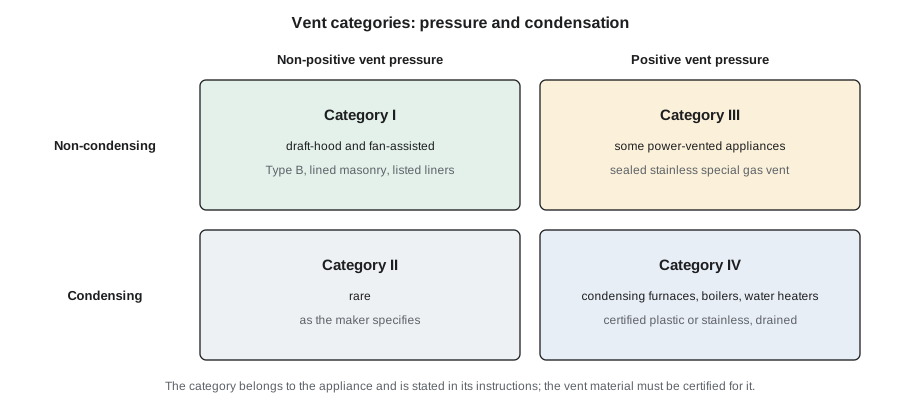
| Category | Vent pressure | Condensing in the vent? | Typical appliances | Typical vent materials |
|---|---|---|---|---|
| I | Non-positive | No | Draft-hood appliances, fan-assisted furnaces and boilers | Type B gas vent, lined masonry chimney, listed liners |
| II | Non-positive | Yes | Very few; rarely seen | As the maker specifies |
| III | Positive | No | Some power-vented appliances and boilers | Sealed special gas vent, usually stainless steel, as listed |
| IV | Positive | Yes | Condensing furnaces, boilers, water heaters, tankless heaters | Plastic or stainless vent certified to ULC S636, as the maker lists |
Category I
Category I appliances vent at non-positive pressure and produce flue gas hot enough to stay above its dew point in a correctly sized vent. Every natural-draft appliance with a draft hood is Category I, and so are fan-assisted mid-efficiency furnaces and boilers. Their vents work by buoyancy and are sized from tables, as lesson 4 explains. Because the gas is meant to stay dry, a Category I vent that runs too cold, is too large, or is fed too little flue gas, can condense anyway, which is the main way Category I vents fail.
Category I appliances may be vented into Type B gas vent, into a masonry chimney that is properly lined and sized, or into a listed chimney liner. Connectors between the appliance and the vent may be Type B or, where the code and the instructions allow, single-wall metal pipe. A Category I vent is never a plastic pipe: its flue gas is far too hot for plastic.
Category III and IV
Category III appliances push their flue gas through the vent under positive pressure but keep it hot enough not to condense. They are less common in houses today than they were in the 1990s, but they still turn up as power-vented appliances and some boilers. Their vents must be gas-tight, so they are usually a special gas vent of stainless steel with sealed joints, of the brand and type the appliance maker lists.
Category IV appliances push their flue gas through the vent under positive pressure and extract so much heat from it that it condenses in the heat exchanger and in the vent. Every condensing furnace, condensing boiler, condensing water heater and condensing tankless water heater is Category IV. The vent must be gas-tight, must resist the acid in the condensate, and must slope so the condensate drains, usually back to the appliance's own trap. Category IV vents are usually plastic, but some appliances call for stainless steel or polypropylene systems instead, and the choice is always the maker's.
Category II, non-positive and condensing, exists on paper and in a few old appliances, but almost nothing sold today is certified for it. If you ever meet one, its instructions decide everything about its vent.
Vent materials
Type B gas vent is factory-made double-wall pipe for Category I appliances: an inner liner of aluminum, which resists the mild acids of occasional condensation and heats up quickly, inside an outer pipe of galvanized steel, with an air space between them. The air space keeps the inner pipe warm and the outer pipe cool enough that the listing allows a small clearance to combustible material, commonly 25 mm. Type B must be assembled from the same maker's pipe and fittings, with the joints locked as the instructions say, supported, and capped with a listed cap. It is for gas only; it is not for oil, solid fuel or positive pressure. A related product, Type BW, is an oval version for recessed wall furnaces.
Single-wall metal pipe is used for vent connectors where the code and the appliance instructions allow it. It loses heat quickly, so it cools the flue gas, and it needs a much greater clearance to combustibles than Type B, commonly 150 mm for residential appliances with draft hoods. It may not pass through floors, ceilings, walls or attics, and the code limits its length and its use with fan-assisted appliances. On a basement job the most common single-wall mistake is a connector that was installed on a warm appliance years ago and now runs, rusted thin, beside a new wooden bulkhead.
Masonry chimneys are brick or block chimneys with a clay-tile or other liner. They are heavy, slow to warm, and in older houses often far too large for modern appliances. Lesson 5 covers when a gas appliance may use one and when it must be relined.
Plastic vent pipe for Category IV appliances in Canada must be certified to ULC S636, the Canadian standard for Type BH gas venting systems. Certified plastic systems are made in classes by the maximum flue gas temperature they can take: about 65 °C for Class IIA, usually PVC; 90 °C for Class IIB, usually CPVC; and 110 °C for Class IIC, usually polypropylene. Plain plumbing PVC or ABS drain pipe, even if it is the same size and colour, is not certified and may not be used as a vent, and the pipe, fittings, primer and cement must all be the certified system's, joined as its instructions say. TSSA has enforced this in Ontario since 2007. The appliance maker's instructions then say which certified class and which sizes may be used with each appliance.
Stainless steel special gas vent is used for Category III and some Category IV appliances, and for many commercial appliances. It comes in grades chosen for the acidity of condensate, joined with gaskets or sealant as the system's instructions say. Where a maker lists one brand of special gas vent, another brand that looks similar may not be substituted, because the joints, gaskets and fittings are tested as a system.
Worked problem
Why a plastic pipe cannot vent a mid-efficiency furnace
A fan-assisted mid-efficiency furnace sends flue gas into its vent connector at about 180 °C. A Class IIA PVC vent is limited to about 65 °C. By how much does the flue gas exceed the limit, and what is the ratio of the flue gas temperature to the limit in absolute terms?
Show solution
- Difference:
- \[180 - 65 = 115\ {}^\circ\text{C}\]
- Absolute temperatures:
- \[180 + 273 = 453 \text{ K} \qquad 65 + 273 = 338 \text{ K}\]
- Ratio:
- \[\frac{453}{338} = 1.34\]
Answer: The flue gas is 115 °C above what PVC can take. Plastic softens, sags and fails at those temperatures, which is why Category I appliances are never vented in plastic, and why a Category IV appliance with a fault that sends hot gas into its vent has a high-temperature limit to shut it down.
What went wrong in the basement
Rosa went through the handyman's vent with Jonah, fault by fault. The pipe was drain pipe, not a vent product the water heater's maker listed, and it was not certified to ULC S636. The cement was for drain pipe. The joints had been glued without primer, and one had been pushed only partly into its socket. The run of 7 m with five elbows was at the very limit of the maker's table for that diameter, and the handyman had not counted the elbows. The straps were too far apart for warm plastic, which expands and softens a little when hot, so the pipe sagged and held condensate in each sag, adding weight. The pipe also sloped the wrong way at one end, away from the water heater, so condensate collected at the termination wall and dripped down the siding. And there was no carbon monoxide alarm near the sleeping area upstairs, only the one in the basement that had raised the alarm.
Worked problem
Why a slightly bigger pipe is not always better
The handyman said he might have used 100 mm pipe instead of 75 mm to be safe. Compare the cross-sectional areas of 75 mm and 100 mm round pipe.
Show solution
- Area of a circle is π d² ÷ 4:
- \[A_{75} = \frac{\pi \times 75^2}{4} = 4{,}418 \text{ mm}^2 \qquad A_{100} = \frac{\pi \times 100^2}{4} = 7{,}854 \text{ mm}^2\]
- Ratio:
- \[\frac{7{,}854}{4{,}418} = 1.78\]
Answer: The larger pipe has about 1.8 times the area. For a fan-driven vent that can lower the resistance, which is why many makers allow a larger diameter for longer runs, but only as their tables say, because some appliances need enough back pressure for their pressure switches and burners to work as tested, and a bigger pipe still has to be a listed material. More area is not a fix for the wrong material.
Reading the instructions for a vent
For every appliance that is not a simple draft-hood Category I appliance, the installation instructions contain a venting section that the installer follows line by line. It states the category, the permitted materials by name or standard, the permitted diameters, the maximum and minimum vent lengths for each diameter, how much each elbow counts as, the termination kits and clearances, the slope, the support spacing, and the joining method. Some instructions also limit where the vent may run, such as through unheated spaces only with insulation, or not at all through attics. The code requires the vent to be installed as the instructions say, so the instructions are as binding as the code itself. Bayline's rule is simple: if the instructions are not on site, download them before you cut the first piece of pipe.
The next day, Rosa and Jonah installed the water heater maker's listed vent in the right diameter for the length, with primer and the system's cement, supported every 0.9 m as the instructions required for that pipe, sloping back to the water heater at 20 mm per metre, and terminated with the maker's kit at the correct clearances. They added an alarm on the bedroom floor. After the water heater had run for 15 minutes, Rosa's analyzer read 0 ppm of carbon monoxide along the whole run and at the joints, and the tenant's basement alarm stayed quiet.
Common mistakes
MistakeChoosing a vent material because it fits the appliance outlet.
InsteadUse only a material certified for the appliance's category and listed in its instructions.
MistakeVenting a power-vented or condensing appliance in drain pipe.
InsteadUse a vent system certified to ULC S636 and listed by the maker.
MistakeMixing brands of special gas vent or Type B.
InsteadUse one maker's pipe, fittings and joints as a system.
MistakeUsing single-wall connector pipe through a wall, floor or attic.
InsteadSingle-wall pipe is for exposed connectors only, at its required clearance.
MistakeIgnoring the elbow count.
InsteadEach elbow counts as extra length in the maker's tables.
Summary and key terms
- Vents are classified by two questions: is the vent under positive pressure, and does the flue gas condense in it? Category I vents are non-positive and non-condensing: draft-hood and fan-assisted appliances, vented in Type B, lined masonry or listed liners.
- Category III vents are positive and non-condensing, and need sealed special gas vent.
- Category IV vents are positive and condensing: all condensing appliances, vented in sealed, drained plastic or stainless systems.
- Category II is rare.
- The category belongs to the appliance and is stated in its instructions; the installer chooses a certified material for it.
- Type B is double-wall aluminum and steel for Category I gas appliances only.
- Single-wall pipe is for exposed connectors only, with large clearances.
- Plastic vents must be the certified system the maker lists, never drain pipe.
- Vent category
- A classification of an appliance by whether its vent is under positive pressure and whether its flue gas condenses in the vent.
- Dew point
- The temperature at which the water vapour in flue gas begins to condense.
- Type B gas vent
- Factory-made double-wall vent with an aluminum inner pipe, for Category I gas appliances.
- Special gas vent
- A sealed vent system, usually stainless steel, certified for positive-pressure appliances.
- Single-wall connector
- Uninsulated metal pipe joining an appliance to a vent, used only where allowed and with large clearances.
- Condensate
- The acidic water that forms when flue gas cools below its dew point.
- Listed
- Certified for a stated use and named in the appliance or vent instructions.
Practice problems
Work each problem on paper first, then reveal the answer to check.
What two questions decide a vent's category?
Show answer
Whether the vent is under positive pressure, and whether the flue gas condenses in it.
Which category are condensing furnaces?
Show answer
Category IV.
Why must a positive-pressure vent be gas-tight?
Show answer
Any leak pushes flue gas into the building.
Why can a Category I appliance never be vented in plastic?
Show answer
Its flue gas is far hotter than plastic can withstand.
Who decides the vent material for a Category IV appliance?
Show answer
The appliance maker, through the installation instructions, within what the code allows.
Lesson quiz · 5 questions
Score 60% or more to complete this lesson.
Create a free account to save your progress, take quizzes and earn a certificate.