
GAS-230 · Lesson 11 of 12 · 29 min
Adjusting burners for clean combustion
▶ Video coming soon A video version of this lesson is on the way.
On Thursday, September 24, before the heating season started, a church in Delta, in Hamilton's east end asked Bayline to look at the boiler that heated its hall. The volunteer caretaker had noticed black streaks on the boiler's jacket around the draft hood and a smell "like an old candle" the last time it ran in the spring. The boiler was a 1998 atmospheric hot-water boiler, natural draft with a draft hood, rated 64.5 kW, with eight cast-iron sections and a row of ribbon burners underneath. Rosa took Jonah, her analyzer, a manometer, a set of burner brushes, a flue brush and a vacuum. "A burner that's sooting is telling you it's short of air or it's being fed too much gas," she said. "The analyzer will tell us how bad. Then we find out which, and we fix that, not the symptom."
This lesson covers what a technician can adjust on gas burners, and how to do it safely and in the right order: cleaning first, then checking the gas input, then the air, and always measuring before and after.
Clean first, adjust second
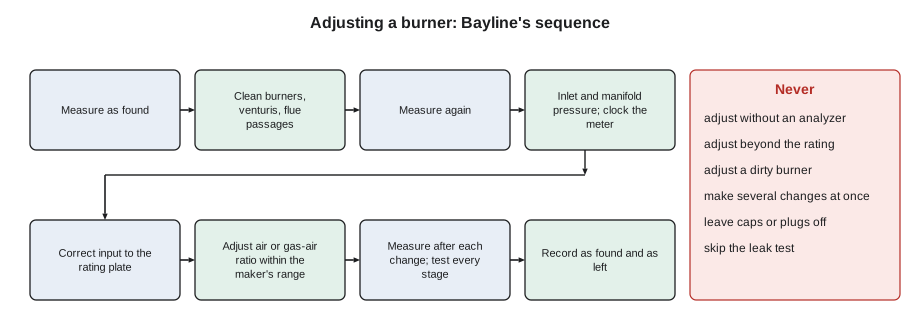
Most burners that burn badly are not out of adjustment; they are dirty. Dust, lint, rust flakes from the heat exchanger or flue, spider webs in the burner's venturi, soot from earlier bad combustion, and corrosion in the burner ports all change how much air the burner draws and how its flame forms. Adjusting a dirty burner to read well only hides the problem until the dirt shifts again. Bayline's order of work is always: measure as found, clean, measure again, and only then adjust what still needs it.
At the church, the as-found readings after the boiler had run for five minutes were poor. Below the draft hood, the analyzer showed oxygen 5.6 and CO 190 ppm. The flames were tall and lazy, with long yellow tips, and two of the burners near the back were laying soot on the sections above them.
Worked problem
How bad were the as-found readings?
The as-found readings were oxygen 5.6 and CO 190 ppm below the draft hood. Calculate the air-free CO and the excess air.
Show solution
- Air-free CO:
- \[190 \times \frac{20.9}{20.9 - 5.6} = 190 \times \frac{20.9}{15.3} = 190 \times 1.366 = 260 \text{ ppm}\]
- Excess air:
- \[\frac{5.6}{20.9 - 5.6} = \frac{5.6}{15.3} = 0.37 = 37 \text{ in } 100\]
Answer: The boiler is making about 260 ppm air-free with only about 37 in 100 excess air, low for an atmospheric burner, which usually needs more. High CO with low oxygen points to too little air, too much gas, or both.
Rosa shut the boiler off, closed its gas valve and let it cool. With Jonah she removed the burners, brushed and vacuumed the burner ports and blew out the venturis, which were partly blocked with dust and the remains of a mud-dauber wasp's nest. Through the boiler's flue collector they brushed the passages between the sections, where soot had built up enough to narrow them, and vacuumed out the debris. Partly blocked flue passages restrict the flue gas, which reduces the secondary air the burners can draw, and soot insulates the heat exchanger, which raises the flue gas temperature and wastes fuel.
Checking the input
The next question is whether the burner is getting the right amount of gas. A burner that is overfired, fed more gas than its rating, needs more air than its design provides, runs short of excess air, and makes CO. A burner that is underfired runs with too much excess air, loses efficiency, may condense in its vent, and on some burners lifts or makes CO from a cooled flame. The input is checked two ways. The manifold pressure is measured at the gas valve's outlet tap with a manometer and compared with the rating plate; and on natural gas, the input is clocked at the meter, with every other appliance off, as GAS-110 showed.
Worked problem
Clocking the church boiler
With everything else off, the meter's 0.05 m³ test dial takes 26.5 s for one revolution with the boiler firing. The heating value is 37.5 MJ/m³. What is the input, and how does it compare with the 64.5 kW rating?
Show solution
- Revolutions per hour:
- \[\frac{3{,}600}{26.5} = 135.8\]
- Flow:
- \[135.8 \times 0.05 = 6.79 \text{ m}^3\text{/h}\]
- Input:
- \[6.79 \times 37.5 = 254.6 \text{ MJ/h} \qquad \frac{254.6}{3.6} = 70.7 \text{ kW}\]
- Compared with the rating:
- \[\frac{70.7}{64.5} = 1.096\]
Answer: The boiler is overfired by about 10 in 100. That alone is enough to push an atmospheric burner short of air.
The manometer at the gas valve's outlet tap explained why: the manifold pressure was 1.05 kPa against a rating plate value of 0.87 kPa. Somebody had turned the regulator up, perhaps to make the hall warm faster. Because flow through an orifice rises with the square root of the pressure, as GAS-220 showed, a pressure 1.21 times the rated value gives a flow about 1.10 times the rated flow, which matches the clocking.
Worked problem
Checking the manifold pressure against the clocking
Use the square-root rule to predict the flow ratio from the manifold pressures, 1.05 kPa measured and 0.87 kPa rated.
Show solution
- \[\sqrt{\frac{1.05}{0.87}} = \sqrt{1.207} = 1.099\]
Answer: The predicted overfiring of about 10 in 100 agrees with the meter. Two independent checks giving the same answer is what lets a technician adjust with confidence.
Before turning the regulator, Rosa checked the inlet pressure at the valve's inlet tap with the boiler firing, because a regulator can only deliver its set outlet pressure if the supply is high enough, and a low inlet pressure can look like a regulator fault. It was normal. She then turned the regulator's adjusting screw, under its cap, until the manifold pressure read 0.87 kPa, replaced the cap, and clocked the meter again: 29.0 s per revolution, which works out to 64.7 kW, within a few parts in 1,000 of the rating.
Adjusting primary air
Atmospheric burners like the church boiler's draw their primary air through the venturi, where the gas jet from the orifice pulls air in and mixes it with the gas before the burner ports. Many older atmospheric burners have an adjustable air shutter at the venturi opening, a rotating disc or sliding plate that sets how much primary air enters. The rest of the air the flame needs, the secondary air, is drawn in around the flame from the combustion chamber, and is set by the design of the chamber, the flue passages and the draft. Modern residential furnaces mostly have fixed primary air with no shutter.
Primary air is adjusted by watching the flame and confirming with the analyzer. Too little primary air gives long, soft flames with yellow tips, which soot and make CO. Too much gives short, hard flames that lift off the ports, roar, or flash back into the burner. The goal is a flame that is mostly blue, with a well-defined inner cone at each port, seated on the port without lifting, and with no more than faint orange streaks from dust in the air. At the church, with the input corrected, Rosa opened the shutters of each burner a little at a time until the yellow tips disappeared and the flames sat firmly on their ports, then checked them all for an even pattern.
| Flame appearance | Likely cause |
|---|---|
| Long, soft, yellow-tipped, sooting | Too little primary air, overfiring, or restricted secondary air |
| Short, hard, lifting off the ports | Too much primary air, or overfiring |
| Flashback, burning inside the burner | Too much primary air, low gas pressure, or damaged ports |
| Lazy flame that wanders or rolls out | Poor draft, blocked flue passages, or depressurized room |
| Uneven flames between burners | Dirty or damaged burners, misaligned orifices |
| Orange streaks only | Usually dust in the air, not a fault in itself |
The result at the church
With the boiler cleaned, the input reset and the air shutters adjusted, Rosa let it run for ten minutes and took a final set of readings below the draft hood: oxygen 7.5, CO 15 ppm, and a flue gas temperature much lower than before, because the clean sections were taking more heat into the water. Draft above the draft hood was steady, and a smoke test showed no spillage.
Worked problem
As found and as left
As found: oxygen 5.6, CO 190 ppm. As left: oxygen 7.5, CO 15 ppm. Calculate the as-left air-free CO and excess air, and compare the air-free CO before and after.
Show solution
- As-left air-free CO:
- \[15 \times \frac{20.9}{20.9 - 7.5} = 15 \times \frac{20.9}{13.4} = 15 \times 1.560 = 23 \text{ ppm}\]
- As-left excess air:
- \[\frac{7.5}{13.4} = 0.56 = 56 \text{ in } 100\]
- Air-free CO before and after:
- \[\frac{260}{23} = 11.3\]
Answer: The air-free CO fell from about 260 ppm to about 23 ppm, less than a tenth of the as-found value, and the excess air rose to a normal level for an atmospheric burner. Rosa wrote both sets of readings on the report and explained to the caretaker why the regulator must not be touched again.
Adjusting condensing and modulating appliances
Condensing furnaces and boilers are adjusted differently, and often not at all in the field. Many condensing furnaces have no air adjustment: the inducer, the orifices and the burner are matched at the factory, and the technician sets only the manifold pressure on each stage to the rating plate and checks the readings. Many modulating condensing boilers and water heaters, on the other hand, premix gas and air in a blower and use a gas valve that follows the blower's air pressure, and their instructions give a target CO₂ range at high fire and at low fire, with an adjustment on the gas valve, often called the throttle or ratio screw, for setting the gas-air ratio at high fire and sometimes an offset adjustment for low fire. These are set only with a warmed-up, recently checked analyzer, only within the maker's range, and only in the order the instructions give, usually high fire first.
Worked problem
Setting a modulating boiler to its CO₂ range
A sample set of instructions, made up for practice, gives a target of 9.0 to 9.6 CO₂ at high fire on natural gas. The analyzer reads 10.2 CO₂ at high fire. Is the mixture too rich or too lean, and which way should the oxygen move after adjustment?
Show solution
- Compare with the range:
- \[10.2 > 9.6\]
- Find the oxygen that corresponds to 10.2 CO₂ with a maximum of 11.7:
- \[\text{O}_2 = 20.9 \times (1 - \frac{10.2}{11.7})\]
- Work it out:
- \[20.9 \times (1 - 0.872) = 20.9 \times 0.128 = 2.7\]
- And for the top of the range, 9.6 CO₂:
- \[20.9 \times (1 - \frac{9.6}{11.7}) = 20.9 \times 0.179 = 3.8\]
Answer: The CO₂ is above the range, so the mixture has too little air: it is too rich. Adjusting the throttle toward lean should bring the CO₂ down into range and the oxygen up from about 2.7 to above about 3.8, with the CO checked after each small turn.
Two warnings go with every adjustment on these appliances. First, a premix burner is very sensitive to its gas-air ratio, and a small turn of the throttle can change its CO a lot; small turns, a wait for the reading to settle, and a CO check after each change are the only safe way. Second, a reading out of range on an appliance that was set correctly before usually means something has changed, such as a blocked intake, a dirty burner, a recirculating termination or the wrong gas, and that cause must be found before anything is turned.
Propane and altitude
Appliances converted to propane, as GAS-210 described for the rural customer, use different orifices and a different regulator spring, and their manifold pressure is much higher, typically around 2.5 kPa on residential appliances, set from the rating plate and the conversion kit's label. Propane input cannot usually be clocked, because there is no meter at the appliance, so the manifold pressure and the analyzer carry more weight. At high altitude, thin air means burners need less gas for the same air, and the codes and the instructions require appliances to be derated or fitted with high-altitude orifices above a stated elevation. Hamilton is well below that elevation, but Bayline technicians who travel for work check it.
Rules for every adjustment
Bayline's rules for adjusting burners are short. Never adjust a burner without an analyzer, because the flame's appearance alone cannot show CO. Never adjust beyond the rating plate or the maker's range. Never adjust a dirty burner; clean first. Make one change at a time, wait for steady readings, and measure after each change. Test every stage of a multi-stage or modulating appliance. Put back every cap, plug and cover, and leak-test every fitting that was opened. Record the as-found and as-left readings and settings. And if the readings will not come right, the appliance has a problem that adjustment cannot fix, and it is shut off and tagged until that problem is found.
Common mistakes
MistakeAdjusting the air to hide a dirty burner.
InsteadClean first; adjust only what still needs it.
MistakeTurning up the manifold pressure to get more heat.
InsteadSet the manifold pressure to the rating plate; overfiring makes CO.
MistakeAdjusting by flame colour alone.
InsteadConfirm every adjustment with the analyzer.
MistakeMaking several changes at once on a premix boiler.
InsteadMake one small change, wait, and measure CO each time.
MistakeForgetting the inlet pressure.
InsteadCheck inlet pressure before blaming or adjusting the regulator.
Summary and key terms
- Most burners that burn badly are dirty, so the order of work is to measure as found, clean the burners, venturis and flue passages, and measure again before adjusting anything.
- Check the input next: measure inlet and manifold pressures against the rating plate and, on natural gas, clock the meter; overfiring starves the burner of air and makes CO, and underfiring wastes fuel and can make CO from a cooled flame.
- Flow rises with the square root of manifold pressure.
- On atmospheric burners with shutters, adjust primary air for a blue, seated flame with clear inner cones, confirmed with the analyzer.
- On modulating premix appliances, set the gas-air ratio only to the maker's CO₂ range, with small turns and a CO check after each.
- Never adjust without an analyzer, beyond the rating or a dirty burner; record as found and as left.
- Overfiring
- Supplying a burner with more gas than its rated input.
- Underfiring
- Supplying a burner with less gas than its rated input.
- Primary air
- Air mixed with the gas before it reaches the burner ports.
- Secondary air
- Air drawn in around the flame in the combustion chamber.
- Air shutter
- An adjustable plate that sets the primary air entering an atmospheric burner.
- Manifold pressure
- The gas pressure at the outlet of the appliance gas valve.
- Throttle
- An adjustment on a premix gas valve that sets the gas-air ratio.
- As found, as left
- Readings taken before and after work, recorded together.
Practice problems
Work each problem on paper first, then reveal the answer to check.
What is the first step before adjusting a burner?
Show answer
Measure as found, then clean it.
Name two ways to check an appliance's input on natural gas.
Show answer
Measure the manifold pressure and clock the meter.
What does overfiring do to combustion?
Show answer
It starves the burner of air and raises CO.
What does a long, yellow-tipped, sooting flame suggest?
Show answer
Too little primary air, overfiring or restricted secondary air.
Why make only one change at a time on a premix boiler?
Show answer
Small changes have large effects on CO, so each must be measured.
Lesson quiz · 5 questions
Score 60% or more to complete this lesson.
Create a free account to save your progress, take quizzes and earn a certificate.