
GAS-230 · Lesson 12 of 12 · 32 min
Case study: a home with high carbon monoxide
▶ Video coming soon A video version of this lesson is on the way.
At 11:20 p.m. on Sunday, November 1, the carbon monoxide alarm in the basement hallway of a 1978 two-storey in Templemead, on Hamilton Mountain started to sound. Nadia Haddad was folding laundry down there; her husband Sami had gone to bed with a headache an hour before, and their children, Layla, 9, and Omar, 6, were asleep upstairs. The alarm's display read 74 ppm. Nadia did what the alarm's label said: she woke everyone, got them out onto the driveway in their coats, and called 911 from outside. The fire department arrived within minutes, measured about 68 ppm in the basement and 22 ppm on the bedroom floor, ventilated the house and called the gas utility, whose technician shut off and tagged the water heater. Paramedics checked the family; Sami's headache eased in the fresh air, and nobody needed to go to hospital. At 12:15 a.m. Luis and Jonah, on call for Bayline that night, arrived to make the house safe until morning.
This lesson follows the Haddad call from the alarm to the verification test four days later. It draws on every lesson in the course: draft and buoyancy, appliance types, vent categories, masonry chimneys, air supply, depressurization, and the analyzer.
The night call
Luis's first job was the people, not the appliances. With his personal CO monitor clipped on and the analyzer zeroed in the driveway, he walked the house with Jonah: 4 ppm on the bedroom floor and 9 ppm in the basement after the firefighters' ventilation, falling. He checked that the water heater's gas valve was off and tagged, and that the furnace, a 2024 condensing model vented through the side wall, was running normally. He did not try to diagnose the water heater at midnight in a cold house with tired children waiting to go back in: the hazard was off, the alarm was working, and the readings were safe. He explained that to Nadia and Sami, confirmed there was a working alarm on the bedroom floor as well as in the basement, and booked Rosa for eight the next morning. "The water heater stays off until we know why," he said. "No hot water tonight is a small price."
In the van, Jonah wrote down what the alarm had been telling them. Residential CO alarms certified to CSA 6.19 are designed not to sound at low levels that are common briefly, and to sound within set time windows at higher ones: at about 70 ppm, somewhere between one and four hours; at about 150 ppm, between 10 and 50 minutes; and at about 400 ppm, within 4 to 15 minutes. An alarm that sounds at 74 ppm has usually seen elevated CO for an hour or more.
Worked problem
What the alarm's timing says
Nadia had started the dryer at about 9:50 p.m. The alarm sounded at 11:20 p.m., reading 74 ppm. How long had the dryer been running, and does that fit the alarm's design window at about 70 ppm?
Show solution
- Time from 9:50 to 11:20:
- \[11{:}20 - 9{:}50 = 1 \text{ h } 30 \text{ min} = 90 \text{ min}\]
- Design window at about 70 ppm:
- \[60 \text{ to } 240 \text{ min}\]
- Compare:
- \[60 \le 90 \le 240\]
Answer: Ninety minutes falls inside the window. The timing suggested that whatever was producing CO had started at about the time the dryer went on, which Rosa would test the next morning.
Morning: the investigation
Rosa and Jonah arrived at 8:00 a.m. on Monday, November 2. It was −3 °C, and still. Rosa started, as always, with ambient CO: 0 ppm on every floor. Then she walked the appliances with Jonah and the owners, listing what she found before testing anything.
The furnace was a 2024 two-pipe condensing furnace, installed by another contractor, with both pipes terminating on the side wall. When it went in, the old furnace had been disconnected from the chimney, leaving the 2012 atmospheric water heater, rated 11.7 kW, alone in the house's masonry chimney. That chimney ran up the outside of the house, an exterior chimney with a clay-tile liner. Under the code as Ontario has adopted it, an exterior chimney serving a gas appliance cannot keep a tile liner; it has to be relined with a certified metal liner, and the chimney has to be examined whenever an appliance on it is replaced or removed. No liner had ever been installed. The water heater had been orphaned in an exterior tile flue for two winters.
Rosa's list grew quickly. The water heater's draft hood was scorched brown on one side and the plastic cover over its gas valve wiring had softened. The flame, when she lifted the inner door with the gas off, showed a burner crusted with rust flakes. The basement had been finished in the spring, with the laundry and a new bathroom beside the mechanical room and a new bathroom fan. The dryer vent ran out through the rim joist. And the furnace room, now enclosed, had a slatted door that had been painted shut and a stack of storage bins in front of its lower half.
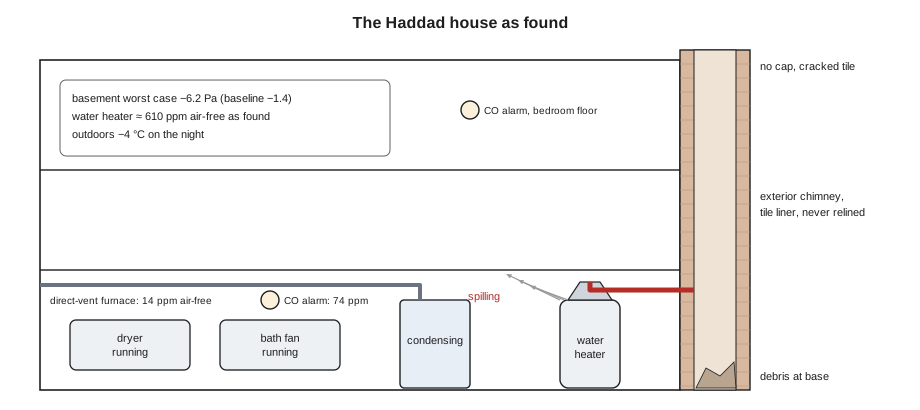
The chimney
Rosa examined the chimney the way lesson 5 described. From the ladder, she found the cap missing entirely and the top tile cracked through. Her camera on a pole showed mortar missing from most joints, two tiles shifted out of line, and white crust on the walls. At the base, the clean-out door opened on a heap of tile fragments, crumbled mortar and wet leaves that reached the bottom of the thimble and covered about half of the connector's opening into the flue. Two winters of an orphaned water heater's condensate had done to this chimney what decades had done at Westdale.
Worked problem
How much of the connector was blocked?
The water heater's connector enters the flue through a 100 mm round thimble. The debris covered the lower half of the opening. What open area was left, compared with the water heater's 75 mm draft hood outlet?
Show solution
- Full thimble area:
- \[\frac{\pi \times 100^2}{4} = 7{,}854 \text{ mm}^2\]
- Half of it:
- \[\frac{7{,}854}{2} = 3{,}927 \text{ mm}^2\]
- Draft hood outlet:
- \[\frac{\pi \times 75^2}{4} = 4{,}418 \text{ mm}^2\]
- Ratio:
- \[\frac{3{,}927}{4{,}418} = 0.89\]
Answer: The opening left was smaller than the draft hood outlet itself, about nine-tenths of its area. A weak vent in a cold exterior chimney was now also restricted at its base.
The water heater and the analyzer
With the clean-out door closed again, the storage bins moved and the furnace room door open, Rosa had the utility technician's tag noted, relit the water heater under her own supervision for testing only, and ran it with the house's fans off. The vent was cold, and the smoke pencil showed spillage at the draft hood for the first two minutes and a weak draw after that. After five minutes she took the analyzer reading below the draft hood: oxygen 8.9 and CO 350 ppm. The furnace, sampled at its test port, read oxygen 7.1 and CO 9 ppm.
Worked problem
Air-free CO for both appliances
The water heater read oxygen 8.9 and CO 350 ppm; the furnace read oxygen 7.1 and CO 9 ppm. Calculate each appliance's air-free CO.
Show solution
- Water heater:
- \[350 \times \frac{20.9}{20.9 - 8.9} = 350 \times \frac{20.9}{12.0} = 350 \times 1.742 = 610 \text{ ppm}\]
- Furnace:
- \[9 \times \frac{20.9}{20.9 - 7.1} = 9 \times \frac{20.9}{13.8} = 9 \times 1.514 = 14 \text{ ppm}\]
Answer: The water heater was making about 610 ppm air-free even with the house's fans off, three times the 200 ppm guidance for water heaters and six times Bayline's 100 ppm investigation line. The furnace, sealed and direct vent, was burning cleanly at about 14 ppm. The source was the water heater.
Rosa shut the water heater off again and pulled its burner. The burner ports were half blocked with rust flakes from the flue baffle and the inside of the flue tube, which had corroded from condensation running back down from the cold chimney. A blocked burner draws less primary air and makes a soft, yellow, impinging flame, which explained the high CO with fairly normal oxygen: poor mixing, as lesson 10's table described, rather than a simple shortage of air.
The worst-case test
The last piece was the house. Rosa set up her manometer with a tube to the outdoors and ran the worst-case depressurization test from lesson 8. With everything off, the basement read −1.4 Pa, a cold November morning's stack effect in a two-storey house. With the dryer running, the basement bathroom fan on, the kitchen hood on high and the furnace blower running, and the door at the top of the basement stairs closed, which made it worst, the basement read −6.2 Pa.
Worked problem
Induced depressurization at the Haddads'
The baseline was −1.4 Pa and the worst case −6.2 Pa. Find the induced depressurization and compare the worst case with the typical screening limit of about −2 Pa for a natural-draft appliance in an exterior masonry chimney.
Show solution
- Induced depressurization:
- \[-6.2 - (-1.4) = -4.8 \text{ Pa}\]
- Worst case against the screening limit:
- \[\frac{6.2}{2} = 3.1\]
Answer: The basement went about three times more negative than a natural-draft appliance in an exterior chimney can be expected to tolerate. On the night of the alarm, colder at −4 °C, with the dryer and the bathroom fan both running and the furnace room door blocked, the water heater would have been spilling continuously.
Rosa did not relight the water heater for the worst-case spillage test, because she already knew the answer and running a 610 ppm burner into a depressurized basement would only have proved it the dangerous way. She recorded the pressures and went upstairs to talk to the family.
What happened that night
Rosa laid it out for Nadia and Sami in order, the way she wanted Jonah to learn to explain it. Two years ago the furnace was replaced and the water heater was left alone in a chimney that was far too big and too cold for it, without the liner it needed. Since then, its condensate had been eating the chimney's mortar, and the debris had built up at the base until it blocked half the connector. The same condensate had rusted the water heater's flue and dropped rust onto its burner, so it was making a lot of carbon monoxide. That would have been dangerous on its own. On Sunday night three things came together: the first properly cold night of the fall, which made the house pull harder on the basement; the dryer and the new bathroom fan running together, pulling it harder still; and the furnace room door blocked by bins, so the water heater's corner of the basement could not draw air easily. The weak, partly blocked vent could not win, the water heater spilled flue gas full of carbon monoxide into the basement, and the alarm did its job.
| Cause | Lesson | What it contributed |
|---|---|---|
| Orphaned water heater in an exterior tile-lined chimney, never relined | 4 and 5 | Weak, cold vent with long cold-start spills and condensation |
| Debris at the chimney base blocking half the connector opening | 5 | Restricted vent |
| Rust flakes on the burner from a corroded flue | 10 and 11 | Poor mixing and about 610 ppm air-free CO |
| Dryer, bathroom fan and stack effect on a cold night | 1 and 8 | Basement depressurized to about −6 Pa |
| Painted-shut slatted door and bins blocking it | 7 | Air supply to the appliance space restricted |
| Working CO alarms | 10 | Gave the warning that got the family out |
The decision and the repair
Rosa gave the family two options. The first was to reline the chimney with a certified liner sized for the water heater, clean and repair the burner and flue or replace the water heater, and fit make-up air or limit the basement's exhaust. The second was to replace the water heater with a direct-vent model that took its air from outdoors and vented through the wall, and stop using the chimney for gas altogether. Given the water heater's age, the state of the chimney and the house's tendency to go negative, she recommended the second, and the Haddads agreed.
On Tuesday, November 3, while Jonah was on another call, Luis and Hank installed a direct-vent water heater, vented with its certified kit through the rim joist at the clearances its instructions and the code required, and sealed the old thimble. They capped the chimney flue at the top, cleared the base through the clean-out, and recommended that the family have a mason look at the chimney itself. They cleaned the dryer vent, which was partly blocked with lint, freed the furnace room door, and fitted a new grille in it. Hank sent TSSA the details of the 2024 installation and the incident, as Bayline does whenever a code violation lies behind a carbon monoxide call.
Verification
Rosa and Jonah went back at 7:30 a.m. on Thursday, November 5, before their next job, to prove the fix under the conditions that had caused the problem. At −2 °C, Rosa set up the worst-case test again: every exhaust on, the furnace blower running, the basement stairs door closed. The basement read −6.0 Pa, almost as before, because the house had not changed. But now nothing in it depended on the basement's air. The new water heater, sampled at its test port after five minutes of firing, read oxygen 6.4 and CO 8 ppm. The furnace read the same as on Monday. Ambient CO was 0 ppm on every floor throughout the test.
Worked problem
The verification readings
The new water heater read oxygen 6.4 and CO 8 ppm at its test port under worst-case conditions. Calculate its air-free CO and compare it with the old water heater's 610 ppm.
Show solution
- Air-free CO:
- \[8 \times \frac{20.9}{20.9 - 6.4} = 8 \times \frac{20.9}{14.5} = 8 \times 1.441 = 12 \text{ ppm}\]
- Compared with the old water heater:
- \[\frac{610}{12} = 51\]
Answer: The new water heater makes about one-fiftieth of the carbon monoxide the old one did, and it does so with the basement at its most negative, because it is sealed from the room.
Rosa then checked both CO alarms with their test buttons and their dates. The basement alarm was seven years old, near the end of its rated life, and Bayline replaced it. The bedroom-floor alarm had been added in January to meet Ontario's requirement for an alarm on every storey, and Rosa added one on the main floor, which had none. She left the family a one-page summary of what had been found and done, with the readings, and explained what the alarms' beeps and displays mean.
On Friday, November 13, Rosa phoned the Haddads. The alarms had been silent, the hot water was fine, and Nadia said the basement felt warmer with the door grille and no draft from the old chimney. The family plans to have the chimney taken down below the roofline in the spring.
What Jonah took from it
In his notebook that week, Jonah wrote four lines. First, the alarm, the family and the fire department did everything right; the gas trade's job was to find out why and make sure it never happened again. Second, nothing about this house was unusual: an orphaned water heater, a finished basement, a dryer and a cold night are in thousands of houses. Third, no single test found the problem; the chimney examination, the analyzer and the worst-case test each showed one part of it, and only together did they explain the alarm. Fourth, the fix that removed the dependence on the house's air was better than any fix that tried to make a weak vent win.
Common mistakes
MistakeDiagnosing a CO call at midnight with the family waiting.
InsteadMake it safe, confirm the alarms, and investigate properly in daylight.
MistakeStopping at the first fault found.
InsteadCO incidents usually have several causes; find them all.
MistakeRunning a high-CO appliance into a depressurized house to prove it.
InsteadOnce the readings show the hazard, do not create it again.
MistakeLeaving after the repair without testing under worst-case conditions.
InsteadProve the fix under the conditions that caused the problem.
MistakeIgnoring the alarms themselves.
InsteadCheck every alarm's age and function, and make sure every required location has one.
Summary and key terms
- At the Haddad house, a CO alarm at 74 ppm got the family out safely.
- The night call made the house safe and left the water heater off for a daylight investigation.
- The investigation found an atmospheric water heater orphaned for two years in an exterior tile-lined chimney that should have been relined when the furnace was replaced; acidic condensate had eaten the chimney and dropped debris that blocked half the connector opening, and had rusted the water heater's flue onto its burner, which was making about 610 ppm air-free.
- A worst-case test showed the basement going to about −6 Pa with the dryer, bathroom fan and stack effect, three times what such an appliance tolerates, and a blocked furnace room door restricted its air.
- The fix replaced the water heater with a direct-vent model, capped the chimney, cleaned the dryer vent, restored the door's air supply and renewed the alarms.
- A verification test under worst-case conditions showed 12 ppm air-free and no ambient CO.
- CO incident
- An event in which carbon monoxide from an appliance reaches occupied space.
- Making safe
- Shutting off and tagging a hazard and confirming the occupants are protected before full diagnosis.
- Verification test
- A test that proves a repair under the conditions that caused the problem.
- Alarm response window
- The range of times within which a certified CO alarm is designed to sound at a given concentration.
- Root cause
- The underlying reason for a fault, as opposed to its symptoms.
- Contributing cause
- A condition that made a fault worse or more likely without causing it alone.
Practice problems
Work each problem on paper first, then reveal the answer to check.
What was Luis's priority on the night call?
Show answer
Making the house safe and protecting the family, not diagnosing the appliance.
What made the water heater's chimney unsuitable?
Show answer
It was an exterior chimney with a tile liner, far too big for the water heater alone, and never relined.
Why did the water heater make so much CO?
Show answer
Rust flakes from its corroded flue had blocked its burner ports.
Which three conditions came together on the night of the alarm?
Show answer
A cold night's stack effect, the dryer and bathroom fan running, and a blocked furnace room door.
Why was a direct-vent water heater the better fix?
Show answer
It does not depend on the house's air or on a weak vent.
Lesson quiz · 5 questions
Score 60% or more to complete this lesson.
Create a free account to save your progress, take quizzes and earn a certificate.