
GAS-230 · Lesson 8 of 12 · 30 min
Spillage, backdrafting and depressurization
▶ Video coming soon A video version of this lesson is on the way.
On Wednesday, October 7, Priya forwarded Rosa an email from an energy advisor. The advisor had just finished a follow-up test on a 1960s storey-and-a-half in Westcliffe, on the west Mountain, after the owners, Dev and Anneke Bakshi, had spent the summer on new windows, attic insulation, sealed basement rim joists and a new kitchen with a powerful range hood. During the test, with the house's exhaust fans running, the advisor's smoke had poured out of the water heater's draft hood and kept pouring. "Atmospheric water heater fails depressurization test," the email ended. "Please assess." Rosa and Jonah were there by two o'clock with two manometers, a smoke pencil, the analyzer and a long length of tubing. "Good on the advisor," Rosa said. "Tight houses are better houses. But you can't seal a house up like a jar and expect a water heater to keep breathing through a straw."
This lesson covers what happens when a house pulls harder than a vent can push: spillage, backdrafting and the depressurization that causes them, how to test for them under worst-case conditions, and how to fix them.
Spillage and backdrafting
Spillage is flue gas escaping into the room from a draft hood, a barometric damper or another opening in an appliance or its vent, instead of going up the vent. A short spill when a cold vent starts up, as lesson 1 described, is common and stops as the vent warms. Prolonged spillage continues after the vent should have warmed, and is a hazard. Backdrafting is a sustained reversal of flow, in which outdoor air comes down the vent and flue gas is pushed out into the room, sometimes while the burner is running and sometimes even when it is off, when the vent becomes an air inlet for the house. In the worst cases, a backdrafting appliance's flame is pushed out of its combustion chamber, which is flame rollout, and the rollout switch trips if the appliance has one.
Spilled flue gas is not always dangerous in its own right: a clean-burning appliance's flue gas is mostly nitrogen, carbon dioxide and water vapour. But it is never only that. It carries any carbon monoxide the burner makes, and a burner starved of air by the same depressurization that causes the spillage makes much more carbon monoxide than usual. The spilled gas is also hot and wet, so prolonged spillage rusts draft hoods, melts the plastic on water heater fittings, rots window frames and leaves condensation on cold surfaces, which are among the signs a technician learns to look for.
| Sign | What it suggests |
|---|---|
| Rust, scorching or discoloration at a draft hood | Repeated spillage |
| Melted or deformed plastic fittings or wire insulation on top of a water heater | Hot flue gas spilling over them |
| Heavy condensation on basement windows in winter | Moist flue gas in the room |
| A spill switch that has tripped | Prolonged spillage at a draft-hood appliance |
| Soot around the burner or the draft hood | Incomplete combustion, often with spillage |
| Occupants report headaches or a sharp smell when appliances run | Flue gas and possibly CO in the room |
| A carbon monoxide alarm sounding or showing a reading | CO in the house; investigate at once |
What depressurizes a house
Every fan that blows air out of a house must be matched by the same amount of air coming in somewhere. In a leaky house, that air leaks in through the walls easily, and the house's pressure drops only a little. In a tight house, the house's pressure drops until enough air is drawn in through the remaining gaps, and one of the easiest gaps is a chimney or a vent. The main causes are these. Exhaust fans: kitchen range hoods, which in new kitchens can move several hundred litres per second; clothes dryers; bathroom fans; and central vacuums vented outdoors. Other combustion: a wood fireplace or wood stove draws large amounts of house air up its chimney. Duct leakage: a furnace whose return ducts leak in the basement, or whose supply ducts leak into an attic or crawl space, can pull the basement negative whenever the blower runs. Stack effect, which lesson 1 showed works against basement appliances on cold days. And wind, which can push down or pull across a termination and change the pressures in the house.
Worked problem
Exhaust fans compared with a water heater
The Bakshis' new range hood is rated 350 L/s, their dryer moves about 70 L/s and their two bathroom fans about 25 L/s each. Lesson 2 estimated that an 11.7 kW draft-hood water heater uses about 9.3 L/s of room air. How much air can the fans exhaust together, and how many times the water heater's air is that?
Show solution
- Total exhaust:
- \[350 + 70 + 25 + 25 = 470 \text{ L/s}\]
- Compared with the water heater:
- \[\frac{470}{9.3} = 51\]
Answer: The house's fans can move about fifty times as much air as the water heater uses. When they all run, the water heater's vent is not a contest it can win.
How far the house goes negative depends on how leaky it is. Energy advisors measure this with a blower door, a calibrated fan in an outside doorway, and express the result as the airflow that leaks through the house when it is held 50 Pa below outdoors. Because flow through cracks does not rise in direct proportion to pressure, the pressure a given exhaust flow creates can be estimated from that test result with a standard exponent, about 0.65 for houses.
Worked problem
Estimating how negative the house goes
The advisor's blower door test found the Bakshi house leaking 1,230 L/s at 50 Pa after the retrofit. Estimate the house pressure with all the fans running at 470 L/s, using pressure = 50 × (flow ÷ leakage at 50 Pa) raised to the power 1 ÷ 0.65.
Show solution
- Flow ratio:
- \[\frac{470}{1{,}230} = 0.382\]
- Exponent:
- \[\frac{1}{0.65} = 1.538\]
- Raise the ratio to that power:
- \[0.382^{1.538} = 0.228\]
- Pressure:
- \[50 \times 0.228 = 11.4 \text{ Pa}\]
Answer: The estimate is a house pressure of about 11 Pa negative with every fan at full rated flow. Real fans move less than their rating against back pressure, so the measured figure is usually lower, but even half of this is more than a natural-draft water heater's few pascals of draft can overcome.
Worst-case depressurization testing
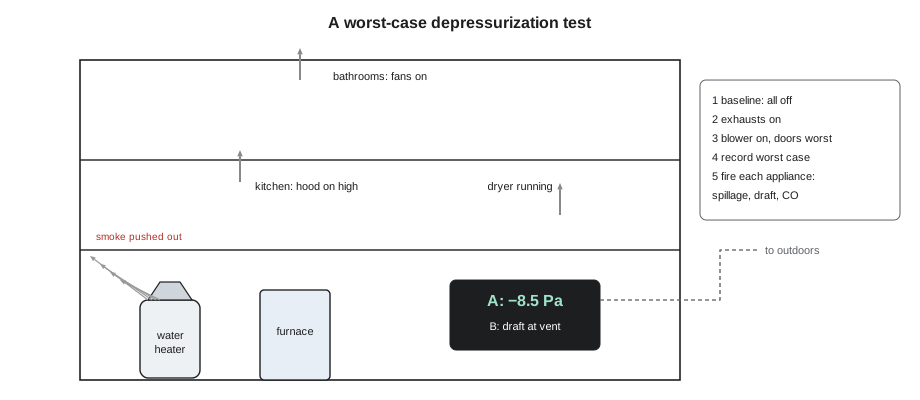
A worst-case depressurization test sets the house up in the way that makes the appliance space as negative as normal use could make it, and then checks whether each appliance still drafts, does not spill and does not make carbon monoxide. Procedures differ a little between programs and jurisdictions, and Canadian energy advisors use the spillage test procedure in CAN/CGSB-51.71, while Ontario's adoption of CSA B149.1 calls for a depressurization test to its own annex procedure when a natural-draft boiler shows signs of spillage, but they share the same steps, which Bayline's procedure follows.
| Step | What to do |
|---|---|
| 1. Check ambient CO | Zero the CO meter outdoors, then check the living space and appliance area. Stop and ventilate if CO is elevated. |
| 2. Set up the manometer | One channel reads the appliance space against outdoors; the other can read draft in the vent. |
| 3. Baseline | All exhaust fans, the air handler and the appliances off; exterior doors and windows closed; record the appliance space pressure. |
| 4. Exhausts on | Turn on the range hood on high, the dryer, every bath fan and any other exhaust; close fireplace dampers. |
| 5. Air handler and doors | Turn on the furnace blower; open or close interior doors and the appliance room door, whichever makes the space most negative. |
| 6. Record worst case | Record the most negative pressure; subtract the baseline to get the induced depressurization. |
| 7. Fire each appliance | Start with the smallest; check for spillage at the draft hood at the set time and measure draft and flue gas CO. |
| 8. Return the house to normal | Fans off, doors back, appliances back to normal settings; record everything. |
Spillage is checked with a smoke pencil, a mirror that fogs, or a temperature probe at the draft hood's relief opening, at a set time after the burner lights. Current US practice under ANSI/BPI-1200 checks at 2 minutes for appliances with warm vents, such as a water heater that has just run, and at 5 minutes for cold vents; older field guides used 60 seconds. Bayline's rule is to check at the time its procedure sets and to record the outdoor temperature, the house pressure and the result. Flue gas CO is measured after the appliance has run for 5 minutes, below the draft hood where the gas is undiluted.
Energy programs also use depressurization limits as a screening tool: the most negative pressure each type of appliance can be expected to tolerate. They are guidelines rather than code, and the spillage and CO results decide the outcome, but they help a technician predict which appliance will fail first.
| Appliance and vent | Typical screening limit |
|---|---|
| Natural draft, in mild weather | About −2 Pa |
| Natural draft, in moderate weather | About −3 Pa |
| Natural draft, in very cold weather | About −5 Pa |
| Natural draft in an exterior masonry chimney | About −2 Pa |
| Fan-assisted Category I | About −15 Pa |
| Power-vented, using room air | About −15 to −20 Pa |
| Direct vent, sealed combustion | About −50 Pa |
The test at the Bakshis'
Rosa set up the two-channel manometer with one tube run out under the back door to the outdoors. With everything off, the basement read −0.5 Pa compared with outdoors, the stack effect of a cool October afternoon. Jonah went through the house turning things on: the range hood on its highest setting, the dryer on air-dry with no heat, both bath fans, and finally the furnace blower. With each, Rosa called out the reading. With everything running and the basement door closed at the top of the stairs, which made it worst, the basement read −8.5 Pa.
Worked problem
Induced depressurization
The basement read −0.5 Pa at baseline and −8.5 Pa under worst-case conditions. What is the induced depressurization, and how does it compare with the screening limits for the two appliances?
Show solution
- Induced depressurization:
- \[-8.5 - (-0.5) = -8.0 \text{ Pa}\]
- Water heater, natural draft, moderate weather, screening limit about −3 Pa:
- \[-8.0 \text{ Pa is well beyond} -3 \text{ Pa}\]
- Furnace, fan-assisted, screening limit about −15 Pa:
- \[-8.0 \text{ Pa is within} -15 \text{ Pa}\]
Answer: The fans pull the basement 8 Pa more negative than normal. That is far beyond what a natural-draft water heater can tolerate and within what a fan-assisted furnace usually can.
Then she fired the appliances. The water heater, its vent already warm from a shower an hour before, spilled from the moment the burner lit; at 2 minutes the smoke was still being pushed out of the hood, and at 5 minutes the flue gas carbon monoxide below the draft hood had risen to well above what it read with the fans off. The furnace, a fan-assisted model, fired normally, its pressure switch closed, and its flue gas was clean. With the fans off again, the water heater drew within 30 seconds and its CO fell back. The test told Rosa exactly what was wrong: the water heater and its vent were fine on their own, and the house was overpowering them.
Fixing depressurization problems
There are three ways to fix a depressurization problem, and the best jobs usually combine them. The first is to fix the vent: make sure it is the right size, lined if it is masonry, clear, and terminated properly, because a marginal vent fails first. The second is to reduce the depressurization: balance the house's exhaust with make-up air, ideally a duct with a motorized damper interlocked to open whenever the range hood runs, sized for the hood's flow; seal return duct leaks in the appliance space; give a wood fireplace its own outdoor air and tight doors; and size new range hoods sensibly. The third is to change the appliance: replace a natural-draft appliance with a power-vented or, better, a direct-vent one that does not depend on the house's pressure at all.
Building codes deal with part of this. Ontario's building code includes provisions to protect houses that have naturally vented fuel-burning appliances from depressurization by exhaust equipment, and they apply when new exhaust equipment is installed under a permit. A kitchen renovation done without one, as many are, does not get that check, which is why a gas technician is often the first person to notice the problem.
The Bakshis chose two fixes. Bayline replaced the water heater with a direct-vent model on Friday, October 9, venting it through the rim joist with its own intake, and capped the old chimney opening. Their kitchen contractor arranged a make-up air duct with a motorized damper interlocked to the range hood, sized by the hood maker's instructions, to be fitted the following week. When it was in, Rosa repeated the worst-case test: the basement now read −3.1 Pa with every fan running, the furnace still drafted and burned cleanly, and the new water heater, sealed from the room, was unaffected. The energy advisor's report was amended to note the fix.
Worked problem
How much did the fixes help?
Before the fixes, worst case was −8.5 Pa against a baseline of −0.5 Pa. After them, worst case was −3.1 Pa against a baseline of −0.4 Pa. Compare the induced depressurization before and after.
Show solution
- Before:
- \[-8.5 - (-0.5) = -8.0 \text{ Pa}\]
- After:
- \[-3.1 - (-0.4) = -2.7 \text{ Pa}\]
- Reduction:
- \[\frac{8.0 - 2.7}{8.0} = \frac{5.3}{8.0} = 0.66\]
Answer: The make-up air cut the induced depressurization by about two-thirds, and the remaining appliance, a fan-assisted furnace, tolerates −2.7 Pa easily. The direct-vent water heater no longer cares what the house does.
When the test fails and no fix is ready
A failed worst-case test is not something to write up and drive away from. If an appliance spills under conditions the occupants will create, such as cooking dinner with the hood on while the dryer runs, it will spill tonight. The technician explains the risk to the owner in plain language, makes sure there are working carbon monoxide alarms on every level and near the bedrooms, and, if the appliance is a hazard as it stands, shuts it off and tags it until it is fixed, following TSSA's rules for unacceptable conditions and immediate hazards. Where the risk is limited and the owner can avoid it, for example by not running the hood on high until make-up air is installed, the technician writes down exactly what was explained and agreed. Bayline's rule is that a customer must never learn about a spillage hazard from a carbon monoxide alarm.
Common mistakes
MistakeTesting draft only with the house's fans off.
InsteadTest under worst-case conditions, with every exhaust and the air handler running.
MistakeTreating the screening limits as a pass mark.
InsteadSpillage and CO results decide; the limits only predict.
MistakeFixing a spilling water heater by replacing the vent alone when the house is the problem.
InsteadReduce the depressurization or change to a direct-vent appliance.
MistakeForgetting the air handler and doors.
InsteadDuct leaks and closed doors can make one space far more negative than the rest of the house.
MistakeLeaving the house in test conditions.
InsteadReturn every fan, door and appliance to normal and record the results.
Summary and key terms
- Spillage is flue gas escaping into the room instead of up the vent; backdrafting is a sustained reversal of flow, and flame rollout is its worst form.
- A depressurized house causes both, and starves burners so they make more carbon monoxide.
- Exhaust fans, other combustion, duct leakage, stack effect and wind depressurize houses, and tight houses go much more negative for the same exhaust.
- A worst-case depressurization test sets the house up with every exhaust and the air handler running and doors in their worst positions, records the appliance space pressure against outdoors, and then checks each appliance for spillage, draft and flue gas CO at set times.
- Screening limits predict which appliance will fail, but the spillage and CO results decide.
- Fixes are to correct the vent, reduce depressurization with interlocked make-up air and duct sealing, or change to direct-vent appliances, and a hazard is never left without being explained, alarmed and, if needed, shut off.
- Spillage
- Flue gas escaping into a room from a draft hood or other opening instead of going up the vent.
- Backdrafting
- A sustained reversal of flow in a vent, bringing outdoor air in and pushing flue gas out into the room.
- Depressurization
- A building or space being at a lower pressure than outdoors.
- Worst-case depressurization test
- A test that sets up a house to make the appliance space as negative as normal use can, then checks each appliance.
- Make-up air
- Outdoor air supplied to replace air removed by exhaust equipment.
- Blower door
- A calibrated fan used to measure how leaky a building is.
- Induced depressurization
- The worst-case pressure minus the baseline pressure.
Practice problems
Work each problem on paper first, then reveal the answer to check.
What is the difference between spillage and backdrafting?
Show answer
Spillage is flue gas escaping into the room; backdrafting is a sustained reversal of flow in the vent.
Name four things that depressurize a house.
Show answer
Exhaust fans, other combustion, duct leakage, stack effect and wind.
Why is the most negative pressure found with doors in a particular position?
Show answer
Closed doors and duct leaks can isolate a space and make it more negative.
What decides whether an appliance passes a worst-case test?
Show answer
The spillage and CO results, not the screening limits.
What are the three ways to fix a depressurization problem?
Show answer
Fix the vent, reduce the depressurization, or change to a direct-vent appliance.
Lesson quiz · 5 questions
Score 60% or more to complete this lesson.
Create a free account to save your progress, take quizzes and earn a certificate.