
GAS-230 · Lesson 10 of 12 · 27 min
Reading carbon monoxide, oxygen and efficiency results
▶ Video coming soon A video version of this lesson is on the way.
The morning after Hank's analyzer class, Tuesday, October 6, Jonah took his first set of combustion readings on a real job, with Rosa looking over his shoulder. The house was a 1970s bungalow in Mountview, on the west Mountain, due for its annual service: a 2008 fan-assisted mid-efficiency furnace and a 2014 draft-hood water heater. On Thursday, October 8, they did a second service on a 2016 two-stage condensing furnace in a newer house in Crerar, on the east Mountain. By the end of the week Jonah had three printouts, and Rosa sat him down in the van to read them. "Anyone can push the button," she said. "The skill is in reading what the numbers say about the flame, and knowing which one to worry about."
This lesson explains what the analyzer's numbers mean: how oxygen, carbon dioxide and excess air relate to each other, why air-free carbon monoxide is the number that decides safety, what the action levels are, what efficiency readings mean and do not mean, and how the readings together point to a cause.
Oxygen, carbon dioxide and excess air
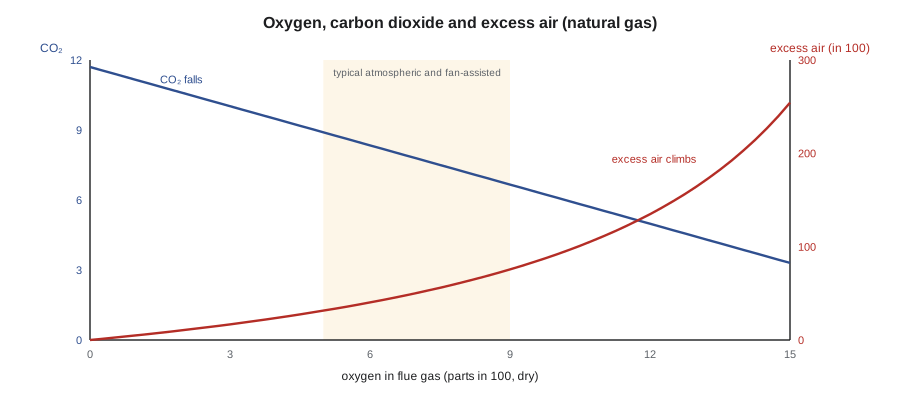
Every burner runs with excess air: more air than the fuel needs in theory, so every molecule of gas finds enough oxygen to burn completely. The oxygen that is not used passes through and appears in the flue gas. So the oxygen reading is a direct measure of excess air: a flue gas with no oxygen came from a burner with no excess air, and the more oxygen there is, the more excess air the burner is getting. As excess air rises, the carbon dioxide made by the fuel is diluted by more and more unused air, so carbon dioxide falls as oxygen rises. Natural gas burned with exactly the theoretical amount of air would produce flue gas with about 11.7 parts in 100 of CO₂ on a dry basis; this is its maximum CO₂. Propane's maximum is higher, about 13.7, because it contains more carbon for its hydrogen.
Two simple formulas, which the analyzer uses, connect these readings for any fuel. Carbon dioxide equals the fuel's maximum CO₂ times 20.9 minus the oxygen reading, divided by 20.9. Excess air, as a fraction of the theoretical air, is approximately the oxygen reading divided by 20.9 minus the oxygen reading.
Worked problem
Jonah's first furnace reading
The Mountview furnace on high fire gave: oxygen 8.2, CO 38 ppm, flue gas 182 °C, combustion air 20 °C. Natural gas was selected. Calculate the CO₂, the excess air and the air-free CO, and check them against the printout.
Show solution
- Carbon dioxide:
- \[11.7 \times \frac{20.9 - 8.2}{20.9} = 11.7 \times \frac{12.7}{20.9} = 11.7 \times 0.608 = 7.1\]
- Excess air:
- \[\frac{8.2}{20.9 - 8.2} = \frac{8.2}{12.7} = 0.65 = 65 \text{ in } 100\]
- Air-free CO:
- \[38 \times \frac{20.9}{12.7} = 38 \times 1.646 = 63 \text{ ppm}\]
Answer: The printout showed CO₂ 7.1, excess air 65 in 100 and air-free CO 63 ppm, matching Jonah's arithmetic. The burner is running with about two-thirds more air than it needs, which is typical of an older induced-draft furnace, and its carbon monoxide is moderate.
Why air-free CO decides
The raw CO reading on the screen, called as-measured CO, depends on how much air is mixed into the sample. The same burner making the same amount of carbon monoxide shows a lower raw reading if it runs with more excess air, if the sample is diluted by a draft hood, or if the hose leaks, as lesson 9 showed. Air-free CO removes all of that by correcting the reading to what it would be if the flue gas contained no oxygen at all. It is the only fair way to compare appliances with different amounts of excess air, and the action levels in standards and manufacturers' instructions are almost always stated as air-free values.
Worked problem
The water heater's reading
The same house's draft-hood water heater, sampled below the draft hood after 5 minutes, gave oxygen 11.5 and CO 45 ppm. Last year's service record showed 40 ppm air-free. What is the air-free CO now, and what has changed?
Show solution
- Air-free CO:
- \[45 \times \frac{20.9}{20.9 - 11.5} = 45 \times \frac{20.9}{9.4} = 45 \times 2.223 = 100 \text{ ppm}\]
- Compared with last year:
- \[\frac{100}{40} = 2.5\]
Answer: The raw reading, 45 ppm, looks lower than the furnace's 63 air-free, but the water heater is actually making 100 ppm air-free, two and a half times last year's figure. That rise matters more than the number itself. Rosa had Jonah pull the burner: its ports were partly blocked with rust flakes from the flue baffle. Cleaned, it read 31 ppm air-free.
Action levels
How much carbon monoxide in the flue gas is too much depends on the appliance, the standard and the maker. Appliance certification standards test new appliances against flue CO limits, and the maker's installation and service instructions often give their own, usually stricter, targets for start-up and service; these instructions come first. Energy and safety programs also publish action levels for appliances in houses, which give technicians a common line. In the US, ANSI/BPI-1200, the standard used by energy auditors, sets flue gas limits of about 400 ppm air-free for central furnaces and boilers and 200 ppm air-free for water heaters and room heaters, measured after 5 minutes of firing, with an as-measured limit for ovens.
In Ontario, the adoption document for CSA B149.1 adds a specific rule for natural-draft boilers with draft control devices of 300,000 Btu/h, about 88 kW, or less: during the heating season, from October 15 to April 30, a technician working on one must measure the carbon monoxide in the flue gas upstream of the draft control device, and a reading over 100 ppm makes the boiler an immediate hazard that must be corrected at once. Signs of spillage on such a boiler call for a depressurization test. Bayline applies a company rule to everything else: any appliance reading above 100 ppm air-free, or any appliance whose air-free reading has risen noticeably since its last service, is investigated and corrected before the technician leaves, whatever the general limit for that appliance type would allow.
| Reading | Typical guidance | Source |
|---|---|---|
| Central furnace or boiler flue gas | About 400 ppm air-free limit | ANSI/BPI-1200 (US) |
| Water heater or room heater flue gas | About 200 ppm air-free limit | ANSI/BPI-1200 (US) |
| Oven, after heating | About 225 ppm as measured | ANSI/BPI-1200 (US) |
| Natural-draft boiler with draft control, Ontario, heating season | Over 100 ppm in flue gas is an immediate hazard | Ontario adoption of CSA B149.1 |
| Any appliance | Investigate above 100 ppm air-free or any rising trend | Bayline company rule |
| Maker's instructions | Often lower targets for start-up and service | Appliance instructions; these come first |
Ambient readings, in the air people breathe, are a different matter and have much lower thresholds. ANSI/BPI-1200 uses about 9 ppm as the top of normal background; 9 to 35 ppm calls for informing the occupants and looking for the source; 36 to 69 ppm calls for shutting off suspect appliances and ventilating; and 70 ppm or more, or any reading with occupants who have symptoms, calls for getting everyone out and calling the emergency services. Health limits for exposure, which GAS-110 described, are in the same range. Bayline follows these steps in every house in both countries.
Reading the readings together
No single number tells the whole story. The real skill is reading oxygen, CO and temperature together, and against the appliance's own history. A few patterns cover most of what technicians see.
| Pattern | Likely causes |
|---|---|
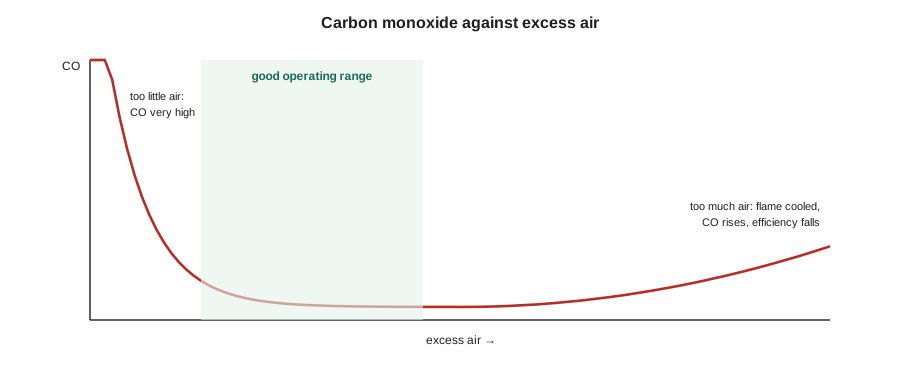
| High CO with low oxygen | Too little air: overfiring, blocked air openings or flue passages, a starved room, depressurization |
| High CO with normal or high oxygen | Poor mixing or a quenched flame: flame touching a cool surface, a misaligned or damaged burner, dirty burner ports, incorrect orifice |
| Very high oxygen, low CO, low CO₂ | Too much air: underfiring, air leaking into the heat exchanger or vent, or a sample line leak |
| Flue gas temperature higher than before | Overfiring, a dirty heat exchanger, scale on the water side of a boiler, or a missing baffle |
| Flue gas temperature lower than before | Underfiring, or more excess air diluting the gas |
| CO rises steadily during the test | A worsening condition: flame impingement as parts heat, depressurization, a vent warming poorly |
| Good on high fire, poor on low fire | Low-fire pressure or air set wrong, or a burner that does not hold its flame at low input |
Worked problem
The condensing furnace on two stages
At Crerar, the two-stage condensing furnace read: high fire, oxygen 6.8 and CO 12 ppm; low fire, oxygen 9.6 and CO 48 ppm. Calculate the air-free CO at each stage and say what the pattern suggests.
Show solution
- High fire:
- \[12 \times \frac{20.9}{20.9 - 6.8} = 12 \times \frac{20.9}{14.1} = 12 \times 1.482 = 18 \text{ ppm}\]
- Low fire:
- \[48 \times \frac{20.9}{20.9 - 9.6} = 48 \times \frac{20.9}{11.3} = 48 \times 1.850 = 89 \text{ ppm}\]
Answer: The furnace burns very cleanly on high fire and noticeably worse on low fire, with more excess air. That pattern points at the low-fire setting. Rosa measured the low-fire manifold pressure: it was below the rating plate figure, so the burner was underfired on low, its flame weak and cooled by the extra air. She reset it to the plate value, as lesson 11 explains, and the low-fire reading fell to 24 ppm air-free.
Efficiency readings
The combustion efficiency an analyzer shows is a steady-state figure: the fraction of the fuel's heat that is not carried up the vent in the hot flue gas at the moment of the test. The analyzer calculates it from the difference between the flue gas temperature and the combustion air temperature, the oxygen, and the fuel's properties. The hotter the flue gas compared with the incoming air, and the more excess air carrying that heat away, the larger the stack loss and the lower the efficiency. For condensing appliances, whose flue gas is cool and which recover heat from condensing water vapour, analyzers need to be set to their condensing mode, and their efficiency figures depend on which heating value of the fuel they use, so they are best compared with the same analyzer and settings each time.
Combustion efficiency is not the same as the AFUE, the annual fuel utilization efficiency printed on a furnace's energy label. AFUE is a laboratory rating over a whole season, including cycling, standby and jacket losses. A mid-efficiency furnace rated at about 80 AFUE might show 81 or 82 on the analyzer at steady state; a condensing furnace rated at 95 AFUE might show anywhere from 90 to 98 depending on the conditions and the analyzer's settings. The value of the efficiency reading is in comparison: with the same appliance last year, or before and after an adjustment.
Worked problem
What an efficiency improvement is worth
After cleaning and adjustment, an older boiler's combustion efficiency rose from 78.5 to 81.0. The house uses about 2,000 m³ of gas a year for heating. Estimate the gas saved in a year.
Show solution
- The same heat now needs less fuel in the ratio of the efficiencies:
- \[\frac{78.5}{81.0} = 0.969\]
- Fraction of fuel saved:
- \[1 - 0.969 = 0.031 = 3.1 \text{ in } 100\]
- Gas saved:
- \[2{,}000 \times 0.031 = 62 \text{ m}^3 \text{ a year}\]
Answer: A gain of two and a half points saves about 62 m³ a year, roughly 3 in 100 of the heating gas. Note that the saving is worked out from the ratio of the efficiencies, not by subtracting them.
What goes on the record
Rosa's rule for Jonah's printouts was that each one had to answer five questions: which appliance, which stage, where the probe was, how long it had been firing, and what the outdoor and combustion air temperatures were. With those, a reading can be compared next year. Without them, it is just a number. She also had him write one line under each reading saying what it meant: "normal for this furnace", "water heater CO up from last year: burner cleaned, now 31 ppm air-free", "low fire underfired: reset to plate, now 24 ppm air-free". Those lines are what the next technician, or Jonah himself next fall, will actually read.
Common mistakes
MistakeJudging an appliance by its raw CO reading.
InsteadUse air-free CO, which corrects for excess air and dilution.
MistakeTreating the general limit as the target.
InsteadFollow the maker's instructions and investigate any rising trend.
MistakeReading only high fire on a two-stage furnace.
InsteadTest each stage; problems often show on low fire.
MistakeConfusing combustion efficiency with AFUE.
InsteadCombustion efficiency is a steady-state snapshot; AFUE is a seasonal rating.
MistakeWorking out savings by subtracting efficiencies.
InsteadUse the ratio of the efficiencies.
Summary and key terms
- Oxygen in the flue gas measures excess air; as oxygen rises, CO₂ falls from the fuel's maximum, about 11.7 for natural gas and 13.7 for propane, and excess air climbs.
- CO₂ is about the maximum times (20.9 − O₂) ÷ 20.9, and excess air about O₂ ÷ (20.9 − O₂).
- Air-free CO, the measured CO times 20.9 ÷ (20.9 − O₂), corrects for excess air and dilution and is the figure action levels use.
- Makers' instructions come first; ANSI/BPI-1200 gives about 400 ppm air-free for furnaces and boilers and 200 for water heaters, Ontario treats over 100 ppm in a natural-draft boiler's flue in the heating season as an immediate hazard, and Bayline investigates above 100 ppm or any rising trend.
- Ambient CO above about 9 ppm needs investigating and 70 ppm or symptoms means evacuating.
- Readings are read together: high CO with low oxygen means too little air; with high oxygen, poor mixing or quenching.
- Combustion efficiency is a steady-state figure, not AFUE, and savings are found from the ratio of efficiencies.
- Excess air
- Air supplied to a burner beyond what the fuel needs in theory.
- Maximum CO₂
- The CO₂ a fuel produces when burned with exactly the theoretical air.
- As-measured CO
- The raw CO reading in a diluted sample.
- Action level
- A reading at which a stated action must be taken.
- Combustion efficiency
- The steady-state fraction of fuel heat not carried away in the flue gas.
- Stack loss
- The heat carried up the vent in hot flue gas.
- AFUE
- Annual fuel utilization efficiency, a laboratory seasonal rating.
- Flame quenching
- Cooling of a flame by a cold surface or excess air so that combustion is incomplete.
Practice problems
Work each problem on paper first, then reveal the answer to check.
What does the oxygen reading tell you about a burner?
Show answer
How much excess air it is running with.
Why is air-free CO used rather than as-measured CO?
Show answer
It corrects for excess air and dilution so readings can be compared.
What does high CO with low oxygen usually mean?
Show answer
Too little air.
What does high CO with high oxygen usually mean?
Show answer
Poor mixing or a quenched flame.
Why is combustion efficiency not the same as AFUE?
Show answer
It is a steady-state snapshot; AFUE is a seasonal laboratory rating.
Lesson quiz · 5 questions
Score 60% or more to complete this lesson.
Create a free account to save your progress, take quizzes and earn a certificate.