
FIN-301 · Lesson 10 of 12 · 29 min
Fixed income II: duration, convexity and credit risk
Bond investors face two main risks: that interest rates will change, and that the issuer will not pay. This lesson develops the tools for measuring and managing both. Duration, introduced briefly in FIN-201 lesson 5, is the workhorse measure of interest rate sensitivity; convexity refines it for large rate changes. Together they underpin immunization, the technique pension funds and insurers use to protect themselves against rate moves, and the active strategies bond managers use to try to add value. The second half of the lesson turns to credit risk: how default probabilities, recovery rates and risk premiums combine into the credit spreads investors see, and how those spreads behave across the business cycle.
Macaulay and modified duration
Frederick Macaulay defined duration in 1938 as the weighted average time until a bond's cash flows are received, where each payment's weight is its share of the bond's present value. A zero-coupon bond's duration equals its maturity; a coupon bond's duration is shorter, because some cash arrives earlier. Duration matters because it measures price sensitivity. Dividing Macaulay duration by one plus the yield per period gives modified duration, and the percentage change in price is approximately minus the modified duration times the change in yield.
Duration follows a few rules that bond managers use constantly. It rises with maturity, though more slowly for coupon bonds. It is lower when the coupon is higher, because more of the value comes early. It is lower when yields are higher, because distant payments are discounted more heavily. A perpetuity's duration is (1 + y) ÷ y, so even an infinitely long bond yielding 5 % has a duration of only 21 years. And a portfolio's duration is the value-weighted average of its bonds' durations, which lets a manager set the portfolio's interest rate sensitivity by mixing bonds. Practitioners also quote dollar duration or DV01, the dollar change in value for a one-basis-point change in yield, which is handy for hedging.
Worked problem
Duration of a five-year bond
A 5-year bond pays a 6 % annual coupon on $1,000 face value and yields 5 %. Find its price, Macaulay duration and modified duration, and estimate the price change for a one-percentage-point rise in yield.
Show solution
- Price = PV of 60 for four years and 1,060 in year five = 1,043.29.
- Weighted times: Σ t × PV(CF) ÷ P = 4.478 years (Macaulay duration).
- Modified duration = 4.478 ÷ 1.05 = 4.265.
- Estimated change for +1 point: −4.265 × 0.01 = −4.26 %; the exact change is −4.15 %.
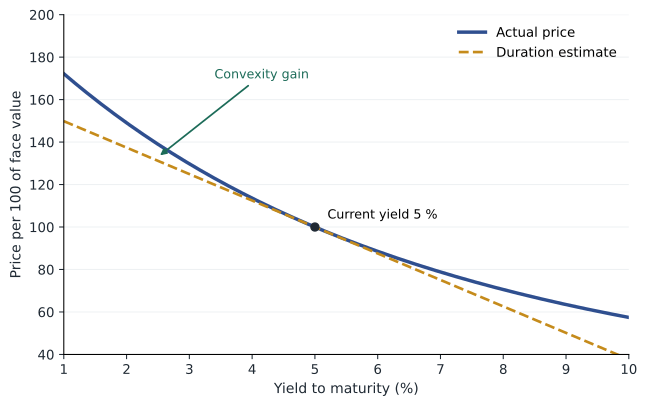
Answer: Duration gives a good first estimate. It slightly overstates the fall in price, because the price–yield relationship is curved.
Convexity
The relationship between bond price and yield is not a straight line but a curve that bows toward the origin. Duration is the slope of that curve at the current yield, so for large changes it overstates price falls and understates price rises. Convexity measures the curvature, and adding a convexity term improves the estimate considerably. For ordinary bonds, convexity is positive: prices rise more when yields fall than they fall when yields rise by the same amount, a property investors value. Longer maturities, lower coupons and lower yields all increase convexity.
Callable bonds and mortgage-backed securities behave differently. When rates fall, the issuer of a callable bond is likely to call it, and homeowners refinance their mortgages, so the price stops rising: these securities have negative convexity at low yields. For them, analysts use effective duration and effective convexity, computed by repricing the bond with a model for small rises and falls in rates, rather than the formulas above, which assume fixed cash flows.
# Duration, convexity and how well each approximation works
def cashflows(face, cpn_rate, years):
    return [face * cpn_rate] * (years - 1) + [face * (1 + cpn_rate)]

def price(cfs, y):
    return sum(c / (1 + y) ** (t + 1) for t, c in enumerate(cfs))

def duration_convexity(cfs, y):
    p = price(cfs, y)
    mac = sum((t + 1) * c / (1 + y) ** (t + 1) for t, c in enumerate(cfs)) / p
    conv = sum((t + 1) * (t + 2) * c / (1 + y) ** (t + 3) for t, c in enumerate(cfs)) / p
    return p, mac, mac / (1 + y), conv

for years in (5, 20):
    cfs = cashflows(1000, 0.06 if years == 5 else 0.05, years)
    p, mac, mod, conv = duration_convexity(cfs, 0.05)
    print(f"{years}-year bond: price {p:,.2f}  Macaulay {mac:.3f}  modified {mod:.3f}  convexity {conv:.2f}")
    for dy in (-0.02, 0.01, 0.02):
        exact = price(cfs, 0.05 + dy) / p - 1
        d_only = -mod * dy
        d_conv = d_only + 0.5 * conv * dy ** 2
print(f" yield change {dy:+.0%}: exact {exact:+.2%} duration {d_only:+.2%} duration+convexity {d_conv:+.2%}")5-year bond: price 1,043.29 Macaulay 4.478 modified 4.265 convexity 23.44 yield change -2%: exact +9.02% duration +8.53% duration+convexity +9.00% yield change +1%: exact -4.15% duration -4.26% duration+convexity -4.15% yield change +2%: exact -8.08% duration -8.53% duration+convexity -8.06% 20-year bond: price 1,000.00 Macaulay 13.085 modified 12.462 convexity 211.33 yield change -2%: exact +29.75% duration +24.92% duration+convexity +29.15% yield change +1%: exact -11.47% duration -12.46% duration+convexity -11.41% yield change +2%: exact -21.19% duration -24.92% duration+convexity -20.70%
Immunization
Pension plans and insurers have obligations due far in the future. If they hold bonds of the wrong duration, a change in rates can leave assets short of liabilities. Immunization protects a fixed future obligation by holding a bond portfolio whose duration equals the obligation's horizon and whose present value equals the obligation's present value. When rates rise, the portfolio's price falls, but its coupons are reinvested at higher rates; when rates fall, the reverse happens. With matched durations, the two effects offset, at least for small, parallel shifts in the yield curve. Because duration changes as time passes and rates move, the portfolio must be rebalanced periodically. Cash flow matching, or dedication, is a stricter alternative: buying zero-coupon or other bonds whose payments exactly match each liability, which removes interest rate risk entirely but costs more and is harder to arrange for long, uncertain obligations.
Worked problem
Immunizing a future payment
An insurer must pay $1 million in 7 years. Rates are 5 %. It can use a 3-year zero-coupon bond and a perpetuity paying annual interest. What mix immunizes the obligation?
Show solution
- Present value of the obligation: 1,000,000 ÷ 1.05⁷ = 710,681.
- Durations: the zero = 3 years; the perpetuity = 1.05 ÷ 0.05 = 21 years.
- Solve 3w + 21(1 − w) = 7: w = 14 ÷ 18 = 0.778.
- Invest 77.8 % (552,752) in the 3-year zero and 22.2 % (157,929) in the perpetuity.
Answer: The portfolio has the same value and duration as the obligation. After rates move or time passes, the weights must be recalculated.
Canadian defined-benefit pension plans have increasingly used liability-driven investing, matching the duration of their bond holdings to their pension obligations, sometimes with leverage or derivatives. Funding rules set by provincial regulators and, for federally regulated plans, the Office of the Superintendent of Financial Institutions affect how plans measure liabilities and deficits.
Immunization has limits. It protects against small parallel shifts in a flat yield curve, but real curves twist and change shape. It ignores default risk if corporate bonds are used. And it is passive: it locks in a return rather than trying to beat one. A hybrid approach, contingent immunization, lets a manager pursue active strategies as long as the portfolio stays comfortably above the value needed to immunize, switching to immunization if it falls to a trigger level.
Active bond management
Active bond managers try to add value in several ways. Interest rate anticipation lengthens duration when the manager expects rates to fall and shortens it when they are expected to rise; it requires better forecasts than the market's, embodied in forward rates. Riding the yield curve buys bonds with maturities longer than the investment horizon when the curve is steep, expecting to sell them at a lower yield as they roll down the curve. Bond swaps exchange one bond for another to pick up yield, exploit a perceived mispricing, change sector exposure or realize a tax loss. Credit analysis seeks bonds whose spreads more than compensate for their default risk. As with equities, most active bond funds struggle to beat their benchmark indices after fees over long periods.
Credit risk: default, recovery and spreads
A corporate bond's yield exceeds that of a government bond of the same maturity by its credit spread. The spread compensates for three things: the expected loss from default, a risk premium because defaults cluster in bad economic times when investors can least afford losses, and lower liquidity. The expected annual loss is roughly the probability of default times the loss given default, which is one minus the recovery rate. Historically, senior unsecured bondholders have recovered on average around 40 % of face value in default, with wide variation by industry and by the state of the economy.
Worked problem
Decomposing a credit spread
A BB-rated bond yields 7.2 % when a government bond of the same maturity yields 4.0 %. Analysts estimate a 2 % annual probability of default and a 40 % recovery rate. How much of the spread is expected loss?
Show solution
- Spread = 3.2 %.
- Expected loss ≈ 0.02 × (1 − 0.40) = 1.2 % a year.
- Remaining spread ≈ 2.0 % for the default risk premium and illiquidity.
Answer: The bond's expected return is about 6.0 %, not its promised 7.2 %; the extra 2 % over government bonds is the reward for bearing credit risk.
Rating agencies publish data on how often bonds in each rating category default over time. Over long periods, investment-grade bonds have defaulted rarely, while cumulative five-year default rates for the lowest speculative grades have been many times higher. Ratings also migrate: a downgrade from investment grade to high yield, a fallen angel, can force some institutions to sell and push prices sharply lower. Spreads widen in recessions and crises: US high-yield spreads rose above 15 percentage points in late 2008 and briefly to around 10 in March 2020, while investment-grade spreads were typically 1 to 2 percentage points in calmer years.
| Rating group | Typical issuers | Default risk | Typical spread behaviour |
|---|---|---|---|
| AAA to AA | Strongest governments, a few companies | Very low | Narrow and stable |
| A to BBB | Banks, utilities, large industrials | Low | Widens moderately in recessions |
| BB to B | Leveraged companies | Moderate to high | Widens sharply in recessions |
| CCC and below | Distressed issuers | Very high | Very wide; often priced on recovery |
Investors can also trade credit risk directly with a credit default swap (CDS): the buyer pays a periodic premium and receives compensation if the reference borrower defaults. CDS let banks hedge loan exposures and let investors take views on credit, but they also concentrate counterparty risk, as the near-collapse of the insurer AIG showed in 2008. Since then, much CDS trading has moved to central clearing houses.
Common mistakes
MistakeA bond's duration equals its maturity.
InsteadOnly for a zero-coupon bond; coupons make duration shorter than maturity.
MistakeDuration gives the exact price change.
InsteadIt is a linear approximation; convexity improves it for larger changes.
MistakeCallable bonds gain as much as straight bonds when rates fall.
InsteadTheir price is capped near the call price, giving negative convexity.
MistakeAn immunized portfolio needs no further attention.
InsteadDuration drifts with time and rates, so it must be rebalanced; non-parallel shifts can still hurt.
MistakeA high-yield bond's promised yield is its expected return.
InsteadExpected losses from default reduce the expected return below the promised yield.
Summary and key terms
- Macaulay duration is the present-value-weighted average time to cash flows; modified duration measures price sensitivity.
- Duration rises with maturity and falls with higher coupons and yields; portfolio duration is a weighted average.
- Convexity corrects duration for curvature; ordinary bonds have positive convexity, callables and MBS can be negative.
- Immunization matches the duration and value of assets to liabilities; cash flow matching removes rate risk entirely.
- Active strategies include rate anticipation, riding the curve and bond swaps.
- Credit spreads reflect expected loss (PD × loss given default), a risk premium and illiquidity.
- Spreads widen sharply in recessions; credit default swaps let investors trade credit risk directly.
- Macaulay duration
- The weighted average time until a bond's cash flows are received.
- Modified duration
- Macaulay duration divided by one plus the yield; the percentage price change per unit change in yield.
- DV01
- The dollar change in a bond's value for a one-basis-point change in yield.
- Convexity
- A measure of the curvature of the price–yield relationship.
- Negative convexity
- A price–yield relationship in which price gains are limited when yields fall, as with callable bonds.
- Immunization
- Matching the duration and present value of assets and liabilities to protect against rate changes.
- Cash flow matching
- Holding bonds whose payments exactly match each liability.
- Loss given default
- The fraction of value lost when a borrower defaults; one minus the recovery rate.
- Fallen angel
- A bond downgraded from investment grade to high yield.
- Credit default swap
- A contract paying compensation if a reference borrower defaults, in exchange for periodic premiums.
Practice problems
Work each problem on paper first, then reveal the answer to check.
A 3-year zero-coupon bond yields 4 %. Macaulay and modified duration?
Show answer
3 years; 3 ÷ 1.04 = 2.885.
Modified duration 7, convexity 60, yields rise 1.5 points. Estimated price change?
Show answer
−7 × 0.015 + 0.5 × 60 × 0.000225 = −10.5 % + 0.675 % = −9.83 %.
Duration of a perpetuity yielding 4 %?
Show answer
1.04 ÷ 0.04 = 26 years.
A portfolio is 60 % in bonds with duration 4 and 40 % in bonds with duration 12. Portfolio duration?
Show answer
2.4 + 4.8 = 7.2.
An obligation is due in 10 years. Using a 5-year zero and a 20-year zero, what weights immunize it?
Show answer
5w + 20(1 − w) = 10; w = 2/3 in the 5-year zero.
PD 3 %, recovery 45 %. Expected annual loss?
Show answer
0.03 × 0.55 = 1.65 %.
A bond yields 6.5 %, the government bond 4.0 %, expected loss 0.8 %. Risk premium and illiquidity component?
Show answer
2.5 − 0.8 = 1.7 %.
Why do mortgage-backed securities show negative convexity?
Show answer
Homeowners refinance when rates fall, limiting price gains.
What is riding the yield curve?
Show answer
Buying bonds longer than the horizon in a steep curve and selling them as they roll down to lower yields.
Portfolio task: find the average duration of a broad bond index fund and estimate its price change for a one-point rise in yields.
Show answer
Answers vary; show duration × change.
Lesson quiz · 5 questions
Score 60% or more to complete this lesson.
Create a free account to save your progress, take quizzes and earn a certificate.