
FIN-301 · Lesson 1 of 12 · 25 min
The investment environment and securities markets
FIN-201 looked at finance from the inside of the firm: which projects to accept, how to raise money and what that money costs. This course looks from the other side of the table, at the investors who supply that capital. An investor gives up spending today in the hope of more spending later, and in return accepts risk. The same tools appear, such as present value, yields and the capital asset pricing model, but the questions change. How should a person or an institution divide savings between shares, bonds and cash? How should risk be measured and controlled? How are bonds and options priced, and how can they be used to hedge? And how should the results of a fund manager be judged? This first lesson describes the investment environment: real and financial assets, the main asset classes, the players, and how markets are organized.
This course is for education only. Investors with real decisions to make should consider their own circumstances and, where appropriate, speak with a registered adviser. Registration can be checked with the Canadian Securities Administrators' national registration search.
Real assets and financial assets
An economy's wealth ultimately consists of real assets: land, buildings, machines, software, knowledge and the skills of its workers. These produce the goods and services people consume. Financial assets, such as shares, bonds and bank deposits, are claims on the income that real assets generate. A share in a railway is a claim on part of the railway's profits; a bond issued by a province is a claim on future tax revenue. Financial assets do not add to an economy's productive capacity directly, but they allocate it. They let savers lend to borrowers, let firms raise capital from millions of people, let risk be spread among those most willing to bear it, and let ownership be separated from management. When a share changes hands on a stock exchange, no new capital is created; one investor's claim simply passes to another. The value of a financial asset therefore depends entirely on the real assets and cash flows behind it.
The main asset classes
Investors usually group financial assets into a few broad classes. Money market instruments are short-term, high-quality debt: treasury bills, bankers' acceptances in the past, commercial paper and certificates of deposit. They pay little but carry little risk, and they serve as the near risk-free asset in this course. Fixed-income securities, or bonds, are longer-term promises to pay interest and principal; they include government, provincial or state, municipal and corporate bonds, plus mortgage-backed and other asset-backed securities. Equities are ownership shares in companies, with a residual claim on profits after all other claims are paid and limited liability for the owner. Derivatives, such as options, futures, forwards and swaps, have payoffs that depend on the price of some other asset; they are used to hedge risk and to speculate. Finally, real estate, infrastructure, private equity, hedge funds and commodities are often grouped as alternative assets.
| Asset class | Typical instruments | Main risk | Role in a portfolio |
|---|---|---|---|
| Money market | Treasury bills, commercial paper, high-interest savings | Inflation eroding real value | Liquidity and near risk-free return |
| Fixed income | Government and corporate bonds | Interest rate and credit risk | Income and diversification |
| Equities | Common shares, preferred shares, equity funds | Business and market risk | Long-run growth |
| Derivatives | Options, futures, forwards, swaps | Leverage and counterparty risk | Hedging and risk transfer |
| Alternatives | Real estate, private equity, commodities | Illiquidity and valuation risk | Diversification, inflation protection |
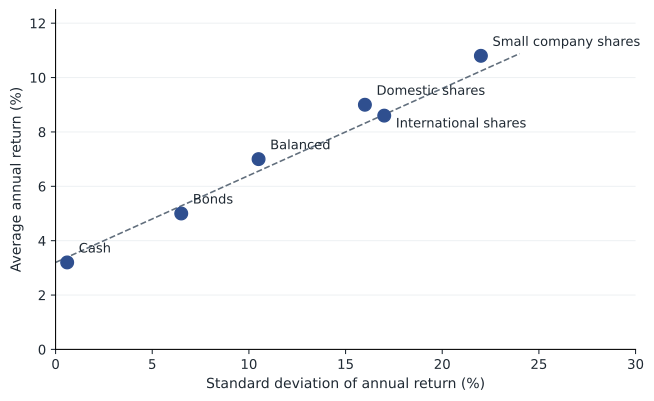
Over long periods, riskier asset classes have earned higher average returns. Studies of the twentieth century in Canada and the United States found that stocks returned several percentage points a year more than treasury bills, with much larger swings from year to year; long bonds sat in between. Those premiums are not guaranteed, and they vary over time and across countries, but the pattern is the basis for the risk–return trade-off that runs through this course.
Who invests and who borrows
Three groups take part in financial markets. Households are the ultimate savers, through bank deposits, pension plans, insurance policies and direct holdings of shares and funds. Businesses are net borrowers: they raise money to invest in real assets. Governments borrow when they run deficits and also invest, through public pension plans and sovereign funds. Between savers and borrowers stand financial intermediaries, which pool savings and invest them: banks, insurers, pension funds, mutual funds and exchange-traded funds. Intermediaries offer diversification, professional management and economies of scale that individuals cannot easily achieve on their own. They also create agency problems of their own, since the manager's interests may differ from the client's, which is why regulation and the performance measures in lesson 12 matter.
Canada's investment industry is dominated by a few large players. The six largest banks own most of the major brokerage firms. Large public pension plans, including the Canada Pension Plan Investment Board, the Caisse de dépôt et placement du Québec, the Ontario Teachers' Pension Plan and others, manage hundreds of billions of dollars and are known internationally for investing directly in infrastructure, real estate and private companies. Mutual funds and exchange-traded funds hold a large share of household savings, much of it inside tax-advantaged accounts described in lesson 2.
Primary and secondary markets
Securities are first sold in the primary market, where the issuer receives the money. FIN-201 lesson 1 described the process: an initial public offering or seasoned offering, usually through investment dealers who underwrite the issue, or a private placement to institutions. After issue, securities trade among investors in the secondary market. The secondary market matters even though the issuer receives nothing from it, because it gives investors liquidity, the ability to sell quickly at a fair price, and it produces the prices that guide new issues and corporate decisions. Investors will pay more for a security they can easily resell, which lowers the cost of capital for issuers.
Secondary markets take several forms. In an exchange, or auction market, buyers and sellers submit orders that are matched centrally, now almost entirely by computers. In a dealer market, dealers quote prices at which they will buy (the bid) and sell (the ask), and investors trade with the dealers; most bonds trade this way, over the counter. Electronic communication networks and alternative trading systems match orders outside traditional exchanges, and dark pools let institutions trade large blocks without displaying their orders. Competition among venues has lowered trading costs dramatically since the 1990s.
Canadian equities trade on the Toronto Stock Exchange (TSX) for senior issuers and the TSX Venture Exchange for smaller, early-stage companies, both owned by TMX Group, as well as on the Canadian Securities Exchange and alternative trading systems. The S&P/TSX Composite Index is the main benchmark. Many large Canadian companies are interlisted on US exchanges as well. Since 27 May 2024, most Canadian securities trades settle one business day after the trade (T+1).
Market indices
An index summarizes the performance of a market or segment. It is used to report how markets moved, to benchmark fund managers and, increasingly, as the basis for index funds and exchange-traded funds that simply hold the index. How an index is built changes what it measures. A price-weighted index, such as the Dow Jones Industrial Average, adds up the share prices and divides by a divisor, so high-priced stocks have more influence regardless of company size. A market-capitalization-weighted index, such as the S&P 500 or the S&P/TSX Composite, weights each company by the market value of its shares (often only the freely traded float), so it mirrors the performance of the whole market and needs little rebalancing. An equally weighted index gives each stock the same weight and must be rebalanced as prices change, which tilts it toward smaller companies.
Worked problem
Price-weighted versus value-weighted returns
Three stocks start the year at prices of $100, $50 and $20 with 10, 40 and 200 million shares outstanding. By year-end the prices are $110, $45 and $22. Compare the return of a price-weighted index with that of a market-value-weighted index.
Show solution
- Price-weighted: sum of prices goes from 170 to 177, a return of 177 ÷ 170 − 1 = 4.12 %.
- Market values at the start: 1,000 + 2,000 + 4,000 = 7,000 million dollars.
- Market values at the end: 1,100 + 1,800 + 4,400 = 7,300 million dollars.
- Value-weighted return: 7,300 ÷ 7,000 − 1 = 4.29 %.
Answer: The two methods give different answers: the price-weighted index is dominated by the $100 stock, the value-weighted index by the largest company, the third stock.
# Index returns under three weighting schemes
p0 = [100, 50, 20]
p1 = [110, 45, 22]
shares = [10, 40, 200]          # millions

price_weighted = sum(p1) / sum(p0) - 1
value_weighted = sum(p * q for p, q in zip(p1, shares)) / sum(p * q for p, q in zip(p0, shares)) - 1
equal_weighted = sum(b / a - 1 for a, b in zip(p0, p1)) / len(p0)

print(f"price-weighted return:  {price_weighted:.2%}")
print(f"value-weighted return:  {value_weighted:.2%}")
print(f"equally weighted return: {equal_weighted:.2%}")

# A 2-for-1 split of the first stock changes the price-weighted divisor, not the value-weighted index
divisor = 3.0
level_before = sum(p1) / divisor
p_split = [55, 45, 22]
new_divisor = sum(p_split) / level_before
print(f"index level {level_before:.2f}; new divisor after the split {new_divisor:.4f}")price-weighted return: 4.12% value-weighted return: 4.29% equally weighted return: 3.33% index level 59.00; new divisor after the split 2.0678
Trends shaping investing
Several long-running trends affect every topic in this course. Globalization means investors can hold shares from almost any country through funds, and companies list in more than one market; currency risk becomes part of the return. Securitization turned mortgages, car loans and credit card balances into tradable bonds, which spread risk but also helped spread the 2008 financial crisis when the underlying loans proved worse than ratings suggested. Financial engineering combines and splits cash flows into new products. Indexing has grown so large that passive funds hold a substantial share of North American equities, which raises questions about price discovery and corporate governance. Technology has cut costs, made trading almost instant and brought in algorithmic and high-frequency trading, robo-advisers and fractional shares. And growing attention to environmental, social and governance factors has created new products and new debates about how those factors are measured, discussed in BUS-310 lesson 7.
Each trend also brings risks. Easy access to markets can encourage frequent trading, which research consistently links to lower returns for individual investors after costs. Complex products can hide leverage and fees. Crypto assets, which many platforms now offer, are volatile and in many cases not protected by the investor-protection funds described in lesson 12. A clear understanding of risk, return and cost, the subject of the rest of this course, is the best defence.
Common mistakes
MistakeBuying shares on the stock exchange gives the company new money.
InsteadSecondary-market trades pass existing shares between investors; only primary issues raise capital for the issuer.
MistakeFinancial assets are the economy's wealth.
InsteadThey are claims on real assets; their value depends on the income those assets produce.
MistakeAll indices measure the same thing, so the choice does not matter.
InsteadPrice-weighted, value-weighted and equally weighted indices can give quite different returns.
MistakeA higher historical return means an asset class will do better next year.
InsteadHigher average returns have come with higher volatility, and any single year can be very different.
MistakeA course on investments tells you what to buy.
InsteadThis course explains how to analyse investments; it is not advice about any particular security.
Summary and key terms
- Real assets produce income; financial assets are claims on that income and allocate capital and risk.
- Main asset classes are money market instruments, fixed income, equities, derivatives and alternatives.
- Riskier asset classes have historically earned higher average returns with more volatility.
- Intermediaries such as funds and pension plans pool savings, offering diversification and professional management.
- Primary markets raise money for issuers; secondary markets provide liquidity and prices.
- Index construction matters: price-weighted, value-weighted and equally weighted indices behave differently.
- Globalization, securitization, indexing and technology are reshaping how investing works.
- Real asset
- An asset used to produce goods and services, such as land, buildings or machinery.
- Financial asset
- A claim on the income generated by real assets, such as a share or bond.
- Money market
- The market for short-term, high-quality debt instruments.
- Derivative
- A security whose payoff depends on the price of another asset.
- Financial intermediary
- An institution that pools savings and invests them, such as a bank or fund.
- Primary market
- The market in which newly issued securities are sold to investors.
- Secondary market
- The market in which existing securities trade between investors.
- Bid and ask
- The prices at which a dealer will buy and sell a security.
- Market-capitalization-weighted index
- An index that weights each stock by the market value of its shares.
- Liquidity
- The ability to buy or sell an asset quickly at a price close to its fair value.
Practice problems
Work each problem on paper first, then reveal the answer to check.
Is a corporate bond a real or a financial asset? A factory?
Show answer
The bond is a financial asset; the factory is a real asset.
Why do investors value secondary markets even though issuers receive no money from them?
Show answer
They provide liquidity and prices, which lowers the return investors require on new issues.
Two stocks are priced $80 and $20. Each rises by $4. What is the price-weighted index return?
Show answer
8 ÷ 100 = 8 %.
In the same case, each company has a market value of $1 billion. What is the value-weighted return?
Show answer
Stock 1: +5 %; stock 2: +20 %; average weighted equally by value = 12.5 %.
Name the main risk of a money market instrument.
Show answer
Inflation eroding its real value; credit and interest rate risks are small.
Give one benefit and one risk of financial intermediaries.
Show answer
Benefit: diversification and economies of scale. Risk: agency conflicts between manager and client.
What does T+1 settlement mean?
Show answer
A trade settles, with cash and securities exchanged, one business day after the trade date.
How does an equally weighted index differ in practice from a value-weighted one?
Show answer
It must be rebalanced as prices change and gives more weight to small companies.
Why did securitization contribute to the 2008 crisis?
Show answer
Risky loans were packaged into securities whose risk was underestimated and widely held.
Portfolio task: look up the S&P/TSX Composite's sector weights and note the three largest sectors.
Show answer
Answers vary by date; record the source and date.
Lesson quiz · 5 questions
Score 60% or more to complete this lesson.
Create a free account to save your progress, take quizzes and earn a certificate.