
FIN-201 · Lesson 4 of 12 · 34 min
Time value of money II: valuing streams of cash flows
Most financial assets and projects produce not one cash flow but many: a bond pays coupons, a share pays dividends, a machine saves costs every year, a loan requires monthly payments. This lesson extends the valuation principle to streams of cash flows. It reviews the annuity and perpetuity formulas from BUS-110 lesson 8, adds growing annuities and growing perpetuities, which are the building blocks of share and firm valuation, and applies them to mortgages, loans with fees and the choice between leasing and buying. The emphasis is on choosing the right formula for the shape of the cash flows and on checking answers with a direct calculation.
Any stream is a sum of single cash flows
The value of a stream of cash flows is simply the sum of the present values of each cash flow, because present values add: owning the whole stream is the same as owning each piece. For an uneven stream, that sum is the only way. For regular streams, formulas save time, but each formula is just a shortcut for the sum. Drawing a timeline, with cash flows placed at the date they occur, is the most reliable way to avoid errors about timing.
Worked problem
An uneven stream
A licensing deal will pay $40,000 at the end of year 1, $55,000 at the end of year 2, nothing in year 3 and $90,000 at the end of year 4. At 9 %, what is the deal worth today?
Show solution
- Year 1: 40,000 ÷ 1.09 = 36,697.25.
- Year 2: 55,000 ÷ 1.09² = 46,292.40.
- Year 4: 90,000 ÷ 1.09⁴ = 63,758.27.
- Total = 146,747.92.
Answer: The deal is worth about $146,748 today, well below the $185,000 total of its payments.
Annuities and perpetuities
An annuity is a stream of equal payments at equal intervals for a fixed number of periods; a perpetuity continues forever. If payments occur at the end of each period (an ordinary annuity), the present value of \( n \) payments of \( C \) at rate \( r \) per period, and of a perpetuity, are given below. An annuity due, with payments at the start of each period, is worth \( (1 + r) \) times as much, because each payment arrives one period sooner. The perpetuity formula also shows why an annuity is the difference between two perpetuities: one starting now and one starting after \( n \) periods.
Growing perpetuities and growing annuities
Many cash flows are expected to grow: dividends, rents, salaries and the free cash flow of a successful business. If the first payment \( C_1 \) arrives one period from now and payments grow at a constant rate \( g \) forever, with \( g < r \), the present value is the growing perpetuity formula. It is the basis of the dividend discount model in lesson 6 and of terminal values in business valuation. If growth continues for only \( n \) periods, the growing annuity formula applies.
Two warnings. First, \( C_1 \) is next period's cash flow, not this period's; if you are told the payment just made, multiply by \( (1 + g) \). Second, the formula only works when \( g < r \). As \( g \) approaches \( r \) the value explodes, which is mathematically correct but economically implausible: no business can grow faster than the economy forever. In practice, long-run growth rates in perpetuity formulas are usually kept at or below the expected long-run growth of nominal GDP.
Worked problem
Endowing a growing scholarship
A donor wants to fund a scholarship paying $12,000 one year from now, rising with expected inflation of 2 % a year forever. The endowment fund expects to earn 6 % a year. How much must the donor give today? How much if the scholarship is fixed at $12,000?
Show solution
- Growing perpetuity: PV = 12,000 ÷ (0.06 − 0.02) = 300,000.
- Level perpetuity: PV = 12,000 ÷ 0.06 = 200,000.
Answer: Protecting the scholarship against inflation costs an extra $100,000 today.
Worked problem
Valuing a growing stream of savings
Energy-efficient equipment will save $18,000 in its first year, with savings growing 3 % a year as energy prices rise, for 15 years. At 8 %, what are the savings worth today?
Show solution
- Ratio (1.03 ÷ 1.08)¹⁵ = 0.95370¹⁵ = 0.49114.
- PV = 18,000 ÷ (0.08 − 0.03) × (1 − 0.49114) = 360,000 × 0.50886 = 183,190.
Answer: The savings are worth about $183,190 today, compared with $154,071 if they did not grow.
# Check the growing annuity formula by summing each year's savings
r, g, c1, n = 0.08, 0.03, 18_000, 15
direct = sum(c1 * (1 + g) ** (t - 1) / (1 + r) ** t for t in range(1, n + 1))
formula = c1 / (r - g) * (1 - ((1 + g) / (1 + r)) ** n)
level = c1 / r * (1 - (1 + r) ** -n)
print(f"direct sum {direct:,.0f} formula {formula:,.0f} level annuity {level:,.0f}")direct sum 183,191 formula 183,191 level annuity 154,071
Mortgages and amortization
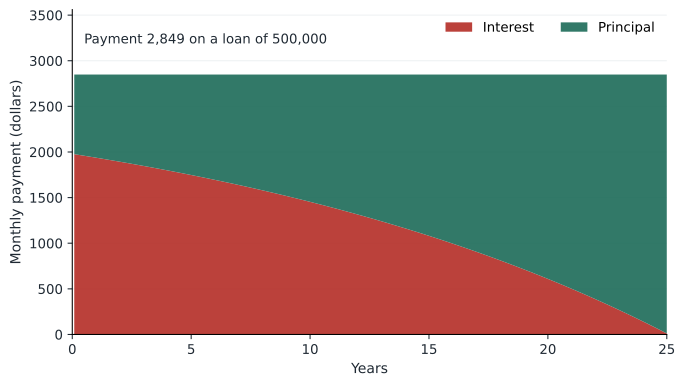
A loan repaid in equal instalments is an annuity from the lender's point of view: the loan amount equals the present value of the payments at the loan rate. Solving the annuity formula for \( C \) gives the payment. Early payments are mostly interest, because the balance is large; later payments are mostly principal. The outstanding balance at any date is the present value of the remaining payments. BUS-110 lesson 9 builds full schedules; here the focus is on how the conventions of each country change the numbers.
Canadian mortgages are usually amortized over 25 years, or up to 30 years for some insured first-time buyers and new builds under rules introduced in 2024, but the interest rate is fixed only for a shorter term, commonly five years, after which the loan is renewed at the rate then prevailing. That exposes Canadian borrowers to interest-rate risk at each renewal, as many found when rates rose sharply in 2022 and 2023. Rates are compounded semi-annually, so the monthly rate is derived as in lesson 3.
Worked problem
A Canadian mortgage payment
A buyer borrows $500,000 at 4.79 % compounded semi-annually, amortized over 25 years with monthly payments. Find the payment and the balance after the five-year term.
Show solution
- Monthly rate i = 1.02395^(1/6) − 1 = 0.0039524.
- Payment = 500,000 × i ÷ (1 − (1 + i)^−300) = 2,848.54.
- Balance after 60 payments = PV of remaining 240 payments = 2,848.54 × (1 − 1.0039524^−240) ÷ 0.0039524 ≈ 441,063.
Answer: After five years the borrower has repaid about $59,000 of principal and must renew the remaining $441,000 at whatever rate then applies.
Loans with fees: the effective cost
Lenders often charge fees up front: origination fees, points, legal costs or arrangement fees. The borrower receives less than the face amount but repays the full amount, so the true cost is higher than the quoted rate. The way to measure it is to find the discount rate that makes the present value of the payments equal to the net amount received. That rate is the loan's internal rate of return from the lender's side, and the effective cost from the borrower's. It has no closed-form solution, so it is found by trial and error or with a spreadsheet's RATE or IRR function; the code below uses bisection, the same method used for bond yields in lesson 5.
Worked problem
A business loan with a fee
A firm borrows $200,000 for five years at 7 % compounded monthly, with monthly payments, and pays a $6,000 arrangement fee. What is the effective annual cost?
Show solution
- Payment = 200,000 × 0.0058333 ÷ (1 − 1.0058333^−60) = 3,960.24.
- Net amount received = 200,000 − 6,000 = 194,000.
- Find the monthly rate j such that 3,960.24 × (1 − (1 + j)^−60) ÷ j = 194,000; j ≈ 0.6905 %.
- Effective annual cost = 1.006905¹² − 1 ≈ 8.61 %.
Answer: The fee raises the effective annual cost from 7.23 % to about 8.61 %. Comparing loans on quoted rates alone would miss this.
# Effective cost of a loan with an up-front fee, found by bisection
def annuity_pv(payment, rate, n):
    return payment * (1 - (1 + rate) ** -n) / rate

principal, fee, n = 200_000, 6_000, 60
i = 0.07 / 12
payment = principal * i / (1 - (1 + i) ** -n)
lo, hi = 1e-6, 0.05
for _ in range(100):
    mid = (lo + hi) / 2
    if annuity_pv(payment, mid, n) > principal - fee:
        lo = mid
    else:
        hi = mid
print(f"payment {payment:,.2f}  monthly cost {mid * 100:.4f} %  EAR {((1 + mid) ** 12 - 1) * 100:.2f} %")
print(f"EAR without the fee {((1 + i) ** 12 - 1) * 100:.2f} %")payment 3,960.24 monthly cost 0.6905 % EAR 8.61 % EAR without the fee 7.23 %
Leasing or buying
A firm that needs equipment can buy it, usually financed with a loan, or lease it, paying regular amounts for its use. Leasing is a form of borrowing: the lease payments are a fixed obligation, like debt service. A simple comparison, ignoring taxes for now, discounts the costs of each option at the firm's borrowing rate, because the lease payments are as certain as loan payments. Buying costs the purchase price minus the present value of the asset's resale value at the end; leasing costs the present value of the lease payments, which are often made at the start of each period. Taxes change the comparison, because the owner claims depreciation (capital cost allowance in Canada) and the lessee deducts lease payments; lesson 8 shows how to include those tax effects. Accounting standards now put most leases on the balance sheet (IFRS 16 for public Canadian companies and ASC 842 under US GAAP), so leasing no longer hides debt from analysts.
Worked problem
Lease or buy (before tax)
A delivery truck costs $90,000 and will be worth $30,000 after four years. Alternatively it can be leased for four years at $22,000 a year, paid at the start of each year. The firm can borrow at 6 %. Which is cheaper?
Show solution
- Cost of buying = 90,000 − 30,000 ÷ 1.06⁴ = 90,000 − 23,762.81 = 66,237.19.
- Cost of leasing (annuity due) = 22,000 × (1 − 1.06^−4) ÷ 0.06 × 1.06 = 22,000 × 3.67301 = 80,806.26.
Answer: Buying is cheaper by about $14,569 in present value, before considering taxes, maintenance terms or the convenience of leasing.
Choosing the right tool
| Cash flow pattern | Formula or method | Typical use |
|---|---|---|
| One amount at one date | PV = C ÷ (1 + r)^t | Zero-coupon bonds, lump-sum payments |
| Uneven amounts | Sum of individual present values | Project cash flows |
| Level, finite | Annuity formula (×(1 + r) if payments are at the start) | Loans, leases, bond coupons |
| Level, forever | C ÷ r | Preferred shares, consols, endowments |
| Growing, finite | Growing annuity formula | Rising savings, salaries, rents |
| Growing, forever (g < r) | C₁ ÷ (r − g) | Shares, terminal values |
| Unknown rate | Trial and error, bisection, RATE or IRR | Yields, effective loan costs |
Common mistakes
MistakeUse this year's dividend as C₁ in the growing perpetuity formula.
InsteadC₁ is next period's cash flow; multiply the payment just made by (1 + g).
MistakeThe growing perpetuity formula works for any growth rate.
InsteadIt requires g < r, and long-run growth should be realistic.
MistakeA loan's quoted rate is its cost.
InsteadFees reduce the amount received; the effective cost is the rate equating payments with net proceeds.
MistakeLease payments at the start of each year can be valued as an ordinary annuity.
InsteadPayments in advance form an annuity due, worth (1 + r) times as much.
MistakeA five-year mortgage term means the loan is paid off in five years.
InsteadThe term is the period the rate is fixed; amortization is usually 25 years.
Summary and key terms
- A stream of cash flows is worth the sum of the present values of its parts.
- Annuity: PV = (C/r)[1 − (1 + r)^−n]; perpetuity: C/r; an annuity due is worth (1 + r) times more.
- Growing perpetuity: C₁/(r − g) with g < r; growing annuity adds the factor 1 − ((1 + g)/(1 + r))^n.
- Loan payments solve the annuity formula; the balance is the PV of remaining payments.
- Canadian mortgages combine a long amortization with a short fixed-rate term and semi-annual compounding.
- Fees raise the effective cost of borrowing, found by solving for the rate.
- Leasing is a form of borrowing; compare it with buying at the borrowing rate, then add tax effects.
- Annuity
- A series of equal payments at equal intervals for a fixed number of periods.
- Annuity due
- An annuity with payments at the start of each period.
- Perpetuity
- A series of equal payments that continues forever.
- Growing perpetuity
- A series of payments growing at a constant rate forever.
- Growing annuity
- A series of payments growing at a constant rate for a fixed number of periods.
- Amortization
- Repayment of a loan through regular payments of interest and principal.
- Outstanding balance
- The present value of the remaining loan payments.
- Effective cost of borrowing
- The rate that equates the loan payments with the net amount received.
- Bisection
- A method of finding a rate by repeatedly halving the interval that contains it.
- Lease
- A contract giving the right to use an asset in exchange for regular payments.
Practice problems
Work each problem on paper first, then reveal the answer to check.
PV of $2,000 a year for 8 years at 7 % (end of year)?
Show answer
2,000 × 5.97130 = 11,942.60.
Same payments at the start of each year?
Show answer
11,942.60 × 1.07 = 12,778.58.
A preferred share pays $1.50 a year forever; investors require 6 %. Value?
Show answer
$25.00.
A dividend of $2.00 was just paid and is expected to grow 4 % forever; r = 9 %. Value?
Show answer
2.08 ÷ 0.05 = $41.60.
Rent of $30,000 in year 1 grows 2.5 % a year for 10 years; r = 7 %. PV?
Show answer
30,000 ÷ 0.045 × (1 − (1.025/1.07)^10) = 232,847 (approximately).
Payment on a $25,000 car loan at 6 % compounded monthly over 5 years?
Show answer
$483.32.
A $100,000 loan with a $3,000 fee is repaid at $2,028 a month for 60 months. Which rate do you solve for?
Show answer
The monthly rate j with 2,028 × (1 − (1 + j)^−60)/j = 97,000.
Why does a 30-year loan repay little principal in early years?
Show answer
The balance is large, so most of each payment is interest.
Lease at $10,000 a year in advance for 3 years versus buy for $30,000 with $6,000 resale; r = 5 %. Cheaper?
Show answer
Lease PV = 28,594; buy cost = 30,000 − 5,183 = 24,817; buying is cheaper.
Portfolio task: use a spreadsheet to build the amortization schedule for the mortgage example and confirm the five-year balance.
Show answer
Answers vary; balance should match the example within rounding.
Lesson quiz · 5 questions
Score 60% or more to complete this lesson.
Create a free account to save your progress, take quizzes and earn a certificate.