
FIN-201 · Lesson 12 of 12 · 31 min
Capital structure, payout policy and capstone: valuing a project
The last lesson turns to the right-hand side of the balance sheet. Once a firm knows which investments to make, how should it finance them, and how much of the cash they generate should it return to shareholders? These are the capital structure and payout questions. They have a surprising starting point: in a world without taxes, transaction costs or information problems, neither matters to the value of the firm. Understanding why, and then which real-world frictions make them matter, gives a framework that financial managers use to make sensible, if not precise, choices. The lesson ends with a capstone that pulls the whole course together in the valuation of a project for an invented company. Mergers, acquisitions and corporate strategy are left to BUS-450, and derivatives and risk management to FIN-301.
Leverage magnifies returns and risk
Borrowing changes the distribution of returns to shareholders. When a firm earns more on its assets than it pays on its debt, leverage raises the return on equity; when it earns less, leverage lowers it. Either way, the variability of shareholders' returns increases. This is financial risk, added on top of the business risk of the firm's operations.
Worked problem
Leverage and return on equity
A firm has assets of $10 million and no debt. Its EBIT will be $0.6 million in a recession, $1.2 million in a normal year and $1.8 million in a boom. It is considering replacing half its equity with debt at 7 % interest. Ignore taxes. Compare ROE in each state.
Show solution
- All equity: ROE = 6 %, 12 %, 18 %.
- With $5 million of debt, interest = $0.35 million; net income = 0.25, 0.85, 1.45 million on equity of $5 million.
- Levered ROE = 5 %, 17 %, 29 %.
Answer: Leverage raises expected ROE from 12 % to 17 % but widens the range from 12 points to 24. Higher expected returns compensate shareholders for higher risk; they are not a free gain.
Modigliani and Miller
In 1958 Franco Modigliani and Merton Miller showed that, in perfect capital markets with no taxes, the value of a firm does not depend on its capital structure. Their Proposition I rests on the law of one price: investors can borrow on their own account to create any leverage they like, so they will not pay a premium for a firm that does it for them. Proposition II follows: the cost of equity rises with leverage, exactly enough to offset the cheaper cost of debt, so the WACC stays constant. Debt looks cheaper only because it shifts risk onto shareholders, who then demand more.
The MM propositions are not a description of the real world but a benchmark: they say that if capital structure matters, it must be because of taxes, costs of financial distress, agency problems or information differences. Each of these points in a direction.
Taxes and the value of the interest tax shield
Interest is deductible against corporate income tax; dividends are not. Each dollar of interest saves the firm \( T \) dollars of tax, so borrowing transfers value from the government to the firm's investors. If a firm keeps a permanent amount of debt \( D \), the tax saving each year is \( T r_D D \); discounting it at \( r_D \) gives a present value of \( TD \). With corporate taxes, MM's Proposition I becomes \( V_L = V_U + TD \): the levered firm is worth more than the unlevered firm by the present value of its interest tax shields. Taken alone, that would imply firms should be almost entirely debt-financed.
Personal taxes reduce the advantage. Canadian individuals pay full tax on interest income, while eligible dividends from Canadian corporations are grossed up by 38 % and receive a federal dividend tax credit of about 15 % of the grossed-up amount (plus a provincial credit), and only half of capital gains is included in income (a proposal to raise the inclusion rate to two-thirds was cancelled in March 2025). Because equity income is taxed more lightly than interest at the personal level, part of the corporate tax advantage of debt is offset. The dividend tax credit is designed to integrate corporate and personal tax, so that income earned through a corporation and paid out as dividends is taxed roughly as if earned directly.
Worked problem
The value of the interest tax shield
An all-equity firm is worth $400 million. It issues $100 million of permanent debt at 6 % and uses the proceeds to buy back shares. The corporate tax rate is 25 %. Ignoring personal taxes and distress costs, what is the firm worth, and what is its equity worth?
Show solution
- Annual tax saving = 0.25 × 0.06 × 100 = 1.5 million; PV at 6 % = 25 million (= T × D).
- V_L = 400 + 25 = 425 million.
- Equity = 425 − 100 = 325 million.
Answer: Shareholders gain $25 million: they receive $100 million in the buyback and keep shares worth $325 million, a total of $425 million against $400 million before.
Costs of financial distress and the trade-off theory
Debt also has costs. A firm that borrows heavily risks financial distress: difficulty meeting its obligations, possibly ending in bankruptcy. Direct costs of bankruptcy, such as legal and administrative fees, are typically a few per cent of firm value. Indirect costs are larger and start well before bankruptcy: customers stop buying products that need long-term support, suppliers demand cash up front, key employees leave, managers spend time on survival instead of the business, and valuable projects are passed up because lenders would capture most of the gains. These costs are highest for firms whose value depends on intangible assets, growth opportunities and customer trust, such as technology and pharmaceutical companies, and lowest for firms with tangible, resaleable assets and stable cash flows, such as utilities and real estate.
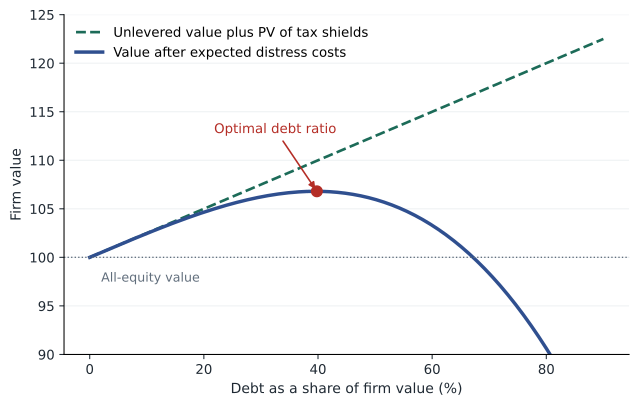
The trade-off theory says that firms balance the tax benefits of debt against the expected costs of financial distress. At low debt levels, tax savings dominate and adding debt raises value; as debt rises, the probability and cost of distress grow until the marginal cost equals the marginal tax benefit. That point is the optimal capital structure. The theory explains why profitable firms with tangible assets borrow more, and why debt ratios differ so much across industries.
Other explanations
The pecking order theory, associated with Stewart Myers and Nicholas Majluf, starts from information asymmetry. Managers know more than outside investors about the firm's prospects, so issuing shares signals that managers think the shares are overvalued, and share prices typically fall when new equity is announced. Firms therefore prefer internal funds first, then debt, and issue equity only as a last resort. That explains why the most profitable firms often borrow least: they do not need to. Agency theories add that debt disciplines managers by committing them to pay out cash rather than waste it, while too much debt creates the shareholder-lender conflicts described in lesson 1. In practice, surveys of CFOs find that financial flexibility, credit ratings and the volatility of earnings weigh heavily in capital structure decisions; few firms calculate an exact optimum, but most have a target range.
Payout policy
A firm can return cash to shareholders as dividends or by buying back its own shares. In perfect markets, MM showed that payout policy, like capital structure, does not affect firm value: given the investment policy, a dollar paid out today reduces the share price by a dollar, and shareholders who want cash can sell shares while those who do not can reinvest dividends. Again, the interesting questions are about the frictions.
Taxes favour different payouts for different investors. For Canadian individuals, eligible dividends benefit from the dividend tax credit, and capital gains are only half taxable and taxed only when realized, so buybacks, which produce capital gains for selling shareholders, can be more tax-efficient for some investors and less for others. Since 2024, a 2 % tax on the net value of equity repurchased by public corporations applies, which slightly reduces the appeal of buybacks. Pension funds and registered accounts (RRSPs, TFSAs) are indifferent to the form of payout for tax purposes.
Beyond taxes, dividends carry information. Firms smooth dividends and are reluctant to cut them, so a dividend increase signals management's confidence in future cash flows, and a cut is usually punished by the market. Buybacks are more flexible: they can be paused without the same stigma, which is why firms increasingly use regular dividends for the permanent part of payout and buybacks for the variable part. Paying out cash also reduces the agency cost of free cash flow, money that managers might otherwise spend on value-destroying projects or acquisitions. Stock splits and stock dividends simply divide the same firm into more shares and do not, in themselves, create value.
Worked problem
Dividend or buyback
A firm has 10 million shares trading at $50 and $20 million of excess cash it plans to distribute. Compare a $2 per share dividend with a buyback of $20 million of shares, ignoring taxes.
Show solution
- Firm value before = 10 × 50 = $500 million, including the cash.
- Dividend: value falls to 480 million; price falls to $48; each shareholder has a $48 share plus $2 cash.
- Buyback at $50: 0.4 million shares retired; 9.6 million remain worth 480 million, or $50 each.
- Selling shareholders receive $50 a share in cash; remaining shareholders hold $50 shares.
Answer: Without taxes or signals, shareholders are equally well off either way. Real-world differences come from taxes, information and flexibility.
Capstone: valuing a project for Larkhill Instruments
Larkhill Instruments is an invented mid-sized maker of laboratory instruments. Its board is considering an expansion: a new production line for a portable spectrometer. The project brings together every part of the course: estimating incremental cash flows, applying tax rules, estimating the cost of capital, calculating NPV, analysing risk and thinking about financing.
| Input | Estimate | Source or reasoning |
|---|---|---|
| Equipment cost | $12.0 million | Supplier quotes |
| Working capital | $1.5 million at start, recovered at end | About 11 % of peak revenue |
| Life | 6 years | Expected product life |
| Units sold | 32, 45, 54, 54, 48 and 40 thousand | Market study; ramp-up then decline |
| Price; variable cost | $248; $150 per unit | Competitor pricing; engineering estimates |
| Fixed cash costs | $1.3 million a year | Staffing and maintenance |
| Salvage value | $2.0 million at year 6 | Used equipment market |
| Capital structure | 30 % debt, 70 % equity (target, market values) | Board policy |
| Market research already done | $0.4 million | Sunk: excluded |
For the Canadian analysis, the tax rate is 26.5 %. The equipment qualifies as Class 53 manufacturing and processing machinery, eligible for immediate expensing under the productivity super-deduction because it will be available for use before 2030; since the class pool is fully written off, the salvage proceeds at the end are taxed as recapture. Larkhill's bonds yield 5.8 %, and its cost of equity, from a beta of 1.1, a 10-year Government of Canada yield of 3.9 % and a market risk premium of 5.5 %, is about 10.0 %; management uses 10.5 % to reflect the product's somewhat higher risk, consistent with a pure-play check on instrument makers.
# Capstone: Larkhill Instruments expansion (Canadian site)
cost, nwc, years, salvage = 12_000_000, 1_500_000, 6, 2_000_000
units = [32_000, 45_000, 54_000, 54_000, 48_000, 40_000]
price, var_cost, fixed, tax = 248.0, 150.0, 1_300_000, 0.265
r_e, r_d, d_v = 0.105, 0.058, 0.30
wacc = (1 - d_v) * r_e + d_v * r_d * (1 - tax)
pv = -cost - nwc
for t, q in enumerate(units, start=1):
    pv += (q * (price - var_cost) - fixed) * (1 - tax) / (1 + wacc) ** t
pv += cost * tax / (1 + wacc)                     # Class 53: immediate expensing, claimed at end of year 1
pv += (salvage + nwc) / (1 + wacc) ** years
pv -= salvage * tax / (1 + wacc) ** years          # proceeds reduce a pool already written off: taxed as recapture
print(f"WACC {wacc * 100:.2f} %   NPV {pv:,.0f}")
for dp in (-0.10, -0.05, 0.05):
    p2 = price * (1 + dp)
    alt = -cost - nwc + sum((q * (p2 - var_cost) - fixed) * (1 - tax) / (1 + wacc) ** t for t, q in enumerate(units, 1))
    alt += cost * tax / (1 + wacc) + (salvage + nwc) / (1 + wacc) ** years - salvage * tax / (1 + wacc) ** years
print(f"price {dp:+.0%}: NPV {alt:,.0f}")WACC 8.63 % NPV 1,636,468 price -10%: NPV -2,092,562 price -5%: NPV -228,047 price +5%: NPV 3,500,983
The results show a positive NPV in the base case, of about $1.5 to $1.6 million, but the price sensitivity reveals how fragile that is: a price about 5 % below the forecast would eliminate all of the project's value, and a 10 % shortfall would turn it into a loss of more than $2 million. A good recommendation to the board would state the base-case NPV and the WACC used; identify price and volume as the critical assumptions and say what evidence supports them; note the value of options, such as the ability to pause the second year of expansion if early sales disappoint or to sell the line to a competitor; and confirm that the project can be financed within the firm's target capital structure without threatening its credit rating. It would also point out that the result relies on the current tax treatment of equipment: without accelerated deductions, the NPV would be noticeably lower.
Common mistakes
MistakeDebt is cheaper than equity, so borrowing always lowers the WACC.
InsteadIn perfect markets the cost of equity rises to offset cheaper debt; any gain comes from tax shields, limited by distress costs.
MistakeThe value of the interest tax shield is the annual tax saving.
InsteadFor permanent debt its present value is T × D.
MistakePaying a dividend makes shareholders richer.
InsteadThe share price falls by the dividend; wealth changes only through taxes, signals or agency effects.
MistakeThe most profitable firms borrow the most.
InsteadMany profitable firms borrow little, as the pecking order theory predicts.
MistakeA positive base-case NPV settles the decision.
InsteadTest critical assumptions, consider options and financing before recommending.
Summary and key terms
- Leverage raises expected ROE and its variability.
- MM: with perfect markets, capital structure and payout policy do not affect value; the cost of equity rises with leverage.
- With corporate taxes, V_L = V_U + TD; personal taxes reduce the advantage.
- The trade-off theory balances tax shields against financial distress costs; the pecking order theory stresses information and internal funds.
- Dividends and buybacks differ mainly in taxes, signalling and flexibility.
- Canadian dividends receive a dividend tax credit, half of capital gains are taxable, and a 2 % tax applies to public share buybacks since 2024.
- A full project valuation combines incremental cash flows, taxes, the cost of capital, risk analysis and financing.
- Financial leverage
- The use of debt in a firm's capital structure.
- Financial risk
- The extra variability of shareholders' returns caused by debt.
- MM Proposition I
- In perfect markets, firm value does not depend on capital structure.
- MM Proposition II
- The cost of equity rises linearly with the debt-to-equity ratio.
- Interest tax shield
- The tax saved because interest is deductible.
- Financial distress
- Difficulty meeting obligations, possibly leading to bankruptcy.
- Trade-off theory
- The theory that firms balance tax benefits of debt against distress costs.
- Pecking order theory
- The theory that firms prefer internal funds, then debt, then equity.
- Share buyback
- A firm's purchase of its own shares.
- Dividend smoothing
- The practice of changing dividends gradually and avoiding cuts.
Practice problems
Work each problem on paper first, then reveal the answer to check.
An unlevered firm worth $200 million issues $60 million of permanent debt; T = 26.5 %. New firm value (MM with taxes)?
Show answer
200 + 15.9 = 215.9 million.
rA = 10 %, rD = 6 %, D/E = 0.5, no taxes. Cost of equity?
Show answer
10 + 0.5 × 4 = 12 %.
Name two indirect costs of financial distress.
Show answer
Lost customers, supplier demands, departing employees, forgone projects.
Why might a firm with large R&D spending choose low debt?
Show answer
High distress costs for intangible assets and growth options.
According to the pecking order theory, why do share prices often fall when equity is issued?
Show answer
Investors infer managers think the shares are overvalued.
Shares trade at $40; a $1.50 dividend is paid. Expected ex-dividend price (no taxes)?
Show answer
$38.50.
$30 million is used to buy back shares at $60 from 20 million shares. Shares remaining and price (no taxes)?
Show answer
19.5 million at $60.
Why do firms use buybacks for the variable part of payout?
Show answer
They can be stopped without the negative signal of a dividend cut.
In the capstone, why is the market research cost excluded?
Show answer
It is sunk.
Portfolio task: write a one-page board memo recommending for or against the Larkhill project, with the NPV, the critical assumptions, the options and the financing plan.
Show answer
Answers vary; the memo should be specific and quantitative.
Lesson quiz · 5 questions
Score 60% or more to complete this lesson.
Create a free account to save your progress, take quizzes and earn a certificate.