
FIN-201 · Lesson 1 of 12 · 33 min
The goal and environment of corporate finance
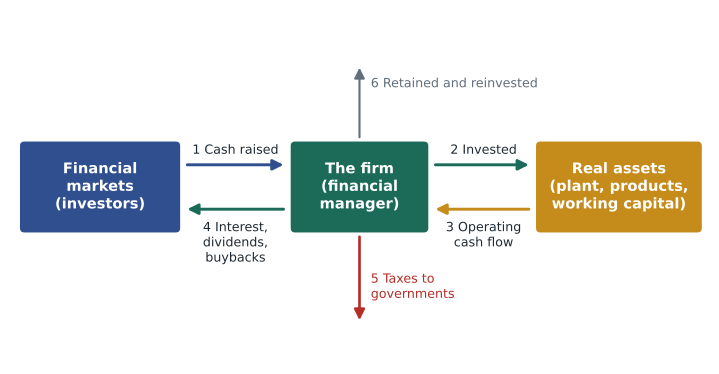
Every business, from a two-person design studio to a national railway, faces the same three financial questions. Which long-term investments should it make? How should it pay for them? And how should it manage the cash that flows through the business day to day, including how much to return to its owners? Corporate finance is the study of how firms answer these questions so that they create value. This first lesson sets out the goal that guides those decisions, the conflicts of interest that get in the way, and the financial markets, institutions and regulators that make up the environment in which firms raise and invest money. The tools come later: time value of money in lessons 3 and 4, valuation of bonds and shares in lessons 5 and 6, capital budgeting in lessons 7 to 9, and risk, the cost of capital and financing policy in lessons 10 to 12.
This course assumes the business mathematics of BUS-110, especially its lessons on compound interest, annuities and a first look at net present value, and the accounting basics of ACCT-101. Where FIN-201 returns to those topics it goes further: it asks not only how to calculate a present value but which cash flows and which discount rate belong in the calculation, and why. Nothing in this course is investment advice; the examples are illustrative and invented unless a source is named.
Three decisions
The investment decision, often called capital budgeting, is about what the firm should own. A manufacturer decides whether to build a new production line; a software company decides whether to develop a product; a retailer decides whether to open a store or close one. These decisions usually involve large sums, commit the firm for years, and are hard to reverse. They are recorded on the left-hand side of the balance sheet as real assets: plant, equipment, buildings, software, patents and the working capital needed to run them.
The financing decision is about how to pay for those assets. The firm can retain profits, borrow from banks, issue bonds, or sell new shares. The mix of debt and equity it chooses is its capital structure, recorded on the right-hand side of the balance sheet. Financing choices affect risk, taxes and the claims that different investors hold on the firm's cash flows.
The third group of decisions is short-term financial management and payout policy: how much cash and inventory to hold, how quickly to collect from customers and pay suppliers, how to finance seasonal needs, and whether to pay dividends or buy back shares. These decisions are smaller one at a time but frequent, and a firm that handles them badly can run out of cash even while it is profitable on paper.
Forms of business organization
How a business is organized affects how it raises money, how it is taxed and who bears its losses. A sole proprietorship is owned by one person, who receives all the profit and is personally liable for all the debts. A partnership spreads ownership among two or more people; general partners have unlimited liability, while limited partners risk only what they invest. A corporation is a separate legal person: shareholders own it, but their liability is limited to their investment, ownership is easy to transfer, and the corporation can live on after its founders. Those features make the corporation the dominant form for large businesses, at the cost of more regulation and, in many cases, taxation of profits first at the corporate level and again when they are paid out to shareholders. BUS-210 lesson 8 covers the legal side; here the focus is on the financial consequences.
| Form | Liability | Taxation (simplified) | Ability to raise capital |
|---|---|---|---|
| Sole proprietorship | Unlimited, personal | Owner taxed on business income | Limited to owner and lenders |
| General partnership | Unlimited, joint | Partners taxed on their shares of income | Limited to partners and lenders |
| Limited partnership | Limited for limited partners | Flow-through to partners | Common for real estate and funds |
| Canadian-controlled private corporation (CCPC) | Limited | Corporate tax, with a lower small business rate on the first $500,000 of active business income; dividends taxed again with a dividend tax credit | Private shares, loans, government programs |
| Public corporation | Limited | General corporate rate (about 26.5 % combined in Ontario in 2026); integration through the dividend tax credit | Can sell shares and bonds to the public under a prospectus |
The goal: maximizing the value of the firm
Corporate finance needs a goal against which decisions can be judged. The standard answer is that managers should make decisions that maximize the current market value of the owners' equity, which for a public company means its share price. This is not the same as maximizing profit. Accounting profit ignores when cash arrives, ignores risk, and can be raised in the short run by cutting research, maintenance or training in ways that destroy value later. Market value, by contrast, reflects investors' estimates of all future cash flows, adjusted for their timing and risk. A decision that adds more to the present value of future cash flows than it costs increases the value of the firm, and that is the test used throughout this course.
Worked problem
Profit versus value
Two projects each cost $1,000 today and each produce total profits (equal to cash flows here) of $1,500 over three years. Project A pays $900, $400 and $200; Project B pays $200, $400 and $900. Investors require 10 % a year. Which project creates more value?
Show solution
- PV of A = 900/1.1 + 400/1.1² + 200/1.1³ = 818.18 + 330.58 + 150.26 = 1,299.02.
- PV of B = 200/1.1 + 400/1.1² + 900/1.1³ = 181.82 + 330.58 + 676.18 = 1,188.58.
- Value created (NPV): A = 1,299.02 − 1,000 = 299.02; B = 188.58.
Answer: Both projects show the same total profit, but A is worth about $110 more today because its cash arrives sooner. A profit target alone cannot tell them apart.
# Same total profit, different timing: present value at 10 %
rate = 0.10
projects = {"A": [900, 400, 200], "B": [200, 400, 900]}
for name, flows in projects.items():
    pv = sum(cf / (1 + rate) ** t for t, cf in enumerate(flows, start=1))
print(f"Project {name}: total profit {sum(flows):,} PV {pv:,.2f} NPV {pv - 1000:,.2f}")Project A: total profit 1,500 PV 1,299.02 NPV 299.02 Project B: total profit 1,500 PV 1,188.58 NPV 188.58
Shareholder value maximization is sometimes criticized as short-termist or as ignoring employees, customers, communities and the environment. Much of that criticism is aimed at a caricature. Market value depends on cash flows far into the future, so a firm that mistreats customers, cuts safety corners or damages its reputation usually loses value over time. But markets can misprice, externalities such as pollution are not fully borne by the firm, and the law in both countries gives directors some room to consider other interests. In Canada, the Supreme Court in BCE (2008) held that directors owe their duty to the corporation and may consider the interests of shareholders, employees, creditors and others; section 122 of the Canada Business Corporations Act was amended in 2019 to list such factors. In the United States, Delaware case law has traditionally emphasized shareholder value, while about forty states allow companies to incorporate as benefit corporations with a broader stated purpose. BUS-310 explores the ethics and governance debate; this course uses value maximization as the working goal while noting where it may fall short.
Agency problems
In a large corporation, ownership and control are separated. Shareholders own the firm, but they hire managers to run it, and managers' interests may differ from theirs. A manager might build an empire to raise their own salary and status, avoid risky but valuable projects that could cost them their job, spend on perks, or resist a takeover that would benefit shareholders. The resulting loss of value, together with the cost of monitoring and bonding managers, is called agency cost. Similar conflicts exist between shareholders and lenders: when a firm is close to default, shareholders may prefer very risky projects because they keep the upside while lenders bear much of the downside.
Firms and markets use several mechanisms to limit agency costs. Boards of directors, especially independent directors, hire, monitor and pay senior managers. Compensation linked to share price, such as restricted shares and options, aligns managers' wealth with shareholders', although poorly designed pay can encourage manipulation or excessive risk. Large shareholders, pension funds and activist investors monitor management. The threat of takeover disciplines managers who let value slip. Lenders write covenants into loan agreements that restrict dividends, new debt or asset sales. And disclosure rules, audits and securities law make it harder to hide bad performance.
Worked problem
An agency conflict in numbers
A chief executive owns 2 % of a company. She can approve a corporate jet costing $5 million in present value, which she values personally at $1 million in convenience and status but which adds nothing to the firm's cash flows. What does the jet cost her, and what does it cost the other shareholders?
Show solution
- The firm's value falls by $5 million.
- Her share of that loss is 2 % × 5 = $0.1 million.
- Her private benefit is $1 million, so her net gain is $0.9 million.
- The other shareholders lose 98 % × 5 = $4.9 million.
Answer: Because she bears only 2 % of the cost, the jet looks attractive to her even though it destroys value. Larger ownership stakes, board approval of major expenses and disclosure of perquisites are ways to reduce this conflict.
Financial markets and institutions
Firms raise money in financial markets and through financial institutions. In primary markets, securities are sold for the first time and the issuing firm receives the cash. In secondary markets, investors trade existing securities with each other; the firm receives nothing directly, but a liquid secondary market makes investors willing to pay more in the primary market. Money markets trade short-term debt such as treasury bills and commercial paper; capital markets trade longer-term bonds and shares. Financial intermediaries, including banks, insurers, pension funds and mutual funds, pool savings and lend or invest them. ECON-102 lesson 6 explains how this system channels national saving to investment; here we look at it from the side of the firm that needs the money.
| Market or body | Role |
|---|---|
| Toronto Stock Exchange (TSX) | Senior equity market; most large Canadian public companies list here |
| TSX Venture Exchange and Canadian Securities Exchange | Markets for smaller and early-stage companies |
| Bond market | Government of Canada, provincial and corporate bonds, mostly traded over the counter |
| Provincial securities commissions (for example the Ontario Securities Commission) | Regulate securities offerings and trading in each province and territory |
| Canadian Securities Administrators (CSA) | Umbrella group that harmonizes provincial rules through national instruments |
| Canadian Investment Regulatory Organization (CIRO) | Self-regulatory organization for investment dealers and trading since 2023 |
Raising capital
A young company typically starts with the founders' own money, then turns to friends and family, angel investors and venture capital funds, which buy equity in exchange for a share of ownership and often board seats. Established private companies borrow from banks and may sell bonds or shares privately to institutions. A firm that wants access to a broad pool of investors can go public through an initial public offering (IPO): it hires investment banks as underwriters, prepares a prospectus describing the business, its risks and its financial statements, files it with regulators, and sells shares to the public at an offering price. Later sales of new shares are seasoned offerings.
In Canada, securities law is provincial. A company selling securities to the public must file a prospectus with the securities regulator in each province or territory where it sells, coordinated through a passport system and the CSA's national instruments; the regulators then issue a receipt. Many sales avoid the prospectus requirement through exemptions, such as sales to accredited investors (individuals or institutions meeting income or asset tests) and offering memorandum exemptions. Attempts to create a cooperative national regulator did not succeed, so the provincial system remains in place in 2026. Listed companies must then file continuous disclosure documents: annual and interim financial statements, management's discussion and analysis, and material change reports.
Going public is expensive. Underwriters typically take a spread of several per cent of the money raised, legal, accounting and listing fees add more, and there is a hidden cost: IPOs are, on average, priced below the price at which the shares first trade. Decades of studies in both countries find average first-day returns in the double digits, although the figure swings widely from year to year. Underpricing compensates investors for the risk of buying an untested share and helps underwriters sell the issue, but it leaves money on the table for the issuing firm.
Worked problem
The cost of underpricing
A company sells 10 million new shares in an IPO at $20. The underwriting spread is 6 %, other direct costs are $2.5 million, and the shares close the first day at $24. What are the total costs of the issue, as a percentage of the amount raised at the offering price?
Show solution
- Gross proceeds = 10 million × $20 = $200 million.
- Spread = 6 % × 200 = $12 million; other direct costs = $2.5 million.
- Underpricing (money left on the table) = 10 million × (24 − 20) = $40 million.
- Total = 12 + 2.5 + 40 = $54.5 million, or 27.25 % of $200 million.
Answer: Measured this way, the first-day price jump costs the firm's existing owners far more than the direct fees. The numbers are illustrative; actual underpricing varies widely.
The financial manager
In a large firm, the chief financial officer (CFO) oversees finance. The treasurer is responsible for raising and managing cash, relationships with banks and investors, and risk management; the controller is responsible for accounting, financial reporting, budgeting and internal control. Financial managers work closely with operating managers, because good financial decisions depend on realistic estimates of sales, costs and investment needs, and with the board, which approves major investments, financings and dividends. Throughout the course, the financial manager's job can be summarized in one sentence: find and fund investments worth more than they cost, and manage the risks and cash flows along the way.
Common mistakes
MistakeThe goal of the firm is to maximize accounting profit.
InsteadThe goal is to maximize the market value of the owners' equity, which accounts for the timing and risk of cash flows.
MistakeWhen investors trade shares on the stock exchange, the company receives the money.
InsteadOnly primary market sales raise money for the firm; secondary trading is between investors.
MistakeLimited liability means shareholders cannot lose money.
InsteadThey can lose their whole investment, but not more than that.
MistakeAgency problems only arise from dishonest managers.
InsteadThey arise whenever an agent bears only part of the costs or benefits of a decision, even when everyone acts within the law.
MistakeAn IPO is a cheap way to raise money because the firm pays no interest.
InsteadEquity is costly: spreads, fees and underpricing are large, and shareholders expect a higher return than lenders.
Summary and key terms
- Corporate finance covers investment, financing, and short-term and payout decisions.
- The working goal is to maximize the current market value of the owners' equity, not accounting profit.
- Profit ignores timing and risk; present value captures both.
- Agency problems arise when managers or shareholders bear only part of the consequences of their decisions; boards, pay design, monitoring, covenants and disclosure limit them.
- Primary markets raise money for firms; secondary markets provide liquidity.
- Securities are regulated provincially in Canada, coordinated by the CSA, with CIRO overseeing dealers.
- IPOs involve direct costs and, on average, significant underpricing.
- Capital budgeting
- The process of choosing long-term investments in real assets.
- Capital structure
- The mix of debt and equity a firm uses to finance its assets.
- Agency cost
- The loss of value and monitoring costs that result from conflicts between principals and agents.
- Primary market
- The market in which newly issued securities are sold and the issuer receives the proceeds.
- Secondary market
- The market in which investors trade existing securities with each other.
- Initial public offering (IPO)
- A company's first sale of shares to the public.
- Prospectus
- A disclosure document describing a securities offering, the issuer and its risks.
- Underpricing
- Selling an IPO at a price below the price at which it begins trading.
- Underwriter
- An investment bank that buys or sells a new issue and certifies its price.
- Accredited investor
- An investor who meets income or wealth tests and can buy securities sold without a prospectus or registration.
Practice problems
Work each problem on paper first, then reveal the answer to check.
Name the three main kinds of decision in corporate finance.
Show answer
Investment (capital budgeting), financing (capital structure), and short-term financial management and payout.
Why is maximizing profit an inadequate goal?
Show answer
It ignores the timing and risk of cash flows and can be gamed in the short run.
A project pays $500 in year 1 and $500 in year 2; another pays $1,000 in year 2. At 8 %, which is worth more?
Show answer
The first: 463.0 + 428.7 = 891.6 versus 857.3.
A manager owns 5 % of the firm and can spend $2 million of the firm's money on an office renovation she values at $300,000. Is it in her interest?
Show answer
Her cost is $100,000 and benefit $300,000, so yes, even though shareholders lose.
What is the difference between a primary and a secondary market?
Show answer
Primary: new issues, the firm receives cash. Secondary: trading between investors.
List three mechanisms that reduce agency costs.
Show answer
Independent boards, incentive pay, activist or large shareholders, takeover threat, debt covenants, disclosure and audit.
An IPO sells 4 million shares at $15; the spread is 7 % and the first-day close is $18. Find the spread and the money left on the table.
Show answer
Spread $4.2 million; underpricing $12 million.
Who regulates a public share offering in Canada?
Show answer
The provincial and territorial securities regulators, coordinated by the CSA.
Why might shareholders of a firm near bankruptcy favour very risky projects?
Show answer
They keep the upside while lenders bear much of the downside.
Portfolio task: find a recent IPO in your country and compare its offering price with its first-day closing price.
Show answer
Answers vary; compute the first-day return and money left on the table.
Lesson quiz · 5 questions
Score 60% or more to complete this lesson.
Create a free account to save your progress, take quizzes and earn a certificate.