
FAT-130 · Lesson 8 of 12 · 18 min
Battery calculations
After the Willowbank call, Gerry gives Sasha a job that most trainees dread: redo the battery calculation for Tamarind House from scratch, using the current device list. 'The one in the binder is from 2014,' he says. 'Since then, they've added a fit-out on the fourth floor, two duct detectors, a door holder circuit and a new annunciator. I'd bet the batteries in that panel are too small now, and I want you to prove it either way.' A battery calculation is the arithmetic that decides whether a fire alarm system will still work after a day without power. This lesson walks through the method, the standards' requirements, the derating factor and the common mistakes.
The method
Every battery calculation has the same structure. List every device that draws current from the battery, with its standby current and its alarm current. Multiply each by its quantity and add them to get the system's total standby current and total alarm current. Multiply the standby current by the required standby time and the alarm current by the required alarm time, and add the two to get the amp-hours needed. Multiply by a safety margin, or derating factor, to allow for ageing and temperature, and choose the next standard battery size at or above the result.
In this equation, C is the battery capacity in amp-hours, I with subscript s is the standby current and t with subscript s the standby time in hours, I with subscript a is the alarm current and t with subscript a the alarm time in hours, and k is the derating factor. The times come from the code or standard that applies to the building, and the currents come from the data sheets of the installed equipment.
Standby and alarm currents
Standby current is what each device draws when the system is normal, with the primary power off. It includes the panel's own electronics, the signalling line circuit devices, annunciators, relays and modules, four-wire detectors, and any auxiliary loads that stay on when the power fails. Notification appliances draw almost nothing in standby, only the supervisory current through the end-of-line resistor. Alarm current is what each device draws with the system in full alarm: the panel's alarm current, which is higher than its standby because its relays and indicators are energized, every notification appliance at its installed setting, every relay and module in its alarm state, and auxiliary loads that stay on in alarm.
Some loads change between standby and alarm in ways that are easy to miss. Door holders draw current in standby and release in alarm, so they appear in the standby column only. A relay that energizes in alarm appears in the alarm column only. An LED annunciator draws more in alarm, when more of its lamps are lit. Addressable devices draw slightly more in alarm, when their indicator lights. The device data sheets give both figures.
Required times
For a building in Canada, the times come from the National Building Code, Article 3.2.7.8: 24 hours of supervisory operation, followed by the alarm period for the building. For Riverlight Tower, a high building, the alarm period is 2 hours; for Tamarind House, an office building that isn't in the scope of Subsection 3.2.6, it is 30 minutes. Voice systems follow the same durations.
Alarm time is converted to hours for the calculation: 5 minutes is 0.0833 hours, 15 minutes is 0.25 hours, 30 minutes is 0.5 hours.
The derating factor
Batteries lose capacity with age and in the cold, and the standby discharge is not exactly the 20-hour rate the battery is rated at. To make sure the battery still has enough capacity at the end of its life, the calculation is multiplied by a safety margin. Long-standing practice, and many panel makers' worksheets, use a 20 percent margin, a factor of 1.2. Some recent editions of the standards and some makers specify a larger margin, such as 1.25. The factor to use is the one required by the code or standard adopted in the jurisdiction, or the panel maker's, whichever is greater.
CAN/ULC-S524 and the panel maker's installation manual set the method and margin to use in Canada; Bramwell's standard calculation sheet uses the maker's factor and notes the standard's edition.
Working through a calculation
# Battery calculation for the main panel at Tamarind House (illustrative device list)
# The upper floors' appliances are on the remote power supplies and are calculated separately.
devices = [  # name, quantity, standby A each, alarm A each
    ("Control unit", 1, 0.180, 0.330),
    ("Smoke detectors (addressable)", 96, 0.0003, 0.0007),
    ("Monitor modules", 22, 0.0004, 0.0008),
    ("Control relay modules", 8, 0.0004, 0.0055),
    ("Annunciator", 1, 0.035, 0.065),
    ("Duct detector modules", 4, 0.012, 0.025),
    ("Horn-strobes, 30 cd (panel circuits)", 14, 0.0, 0.143),
    ("Horn-strobes, 75 cd (panel circuits)", 6, 0.0, 0.264),
    ("Door holders", 6, 0.035, 0.0),
]
standby = sum(q * s for _, q, s, _ in devices)
alarm = sum(q * a for _, q, _, a in devices)
t_standby, t_alarm = 24, 0.5
k = 1.2
ah = (standby * t_standby + alarm * t_alarm) * k
print(f"standby current {standby:.3f} A x {t_standby} h = {standby * t_standby:.2f} Ah")
print(f"alarm current   {alarm:.3f} A x {t_alarm:.4f} h = {alarm * t_alarm:.2f} Ah")
print(f"with factor {k}: {ah:.2f} Ah required")
sizes = [7, 12, 18, 26, 33, 40, 55]
choice = next(s for s in sizes if s >= ah)
print(f"next standard size: {choice} Ah")standby current 0.514 A x 24 h = 12.33 Ah alarm current 4.210 A x 0.5000 h = 2.10 Ah with factor 1.2: 17.32 Ah required next standard size: 18 Ah
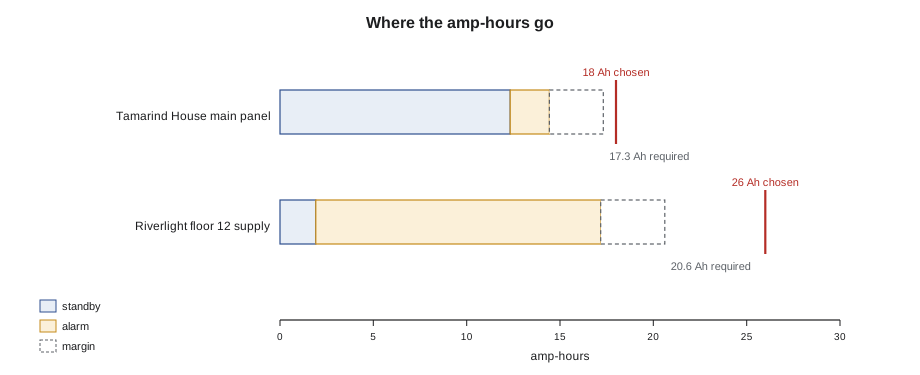
For the main panel at Tamarind House under the NBC's 30-minute alarm period, the calculation calls for about 17.3 Ah, so the next standard size is 18 Ah. The installed batteries are 18 Ah, so Gerry loses his bet, but only just: the additions have used up almost all the margin, and the next device added to the panel will push the requirement over. Sasha notes this on the calculation so that the next fit-out's designer sees it.
The result depends heavily on the alarm period. A system with a long required alarm period is dominated by the alarm current; one with a short alarm period is dominated by standby. This is why the same device list can need very different batteries in different jurisdictions or building types.
Checking the result
A finished calculation is checked three ways. First, against the charger: the selected battery must be no larger than the charger is listed to recharge in the required time. If it is, an external listed charger or a larger panel power supply is needed. Second, against the cabinet: the battery must physically fit in the panel's cabinet, or a listed battery cabinet is added. Third, against reality: the measured standby current, taken with a clamp meter with the AC off, should be close to the calculated standby current. A large difference means the device list is wrong.
Remote power supplies are calculated separately, each with its own device list: the supply's own standby current, the supervisory current of its notification circuits, and the alarm current of every appliance it powers. A common mistake is to include a remote supply's appliances in the main panel's calculation as well, or to leave them out of both.
When the battery is too large
Sometimes the calculation calls for a battery larger than the panel can charge or the cabinet can hold. The fixes are design changes: move notification circuits to a remote power supply with its own battery; power door holders and other auxiliary loads from a separate supply that doesn't need battery backup, where the code allows; reduce standby current by replacing older, higher-current devices; or add a listed external battery cabinet and charger. Installing oversized batteries that the charger can't recharge in time is not a fix, because after one long outage the system would be left with partly charged batteries.
Documenting the calculation
The battery calculation is part of the system's record documents. It lists the code or standard and edition used, the required times, every device with its quantity and currents, the totals, the derating factor, the required capacity and the installed battery. It is updated whenever devices are added or removed, and it is checked at each annual inspection against the installed batteries. An out-of-date calculation is a common inspection deficiency.
Worked problem
Riverlight Tower's main panel
Riverlight Tower's main panel has a standby current of 1.42 A and an alarm current of 3.85 A, after the upper floors' notification circuits moved to two remote supplies. How large must its battery be?
Show solution
- Under the NBC, a high building needs 24 hours supervisory and 2 hours alarm: 1.42 × 24 = 34.1 Ah, plus 3.85 × 2 = 7.7 Ah, for 41.8 Ah.
- With a factor of 1.2, the requirement is 50.2 Ah.
- The next standard size is 55 Ah, far more than the panel's built-in charger is listed for.
- The design uses a listed external battery cabinet and charger, as the original installation did.
Answer: Sasha finds that the original design used two 55 Ah batteries in an external cabinet with its own charger, which matches. Her new calculation goes in the record binder with today's date.
Common gaps in battery calculations
Inspectors who review battery calculations see the same gaps again and again. The panel's own current is taken from the wrong row of its data sheet, often the figure without its optional cards or network modules installed. The alarm current omits relays that energize in alarm, such as those that release door holders, shut down fans or recall elevators. Annunciators are counted in standby but not in alarm, though they draw more with their lamps lit. Four-wire smoke detectors and their power supervision relays are forgotten because they are on an auxiliary output rather than a circuit. And remote power supplies are left out entirely, on the assumption that someone else calculated them.
A second group of gaps comes from the times. The wrong alarm period is used because the calculation was copied from a building of a different kind or from a different jurisdiction. Minutes are entered as if they were hours, which makes the alarm amp-hours sixty times too large, or hours as minutes, which makes them sixty times too small. Both errors are easy to make in a spreadsheet and easy to catch with a sanity check: a typical alarm period's amp-hours should be the alarm current times a fraction of an hour, or times one or two hours in buildings that need a long alarm period.
A third group comes from the battery selection. The calculated capacity is rounded down to a standard size instead of up. A battery size is chosen that the charger isn't listed to recharge. Or the battery fits the calculation but not the cabinet, and someone installs it outside the cabinet on the floor, where it is neither protected nor supervised as the listing requires.
Sasha's checklist, written in the margin of her Tamarind House calculation, has one line for each of these. Gerry tells her to keep it: every calculation she checks for the rest of her career will have at least one of them.
The last check is the simplest: does the answer make sense for a building of this size? A six-storey office with a few hundred devices on its main panel will typically need batteries somewhere between 12 and 40 amp-hours, depending on its alarm period. A result of 3 or 300 amp-hours means a mistake somewhere, and it is worth finding before anyone orders batteries.
Common mistakes
MistakeUsing a calculation from years ago without updating the device list.
InsteadRecalculate whenever devices are added or removed.
MistakePutting door holders in the alarm column.
InsteadDoor holders draw in standby and release in alarm.
MistakeForgetting the derating factor.
InsteadMultiply by the required safety margin.
MistakeInstalling a battery larger than the charger is listed to recharge.
InsteadUse an external listed charger or redesign.
MistakeCounting a remote supply's appliances in the main panel's calculation too.
InsteadCalculate each supply with its own device list.
Summary and key terms
- Capacity = (standby current × standby time + alarm current × alarm time) × derating factor.
- The NBC requires 24 h supervisory, then 2 h of alarm in high buildings and 30 min in most others.
- A derating factor, commonly 1.2 or more, covers ageing and temperature.
- Choose the next standard size and check it against the charger and the cabinet.
- Compare the calculated standby current with a measured one.
- Keep the calculation current in the system's records.
- Battery calculation
- The calculation of the amp-hours a system needs from its secondary supply.
- Standby current
- Current drawn from the battery with the system normal and the AC off.
- Alarm current
- Current drawn from the battery with the system in full alarm.
- Derating factor
- A multiplier that adds a safety margin for battery ageing and temperature.
- External charger
- A listed charger used for batteries larger than the panel can recharge.
- Record documents
- The system's as-built drawings, calculations and test records.
Practice problems
Work each problem on paper first, then reveal the answer to check.
A panel draws 0.6 A standby and 2.4 A in alarm. Under the NBC's 30-minute alarm period and a 1.2 factor, what capacity is needed?
Show answer
(0.6 × 24 + 2.4 × 0.5) × 1.2 = 18.7 Ah, so 26 Ah.
Why do high buildings in Canada usually need much larger batteries?
Show answer
Their alarm period is 2 hours instead of 30 minutes.
A calculation calls for 13.1 Ah. What standard size is chosen?
Show answer
18 Ah.
The measured standby current is 50 percent higher than calculated. What should happen?
Show answer
The device list and calculation should be checked and updated.
Lesson quiz · 5 questions
Score 60% or more to complete this lesson.
Create a free account to save your progress, take quizzes and earn a certificate.