
FAT-130 · Lesson 12 of 12 · 18 min
Capstone: power and voltage-drop calculations for a high-rise
Riverlight Tower's owners have approved a project that Bramwell has been recommending for two years: replacing the horn-strobes on floors 12 to 18 with speaker-strobes, adding low-frequency sounders in the suites, and moving those floors' notification circuits to a new remote power supply on the 12th floor, alongside the existing one. Ravi Menon is designing it, and he gives Sasha the job of preparing the power and voltage-drop calculations for the new supply as her capstone for the electrical theory block. Gerry will check her work, and Ravi will sign it. 'Everything you've done this winter is in this,' Gerry says. 'Ohm's law, wire resistance, batteries, voltage drop, the code. If you can do this one, you can do them all.' This lesson follows Sasha through the calculation from the device list to the signed sheet.
Step 1: the scope and the rules
Sasha starts by writing down what applies. The building is an 18-storey residential tower with an emergency voice system, a fire pump, stair pressurization and an emergency generator. The new remote supply will power the strobe circuits and the suite low-frequency sounder circuits for floors 12 to 18. The voice speakers on those floors are powered by amplifiers in a separate cabinet and are not part of this calculation; their amplifier cabinet has its own calculation, done by the voice system's supplier.
Riverlight Tower is a high building within the scope of NBC Subsection 3.2.6, so Article 3.2.7.8 requires the fire alarm system's emergency power to supply 24 hours of supervisory operation followed by 2 hours of alarm. The batteries in the new supply must carry that duration on their own, because the generator is an additional source, not a replacement. CAN/ULC-S524 and the panel maker's manual set the calculation method and margin, and the riser feeding the new supply must meet NBC 3.2.7.10's protection requirement.
The new supply's maker publishes its ratings: 8 amps total output at 24 volts, four notification outputs at 3 amps each, an auxiliary output, a built-in charger listed for batteries up to 26 Ah, and a cabinet that holds two 18 Ah batteries. Bramwell's design standard limits each circuit to 80 percent of its rating and the supply to 85 percent of its total.
Step 2: the device list
From Ravi's drawings, each floor from 12 to 18 has a corridor with four speaker-strobes and six suites, each suite with a low-frequency sounder base under its smoke alarm and a strobe in the living area. The corridor strobes are set to 75 cd; the suite strobes to 110 cd, because they are in sleeping-area units; the low-frequency sounders draw their listed maximum current. The supply's own standby current, its supervisory current for each circuit, and an addressable control module that triggers it come from the data sheets.
| Load | Per floor | Floors 12 to 18 | Standby each (mA) | Alarm each (mA) |
|---|---|---|---|---|
| Corridor speaker-strobe, strobe at 75 cd | 4 | 28 | 0 | 264 |
| Suite strobe, 110 cd | 6 | 42 | 0 | 354 |
| Suite low-frequency sounder | 6 | 42 | 0 | 95 |
| Remote supply's own electronics | 1 | 65 | 120 | |
| Control module (powered from the supply) | 1 | 5 | 8 |
Step 3: circuits and loading
Sasha's first try puts the corridors on one circuit and the suites on another, but the arithmetic stops her immediately: the suite strobes alone draw 42 × 0.354 = 14.9 amps, nearly twice the supply's total rating. One supply can't carry this load. She goes back to Ravi with the numbers, and he splits the floors between two new supplies: one on the 12th floor for floors 12 to 15, and one on the 16th floor for floors 16 to 18, the second on a new dedicated branch circuit from the emergency panel. Sasha's calculation now covers the 12th-floor supply and four floors.
# Circuit loading for the 12th-floor supply (floors 12 to 15), illustrative currents in A
corridor_ss, suite_strobe, suite_lf = 0.264, 0.354, 0.095
floors = 4
circuits = {
    "NAC 1 corridors 12-15": floors * 4 * corridor_ss,
    "NAC 2 suites 12-13 strobes": 2 * 6 * suite_strobe,
    "NAC 3 suites 14-15 strobes": 2 * 6 * suite_strobe,
    "NAC 4 suite sounders 12-15": floors * 6 * suite_lf,
}
rating_circuit, rating_total = 3.0, 8.0
total = 0
for name, amps in circuits.items():
    total += amps
    pct = amps / rating_circuit * 100
    print(f"{name:28s} {amps:5.2f} A  {pct:5.1f} % {'over 80 %' if pct > 80 else 'ok'}")
print(f"supply total {total:.2f} A, {total / rating_total * 100:.1f} % of rating")NAC 1 corridors 12-15 4.22 A 140.8 % over 80 % NAC 2 suites 12-13 strobes 4.25 A 141.6 % over 80 % NAC 3 suites 14-15 strobes 4.25 A 141.6 % over 80 % NAC 4 suite sounders 12-15 2.28 A 76.0 % ok supply total 15.00 A, 187.5 % of rating
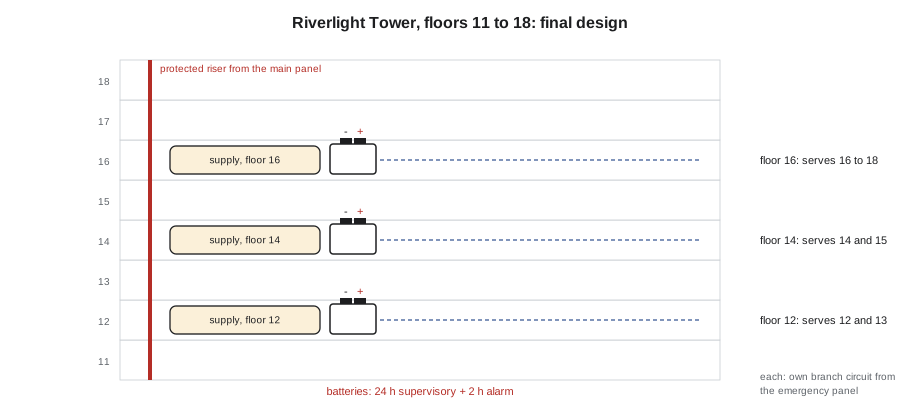
Two problems show. Three of the four circuits carry more than 4 amps, well over a 3-amp output, and the total of 15.0 amps is nearly twice the supply's 8-amp rating. Even four floors is too much for one supply of this size with 110 cd suite strobes. Sasha checks with Ravi whether the suite strobes really need 110 cd. They do: the suite living areas are sleeping-area spaces, and the strobe placement within 24 inches of the ceiling sets the candela. Ravi changes the design again: three supplies of the same model, on the 12th, 14th and 16th floors, with the 12th-floor supply serving floors 12 and 13 only.
# Circuit loading for the 12th-floor supply (floors 12 and 13)
corridor_ss, suite_strobe, suite_lf = 0.264, 0.354, 0.095
circuits = {
    "NAC 1 corridors 12-13": 2 * 4 * corridor_ss,
    "NAC 2 suite strobes 12": 6 * suite_strobe,
    "NAC 3 suite strobes 13": 6 * suite_strobe,
    "NAC 4 suite sounders 12-13": 2 * 6 * suite_lf,
}
total = 0
for name, amps in circuits.items():
    total += amps
    print(f"{name:28s} {amps:5.2f} A  {amps / 3.0 * 100:5.1f} % of 3 A")
print(f"supply total {total:.2f} A, {total / 8.0 * 100:.1f} % of 8 A")NAC 1 corridors 12-13 2.11 A 70.4 % of 3 A NAC 2 suite strobes 12 2.12 A 70.8 % of 3 A NAC 3 suite strobes 13 2.12 A 70.8 % of 3 A NAC 4 suite sounders 12-13 1.14 A 38.0 % of 3 A supply total 7.50 A, 93.8 % of 8 A
Now every circuit is under 80 percent of its rating, and the supply carries 7.50 amps, about 94 percent of its rating, over Bramwell's 85 percent supply limit. Ravi accepts this with a note, because the supply's maker allows full rated output and the circuits themselves have margin; but he records that no further load may be added to this supply. Sasha learns the lesson that the calculation, not the drawing, decides how many power supplies a project needs.
Step 4: the battery
With the loads settled, Sasha calculates the battery for the 12th-floor supply. Standby current is the supply's own electronics, the control module and the four circuits' supervisory currents, which are small. Alarm current is the supply's electronics in alarm plus the full notification load.
# Battery for the 12th-floor supply
standby = 0.065 + 0.005 + 4 * 0.0025          # electronics, control module, NAC supervision (A)
alarm = 0.120 + 0.008 + 7.500                 # electronics, module, NAC load (A)
t_s, t_a, k = 24, 2.0, 1.2
need = (standby * t_s + alarm * t_a) * k
print(f"standby {standby:.3f} A x {t_s} h = {standby * t_s:.2f} Ah")
print(f"alarm   {alarm:.3f} A x {t_a} h = {alarm * t_a:.2f} Ah")
print(f"required with factor {k}: {need:.1f} Ah")
sizes = [7, 12, 18, 26, 33, 40, 55]
pick = next(s for s in sizes if s >= need)
print(f"next standard size {pick} Ah; charger limit 26 Ah, cabinet holds 18 Ah")standby 0.080 A x 24 h = 1.92 Ah alarm 7.628 A x 2.0 h = 15.26 Ah required with factor 1.2: 20.6 Ah next standard size 26 Ah; charger limit 26 Ah, cabinet holds 18 Ah
The 2-hour alarm period makes the alarm load dominate: about 15 amp-hours of alarm against 2 of standby. The result calls for about 20.6 Ah, so 26 Ah batteries, which the charger can recharge but which won't fit in the supply's cabinet. The design adds a listed battery cabinet beside each supply.
Sasha also confirms that the batteries' charger can recharge them in the required time and that the branch circuit for each supply is sized for the supply's input current while recharging, which the electrician needs for the electrical drawings.
Step 5: voltage drop
Sasha calculates each circuit point to point. The worst one is NAC 2, the 12th-floor suite strobes: the circuit leaves the supply in the electrical room, runs 18 m to the first suite, and then 9 m between each suite's strobe along the corridor, entering each suite, on 14 AWG.
# Point-to-point voltage drop, NAC 2 (12th-floor suite strobes)
I_each, n = 0.354, 6
first, step = 18, 9          # one-way distances, m
r = 10.1 / 1000                          # 14 AWG, ohm per m per conductor
v = 20.4
for k in range(1, n + 1):
    seg = first if k == 1 else step
    current = (n - k + 1) * I_each
    v -= current * 2 * seg * r
    print(f"strobe {k}: {current:5.3f} A in segment, {v:5.2f} V")
print("pass" if v >= 16.0 else "fail", f"with {v - 16.0:.2f} V to spare")strobe 1: 2.124 A in segment, 19.63 V strobe 2: 1.770 A in segment, 19.31 V strobe 3: 1.416 A in segment, 19.05 V strobe 4: 1.062 A in segment, 18.86 V strobe 5: 0.708 A in segment, 18.73 V strobe 6: 0.354 A in segment, 18.66 V pass with 2.66 V to spare
The last suite strobe gets about 18.7 volts, a comfortable margin. Sasha runs the same calculation for each of the four circuits, and all pass, the corridor circuit with the smallest margin because of its long run to the far end of the 13th floor.
Step 6: the riser and the branch circuits
The new supplies are triggered and supervised by the main panel through the building's protected riser. Sasha's calculation package lists the supplies' connection to the riser and confirms that the new cable from the riser to each supply's cabinet is the protected type the design specifies, because the code's protection requirement extends from the riser to the equipment it serves. Each new supply gets a dedicated branch circuit from the emergency electrical panel, with a red, locked breaker identified on the panel directory and at the supply.
Step 7: checking and signing
Gerry checks Sasha's work line by line: device counts against the drawings, currents against the data sheets for the specified models and settings, the alarm period against the code, the derating factor, the charger limit, the cabinet, and each voltage drop. He finds one error: she used the 75 cd current for the two corridor strobes nearest the elevator lobby, which Ravi had changed to 95 cd on a later drawing revision. The corrected circuit still passes. Ravi reviews the package and signs it. It goes into the project's record documents, and a copy goes to the electrician so the branch circuits and battery cabinets are installed as calculated.
At verification, months later, Sasha will measure the voltage at the last appliance of each circuit in alarm, on battery, and compare it with her calculation; and she will measure the standby current of each supply and compare it with the battery calculation. If the readings match, the calculation was right. If they don't, the difference will point to whatever was installed differently from the design.
Worked problem
What if a suite strobe is added?
A year after the project, the owner asks to add a strobe in each 12th-floor suite's second bedroom. What does Sasha's calculation show?
Show solution
- Six more strobes at 0.354 A add 2.12 A to the 12th floor's suite circuits.
- NAC 2 would carry 4.25 A, well over its 3 A output rating.
- The supply's total would be 9.62 A, over its 8 A rating.
- The addition can't go on the existing supply: it needs another circuit on a supply with capacity, or a new supply.
Answer: Because the calculation is on file with the note 'no spare capacity', the answer takes ten minutes instead of a site visit, and the owner gets an accurate price for the extra supply.
Common mistakes
MistakeStarting the drawings before checking the loads against the supply's ratings.
InsteadDo the loading arithmetic first; it decides how many supplies are needed.
MistakeTaking credit for a generator when calculating the battery without checking the code allows it.
InsteadUse the battery-only duration unless the code and design permit otherwise.
MistakeUsing currents from an earlier drawing revision.
InsteadCheck each setting against the latest drawings.
MistakeForgetting that the battery must fit the cabinet and the charger.
InsteadCheck both, and add a listed battery cabinet or charger if needed.
MistakeFiling the calculation without a note of spare capacity.
InsteadRecord what margin remains for future additions.
Summary and key terms
- A high-rise power design starts with the code's duration and the supply's ratings.
- Loading arithmetic decides how many remote power supplies a project needs.
- A 2-hour alarm period makes the alarm load dominate the battery size.
- Every circuit is checked point to point with the worst-case source voltage.
- Risers and branch circuits feeding the supplies are part of the design.
- A checked, signed calculation is verified by measurements at commissioning.
- Calculation package
- The set of loading, battery and voltage-drop calculations for a design.
- Spare capacity
- The margin left on a circuit or supply for future additions.
- Drawing revision
- A change to the design drawings, which may change settings and currents.
- Battery cabinet
- A listed enclosure for batteries too large for the panel or supply cabinet.
- Protected riser
- A riser whose conductors are protected against fire as the code requires.
- Verification
- Testing an installed system against its design and the standards.
Practice problems
Work each problem on paper first, then reveal the answer to check.
A supply rated 8 A serves loads of 7.5 A. What percentage of its rating is that?
Show answer
About 94 percent.
Why does the 2-hour alarm period matter so much for Riverlight Tower's batteries?
Show answer
The alarm current is large and must run for 2 hours, so it dominates the capacity.
Six strobes at 0.354 A are on a 3 A output. What percentage is that?
Show answer
About 71 percent.
What two measurements at verification check the calculations?
Show answer
Voltage at the last appliance in alarm on battery, and the supply's standby current.
Lesson quiz · 5 questions
Score 60% or more to complete this lesson.
Create a free account to save your progress, take quizzes and earn a certificate.