
FAT-130 · Lesson 11 of 12 · 19 min
Wiring methods and cable types (CEC Section 32)
Captain Helen Strand from the fire department's fire prevention office joins Bramwell's crew for the walk-through of a renovated floor at Riverlight Tower, and she stops at an open ceiling tile in the corridor. 'What's that red cable doing tied to the sprinkler pipe?' she asks. The electrical contractor had supported the fire alarm cable from the sprinkler branch line to save time, which the rules don't allow. It's a small thing, but it's typical: most fire alarm wiring problems are not exotic electrical faults but ordinary installation shortcuts. This lesson covers the cable types used for fire alarm circuits, the wiring rules in the electrical code, how circuits are kept separate from other systems, supported and protected, and how critical circuits are made to survive a fire.
Where the wiring rules come from
In Canada, the wiring of fire alarm systems is governed by the Canadian Electrical Code, Part I, Section 32, Fire alarm systems, smoke and carbon monoxide alarms, and fire pumps, together with CAN/ULC-S524 and the National Building Code. Section 32 covers the wiring methods, conductor types, separation from other systems and the supply to the system. CAN/ULC-S524 adds fire-alarm-specific installation rules, and the NBC sets where conductors must be protected against fire. Saskatchewan, like the other provinces, adopts the CEC with its own amendments, and the provincial electrical inspection authority enforces it.
Power-limited and non-power-limited circuits
Most modern fire alarm circuits are power-limited: the energy available on them is limited by the panel's design, so that a fault can't start a fire or give a dangerous shock. Power-limited circuits may use lighter cable and wiring methods than building power circuits. The CEC treats fire alarm circuits in Section 32, with references to Section 16, which covers Class 1 and Class 2 low-energy circuits, for the general rules of limited-energy wiring. The panel's listing and markings state which of its outputs are power-limited.
The distinction matters most at the panel and in shared boxes. A panel's primary power wiring, at 120 volts, is not power-limited, and it must be routed and separated from the power-limited field wiring inside the cabinet as the panel's installation manual shows. Running a power-limited notification circuit through the same conduit as a 120-volt circuit would remove the protection that the power limit gives.
Fire alarm cable types
Fire alarm cable in Canada is listed to the CSA standard for fire alarm and signal cable and marked FAS, with a temperature rating, and with a flame-spread rating such as FT4 or FT6 that decides where it may be installed: FT4 in most buildings, and FT6 where the code requires a lower smoke and flame rating, such as some plenum spaces. Fire alarm cable is commonly red, which helps identify it but is not a substitute for the marking: the printed legend on the jacket is what shows the cable's listing and ratings.
The cable must also suit the circuit. Signalling line circuits may need twisted or shielded pairs, as the panel maker specifies. Notification circuits need conductors large enough for the voltage drop. Circuits in wet locations, underground or outdoors need cable listed for those conditions, which many standard fire alarm cables are not.
Raceways, cable support and routing
Fire alarm cable may be run in raceway, such as conduit or tubing, or installed as exposed cable where the code allows. Exposed cable must be supported by the building structure at intervals, in a way that doesn't damage it, and must not be supported by ceiling grid wires, sprinkler pipes, ductwork or other systems' supports. It must be protected where it is exposed to physical damage, typically by running it in conduit below a certain height in exposed locations, and it must not be laid directly on a suspended ceiling.
Cables pass through fire separations and fire-rated walls in ways that keep the rating: through listed firestop systems, not open holes. A cable through a rated wall without the proper firestop is a deficiency the fire inspector will find. Cables are also kept away from sources of heat and from sharp edges, and pulled without exceeding their tension or bend radius limits.
Junction boxes and terminal cabinets on fire alarm circuits are identified, often by being painted red or labelled, so that other trades know not to use them. CAN/ULC-S524 and the CEC set the identification requirements.
Separation from other systems
Fire alarm circuits are kept separate from power, lighting and other systems' circuits, so that a fault in another system can't damage the fire alarm wiring or put a dangerous voltage on it, and so that work on another system doesn't disturb the fire alarm. Power-limited fire alarm conductors may not share a raceway, cable or box with power, lighting or non-power-limited circuits, except where the code permits and a barrier or a specified separation is maintained. Sharing a cable tray with data cabling may be allowed in some cases, but sharing a conduit with a 120-volt circuit is not.
Survivability: circuits that must work during a fire
In most buildings, if fire damages a notification circuit in one area, the occupants of that area have already been warned. In some buildings, though, the alarm must keep working in areas away from the fire for a long time: high buildings where occupants are moved floor by floor, hospitals that protect patients in place, and buildings with voice systems that tell different areas to do different things. In these buildings, the wiring that connects the panel to remote equipment and floors, especially the risers, must survive a fire.
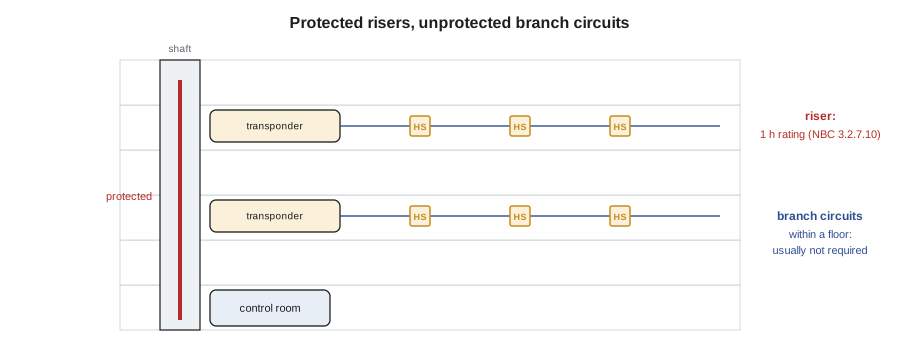
In Canada, the National Building Code, Article 3.2.7.10, requires certain conductors in high buildings and some other buildings to be protected against fire. For fire alarm systems, the conductors from the emergency power source to the fire alarm control units, transponders and annunciators, and the conductors connecting control units, transponders and annunciators in different fire compartments, must have a fire protection rating of at least 1 hour. This is done either with cable that has a circuit integrity rating of at least 1 hour under CAN/ULC-S139, or by running the conductors in a service space separated from the rest of the building by a 1-hour fire separation. Branch circuits within a storey are exempt. At Riverlight Tower, the risers between the control room and the transponders on the 6th and 12th floors are circuit integrity cable.
Circuit integrity cable is tested as a system, with its supports, and is listed for a fire rating when installed exactly as its listing describes: specific supports at specific spacings, specific conduit or none, specific splices or none. A rated cable installed on ordinary cable ties, which melt, may not keep its rating. The listing's installation instructions are part of the rating.
Splices, terminations and records
Splices in fire alarm wiring are made in accessible boxes with listed connectors, and kept to a minimum. Each splice is a potential point of failure, and splices hidden in ceilings make faults hard to find. Conductors are terminated on the devices' in and out terminals so that the circuit remains supervised. Conductors are labelled at the panel and at junction boxes with their circuit and address ranges, and the as-built drawings show the actual routing, so that the next technician can trace a circuit without guesswork.
At the end of an installation, the field wiring is tested before devices are connected: for continuity, for shorts between conductors, and for grounds, with the results recorded. These tests catch damaged cable, crossed conductors and missing connections early, when they are easy to fix.
Worked problem
The Riverlight corridor walk-through
During the renovated floor's walk-through at Riverlight Tower, Captain Strand and Sasha list what they find above the corridor ceiling. What needs to be corrected?
Show solution
- A fire alarm cable supported from the sprinkler branch line: re-support it from the structure on its own hangers.
- A loop of fire alarm cable lying loose on the ceiling tiles near the elevator lobby: support it properly.
- A cable passing through the rated wall into the stair vestibule through an open, unsealed hole: install the listed firestop system.
- A junction box with fire alarm conductors that also contains a lighting circuit's splice: separate the systems into their own boxes.
Answer: The electrical contractor corrects all four items before the floor's verification. Sasha photographs each correction for the record, and the cable's legend is checked to confirm it is the listed type the design specified.
Wiring for special locations
Some locations need more than ordinary fire alarm cable. Outdoor runs, such as those to a parking structure, a detached building or a gate, need cable and appliances listed for wet locations, and underground runs need cable listed for direct burial or installed in a raceway that is considered a wet location. Cable through areas with corrosive vapours, such as pool equipment rooms, needs a jacket that resists them. Cable through hazardous locations, where flammable gases or dusts may be present, must follow the electrical code's rules for those locations, which may require specific wiring methods and seals. In each case the design identifies the location, and the technician confirms that the installed cable's legend shows the right listing.
Cable that leaves one building and enters another also brings a risk that most fire alarm wiring doesn't: lightning and ground potential differences between buildings. Circuits between buildings may need surge protection at each end, as the panel's maker specifies, and some designers use fibre-optic links between buildings' panels to avoid the problem altogether. At the Cartwright Distribution Centre, the guard house at the truck gate is connected to the main panel by a fibre link for exactly this reason.
Inspecting someone else's wiring
Fire alarm technicians often take over systems wired by other contractors, or work on renovations where the electrical contractor installed the cable. Before terminating and testing, the technician inspects what is there. Cable jackets are read to confirm the cable type matches the design and the space. Supports are checked above open ceilings. Penetrations through rated walls and floors are checked for firestopping. Boxes are opened to look for splices, shared boxes and conductors damaged during pulling. The riser and any other circuits that need fire protection are checked against their listed installation method.
Problems found before termination are cheap to fix: the electrician corrects them while the ceilings are still open and the scaffolding is still up. Problems found at verification, with the ceilings closed and the tenant moving in, are expensive, and problems found after a fire are worse. Sasha's notes from the Riverlight walk-through, with photographs and locations, go to the electrical contractor the same day, and the corrections are photographed before the ceilings close.
The same inspection applies to existing systems before they are extended. Old cable may be in good condition but of a type no longer permitted in the space after a change of use, such as general-purpose cable in a ceiling that has become a return air plenum during a renovation. Old risers may not meet today's protection requirements; whether they must be upgraded depends on the scope of the work and on the authority having jurisdiction, and the designer settles that question before work starts.
Finally, the technician records what was found. The as-built drawings show the cable types, routes and any protected circuits, so that the next person to work on the system knows which cables must not be disturbed, which supports are part of a listed fire-rated installation, and where the splices are. A fire-rated riser that someone later reroutes or re-supports with ordinary ties loses its rating without anyone noticing, unless the records make its status clear.
Gerry's last piece of advice on wiring is practical. Keep a photograph of every cable legend on every job. When a question comes up two years later about what cable was installed in a riser, the photograph answers it in seconds, without opening a wall.
Common mistakes
MistakeSupporting fire alarm cable from sprinkler pipes, ductwork or ceiling grid wires.
InsteadSupport it from the building structure on its own supports.
MistakeJudging cable by its red colour.
InsteadRead the jacket legend for its listing and rating.
MistakeRunning power-limited fire alarm conductors with power circuits.
InsteadKeep them separate as the electrical code requires.
MistakeInstalling circuit integrity cable on ordinary supports.
InsteadFollow the cable's listed installation instructions exactly.
MistakeLeaving cable penetrations through rated walls unsealed.
InsteadUse a listed firestop system.
Summary and key terms
- CEC Section 32, CAN/ULC-S524 and the NBC govern fire alarm wiring in Canada.
- Fire alarm cable is marked FAS with a flame rating such as FT4 or FT6.
- Most fire alarm circuits are power-limited and must be kept separate from power circuits.
- Cable is supported from the structure, protected from damage and firestopped through rated walls.
- NBC 3.2.7.10 requires 1-hour protection for certain fire alarm conductors in high buildings.
- Splices are minimized, accessible and recorded.
- Power-limited circuit
- A circuit whose energy is limited by its listed power source.
- Circuit integrity cable
- Cable listed to keep working for a stated time in a fire when installed as listed.
- Firestop system
- A listed method of sealing a penetration so that a wall or floor keeps its fire rating.
- Jacket legend
- The printing on a cable's jacket that shows its type, ratings and listing.
- Riser
- Wiring that runs vertically between floors.
- Survivability
- The ability of a circuit to keep working while exposed to fire.
Practice problems
Work each problem on paper first, then reveal the answer to check.
What flame rating would you expect on fire alarm cable in most areas of a building?
Show answer
FT4.
How long must certain fire alarm conductors in a high building be protected under NBC 3.2.7.10?
Show answer
At least 1 hour.
Name two ways of meeting that requirement.
Show answer
Circuit integrity cable rated to CAN/ULC-S139, or a service space with a 1-hour fire separation.
Why isn't red colour enough to identify fire alarm cable?
Show answer
The jacket legend shows its listing and ratings.
Lesson quiz · 5 questions
Score 60% or more to complete this lesson.
Create a free account to save your progress, take quizzes and earn a certificate.