
FAT-130 · Lesson 10 of 12 · 20 min
Supervision: end-of-line devices and ground faults
The trouble at Eastview General Hospital has been coming and going for three weeks. The panel reports a ground fault, the night staff call Bramwell, and by the time a technician arrives the fault has cleared. Donna Achebe finally assigns Sasha to sit with the panel on a damp evening with a meter and a set of drawings. 'Ground faults are the most annoying trouble in the trade,' Gerry tells her, 'and the most important one to find. One ground doesn't stop anything working. Two can stop a circuit, or set off an alarm.' This lesson covers how fire alarm panels supervise their circuits: end-of-line devices on initiating and notification circuits, how panels tell opens from shorts, ground fault detection, and how to track faults down.
Why circuits are supervised
A fire alarm circuit spends almost all its life doing nothing. A notification circuit might sit idle for years between fires and tests. If a conductor broke, a terminal came loose, or someone cut a cable during a renovation, nobody would know until the circuit was needed. Supervision solves this by passing a small current through every supervised circuit all the time and watching it. A change in that current means a fault, and the panel reports it as a trouble so that a technician can fix it before the circuit is needed.
CAN/ULC-S524 requires the wiring of initiating, notification and signalling line circuits to be supervised so that an open, a short or a ground fault results in a trouble signal, and sets the circuit configurations allowed. FAT-210 covers circuit classes in detail.
End-of-line resistors on initiating circuits
On a conventional initiating device circuit, an end-of-line resistor at the far end of the circuit completes the supervisory loop. The panel applies a voltage and measures the current. With the resistor in place and the wiring intact, a known current flows: the normal condition. If a conductor breaks, the current falls to zero: an open, reported as a trouble. When a detector or manual station operates, it connects a lower resistance across the pair, and the current rises into the alarm range. A dead short, with almost no resistance, raises the current further; some panels report that as a trouble rather than an alarm, and others treat it as an alarm, depending on their design and the circuit's class.
The resistor's value is chosen by the panel's maker, and only that value works. A 4.7 kΩ resistor on a panel designed for 3.9 kΩ may produce a slightly different current that the panel still reads as normal, or it may sit near a threshold and cause intermittent troubles. The installation manual lists the correct value, and replacement resistors must match. Many panels use an end-of-line resistor in a listed plate or module so that it can't be lost or swapped.
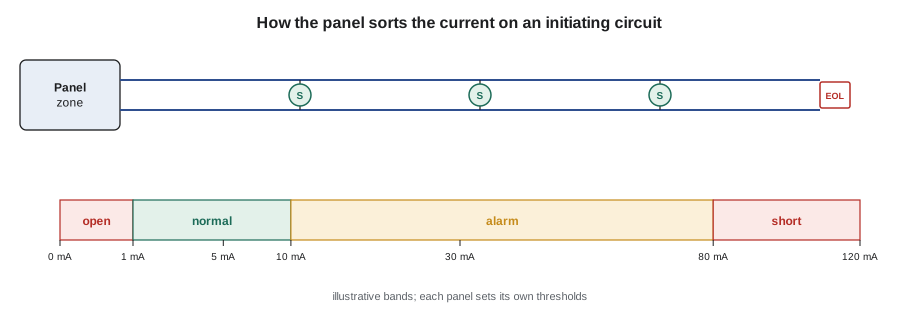
# Classify an idle initiating circuit from its measured current (illustrative thresholds)
V = 24.0
EOL = 4700.0
def state(mA):
    if mA < 1.0: return "open: trouble"
    if mA < 10.0: return "normal"
    if mA < 80.0: return "alarm"
    return "short: trouble"
print(f"normal current through the {EOL:.0f} ohm resistor: {V / EOL * 1000:.2f} mA")
for mA in (0.0, 5.1, 6.6, 32.0, 240.0):
print(f" {mA:6.1f} mA -> {state(mA)}")normal current through the 4700 ohm resistor: 5.11 mA
0.0 mA -> open: trouble
5.1 mA -> normal
6.6 mA -> normal
32.0 mA -> alarm
240.0 mA -> short: troubleSupervising notification circuits
Notification appliances are polarized: each contains a diode, or circuitry that behaves like one, so that it draws current only when the voltage is applied in one direction. The panel uses this to supervise the circuit while it is idle. In standby, the panel applies a small voltage of reversed polarity, so that the appliances don't operate, and a small supervisory current flows through the wiring to the end-of-line resistor and back. The panel watches the current exactly as it does on an initiating circuit: zero means an open, and a large current means a short. In alarm, the panel switches the polarity and applies full power, and the appliances operate.
A short on an idle notification circuit is reported as a trouble. A short that develops during an alarm would draw enough current to trip the circuit's protection, so the panel protects itself and reports the fault, and the appliances on that circuit stop. This is one reason designers spread a space's appliances across more than one circuit in important areas, so that a single failure doesn't silence a whole space.
Because the appliances' diodes block current in standby, a technician who measures an idle notification circuit with an ohmmeter, with the panel disconnected, will read roughly the end-of-line resistor plus the wire in one polarity, and a different value in the other, as the meter's own small voltage turns the appliance diodes on. Reversing the meter leads and seeing the reading change confirms that appliances are connected.
Signalling line circuits
Addressable signalling line circuits are supervised by communication. The panel polls every device in turn, and each answers. A device that stops answering is reported as missing. A short across the loop stops all communication beyond it, and an open breaks the loop. On a loop wired so that both ends return to the panel, the panel can talk to every device from both ends, so a single open doesn't lose any devices: the panel reports the open as a trouble and keeps working. Short-circuit isolators, built into many devices or installed as separate modules, open the loop on either side of a short, so that only the devices between two isolators are lost. FAT-210 covers these arrangements.
Ground faults
A fire alarm panel's DC circuits are not connected to ground. They float, and the panel watches for any leakage from them to ground, usually by measuring the voltage between each side of its DC supply and the building's ground, or by injecting a small test current. When a field conductor touches something grounded, such as a metal back box, a conduit, a sprinkler pipe or a building's steel, the panel detects the leakage and reports a ground fault trouble.
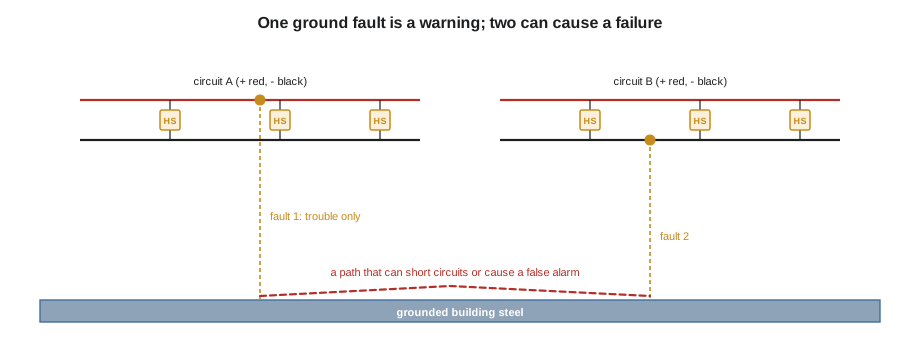
One ground fault by itself doesn't stop a circuit from working, because the circuit has no other connection to ground to complete a path. A second ground fault on another conductor does: if the positive conductor of one circuit and the negative conductor of another both touch grounded metal, there is now a path between them through the building's ground. That path can act as a short circuit, or it can connect an initiating circuit in a way that the panel reads as an alarm. This is why ground faults are reported, and why they must be found and fixed promptly.
Panels detect ground faults below a resistance threshold, which the maker specifies; a typical panel reports a fault when the leakage resistance falls below somewhere in the range of tens of kilohms. Water is a common cause: condensation in a back box in an unheated space, a leaking roof above a ceiling, a cable pulled through a wet slab. That is why ground faults often come and go with the weather, as Eastview's did.
Tracking down a ground fault
Finding a ground fault is a process of elimination. The panel may show which side of its supply has the leakage, and some panels identify the circuit or address. If not, the technician disconnects circuits one at a time, with the monitoring station informed and the building aware that circuits are out of service, and watches for the fault to clear. Once the circuit is found, it is divided: disconnect at a midpoint, test each half with a meter or an insulation tester, and keep halving until the fault is located. A multimeter on its resistance range, measuring from each conductor to ground with the circuit disconnected at both ends, can find a solid fault; an intermittent or high-resistance fault often needs an insulation tester at 250 or 500 volts, with every device disconnected.
# Halving search for a ground fault: insulation readings per section (illustrative)
sections = ["panel to box 3", "box 3 to box 6", "box 6 to box 9", "box 9 to EOL"]
readings_megohm = [550.0, 480.0, 0.04, 610.0]      # conductor to ground, devices disconnected
for name, mohm in zip(sections, readings_megohm):
    flag = "  <- fault" if mohm < 1.0 else ""
print(f"{name:16s} {mohm:8.2f} Mohm{flag}")panel to box 3 550.00 Mohm box 3 to box 6 480.00 Mohm box 6 to box 9 0.04 Mohm <- fault box 9 to EOL 610.00 Mohm
When the faulted section is found, the technician inspects every box and fitting in it. Common finds are a conductor's insulation nicked by a sharp box edge, a staple driven through a cable, a splice that touches the box, water in a box, and a device whose wiring has been pinched by its mounting screws.
Worked problem
The Eastview ground fault
On a wet evening, the Eastview panel reports a ground fault on its negative side. Sasha disconnects notification circuits one at a time and finds the fault clears when NAC 4, serving the east parking structure's stairs, is disconnected. With all appliances removed, an insulation test of the circuit shows 0.05 MΩ from the negative conductor to ground; the positive reads over 500 MΩ. What next?
Show solution
- The fault is on the negative conductor of NAC 4.
- She divides the circuit at its midpoint junction box and tests each half; the far half reads 0.05 MΩ, the near half over 500 MΩ.
- Dividing again narrows it to the section between the third and fourth stair landings.
- The back box on the fourth landing is full of water: the parking structure's drain above it is blocked, and rain runs down the wall.
Answer: Sasha dries the box, replaces the corroded appliance, has the building's maintenance staff clear the drain, and fits a weatherproof box and appliance listed for damp locations. The insulation test reads over 500 MΩ, the ground fault clears, and the deficiency report recommends listed outdoor appliances for the whole stairwell.
Troubles, alarms and what the panel can't tell you
A panel reports what it can measure, and it can't measure everything. An end-of-line resistor installed at the wrong place, for example at the first device instead of the last, gives a perfectly normal supervisory current, but every device beyond the resistor is unsupervised: a break in that part of the circuit would never be reported. A conductor connected to a device's terminal by a single strand gives a normal reading until the strand breaks. A detector that has been removed from a conventional zone's base, on a base designed to keep the circuit continuous, doesn't cause a trouble at all. These are why verification includes physically confirming the location of every end-of-line device and testing that removing a device or opening a conductor at the far end causes a trouble.
Panels also report troubles that aren't faults in the wiring: a device with dirty optics, a module with a failed processor, a power supply with a failed charger. The trouble message on an addressable panel usually names the device and the condition, which saves time. On a conventional panel, the message is just the zone, and the technician works from the zone's drawings.
When a trouble clears by itself, it is recorded and investigated rather than dismissed. Intermittent troubles are early warnings of conditions that will eventually become permanent faults, and they are much easier to find when the technician knows when they happened and what the weather or the building was doing at the time. Many panels keep a history log with the time of each trouble and its clearing, which is the first thing to read on an intermittent call.
Common mistakes
MistakeReplacing an end-of-line resistor with a different value.
InsteadUse only the value the panel's maker specifies.
MistakeIgnoring a ground fault because the system still works.
InsteadA second ground fault can cause a short or a false alarm.
MistakeRunning an insulation test with devices connected.
InsteadDisconnect every device first.
MistakeDisconnecting circuits to find a fault without notifying the monitoring station.
InsteadPut the account on test and tell the building.
MistakeAssuming an intermittent ground fault has fixed itself.
InsteadIntermittent faults often follow moisture; find the cause.
Summary and key terms
- Supervision passes a small current through circuits and reports changes as troubles.
- End-of-line resistors set the normal supervisory current; only the maker's value works.
- Notification circuits are supervised with reversed polarity in standby.
- Signalling line circuits are supervised by polling; isolators limit the effect of shorts.
- Ground faults are reported because two of them can cause a failure.
- Ground faults are found by elimination and halving, often with an insulation tester.
- End-of-line resistor
- A resistor at the end of a circuit that sets its supervisory current.
- Open
- A break in a circuit, reported as a trouble.
- Reverse-polarity supervision
- Supervising an idle notification circuit with reversed voltage so the appliances do not operate.
- Ground fault
- An unintended connection between a circuit conductor and ground.
- Short-circuit isolator
- A device that opens a signalling line circuit on either side of a short.
- Halving search
- A fault-finding method that divides a circuit repeatedly to locate a fault.
Practice problems
Work each problem on paper first, then reveal the answer to check.
What current flows through a 3.9 kΩ end-of-line resistor at 24 V?
Show answer
About 6.2 mA.
What does a zero supervisory current on an idle circuit indicate?
Show answer
An open.
Why doesn't a single ground fault stop a circuit from working?
Show answer
The circuit has no other connection to ground to complete a path.
How does a panel supervise an idle notification circuit without operating the appliances?
Show answer
It applies reversed polarity, which the appliances block.
A circuit's far half tests at 0.1 MΩ to ground and the near half at 600 MΩ. Where is the fault?
Show answer
In the far half.
Lesson quiz · 5 questions
Score 60% or more to complete this lesson.
Create a free account to save your progress, take quizzes and earn a certificate.