
ENGG-404 · Lesson 8 of 12 · 22 min
Workplace safety, environmental and employment law
Contract and tort law are private law: they settle disputes between parties. A large part of the law that shapes engineering work is public law instead. Occupational health and safety legislation tells employers, supervisors, owners and workers what they must do to keep people alive on site. Environmental legislation decides whether a project may proceed at all and on what conditions. Employment law governs the engineer's own job. Breaking these laws is usually an offence, prosecuted by the state, with fines and sometimes jail. This lesson surveys the three areas as they affect engineers, again through the Northbridge bridge.
The professional practice exams test this material because engineers are so often the people who design the temporary works, specify the protective measures, write the environmental management plan or supervise the crew. Many of the duties fall on whoever directs the work, and engineers frequently do.
Occupational health and safety: the framework
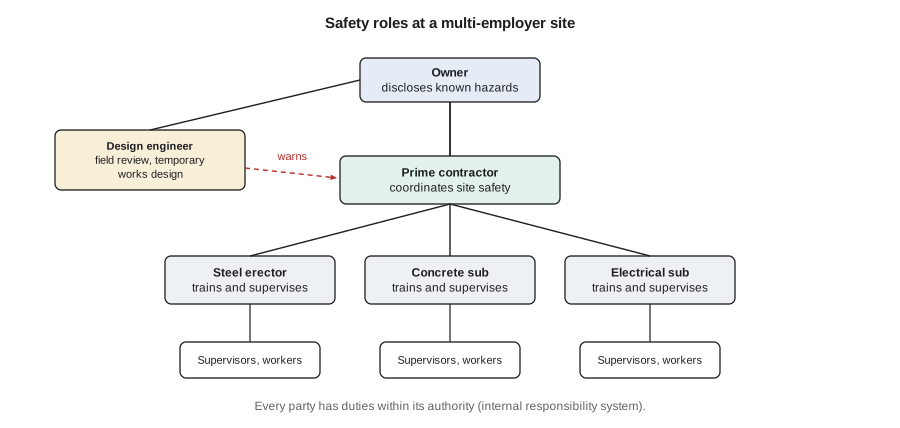
In Canada, occupational health and safety is mostly provincial. Each province and territory has an act and regulations; in Saskatchewan these are Part III of The Saskatchewan Employment Act and The Occupational Health and Safety Regulations, 2020. Federally regulated workplaces, such as railways, interprovincial pipelines, airlines and banks, fall under Part II of the Canada Labour Code instead. The provincial schemes share a philosophy called the internal responsibility system: everyone in the workplace, from the owner to the newest worker, is responsible for safety within their authority, and government inspectors audit and enforce rather than manage safety themselves.
Workers have three basic rights under every Canadian scheme: the right to know about hazards, the right to participate in health and safety through committees and representatives, and the right to refuse work they have reasonable grounds to believe is unusually dangerous, without reprisal. Employers must provide a safe workplace, train and supervise workers, and provide and require the use of protective equipment. Supervisors must ensure that workers follow the rules and must be competent to supervise.
Multi-employer sites and the engineer's role
Construction sites have many employers at once. Saskatchewan, like most provinces, makes one party responsible for coordinating safety at a multi-employer worksite: in Saskatchewan the prime contractor, in Ontario the constructor. The owner usually designates the general contractor as prime contractor by contract; if it does not, the owner may hold the role itself. Owners also have duties of their own, such as disclosing known hazards on the site.
Engineers enter this picture in several ways. Regulations in many provinces require that certain temporary works, such as falsework, formwork above a set height, engineered fall protection systems, shoring of deep excavations and some scaffolds, be designed by a professional engineer, and that the engineer or a competent person inspect them before use. An engineer who designs these is responsible for the design; an engineer who reviews the contractor's temporary works submittal may take on responsibility depending on what the review covered. Consulting engineers doing field review are generally not the employer or prime contractor, but they must not ignore a danger they see: codes of ethics and, increasingly, regulators expect them to warn the person in control and, if necessary, the authorities.
When safety failures become crimes
Most occupational health and safety offences are strict liability offences. The prosecution does not have to prove intent; once it proves the prohibited act, the accused is convicted unless it shows due diligence, meaning that it took all reasonable care to prevent the event, as the Supreme Court of Canada explained in R. v. Sault Ste. Marie (1978). Due diligence is proved with evidence: hazard assessments, written procedures, training records, inspections, supervision and discipline. A safety program that exists on paper but is not enforced rarely succeeds.
Serious failures can also be crimes. After the Westray mine explosion in Nova Scotia killed 26 miners in 1992 and no one was convicted, Parliament amended the Criminal Code in 2004 (the Westray amendments, Bill C-45). Section 217.1 now provides that everyone who undertakes, or has the authority, to direct how another person does work is under a legal duty to take reasonable steps to prevent bodily harm to that person or anyone else arising from the work. Organizations can be convicted of criminal negligence based on the conduct of their senior officers. In R. v. Metron Construction Corporation, after a swing stage collapsed in Toronto on Christmas Eve 2009 and four workers fell to their deaths, the company pleaded guilty to criminal negligence and the Ontario Court of Appeal raised its fine to $750,000 in 2013. The project manager, Vadim Kazenelson, was convicted of criminal negligence causing death in 2015 and sentenced to three and a half years in prison.
For engineers, the practical point is that the duty attaches to authority. An engineer who directs how work is done, approves a work method, or supervises a crew is someone who can be charged if workers are hurt because reasonable steps were not taken. The defence is the same as in any negligence case: do the work competently, document it, and do not let schedule pressure override a safety concern.
Measuring safety performance
Owners and engineers often evaluate contractors partly on safety statistics. The common measures count injuries per 200,000 hours worked, roughly the hours of 100 full-time workers in a year, which lets companies of different sizes be compared. The program computes the usual rates for the bridge contractor's crew.
# Safety performance for the bridge contractor's crew over the project.
# Rates are normalized to 200,000 hours (100 workers x 40 h x 50 weeks).
hours = 41_600                 # total hours worked on site
recordable = 2                 # injuries needing more than first aid
lost_time = 1                  # injuries causing days away from work
days_lost = 9
near_misses = 14

def rate(count, hours):
    return count * 200_000 / hours

print(f"Hours worked:              {hours:,}")
print(f"Total recordable rate:     {rate(recordable, hours):.2f}")
print(f"Lost-time injury rate:     {rate(lost_time, hours):.2f}")
print(f"Severity (days per 200k h): {rate(days_lost, hours):.1f}")
print(f"Near misses per injury:    {near_misses / recordable:.0f}")

# Small hour totals make rates jumpy: one more injury changes a lot.
print(f"With one more recordable: {rate(recordable + 1, hours):.2f}")Hours worked: 41,600 Total recordable rate: 9.62 Lost-time injury rate: 4.81 Severity (days per 200k h): 43.3 Near misses per injury: 7 With one more recordable: 14.42
The last line shows the main weakness of these numbers. On a small project, one additional injury changes the rate by half, so rates mean little without large hour totals or several years of data. Leading indicators, such as near-miss reporting, inspections completed and training delivered, often say more about a small contractor's safety culture than lagging injury rates. A high near-miss count is usually a good sign: it means workers are reporting problems before someone is hurt.
Environmental law
Environmental jurisdiction in Canada is shared. The provinces regulate most land use, emissions, waste and water within their borders; in Saskatchewan the main statutes are The Environmental Assessment Act, which requires approval before a development likely to have significant environmental effects proceeds, and The Environmental Management and Protection Act, 2010. The federal government regulates matters within its powers, notably fisheries, navigation, federal lands and toxic substances. The Fisheries Act prohibits the deposit of deleterious substances into water frequented by fish and works that cause the harmful alteration, disruption or destruction of fish habitat without an authorization. The Canadian Navigable Waters Act governs works in navigable waters. The federal Impact Assessment Act applies to designated major projects; the Supreme Court of Canada found its core scheme partly unconstitutional in a 2023 reference, and Parliament amended it in 2024.
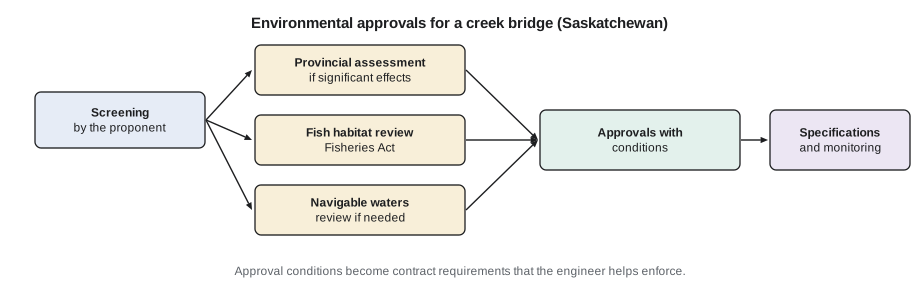
For the Clearwater bridge, the abutments sit outside the creek, but construction access and a temporary crossing affect the channel. Northbridge's environmental subconsultant screens the project: it is unlikely to need a full provincial environmental impact assessment, but it needs a fish habitat review, an in-water work window to protect spawning, erosion and sediment controls, and a spill response plan. Those requirements become specification clauses, and the contractor's compliance becomes something Northbridge monitors during field review.
Environmental offences, like safety offences, are mostly strict liability with a due diligence defence, and many statutes make directors and officers personally liable if they direct, authorize or acquiesce in an offence, or fail to take reasonable care to prevent it. Fines under modern federal statutes can reach millions of dollars for corporations, with minimum fines for serious offences.
Engineers have a further role beyond compliance. Codes of ethics in both countries ask engineers to consider environmental and sustainability effects in their work and to advise clients of them, even where no statute applies. An engineer who sees that a client's plan will breach an environmental law must advise the client, and if the breach would endanger the public, may have to go further, as lesson 10 discusses.
Employment law and the engineer's own job
Most engineers are employees, so employment law governs their own working lives. Provincial employment standards legislation, in Saskatchewan Part II of The Saskatchewan Employment Act, sets minimum terms for hours, overtime, vacation, leave and notice of termination, although professional employees are often exempt from some hours and overtime rules. Human rights codes prohibit discrimination and harassment on grounds such as sex, race, religion, disability and age, and require accommodation to the point of undue hardship.
At common law, an employer that dismisses an employee without just cause must give reasonable notice or pay in lieu, unless a valid contract term limits it. The factors from Bardal v. Globe & Mail (1960), the character of the employment, length of service, age and the availability of similar work, determine how much notice is reasonable, and senior professionals with long service can be entitled to many months. Restrictive covenants that stop a departing employee from competing are enforced only if reasonable and unambiguous; in Shafron v. KRG Insurance Brokers (2009) the Supreme Court refused to rewrite an ambiguous one, and Ontario has banned most non-compete clauses in employment since 2021. Departing employees remain bound by confidentiality, and senior employees may owe fiduciary duties not to take corporate opportunities with them.
Employment law intersects with professional obligations in an important way. An engineer's paramount duty is to the public, not to the employer. An engineer who is told to approve an unsafe design, sign off work she has not reviewed, or hide a safety problem must refuse, even at the risk of her job. Employment law and whistleblower statutes give some protection, which varies by jurisdiction and sector, and engineering regulators have published guidance supporting engineers in this position. Lesson 10 returns to how to handle these conflicts.
Worked problem
A temporary crossing and a refusal
During construction of the Clearwater bridge, the contractor's superintendent wants to remove two shoring frames from the temporary creek crossing early to keep a crane moving. Daniel Ruiz, EIT, on site for field review, sees that the frames are on the temporary works engineer's drawings as required until the deck pour is complete. A labourer tells Daniel that she refused to work under the crossing and was told she would be sent home without pay.
Show solution
- The prime contractor and employer are responsible for site safety, and the temporary works engineer's design governs the shoring. Northbridge is not the employer, but Daniel has seen a likely danger.
- Daniel should tell the superintendent immediately that removing the frames departs from the temporary works drawings, and that only the temporary works engineer can approve a change. He should call Maya Okafor at once.
- Northbridge should confirm the warning in writing to the contractor and owner the same day. If the contractor proceeds anyway and workers are at risk, Northbridge should contact the provincial occupational health and safety inspectors.
- The labourer's refusal is protected: she had reasonable grounds, and sending her home without pay may be a prohibited reprisal. That is between her and her employer, but Daniel can tell her that inspectors will investigate a complaint.
Answer: Northbridge does not run the site, but it must warn the party in control, document the warning and escalate to the regulator if a danger to workers continues.
Common mistakes
MistakeOnly employers have safety duties on a construction site.
InsteadOwners, prime contractors, supervisors, workers and anyone who directs work all have duties.
MistakeA written safety manual proves due diligence.
InsteadDue diligence requires a program that is actually implemented, enforced and documented.
MistakeDesign engineers never have safety responsibilities.
InsteadEngineers who design temporary works or direct work have duties, and all engineers must warn of dangers they see.
MistakeEnvironmental approval is the owner's problem, not the engineer's.
InsteadEngineers translate approval conditions into specifications and monitor compliance.
MistakeAn employer can require an engineer to approve work she believes is unsafe.
InsteadThe duty to the public comes first; the engineer must refuse.
Summary and key terms
- OHS is mostly provincial, with the Canada Labour Code for federal workplaces; the internal responsibility system makes everyone responsible.
- Workers have rights to know, participate and refuse unsafe work; the prime contractor coordinates multi-employer sites.
- Engineers who design temporary works, approve methods or direct work carry legal duties.
- Strict liability offences allow a due diligence defence; Criminal Code s. 217.1 imposes a duty on anyone who directs work.
- Injury rates per 200,000 hours are unreliable for small projects; leading indicators help.
- Environmental approvals come from both provinces and Ottawa, including Fisheries Act and navigable waters reviews.
- Dismissal without cause requires reasonable notice; restrictive covenants must be reasonable and clear.
- The duty to the public overrides the employer's instructions.
- Internal responsibility system
- The principle that everyone in a workplace shares responsibility for safety within their authority.
- Prime contractor
- The party responsible for coordinating safety at a multi-employer worksite.
- Due diligence
- Taking all reasonable care to prevent an offence, a defence to strict liability charges.
- Strict liability offence
- An offence proved by the act alone, subject to a due diligence defence.
- Total recordable rate
- Recordable injuries per 200,000 hours worked.
- Leading indicator
- A measure of safety activity, such as inspections or near-miss reports, that predicts future performance.
- Environmental assessment
- A review of a proposed development's environmental effects before approval.
- Reasonable notice
- The notice of dismissal, or pay in lieu, owed to an employee dismissed without cause.
Practice problems
Work each problem on paper first, then reveal the answer to check.
What does the internal responsibility system mean?
Show answer
Everyone in the workplace is responsible for safety within their authority, with inspectors auditing rather than managing.
How would the total recordable rate change if the crew worked 83,200 hours with the same two injuries?
Show answer
It would halve, from 9.62 to 4.81.
What evidence supports a due diligence defence?
Show answer
Hazard assessments, procedures, training records, inspections, supervision and enforcement.
What does Criminal Code section 217.1 require?
Show answer
Anyone who directs how another person works must take reasonable steps to prevent bodily harm.
Which federal statute protects fish habitat affected by a bridge?
Show answer
The Fisheries Act.
Why is a high near-miss count often a good sign?
Show answer
It shows workers report hazards before someone is hurt.
Lesson quiz · 5 questions
Score 60% or more to complete this lesson.
Create a free account to save your progress, take quizzes and earn a certificate.