
ENGG-404 · Lesson 2 of 12 · 24 min
The Canadian legal system
Engineers do not need to become lawyers, but they do need a working map of the legal system. When a client sends a contract, when a regulator opens a file, when a site accident triggers an investigation or when a bridge owner sues, the engineer who understands where the rules come from, which court will hear the case and what the other side must prove is far better placed to protect the public, the firm and themselves. This lesson draws that map.
Canada has two legal traditions. Quebec private law is based on the civil law tradition, codified in the Civil Code of Québec, while the other provinces and territories, and federal law, follow the common law tradition inherited from England. Over both sits a written constitution that divides power between Parliament and the provinces and protects rights through the Canadian Charter of Rights and Freedoms. Indigenous legal orders, and the constitutional protection of Aboriginal and treaty rights in section 35 of the Constitution Act, 1982, add a third strand that matters a great deal for infrastructure projects.
As in lesson 1, nothing here is legal advice. It is a general description meant to help you recognize issues and talk to lawyers usefully.
Sources of law
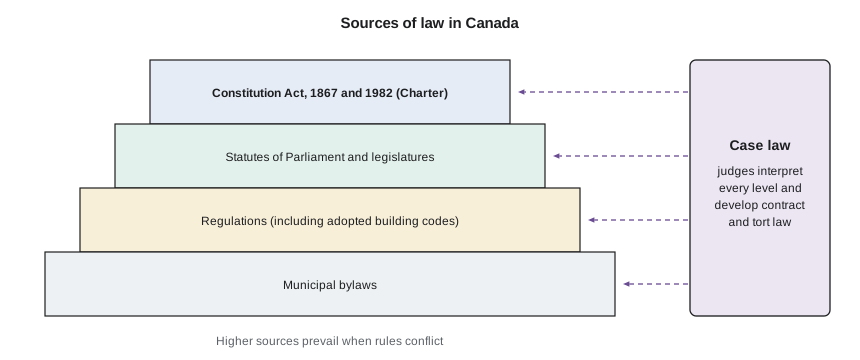
Law comes from a small number of sources, ranked in a clear order. When two rules conflict, the higher source wins.
At the top is the Constitution. The Constitution Act, 1867 divides legislative power: Parliament has authority over matters such as criminal law, navigation and shipping, interprovincial railways and works, and federal lands, while the provinces have authority over property and civil rights, local works, municipal institutions and the regulation of professions. That is why your licence is provincial, why most construction and contract law is provincial, and why a bridge over a navigable river may also need federal approval under the Canadian Navigable Waters Act. The Charter protects rights such as freedom of expression and equality against government action; it rarely touches private contracts but can matter when an engineer's speech is disciplined by a regulator.
Next come statutes: acts passed by Parliament or a provincial legislature, such as a provincial engineering act, an occupational health and safety act, a builders' lien act or the federal Impact Assessment Act. Statutes often authorize regulations, detailed rules made by cabinet or a minister, such as the regulations under a professional engineers act that set out licensing requirements and the code of ethics. Building codes are a special case: the National Building Code of Canada is a model code with no force of its own until a province adopts it, with or without changes, as a regulation. Municipal bylaws, made under authority delegated by the province, sit below provincial law.
Finally there is case law, the body of rules made by judges when they decide disputes. In the common law tradition, judges do more than apply statutes; they develop whole areas of law, such as contract and negligence, case by case. Judges also interpret statutes and decide whether laws are constitutional, and those interpretations become part of the law.
Precedent and how judges make law
The doctrine of precedent, often called by its Latin name stare decisis, means that courts follow earlier decisions on the same legal point. A lower court must follow a decision of a higher court in the same hierarchy. A court is usually expected to follow its own earlier decisions too, although top appellate courts can depart from them. Decisions from other jurisdictions are persuasive but not binding: a court may adopt reasoning from another province, state or country if it finds it convincing.
The binding part of a decision is the ratio decidendi (or holding): the legal principle needed to decide the case on its material facts. Comments that were not necessary to the result are obiter dicta, which may be influential but do not bind. Lawyers argue about which facts were material, so they can either apply a precedent to a new case or distinguish it as different. When you read a summary of a famous engineering case in this course, focus on the rule and the facts that mattered.
The civil law tradition works differently. In Quebec, the Civil Code is the primary source of private law, and judges reason from its general provisions; earlier decisions are respected and influential but do not bind in the same formal way. Quebec engineers also work under the Code's specific rules on contracts for services and enterprise, including the solidary liability of architects, engineers and contractors for the loss of a work within five years of completion, set out in article 2118.
The courts
Canada has a unified court hierarchy with the Supreme Court of Canada at the top. Each province has superior trial courts (for example, the Court of King's Bench in Saskatchewan and Alberta, the Superior Court of Justice in Ontario, and the Supreme Court of British Columbia), provincial courts for smaller civil claims and most criminal matters, and a court of appeal. The Supreme Court of Canada hears appeals from every provincial court of appeal, but only with leave, and it grants leave in a small number of cases of national importance. The Federal Court and Federal Court of Appeal handle specific federal matters such as intellectual property and judicial review of federal agencies.
| Level | Canada (Saskatchewan example) | Role |
|---|---|---|
| Top court | Supreme Court of Canada | Final appeals on questions of law |
| Appeal court | Court of Appeal for Saskatchewan | Reviews trial decisions for errors of law |
| Trial court | Court of King's Bench for Saskatchewan | Hears evidence, finds facts, applies law |
| Lower court | Provincial Court (small claims) | Smaller civil claims and minor matters |
| Tribunals | Regulator discipline committees, labour boards | Specialized decisions, subject to judicial review |
Public law and private law
Law is often divided into public law, which governs the relationship between people and the state, and private law, which governs relationships between private parties. Criminal law, constitutional law, administrative law and regulatory offences are public law. Contract, tort and property law are private law. Engineers meet both: a collapse can lead to a regulatory prosecution under safety legislation, a discipline hearing before the engineering regulator and a private lawsuit for damages, all arising from the same facts.
The three proceedings have different purposes, different parties and different standards of proof. A prosecution is brought by the state to punish and deter. A discipline hearing is brought by the regulator to protect the public. A civil action is brought by the injured party to obtain compensation. Each is decided on its own evidence, and an engineer may win one and lose another.
| Criminal or regulatory | Professional discipline | Civil lawsuit | |
|---|---|---|---|
| Brought by | The state (prosecutor) | The regulator | The injured party |
| Purpose | Punish and deter | Protect the public | Compensate |
| Standard of proof | Beyond a reasonable doubt (criminal); due diligence defence for strict liability offences | Balance of probabilities, on clear and convincing evidence | Balance of probabilities |
| Typical outcome | Fine, probation or prison | Reprimand, fine, suspension or revocation | Damages or an injunction |
Canadian criminal law is federal and found mainly in the Criminal Code. After the Westray mine explosion in Nova Scotia in 1992, which killed 26 miners, Parliament added section 217.1 to the Criminal Code in 2004. It imposes a legal duty on anyone who directs how work is done to take reasonable steps to prevent bodily harm, and it lets organizations be convicted of criminal negligence through the conduct of their senior officers. Most workplace safety prosecutions, though, are regulatory offences under provincial occupational health and safety acts. These are usually strict liability offences: the prosecutor need only prove that the prohibited act happened, and the accused avoids conviction only by proving due diligence, that it took all reasonable care, on a balance of probabilities. That rule comes from the Supreme Court of Canada's 1978 decision in R. v. Sault Ste. Marie.
Administrative law and the regulators
Much of the law that touches engineers is administered by agencies and tribunals rather than courts: licensing bodies, safety regulators, environmental agencies, labour boards and municipal permit offices. Administrative law sets the rules for how these bodies must act. They must stay within the powers their statute gives them, follow fair procedures (notably, giving a person a fair hearing before deciding against them) and make decisions that can be justified.
When an engineer disagrees with a regulator's decision, the usual route is an appeal if the statute provides one, or an application to court for judicial review. Since the Supreme Court of Canada's 2019 decision in Canada (Minister of Citizenship and Immigration) v. Vavilov, courts presume that the standard of review is reasonableness: the court asks whether the decision is justified, transparent and intelligible, not whether it would have reached the same answer. Correctness review applies to a limited set of questions, such as constitutional issues, and where the legislature provides a statutory appeal, appellate standards apply. In practice, this means discipline decisions by an engineering regulator are hard to overturn unless the process was unfair or the reasoning does not hold together.
Engineers working on infrastructure also need to know about the Crown's duty to consult. The Supreme Court of Canada held in Haida Nation v. British Columbia (2004) that when the Crown contemplates conduct that might adversely affect an Aboriginal or treaty right, whether proven or credibly asserted, it has a duty to consult and, where appropriate, accommodate the affected Indigenous peoples. The duty belongs to the Crown and cannot be delegated away, but the procedural parts of consultation are often carried out by project proponents and their consultants, including engineers, who gather information, present design options and modify designs to reduce impacts. Getting this wrong can delay or halt a project; getting it right builds relationships that last beyond it.
Limitation periods
A limitation period is the deadline for starting a lawsuit. Miss it and the claim is lost, however strong it is. Most provinces now have a general limitations statute with a basic period, typically two years from when the claimant discovered, or ought to have discovered, the injury, its cause and the identity of the person responsible, and an ultimate period, often 15 years from the act or omission, after which no claim may be brought regardless of discovery. Saskatchewan's Limitations Act follows that two-year and 15-year pattern; Ontario's Limitations Act, 2002 does too. Quebec's general period is three years. These periods can be suspended or extended in specific circumstances, and some statutes and contracts create their own deadlines, so lawyers always check the specific rules.
Engineers care about limitation periods for two reasons. First, they determine how long the firm is exposed to claims after a project ends, which affects insurance and record keeping. Second, they decide whether a claim the firm wants to bring, such as an unpaid fee, is still alive. The short program below calculates the last day to sue for three defects on the bridge under assumed rules. Real deadlines need a lawyer.
from datetime import date

# Assumed limitation rules for the example (check the current statute):
BASIC_YEARS = 2       # basic period runs from discovery
ULTIMATE_YEARS = 15   # ultimate period runs from the act or omission

def add_years(d, n):
    try:
        return d.replace(year=d.year + n)
    except ValueError:            # February 29
        return d.replace(year=d.year + n, day=28)

def deadline(act, discovered):
    basic = add_years(discovered, BASIC_YEARS)
    ultimate = add_years(act, ULTIMATE_YEARS)
    return min(basic, ultimate), basic, ultimate

claims = [
    ("Cracked deck coating", date(2027, 9, 30), date(2031, 4, 12)),
    ("Bearing corrosion", date(2027, 9, 30), date(2041, 6, 1)),
    ("Railing vibration", date(2027, 9, 30), date(2028, 2, 3)),
]
for name, act, found in claims:
    last, basic, ult = deadline(act, found)
    rule = "basic" if last == basic else "ultimate"
print(f"{name:22} discovered {found} last day to sue {last} ({rule} period)")Cracked deck coating discovered 2031-04-12 last day to sue 2033-04-12 (basic period) Bearing corrosion discovered 2041-06-01 last day to sue 2042-09-30 (ultimate period) Railing vibration discovered 2028-02-03 last day to sue 2030-02-03 (basic period)
The bearing corrosion claim shows how the ultimate period works: although the corrosion was discovered in 2041, the ultimate period, counted from completion in 2027, ended in 2042, which is earlier than the two-year basic period would allow. In a province with no ultimate period, or if the defect had been concealed, the answer could differ.
Working with lawyers
Engineers and lawyers work together often: on contracts, claims, investigations, expert evidence and regulatory compliance. A few habits make the relationship productive. Bring the lawyer in early, before you sign a contract with unusual terms or respond to a claim letter, not after. Give the lawyer the facts, the documents and the technical background, including the facts that hurt. Understand that communications with your lawyer for the purpose of legal advice are usually protected by solicitor-client privilege (in the US, attorney-client privilege), but that ordinary business records, including project emails, are not, and may be disclosed in litigation. Write project correspondence as if a judge will read it, because one may.
Worked problem
Mapping the proceedings after an incident
During construction of the Clearwater pedestrian bridge, a temporary support designed by the contractor's engineer buckles, and a worker is injured. Northbridge reviewed the contractor's temporary works submittal and returned it marked reviewed. What legal proceedings could follow, and who would bring them?
Show solution
- Regulatory: the provincial occupational health and safety regulator investigates and may prosecute the contractor, and potentially others who directed the work, for strict liability offences, with a due diligence defence.
- Criminal: if senior officers showed wanton or reckless disregard for safety, police could lay criminal negligence charges under the Criminal Code duty in section 217.1. This is rare.
- Discipline: the engineering regulator may investigate the temporary works engineer and anyone at Northbridge whose review fell below the standard.
- Civil: the injured worker's claim against the employer is usually barred by workers' compensation legislation, but claims against third parties such as Northbridge may be possible, and the owner and contractor may sue each other.
Answer: Up to four proceedings could follow, each with its own purpose and standard of proof. Northbridge should notify its insurer and lawyer at once and preserve all records.
Common mistakes
MistakeA building code applies everywhere as soon as it is published.
InsteadA model code has no legal force until a province, state or city adopts it, often with amendments.
MistakeA decision from any court binds every other court.
InsteadOnly higher courts in the same hierarchy bind; others are persuasive.
MistakeIf the engineer wins the criminal case, the civil case must fail too.
InsteadEach proceeding has its own standard of proof and evidence; outcomes can differ.
MistakeLimitation periods can always be extended if the claim is strong.
InsteadMissing a limitation period usually ends the claim regardless of merit.
MistakeEverything sent to or copied to a lawyer is privileged.
InsteadPrivilege protects communications made to get legal advice, not ordinary project records.
Summary and key terms
- Canadian law has common law and civil law traditions under a written constitution that divides federal and provincial powers.
- Law comes from the constitution, statutes, regulations, local laws and case law, in that order of priority.
- Precedent binds lower courts in the same hierarchy; the holding binds, obiter dicta do not.
- One failure can bring regulatory, criminal, discipline and civil proceedings, each with its own standard of proof.
- Courts review regulators' decisions mostly for reasonableness under Vavilov.
- The Crown's duty to consult Indigenous peoples shapes infrastructure projects.
- Limitation periods, and in the US statutes of repose, set firm deadlines for claims.
- Stare decisis
- The doctrine that courts follow earlier decisions of higher courts on the same legal point.
- Ratio decidendi
- The legal principle necessary to decide a case, which binds later courts.
- Obiter dicta
- Comments in a judgment that were not necessary to the result and do not bind.
- Statute
- A law passed by a legislature.
- Regulation
- A detailed rule made under authority delegated by a statute.
- Judicial review
- A court proceeding to examine whether a public body acted lawfully and reasonably.
- Strict liability offence
- A regulatory offence proven by showing the act occurred, unless the accused proves due diligence or a similar defence.
- Limitation period
- The deadline for starting a lawsuit.
Practice problems
Work each problem on paper first, then reveal the answer to check.
Why is a model building code not law when it is first published?
Show answer
Because only a legislature or a body with delegated authority can make law; the code takes effect when adopted.
What is the difference between the holding of a case and obiter dicta?
Show answer
The holding is the principle needed to decide the case and binds later courts; obiter dicta are other comments that do not bind.
Name the three kinds of proceeding that can follow a structural failure, apart from criminal charges.
Show answer
Regulatory prosecution or citation, professional discipline and civil lawsuits.
Rerun the limitation program with an ultimate period of 10 years. What happens to the bearing corrosion claim?
Show answer
The ultimate period ends on 2037-09-30, before discovery, so the claim is barred.
Why should project emails be written carefully?
Show answer
Because they are ordinary business records that can be disclosed and read in litigation.
Whose duty is the duty to consult, and who often carries out its procedural parts?
Show answer
The Crown's; proponents and their consultants often carry out procedural parts.
Lesson quiz · 5 questions
Score 60% or more to complete this lesson.
Create a free account to save your progress, take quizzes and earn a certificate.