
ENGG-404 · Lesson 8 of 12 · 23 min
Workplace safety, environmental and employment law
Contract and tort law are private law: they settle disputes between parties. A large part of the law that shapes engineering work is public law instead. Occupational health and safety legislation tells employers, supervisors, owners and workers what they must do to keep people alive on site. Environmental legislation decides whether a project may proceed at all and on what conditions. Employment law governs the engineer's own job. Breaking these laws is usually an offense, prosecuted by the state, with fines and sometimes jail. This lesson surveys the three areas as they affect engineers, again through the Northbridge bridge.
The professional practice exams test this material because engineers are so often the people who design the temporary works, specify the protective measures, write the environmental management plan or supervise the crew. Many of the duties fall on whoever directs the work, and engineers frequently do.
Occupational health and safety: the framework
In the United States, the Occupational Safety and Health Act of 1970 created the Occupational Safety and Health Administration (OSHA) to set and enforce workplace safety standards. About half the states run OSHA-approved state plans that cover private employers, with standards at least as effective as the federal ones; elsewhere, including Kansas and Missouri, federal OSHA enforces directly. The construction standards are in 29 CFR Part 1926 and the general industry standards in Part 1910. Where no specific standard applies, the general duty clause in section 5(a)(1) of the Act requires every employer to keep its workplace free from recognized hazards that are causing or likely to cause death or serious physical harm.
Employers must comply with OSHA standards, keep injury and illness records under 29 CFR Part 1904, train workers in hazards, and provide protective equipment. Workers have the right to file complaints, to request an inspection, and under section 11(c) of the Act to be free from retaliation for raising safety concerns; a worker who believes she was punished for doing so must generally file a complaint within 30 days. OSHA regulations also recognize a limited right to refuse work that presents an imminent danger of death or serious injury when there is no time to have the hazard corrected through normal channels.
Multi-employer sites and the engineer's role
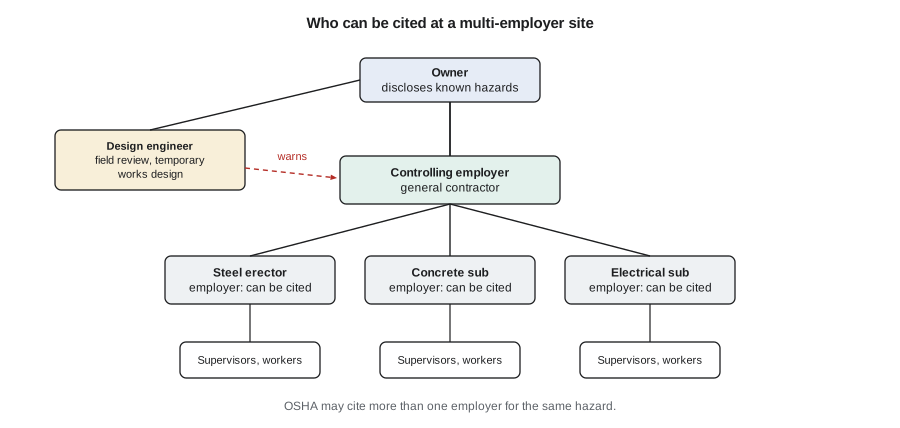
Construction sites have many employers at once. Under OSHA's multi-employer citation policy, more than one employer can be cited for the same hazard: the creating employer that caused it, the exposing employer whose workers were exposed, the correcting employer responsible for fixing it, and the controlling employer with general supervisory authority over the site, usually the general contractor. Courts have generally upheld the policy, although its application to particular parties is often contested.
Engineers enter this picture in several ways. OSHA standards require that some protective systems be designed by a registered professional engineer, for example protective systems for excavations deeper than 20 feet under 29 CFR 1926.652, and the standards rely on engineers for some formwork, shoring and steel erection decisions. An engineer who designs temporary works is responsible for the design; an engineer who reviews the contractor's submittal may take on responsibility depending on what the review covered. Design engineers doing site visits are usually not controlling employers, and standard contracts such as EJCDC and AIA forms state that the contractor alone is responsible for site safety and means and methods. But an engineer whose contract or conduct gives it authority over site safety can be cited, and codes of ethics expect an engineer who sees imminent danger to warn the party in control and, if necessary, the authorities.
When safety failures become crimes
Most OSHA citations are civil. Penalties depend on whether a violation is classified as serious, other-than-serious, willful or repeated, and maximum amounts are adjusted each year for inflation; willful and repeated violations carry penalties roughly ten times those for serious ones. Employers can contest citations before the independent Occupational Safety and Health Review Commission. A defense of unpreventable employee misconduct is available if the employer can show it had work rules designed to prevent the violation, communicated them, took steps to discover violations and enforced the rules when it found them, which in practice requires the same documentation that good safety management produces anyway.
Serious failures can also be crimes. Under section 17(e) of the OSH Act, a willful violation of a standard that causes a worker's death is a federal misdemeanor punishable by a fine and up to six months in prison, a penalty widely criticized as light. State and local prosecutors have increasingly brought charges under general criminal law instead, such as manslaughter or reckless endangerment, against contractors and individual supervisors after fatal trench collapses and falls. Federal prosecutors also use other statutes, such as making false statements to investigators. Engineers who falsify inspection reports or certify work they have not reviewed can face criminal exposure as well as discipline.
For engineers, the practical point is that the duty attaches to authority. An engineer who directs how work is done, approves a work method, or supervises a crew is someone who can be charged if workers are hurt because reasonable steps were not taken. The defense is the same as in any negligence case: do the work competently, document it, and do not let schedule pressure override a safety concern.
Measuring safety performance
Owners and engineers often evaluate contractors partly on safety statistics. The common measures count injuries per 200,000 hours worked, roughly the hours of 100 full-time workers in a year, which lets companies of different sizes be compared. The program computes the usual rates for the bridge contractor's crew.
# Safety performance for the bridge contractor's crew over the project.
# Rates are normalized to 200,000 hours (100 workers x 40 h x 50 weeks).
hours = 41_600                 # total hours worked on site
recordable = 2                 # injuries needing more than first aid
lost_time = 1                  # injuries causing days away from work
days_lost = 9
near_misses = 14

def rate(count, hours):
    return count * 200_000 / hours

print(f"Hours worked:              {hours:,}")
print(f"Total recordable rate:     {rate(recordable, hours):.2f}")
print(f"Lost-time injury rate:     {rate(lost_time, hours):.2f}")
print(f"Severity (days per 200k h): {rate(days_lost, hours):.1f}")
print(f"Near misses per injury:    {near_misses / recordable:.0f}")

# Small hour totals make rates jumpy: one more injury changes a lot.
print(f"With one more recordable: {rate(recordable + 1, hours):.2f}")Hours worked: 41,600 Total recordable rate: 9.62 Lost-time injury rate: 4.81 Severity (days per 200k h): 43.3 Near misses per injury: 7 With one more recordable: 14.42
The last line shows the main weakness of these numbers. On a small project, one additional injury changes the rate by half, so rates mean little without large hour totals or several years of data. Leading indicators, such as near-miss reporting, inspections completed and training delivered, often say more about a small contractor's safety culture than lagging injury rates. A high near-miss count is usually a good sign: it means workers are reporting problems before someone is hurt.
Environmental law
Environmental law in the United States is largely federal, with states implementing many programs. The National Environmental Policy Act (NEPA) requires federal agencies to consider the environmental effects of major federal actions, including projects they fund or permit, through a categorical exclusion, an environmental assessment or a full environmental impact statement. The Clean Water Act requires a section 404 permit from the US Army Corps of Engineers to place fill in waters of the United States, whose scope the Supreme Court narrowed in Sackett v. EPA (2023), and a section 402 stormwater permit for construction that disturbs one acre or more. The Endangered Species Act protects listed species and their critical habitat. CERCLA, the Superfund law, imposes strict, joint and several liability for cleaning up contaminated sites on current and past owners and operators, arrangers and transporters.
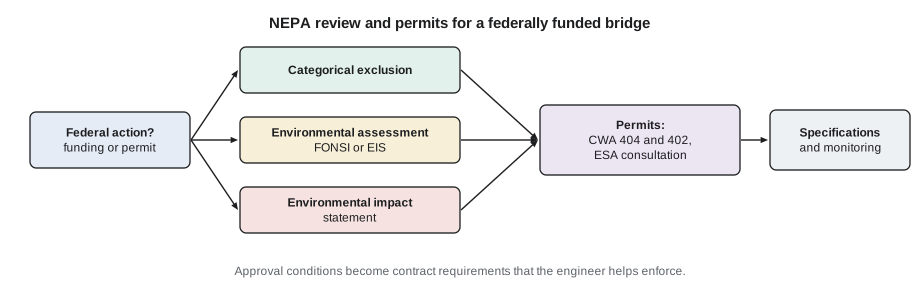
For the Westbrook bridge, the city is using federal transportation funds, so NEPA applies. The project fits a categorical exclusion for small bridge projects, documented by the state department of transportation. Construction access and a temporary crossing affect the creek, so the contractor needs Clean Water Act coverage, likely under a Corps nationwide permit, and the site disturbs more than an acre, so it needs construction stormwater permit coverage and a stormwater pollution prevention plan. Those requirements become specification clauses, and the contractor's compliance becomes something Northbridge monitors during site visits.
Environmental violations can be civil or criminal. Knowing violations of the Clean Water Act are felonies, and negligent violations are misdemeanors. Under the responsible corporate officer doctrine, from United States v. Park (1975), corporate officers with authority to prevent a violation can be held responsible even without personal participation. Engineers who falsify monitoring data or certify compliance they have not verified face personal criminal liability.
Engineers have a further role beyond compliance. Codes of ethics in both countries ask engineers to consider environmental and sustainability effects in their work and to advise clients of them, even where no statute applies. An engineer who sees that a client's plan will breach an environmental law must advise the client, and if the breach would endanger the public, may have to go further, as lesson 10 discusses.
Employment law and the engineer's own job
Most engineers are employees, so employment law governs their own working lives. Employment in most states is at will: either party can end it at any time for any reason that is not illegal. Illegal reasons include discrimination prohibited by Title VII of the Civil Rights Act of 1964, the Age Discrimination in Employment Act and the Americans with Disabilities Act, retaliation for protected whistleblowing, and in many states reasons that violate public policy, such as firing an employee for refusing to break the law. Engineers are usually exempt professionals under the Fair Labor Standards Act, so they are not entitled to overtime pay unless their employer offers it.
Restrictive covenants are governed by state law. California refuses to enforce most non-compete agreements; Kansas and Missouri enforce them if they protect a legitimate business interest and are reasonable in time and geography. A Federal Trade Commission rule that would have banned most non-competes nationwide was set aside by a federal court in 2024 and has not taken effect. Departing employees remain bound by confidentiality agreements and trade secret law, discussed in lesson 9, and may be liable for soliciting the employer's clients in breach of a valid agreement.
Employment law intersects with professional obligations in an important way. An engineer's paramount duty is to the public, not to the employer. An engineer who is told to approve an unsafe design, sign off work she has not reviewed, or hide a safety problem must refuse, even at the risk of her job. Employment law and whistleblower statutes give some protection, which varies by jurisdiction and sector, and engineering regulators have published guidance supporting engineers in this position. Lesson 10 returns to how to handle these conflicts.
Worked problem
A temporary crossing and a refusal
During construction of the Westbrook bridge, the contractor's superintendent wants to remove two shoring frames from the temporary creek crossing early to keep a crane moving. Daniel Ruiz, EI, on site for a site visit, sees that the frames are on the temporary works engineer's drawings as required until the deck pour is complete. A laborer tells Daniel that she refused to work under the crossing and was told she would be sent home without pay.
Show solution
- The contractor is responsible for site safety and means and methods, and the temporary works engineer's design governs the shoring. Northbridge is not the controlling employer, but Daniel has seen a likely danger.
- Daniel should tell the superintendent immediately that removing the frames departs from the temporary works drawings, and that only the temporary works engineer can approve a change. He should call Maya Okafor at once.
- Northbridge should confirm the warning in writing to the contractor and owner the same day. If the contractor proceeds anyway and workers are at risk, Northbridge should notify OSHA.
- The laborer's refusal may be protected, and punishing her for raising the hazard may be illegal retaliation under section 11(c). That is between her and her employer, but Daniel can tell her she can file a complaint with OSHA.
Answer: Northbridge does not run the site, but it must warn the party in control, document the warning and escalate to the regulator if a danger to workers continues.
Common mistakes
MistakeOnly employers have safety duties on a construction site.
InsteadSeveral employers can be cited for the same hazard, and anyone with authority over the work carries risk.
MistakeA written safety manual proves due diligence.
InsteadDue diligence requires a program that is actually implemented, enforced and documented.
MistakeDesign engineers never have safety responsibilities.
InsteadEngineers who design temporary works or direct work have duties, and all engineers must warn of dangers they see.
MistakeEnvironmental approval is the owner's problem, not the engineer's.
InsteadEngineers translate approval conditions into specifications and monitor compliance.
MistakeAn employer can require an engineer to approve work she believes is unsafe.
InsteadThe duty to the public comes first; the engineer must refuse.
Summary and key terms
- OSHA sets and enforces federal standards, with state plans in about half the states and a general duty clause for hazards not covered by a standard.
- Workers can complain and are protected from retaliation; the multi-employer citation policy can reach several employers.
- Engineers who design temporary works, approve methods or direct work carry legal duties.
- Most OSHA violations are civil; willful violations causing death are crimes, and states increasingly prosecute fatal incidents.
- Injury rates per 200,000 hours are unreliable for small projects; leading indicators help.
- NEPA, the Clean Water Act, the Endangered Species Act and CERCLA shape most projects.
- Employment is usually at will, subject to anti-discrimination and anti-retaliation laws; non-competes depend on state law.
- The duty to the public overrides the employer's instructions.
- Internal responsibility system
- The principle that everyone in a workplace shares responsibility for safety within their authority.
- Controlling employer
- The employer with general supervisory authority over a multi-employer worksite.
- Due diligence
- Taking all reasonable care to prevent an offense, a defense to strict liability charges.
- Strict liability offense
- An offense proved by the act alone, subject to a due diligence defense.
- Total recordable rate
- Recordable injuries per 200,000 hours worked.
- Leading indicator
- A measure of safety activity, such as inspections or near-miss reports, that predicts future performance.
- Environmental impact statement
- The most detailed level of NEPA review, for actions with significant effects.
- Employment at will
- Employment that either party may end at any time for any lawful reason.
Practice problems
Work each problem on paper first, then reveal the answer to check.
What does the internal responsibility system mean?
Show answer
It is the Canadian principle of shared responsibility; in the US, employers carry the primary duty under OSHA.
How would the total recordable rate change if the crew worked 83,200 hours with the same two injuries?
Show answer
It would halve, from 9.62 to 4.81.
What evidence supports a due diligence defense?
Show answer
Hazard assessments, procedures, training records, inspections, supervision and enforcement.
What is the maximum criminal penalty under the OSH Act for a willful violation causing death?
Show answer
A fine and up to six months in prison, for a first offense.
Which permit covers construction that disturbs an acre or more?
Show answer
A Clean Water Act section 402 construction stormwater permit.
Why is a high near-miss count often a good sign?
Show answer
It shows workers report hazards before someone is hurt.
Lesson quiz · 5 questions
Score 60% or more to complete this lesson.
Create a free account to save your progress, take quizzes and earn a certificate.