
ENGG-404 · Lesson 7 of 12 · 24 min
Torts and professional liability
Contracts bind only the people who sign them. Yet engineers are regularly sued by people they never signed anything with: a contractor who relied on tender drawings, a building owner who bought the building years after it was built, a pedestrian hurt by a falling panel, a neighbour whose basement flooded. Those claims are brought in tort, the branch of private law that compensates people for wrongs that do not depend on a contract. For engineers, the most important tort by far is negligence, and this lesson is mostly about it.
We pick up the Northbridge bridge years later. The Clearwater pedestrian bridge opened in 2028. In 2033 a municipal inspection finds severe corrosion at several deck-to-stringer connections, and the bridge is closed for repairs costing about $900,000. The investigation points to a drainage detail on Northbridge's drawings that let water pond at the connections, coating defects at the steel fabricator's shop, a contractor who installed the drains at the wrong slope, and a municipality that skipped two scheduled inspections. The municipality sues all three. How is that claim analysed, and who pays?
What a tort is
A tort is a civil wrong, other than a breach of contract, for which the courts award a remedy, usually damages. Torts protect interests that everyone has against everyone else: bodily safety, property, reputation, and in some circumstances financial interests. The same act can be a tort, a breach of contract, a regulatory offence and professional misconduct at once, as lesson 2 showed, and each proceeding runs on its own track.
The main torts that touch engineering work are these.
- Negligence: failing to take reasonable care, causing foreseeable harm to someone to whom a duty of care is owed. It covers design errors, careless inspections, inaccurate reports and poor supervision.
- Negligent misrepresentation: carelessly giving inaccurate information or advice that someone reasonably relies on to their cost. Geotechnical reports, feasibility studies, condition assessments and tender documents all carry this risk.
- Nuisance: unreasonable interference with a neighbour's use and enjoyment of land, such as vibration, dust, noise or drainage changes from a construction site.
- Strict liability torts, which do not require carelessness: for example the rule in Rylands v. Fletcher (1868), under which a person who brings something dangerous onto land and lets it escape is liable for the damage, and in the United States, liability for abnormally dangerous activities such as blasting.
- Fraudulent misrepresentation (deceit) and conversion are rarer in engineering but appear in disputes over false certificates and misused equipment.
The elements of negligence
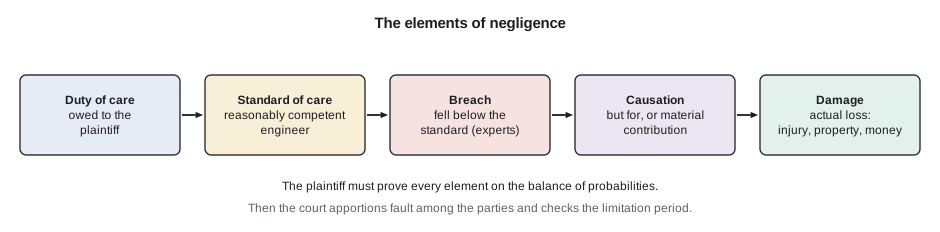
A plaintiff suing in negligence must prove five things, usually on the balance of probabilities.
Duty of care. The defendant must have owed the plaintiff a duty to take care. The modern principle comes from Donoghue v. Stevenson (1932), in which a manufacturer was held to owe a duty to the ultimate consumer of its ginger beer: you must take reasonable care to avoid acts you can reasonably foresee would injure your neighbours, meaning people so closely and directly affected that you ought to have them in mind. In Canada, new categories of duty are tested under the Anns/Cooper framework from Cooper v. Hobart (2001): was the harm reasonably foreseeable, was there sufficient proximity between the parties, and are there policy reasons to deny the duty? Engineers owe a duty of care to their clients, and in many situations to third parties who will foreseeably rely on or be affected by their work.
Standard of care. The defendant must have fallen below the standard the law expects. For professionals, that is the care, skill and diligence of a reasonably competent member of the profession in the same field, in similar circumstances, at the time the work was done. It is not the standard of the best engineer, and it does not require perfection. Hindsight is not the test: a design is judged against what was known and accepted practice when it was prepared. A specialist is held to the standard of a reasonable specialist. And an engineer who takes on work outside her competence is judged by the standard of someone competent to do it, which is one reason codes of ethics forbid practising outside one's competence.
Breach. The plaintiff must show that the defendant's conduct actually fell below that standard. In professional cases this almost always requires expert evidence from other engineers about what a reasonable engineer would have done. Compliance with codes and standards is strong evidence of reasonable care but not conclusive, because codes set minimums and a reasonable engineer may need to go further when circumstances demand it. Conversely, breach of a code is strong evidence of negligence.
Causation. The breach must have caused the harm. The usual test is the but-for test: would the harm have occurred but for the defendant's negligence? Where several causes combine, courts ask whether each defendant's negligence materially contributed. The harm must also not be too remote: it must be of a kind that was reasonably foreseeable.
Damage. The plaintiff must have suffered actual loss: personal injury, property damage or, in some cases, financial loss. Negligence without damage is not actionable, which is why a design error caught by the checker before construction gives rise to no tort claim.
Worked problem
Applying the elements to the bridge
For the corrosion claim against Northbridge, work through each element of negligence.
Show solution
- Duty: Northbridge designed the bridge under contract with the owner, so it owes the owner a duty of care in both contract and tort.
- Standard: a reasonably competent bridge engineer designing a steel pedestrian bridge in this climate would detail positive drainage away from connections, as the bridge design guidance of the day recommended.
- Breach: two expert reports say the drainage detail let water pond against the connections and fell below that standard; Northbridge's expert says the detail was common practice. The court will weigh the evidence.
- Causation: corrosion would probably have been much less severe with proper drainage, but the coating defects, wrong drain slopes and missed inspections also contributed. Each is a material contributing cause.
- Damage: the owner has suffered real loss, the repair cost and closure, so this element is satisfied.
Answer: If breach is proved, Northbridge is liable for part of the loss, and the court will apportion fault among the parties.
Liability for financial loss and misstatements
Courts are cautious about negligence claims for pure economic loss, meaning financial loss that is not the result of injury to the plaintiff's person or property. The worry is indeterminate liability: careless words or work can cause financial ripples to an unlimited number of people. Engineering is full of pure economic loss: a contractor that underbids because of an inaccurate quantity, a purchaser who overpays for a building with a hidden defect, an investor who relies on a feasibility study.
Negligent misrepresentation is the main exception. Since Hedley Byrne & Co. v. Heller & Partners (1964), a person who gives information or advice in circumstances where they know or ought to know that someone will rely on it may owe a duty of care to that person. In Queen v. Cognos Inc. (1993) the Supreme Court of Canada set out five requirements: a duty of care based on a special relationship, an untrue, inaccurate or misleading representation, made negligently, reasonable reliance on it, and damage resulting from that reliance. Edgeworth, discussed in lesson 6, applied these principles to engineers who prepared tender documents. In Winnipeg Condominium Corporation No. 36 v. Bird Construction Co. (1995), the Court also allowed a later owner of a building to recover the cost of repairing defects that posed a real and substantial danger to occupants, even without any contract with the builder. The Court narrowed the scope of recovery for pure economic loss in 1688782 Ontario Inc. v. Maple Leaf Foods Inc. (2020), emphasizing that a defendant's undertaking and the plaintiff's reliance must be closely connected.
For practising engineers the lesson is the same in both countries. When you prepare information that you know others will use, such as a geotechnical report, a structural condition assessment or a set of tender documents, expect that those others may sue you if it is carelessly wrong, and state the purpose, assumptions and limits of the information clearly. A well-written limitations section does not guarantee protection, but courts consider it when deciding whether reliance was reasonable.
Concurrent liability in contract and tort
Engineers who have a contract with the client usually owe duties in both contract and tort. In Central Trust Co. v. Rafuse (1986), the Supreme Court of Canada confirmed that a plaintiff may sue in either or both, unless the contract limits or excludes the tort duty. This matters because the rules differ: limitation periods may start at different times, damages are measured differently, and a contractual limitation of liability usually limits the tort claim too only if it is worded to do so. Engineers should therefore make sure that any liability cap in their services agreement applies to claims however framed, whether in contract, tort or otherwise.
Several defendants: apportioning fault
Construction failures rarely have a single cause, so courts must divide responsibility. Under Saskatchewan's Contributory Negligence Act, as under similar statutes in every common law province, damages are apportioned according to the degree of fault of each party. A plaintiff who was partly at fault has its damages reduced by its own share. Defendants who are jointly responsible are jointly and severally liable to the plaintiff: the plaintiff can recover its whole remaining loss from any one of them, and that defendant must then seek contribution from the others. If one defendant is insolvent or uninsured, the solvent defendants bear its share. The program applies these rules to the corrosion claim, using fault shares a court might find.
# Apportion a damages award by fault (assumed rules: plaintiff's share
# reduces the award; defendants are jointly and severally liable).
DAMAGES = 900_000
fault = {"Plaintiff (owner)": 0.10, "Contractor": 0.50,
         "Northbridge": 0.30, "Steel fabricator": 0.10}

recoverable = DAMAGES * (1 - fault["Plaintiff (owner)"])
print(f"Damages assessed: ${DAMAGES:,}; recoverable after own fault: ${recoverable:,.0f}")
for party, share in fault.items():
    if party.startswith("Plaintiff"):
        continue
    print(f"  {party:17} {share:4.0%} of fault -> ${DAMAGES * share:,.0f} share")

# If the contractor is insolvent, joint and several liability lets the
# owner collect the whole recoverable amount from the remaining defendants.
solvent = {p: s for p, s in fault.items() if p in ("Northbridge", "Steel fabricator")}
total = sum(solvent.values())
for party, share in solvent.items():
print(f" Contractor insolvent: {party:17} pays ${recoverable * share / total:,.0f}")Damages assessed: $900,000; recoverable after own fault: $810,000 Contractor 50% of fault -> $450,000 share Northbridge 30% of fault -> $270,000 share Steel fabricator 10% of fault -> $90,000 share Contractor insolvent: Northbridge pays $607,500 Contractor insolvent: Steel fabricator pays $202,500
Consider what joint and several liability does to an engineering firm. Northbridge is 30 per cent at fault, but if the contractor goes bankrupt and has no insurance, Northbridge may end up paying three quarters of the owner's recoverable loss. Professional liability insurers know this, which is one reason they insist that firms limit their liability by contract where they can.
Who is liable: firm, employee or both
The engineering firm is vicariously liable for negligence committed by its employees in the course of their employment, so the client usually sues the firm. Individual engineers can also be personally liable in tort for their own negligence. In Edgeworth the individual engineers were not liable because the contractor relied on the firm rather than on them personally, but courts have held individual professionals liable in other circumstances, and regulators discipline individuals, not firms alone, in most provinces. This is why many engineers ask whether their employer's insurance covers them personally, including after they leave the firm.
Limitation periods and ultimate limits
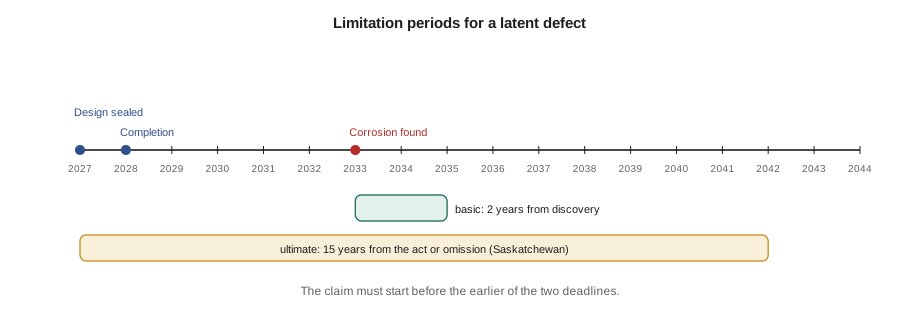
Even a strong claim fails if it is started too late. Saskatchewan's Limitations Act sets a basic two-year period that runs from when the claim was discovered, or reasonably should have been, and an ultimate period of 15 years from the act or omission, whichever expires first. Ontario and Alberta have similar two-year and 15-year (Ontario) or ten-year (Alberta) structures; other provinces differ. For construction defects, discoverability matters a great deal: corrosion that develops over years may not be discoverable until an inspection finds it. Engineers should keep project records at least as long as the ultimate limitation period, and many keep them for the life of the structure.
Managing professional liability
The law of negligence cannot be contracted away entirely, but firms can manage it. The practical tools are the same everywhere.
- Quality management: independent checking of calculations and drawings, design reviews at key stages, document control, and written procedures for software validation. Most claims arise from ordinary errors that a checker would have caught.
- Clear scope: written agreements that define what the firm will and will not do, and written confirmation when the client declines a recommended service, such as full-time field review.
- Contract terms: liability caps that apply however a claim is framed, exclusions of consequential loss, standard-of-care clauses, and no warranties or guarantees beyond insurance.
- Communication: documenting advice, especially advice the client did not take, and stating the limits of reports in plain words.
- Insurance: professional liability insurance on a claims-made basis, kept in force or extended after a firm closes or an engineer retires; prompt notice to the insurer of circumstances that might lead to a claim.
- Records: keeping calculations, correspondence and field reports, which are usually the best evidence of reasonable care years later.
Common mistakes
MistakeA professional is negligent whenever a design fails.
InsteadThe test is reasonable care at the time, not a perfect result judged with hindsight.
MistakeMeeting the building code proves that a design was not negligent.
InsteadCode compliance is strong evidence of reasonable care, but codes are minimums and do not settle the question.
MistakeOnly the client can sue the engineer.
InsteadThird parties who foreseeably rely on or are affected by the work can sue in tort.
MistakeA firm that is 30 per cent at fault pays 30 per cent of the damages.
InsteadWith joint and several liability, it may pay much more if another defendant cannot pay.
MistakeWorking through a corporation protects an engineer from personal liability.
InsteadEngineers can still be personally liable for their own negligence.
Summary and key terms
- Tort law compensates for civil wrongs that do not depend on a contract; negligence is the key tort for engineers.
- Negligence requires a duty of care, a breach of the standard of a reasonably competent engineer, causation and damage.
- Expert evidence usually decides whether the standard of care was met; codes are evidence, not the whole answer.
- Negligent misrepresentation (Hedley Byrne, Cognos, Edgeworth) exposes engineers to people who rely on their information.
- Engineers often owe duties in contract and tort at once, so liability caps should cover claims however framed.
- Provincial statutes apportion fault, and joint and several liability can leave a solvent defendant paying more than its share.
- Limitation periods run from discovery, subject to an ultimate limit such as 15 years in Saskatchewan.
- Quality management, clear scope, sound contracts, insurance and records are the practical defences.
- Tort
- A civil wrong, other than breach of contract, for which the courts award a remedy.
- Negligence
- Failure to take reasonable care, causing foreseeable harm to someone owed a duty of care.
- Standard of care
- The skill, care and diligence of a reasonably competent professional in similar circumstances.
- Pure economic loss
- Financial loss not caused by injury to the plaintiff's person or property.
- Negligent misrepresentation
- Careless inaccurate information relied on by someone to whom a duty was owed.
- Vicarious liability
- An employer's liability for the torts of its employees in the course of employment.
- Joint and several liability
- Each liable defendant can be made to pay the whole of the plaintiff's recoverable loss.
- Ultimate limitation period
- A fixed deadline after the act or omission, regardless of discovery.
Practice problems
Work each problem on paper first, then reveal the answer to check.
Name the five elements a plaintiff must prove in negligence.
Show answer
Duty of care, standard of care, breach, causation and damage.
Why is expert evidence usually needed in a professional negligence case?
Show answer
The court needs other professionals to say what a reasonably competent engineer would have done.
In the program, how much does Northbridge pay if the contractor is insolvent?
Show answer
About $607,500 of the $810,000 recoverable loss.
Why should a liability cap say that it applies to claims in contract, tort or otherwise?
Show answer
Because the client may sue in tort, and a cap limited to contract claims might not reach a tort claim.
A report says, 'This assessment is for the client's use only.' Does that guarantee no third party can sue?
Show answer
No, but it is relevant to whether reliance by a third party was reasonable.
Why should records be kept for many years after a project ends?
Show answer
Claims can be started years later, up to the ultimate limitation period, and records are the best evidence of reasonable care.
Lesson quiz · 5 questions
Score 60% or more to complete this lesson.
Create a free account to save your progress, take quizzes and earn a certificate.