
ENGG-404 · Lesson 11 of 12 · 21 min
Professional practice
The previous lessons covered the law and the codes. This one is about the daily habits and obligations of a practising engineer: authenticating documents, taking responsibility for work done by others, running a practice that manages risk, keeping competence current, and dealing with the regulator when something goes wrong. It ends with the professional practice exam, which tests most of this course.
Regulators in every province publish practice standards and guidelines on these topics. Some, such as authentication rules, are mandatory; others describe what a reasonable engineer does and are used as evidence of the standard of care in discipline and court proceedings. Either way, ignoring them is risky.
Authenticating documents
Applying a seal or stamp, a signature and a date to an engineering document says three things: a licensed engineer prepared the document or directly supervised its preparation, that engineer takes professional responsibility for it, and it is complete for its stated purpose. Every regulator requires final engineering documents, such as drawings issued for construction, specifications, reports and calculations submitted to authorities, to be authenticated by the responsible engineer, and several also require the firm's permit number. Preliminary documents should be clearly marked as not for construction and are generally not sealed.
Engineers may authenticate only work they prepared or directly supervised, and direct supervision means real control: the engineer directed the work, reviewed it in enough depth to take responsibility for it, and could have changed it. Sealing work prepared by others outside the firm after a quick look, sometimes called plan stamping, is professional misconduct. An engineer who reviews and adopts another engineer's work must do enough checking to take full responsibility for it, which usually means checking it as thoroughly as if she had prepared it. Electronic authentication is now accepted by all regulators, using digital signatures that secure the document against undetected changes; a scanned image of a seal pasted into a file is not enough.
Revisions need care. When sealed documents are revised, the revised sheets must be re-authenticated, and when another engineer modifies a sealed design, that engineer must take responsibility for the modification and the original seal must not be left implying responsibility for work the original engineer never saw. Many disputes, and at least one of this course's case studies, turned on who had approved a change to sealed work.
Responsibility for work done by others
Engineering is a team activity. Engineers-in-training, technologists, drafters and subconsultants do much of the work that the responsible engineer authenticates. The responsible engineer must assign work only to people competent to do it, give clear instructions, check the work at a level suited to its risk and the person's experience, and keep a record of the checking. Subconsultants' work raises a further question: the prime consultant is usually liable to the client for its subconsultants under the services agreement, so it should require them to carry their own insurance and check that their documents are coordinated with the rest of the design.
Shop drawings and contractor-designed components, such as precast elements, connections or temporary works, are a frequent source of confusion. The engineer of record reviews them for general conformance with the design; the specialty engineer who designs the component authenticates its design. The specifications should say clearly which engineer is responsible for what, and the review stamp should match that division. The Hyatt Regency case shows what happens when the division is unclear.
Running a practice
Firms that offer engineering services to the public need their own authorization, a certificate of authorization or permit to practice depending on the province, with a licensed engineer designated as responsible for the firm's engineering work. Many regulators now require firms to have a documented professional practice management plan covering quality management, checking, record keeping and continuing education. Good practice includes:
- A quality management system: documented procedures for design development, independent checking of calculations and drawings, design reviews at milestones, and verification of software and spreadsheets.
- Document control, so that everyone works from the current revision and superseded documents are clearly marked.
- Project records: calculations, correspondence, meeting notes, field reports and sealed documents, retained for at least as long as claims can be brought and, for structures, often for their design life.
- Contract review before signing, so that scope, fee, schedule, standard of care and liability terms are understood and insured.
- Risk management: screening projects and clients, staffing projects with competent people, and notifying the insurer promptly of circumstances that might lead to a claim.
- Professional development and supervision, so that junior staff gain experience safely and competence is maintained across the firm.
Continuing competence
Every Canadian regulator requires members to maintain their competence, most through a mandatory continuing professional development program. Members record activities such as courses, conferences, presentations, mentoring, committee work and self-study, often against a target number of hours over a rolling period, and report annually. Regulators audit a sample of members and can suspend those who do not comply. Some also run practice reviews, in which an experienced engineer visits a member or firm and reviews actual work.
The program tracks one engineer's activities against a renewal requirement. The rules in it are assumptions for illustration; real requirements differ in hours, categories and caps.
# Track continuing professional development against a renewal requirement.
# Assumed rules for illustration; check your own regulator's or board's rules.
REQUIRED = 30          # hours per two-year renewal period
MAX_SELF_STUDY = 10    # self-directed hours that count
MIN_ETHICS = 2         # hours of ethics or professional practice

log = [  # (activity, category, hours)
    ("Steel bridge design seminar", "course", 7.0),
    ("Webinar: corrosion of steel connections", "course", 1.5),
    ("Ethics module, professional practice", "ethics", 2.0),
    ("Mentoring two EITs", "service", 6.0),
    ("Reading journals and codes", "self", 14.0),
    ("Conference presentation (prep and delivery)", "presenting", 5.0),
]

self_hours = sum(h for _, c, h in log if c == "self")
other_hours = sum(h for _, c, h in log if c != "self")
ethics = sum(h for _, c, h in log if c == "ethics")
counted = other_hours + min(self_hours, MAX_SELF_STUDY)

print(f"Logged {sum(h for *_, h in log):.1f} h; counted {counted:.1f} h of {REQUIRED}")
print(f"Self-study logged {self_hours:.1f} h, counted {min(self_hours, MAX_SELF_STUDY):.1f} h")
print(f"Ethics hours: {ethics:.1f} (need {MIN_ETHICS})")
short = max(0, REQUIRED - counted)
print("Requirement met" if short == 0 and ethics >= MIN_ETHICS else f"Short by {short:.1f} h")Logged 35.5 h; counted 31.5 h of 30 Self-study logged 14.0 h, counted 10.0 h Ethics hours: 2.0 (need 2) Requirement met
The interesting line is the self-study cap. Maya logged 14 hours of reading, but only ten count, so her surplus is smaller than it looks. Engineers who leave their records until the last month of a reporting period often find that their hours fall into the wrong categories. Logging activities as they happen, with evidence, avoids that problem and makes an audit painless.
Complaints and discipline
Anyone can complain to a regulator about an engineer: a client, a member of the public, another engineer, a building official. The regulator's process usually follows the same stages. Staff screen the complaint and investigate, gathering documents and interviewing the engineer and witnesses. An investigation or complaints committee decides whether there is enough evidence to refer the matter to a hearing; many cases are resolved earlier, by a caution, an undertaking or an agreed resolution. If referred, a discipline committee panel, which includes public members as well as engineers, holds a hearing much like a trial, and decides whether the engineer is guilty of professional misconduct, incompetence or both.
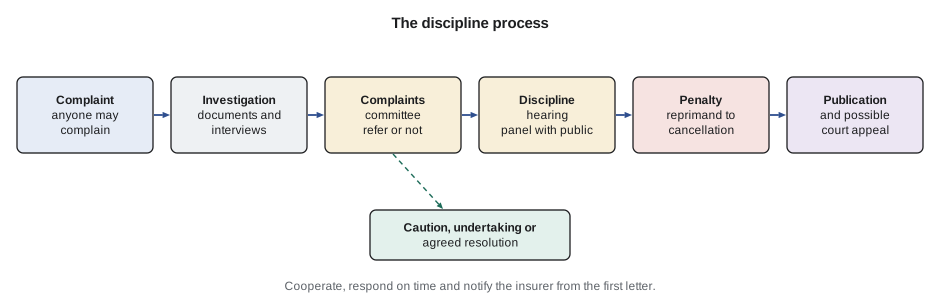
Penalties range from a reprimand, a fine, conditions on practice such as supervision or courses, and suspension, up to cancellation of the licence, often with an order to pay the regulator's costs. Decisions are usually published with the engineer's name, because informing the public is part of the purpose. Engineers can appeal to the courts, which generally defer to the regulator's expertise. Practising without a licence, or misusing the title, is a separate offence prosecuted against anyone, licensed or not.
An engineer who receives a complaint should take it seriously from the first letter: respond within the deadline, cooperate with the investigation (failure to cooperate is itself misconduct), notify the professional liability insurer, which may provide or fund legal advice, and avoid contacting the complainant about the complaint. Most complaints are dismissed, and a calm, complete, documented response is the best way to get there.
The NPPE
The National Professional Practice Exam is the law and ethics exam for licensure in every province except Quebec. As lesson 1 described, it is a computer-based, remotely proctored, multiple-choice exam of about two and a half hours. Its blueprint maps closely onto this course: professionalism and the regulation of the profession (lesson 1), ethics (lesson 10), professional practice (this lesson), law for professional practice, including contract, tort, tendering and business law (lessons 2 to 7 and 9), and professional law, covering the acts, bylaws and discipline (lessons 1 and 11). Workplace safety and environmental law (lesson 8) appear across several sections.
Preparing well is mostly about practice with scenarios, not memorizing statutes. Useful habits:
- Start with the official blueprint and reference materials, and map each topic to the lessons in this course.
- Read your own regulator's or board's code of ethics and practice guidelines closely; exam questions often turn on precise wording, such as whether a duty is to inform or to report.
- Work timed practice questions, and for every question you miss, write down the principle behind the right answer.
- Learn the leading cases by their principle rather than their facts: what each one decided and why it matters to engineers.
- On the exam, read every scenario for the decisive fact, eliminate options that put the client or employer ahead of the public, and be wary of answers that sound reasonable but skip a required step such as written notice.
Worked problem
Sealing under pressure
Northbridge is asked by a developer to seal structural drawings for a small commercial building prepared by an unlicensed designer in another city. The developer offers $2,500 and says the drawings are simple and the building official only needs a stamp. Maya Okafor is tempted because the firm is having a slow month. What should she do, and what is at stake?
Show solution
- The drawings were not prepared by Maya or under her direct supervision, so sealing them after a quick review would be plan stamping: professional misconduct, and possibly aiding unlicensed practice.
- Maya could offer instead to be engaged to take responsibility for the design properly: review and check it as if she had prepared it, redesign where needed, and seal the result, for a fee that reflects that work.
- If the developer refuses, Maya should decline in writing. If she learns the drawings were submitted with someone else's seal or none, she may need to tell the building official or the regulator.
- At stake: Maya's licence, Northbridge's certificate of authorization, uninsured liability for a design it never checked, and the safety of the building's occupants.
Answer: An engineer may seal only work she prepared or truly supervised and checked; a fee is never a reason to authenticate unchecked work.
Common mistakes
MistakeA seal shows that the engineer reviewed the drawings briefly.
InsteadA seal means the engineer prepared or directly supervised the work and takes full responsibility for it.
MistakePreliminary drawings should be sealed to show who prepared them.
InsteadPreliminary documents are marked not for construction and generally not sealed.
MistakeA scanned image of a seal is an acceptable electronic seal.
InsteadElectronic authentication requires a secure, verifiable digital signature.
MistakeAn engineer who receives a complaint should ignore it until a lawyer is hired.
InsteadRespond on time, cooperate, and notify the insurer; failure to cooperate is itself misconduct.
MistakeContinuing education hours can be reconstructed at the end of the period.
InsteadLog activities as they happen, with evidence, to meet category rules and survive an audit.
Summary and key terms
- Authentication with seal, signature and date means preparation or direct supervision and full responsibility.
- Plan stamping is misconduct; adopting others' work requires checking it fully.
- Revisions and modifications must be re-authenticated by the engineer who takes responsibility for them.
- Responsible engineers assign work to competent people, check it, and record the checking.
- Firms need their own authorization and a practice built on quality management, records and contract review.
- Mandatory CPD programs require members to record and report activities; regulators audit and can suspend.
- Discipline runs from complaint and investigation through hearing to penalties, publication and appeal.
- The NPPE tests professionalism, ethics, practice and law, closely matching this course.
- Authentication
- Applying a seal, signature and date to show responsibility for an engineering document.
- Direct supervision
- Real control over and review of work, enough to take responsibility for it.
- Plan stamping
- Sealing work prepared by others without the control or review needed to take responsibility.
- Quality management system
- Documented procedures for producing, checking and controlling engineering work.
- Continuing professional development
- Ongoing learning required to maintain competence and licensure.
- Professional misconduct
- Conduct that breaches the act, regulations, bylaws or code of ethics.
- Incompetence
- A lack of the knowledge, skill or judgment needed to practise safely.
- Practice review
- A regulator's review of a member's or firm's actual work and practices.
Practice problems
Work each problem on paper first, then reveal the answer to check.
What three things does authenticating a document signify?
Show answer
Preparation or direct supervision by a licensed engineer, acceptance of responsibility, and completeness for the stated purpose.
In the program, how many self-study hours are wasted?
Show answer
Four: 14 were logged but only 10 count.
What should an engineer do first on receiving a complaint letter from the regulator?
Show answer
Respond within the deadline, cooperate, and notify the professional liability insurer.
Who authenticates the design of contractor-designed precast elements?
Show answer
The specialty engineer who designs them; the engineer of record reviews for general conformance.
Name three elements of good practice management.
Show answer
Quality management, document control, record retention, contract review, risk management, supervision.
How should you answer an exam question where one option protects the client and another protects the public?
Show answer
Choose the option that protects the public, provided it follows the required steps.
Lesson quiz · 5 questions
Score 60% or more to complete this lesson.
Create a free account to save your progress, take quizzes and earn a certificate.