
ENGG-404 · Lesson 5 of 12 · 22 min
Tendering and procurement
Public owners rarely just pick a contractor. They invite tenders, competitive written offers submitted by a deadline against the same documents, and award the contract under rules designed to be fair to the bidders and to get value for public money. Consulting engineers are at the centre of this process. They prepare the tender documents, answer bidders' questions, issue addenda, open and evaluate tenders and recommend an award. They are also bidders themselves when owners procure engineering services. Canadian tendering law is unusual, and largely judge-made, and getting it wrong has cost owners millions of dollars.
In this lesson the Rural Municipality of Clearwater tenders the construction of the pedestrian bridge that Northbridge designed, with Northbridge as its consultant through the tender. We look first at the law of tendering, then at the procurement of engineering services themselves.
Contract A and Contract B
The foundation of Canadian tendering law is R. v. Ron Engineering & Construction (Eastern) Ltd. (1981). A contractor discovered, shortly after tenders closed, that it had left $750,000 out of its price through a calculation error, and asked to withdraw without forfeiting its $150,000 tender deposit. The Supreme Court of Canada held that submitting a compliant tender in response to a call for tenders can create a preliminary contract, called Contract A, between the owner and each compliant bidder. Its terms are those in the tender documents, typically including that the tender is irrevocable for a stated period. Contract B is the construction contract itself, formed when the owner accepts a tender. Because Ron's tender was irrevocable under Contract A, it could not withdraw and lost its deposit, even though the owner knew of the mistake.
The Contract A analysis does not arise automatically. In M.J.B. Enterprises Ltd. v. Defence Construction (1951) Ltd. (1999), the Supreme Court held that whether Contract A arises depends on the intention of the parties, as shown by the tender documents. Where it does arise, the Court implied a term that the owner will accept only compliant tenders. In M.J.B., the owner awarded the contract to a bidder whose tender contained a material qualification, and the Court held that the owner had breached Contract A with the lowest compliant bidder, which recovered its lost profit. The owner's privilege clause, stating that the lowest or any tender need not be accepted, did not allow it to accept a non-compliant tender.
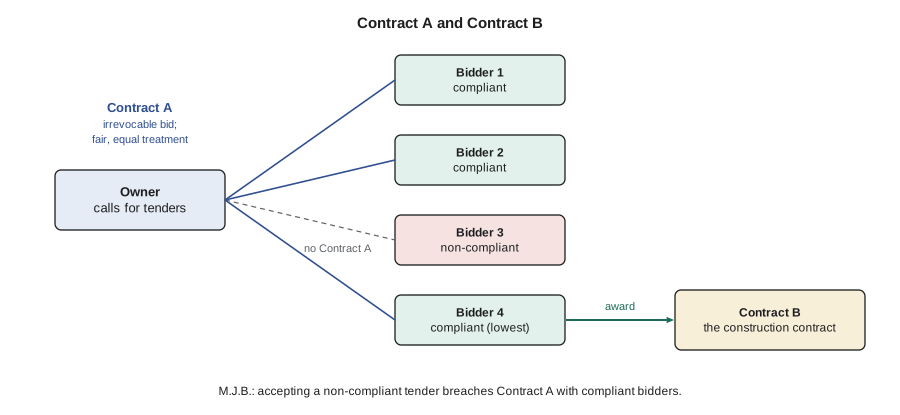
Duties of the owner under Contract A
Courts have implied several duties into Contract A, each of which the engineer administering the tender must respect.
- Accept only compliant tenders. A tender is non-compliant if it fails to meet a material requirement of the tender documents, such as omitting a required bid bond, qualifying the price or failing to acknowledge an addendum that affects price. Minor irregularities that do not affect price, quality or the fairness of the competition can usually be waived if the documents allow it.
- Treat all bidders fairly and equally. In Martel Building Ltd. v. Canada (2000), the Supreme Court confirmed an implied duty to treat all compliant bidders fairly and equally. The owner must evaluate tenders using only the criteria disclosed in the documents, and must not use undisclosed preferences.
- Do not negotiate with only one bidder before award, or engage in bid shopping, using one bidder's price to pressure another. Post-tender negotiation that changes the deal can breach Contract A with the other compliant bidders.
- Follow the documents. In Double N Earthmovers Ltd. v. Edmonton (City) (2007), the Supreme Court held that an owner's duty was to accept only compliant tenders and treat bidders fairly; it was not required to investigate whether the successful bidder would actually deliver what it promised, such as equipment of a certain age, which was a matter for Contract B.
Privilege clauses are common and are enforced according to their words, but courts read them in light of the duty of fairness. A clause allowing the owner to reject any or all tenders lets it cancel the tender or reject all bids. It does not usually let it accept a non-compliant tender, or award on criteria it did not disclose.
Exclusion clauses in tender documents
Owners often try to protect themselves with clauses that exclude liability for claims arising from the tender process. In Tercon Contractors Ltd. v. British Columbia (Transportation and Highways) (2010), the Province had invited proposals for a highway contract from six shortlisted proponents only, but accepted a proposal from one of them that had secretly teamed with an ineligible firm. The Province relied on a clause excluding claims for damages resulting from participation in the RFP. By a 5-4 majority, the Supreme Court held that the clause, interpreted in context, did not apply to claims arising from the owner's own acceptance of an ineligible bidder, because that would undermine the integrity of the process. Tercon recovered its lost profit of about $3.3 million. The case also set out the three-step test for exclusion clauses described in lesson 3.
The engineer's role in the process
The engineer who prepares and administers the procurement on the owner's behalf owes duties to the owner under its services agreement, and must act fairly toward all bidders. Several practical rules follow.
- Write clear, complete documents. Ambiguous instructions to bidders produce disputes about compliance. State which requirements are mandatory, how irregularities will be treated, and the evaluation criteria.
- Answer questions by addendum to everyone. A clarification given to one bidder by phone is unfair to the others and may be unenforceable. Issue every material clarification in writing to all bidders, and require bidders to acknowledge each addendum.
- Evaluate consistently and document reasons. Check each bid against the same list, record the reasons for any finding of non-compliance, and give the owner a written recommendation.
- Keep the owner informed of legal risk. A recommendation to waive an irregularity or to accept a bid with a qualification should be accompanied by advice to consult the owner's lawyer.
- Avoid conflicts. An engineer must not have an undisclosed interest in any bidder, and should not provide advice to bidders on the same project.
On the Clearwater bridge, four tenders arrive by the deadline. Northbridge checks each against the mandatory requirements in the instructions to bidders: a bid bond for 10 per cent of the price, acknowledgement of addenda 1 and 2 (addendum 2 added a lighting conduit that affects price), a signature by an authorized officer, and receipt before closing.
# Evaluate tenders: only compliant tenders can be accepted.
REQUIRED = ["bid_bond", "addenda_1_2", "signed", "on_time"]

tenders = [
    {"name": "Prairie Steel Ltd.", "price": 3_640_000, "bid_bond": True,
     "addenda_1_2": False, "signed": True, "on_time": True},
    {"name": "Riverbend Civil Inc.", "price": 3_795_000, "bid_bond": True,
     "addenda_1_2": True, "signed": True, "on_time": True},
    {"name": "Greystone Builders", "price": 3_710_000, "bid_bond": False,
     "addenda_1_2": True, "signed": True, "on_time": True},
    {"name": "Northern Span Corp.", "price": 3_880_000, "bid_bond": True,
     "addenda_1_2": True, "signed": True, "on_time": True},
]

compliant = []
for t in sorted(tenders, key=lambda t: t["price"]):
    missing = [r for r in REQUIRED if not t[r]]
    status = "compliant" if not missing else "non-compliant: " + ", ".join(missing)
    print(f"{t['name']:22} ${t['price']:>10,}  {status}")
    if not missing:
        compliant.append(t)

best = compliant[0]
print(f"Lowest compliant tender: {best['name']} at ${best['price']:,}")Prairie Steel Ltd. $ 3,640,000 non-compliant: addenda_1_2 Greystone Builders $ 3,710,000 non-compliant: bid_bond Riverbend Civil Inc. $ 3,795,000 compliant Northern Span Corp. $ 3,880,000 compliant Lowest compliant tender: Riverbend Civil Inc. at $3,795,000
The two lowest tenders are non-compliant. The failure to acknowledge an addendum that affects price is material, because the bidder could later argue that its price did not include the conduit; the missing bid bond is a material omission in almost every tender. Under M.J.B., awarding to either would expose the municipality to a claim from Riverbend, the lowest compliant bidder, for its lost profit. Northbridge should recommend award to Riverbend, with its reasons in writing.
Procuring engineering services
Engineering services are often procured differently from construction. The engineering profession, through Engineers Canada and the Association of Consulting Engineering Companies (ACEC-Canada), has long promoted qualifications-based selection (QBS), in which the owner chooses the most qualified firm on technical merit, then negotiates a fair fee with that firm. The argument is that design is a small fraction of a project's life-cycle cost, and choosing the cheapest designer can increase construction and operating costs many times over. Several Canadian municipalities and provincial agencies use QBS, often through pilot programs, but many public owners still weigh price heavily in two-envelope systems, in which technical proposals are scored first and price envelopes opened only for qualifying proponents.
Public procurement of both services and construction is also governed by trade agreements once contract values exceed specified thresholds, including the Canadian Free Trade Agreement between the provinces, the Canada-European Union Comprehensive Economic and Trade Agreement (CETA) and the World Trade Organization's Agreement on Government Procurement. These agreements require open, non-discriminatory competition and published notices, and they are enforced through bid dispute mechanisms such as complaints to the Canadian International Trade Tribunal for covered federal procurements. Thresholds are adjusted periodically, so engineers should check the current figures for their owner.
| Method | How the winner is chosen | Common use |
|---|---|---|
| Low compliant tender | Lowest compliant price after compliance check | Construction with complete design |
| Qualifications-based selection | Best qualified, then fee negotiated | Engineering and architectural services |
| Two-envelope | Technical score first, then price among qualifiers | Services and some design-build |
| Best value | Weighted combination of technical score and price | Design-build and complex projects |
| Prequalification | Shortlist on qualifications, then compete | Large or specialized projects |
After award, the engineer's work on the procurement is not quite done. Unsuccessful bidders often ask for a debriefing, a meeting or letter explaining how their submission was evaluated; offering one is good practice and, under many public policies and trade agreements, an obligation. Debriefings should explain the bidder's own scores and the reasons for any finding of non-compliance, without disclosing the confidential pricing or technical details of other bidders. The engineer should also keep a complete procurement file: the documents and addenda, the list of bidders who obtained documents, the questions and answers, the bid opening record, the evaluation sheets and the award recommendation. If a challenge comes, that file is the owner's best evidence that the process was fair, and the engineer's best evidence that it met its own standard of care.
Finally, the procurement method shapes the rest of the project. A low-bid construction contract based on complete drawings puts heavy weight on the quality of the design documents, because every gap becomes a change order. A best-value or design-build procurement transfers more design responsibility to the contractor's team and changes the engineer's role from designer to the owner's technical adviser. Choosing the method is therefore a risk allocation decision, and lesson 6 takes it up in detail.
Integrity in procurement
Bid-rigging, in which competitors agree on who will win or what they will bid, is a criminal offence under section 47 of the Competition Act, with penalties including fines at the court's discretion and imprisonment. Quebec's Charbonneau Commission, which reported in 2015, documented collusion, kickbacks and illegal political financing in the awarding of public construction and engineering contracts in Quebec, and led to new integrity rules, including the requirement for firms bidding on large public contracts in Quebec to obtain authorization from the Autorité des marchés publics. The federal government also operates an Ineligibility and Suspension Policy that can bar suppliers convicted of certain offences. Engineers who become aware of collusion have an ethical duty to report it.
Worked problem
A late question from a bidder
Two days before tenders close, a bidder phones Daniel Ruiz to ask whether galvanized railings are acceptable in place of the specified stainless steel. Daniel thinks they would be fine and tells the bidder so. What should happen?
Show solution
- Daniel's answer, given only to one bidder, gives that bidder a price advantage and is unfair to the others. It is also unauthorized: an EIT should not change the specifications.
- Maya Okafor should decide, with the owner, whether to allow the substitution. If allowed, it must be issued as an addendum to all bidders, with enough time for them to price it, extending the closing if necessary.
- If not allowed, Northbridge should tell the bidder in writing that the specification stands, and consider issuing an addendum confirming it so that all bidders hear the same message.
- The firm should remind staff that bidder questions must be routed to the designated contact and answered in writing.
Answer: Clarifications must go to all bidders by addendum; one bidder's phone call must never change the competition.
Common mistakes
MistakeThe lowest tender must always win.
InsteadOnly the lowest compliant tender can be accepted when Contract A requires it; the privilege clause may let the owner reject all tenders.
MistakeA missing addendum acknowledgement is always a minor irregularity.
InsteadIt is material if the addendum affects price, quantity or quality.
MistakeA privilege clause lets the owner do anything.
InsteadIt does not let the owner accept non-compliant tenders or use undisclosed criteria.
MistakeEngineering services should always go to the lowest fee.
InsteadQBS chooses on qualifications and negotiates the fee; many owners still weigh price.
MistakeAnswering one bidder's question by phone is helpful.
InsteadMaterial clarifications must go to all bidders by addendum.
Summary and key terms
- Under Ron Engineering, a compliant tender can create Contract A, making the tender irrevocable.
- M.J.B. implies a duty to accept only compliant tenders; Martel adds a duty of fair and equal treatment.
- Tercon shows that exclusion clauses will not protect an owner that undermines the integrity of the process.
- The engineer must write clear documents, answer questions by addendum and evaluate consistently.
- QBS selects engineers on qualifications; many owners still use price in two-envelope systems.
- Bid-rigging is a serious crime; engineers must report collusion.
- Tender
- A competitive written offer submitted against common documents by a deadline.
- Contract A
- The preliminary contract formed by submitting a compliant tender, under Ron Engineering.
- Contract B
- The construction contract formed when the owner accepts a tender.
- Privilege clause
- A clause reserving the owner's right not to accept the lowest or any bid.
- Addendum
- A written change or clarification to bid documents issued to all bidders before closing.
- Bid bond
- A surety bond guaranteeing that the bidder will enter the contract if its bid is accepted.
- Qualifications-based selection
- Choosing a consultant on qualifications, then negotiating the fee.
- Bid shopping
- Using one bidder's price to pressure another to lower its price.
Practice problems
Work each problem on paper first, then reveal the answer to check.
What did Ron Engineering decide about withdrawing a tender after closing?
Show answer
A compliant tender can be irrevocable under Contract A, so the bidder could not withdraw it and forfeited its deposit.
In the program, which bid wins if Prairie Steel had acknowledged both addenda?
Show answer
Prairie Steel, as the lowest compliant or responsive bid.
Why is a missing addendum acknowledgement material when the addendum changes price?
Show answer
Because the bidder could later claim its price did not include the change, which is unfair to the others.
How should the engineer answer bidder questions?
Show answer
In writing, by addendum to all bidders.
What does a two-envelope system do?
Show answer
Scores technical proposals first and opens price only for qualifying proponents.
What is bid-rigging?
Show answer
An agreement among competitors about who will win or what they will bid, which is a crime.
Lesson quiz · 5 questions
Score 60% or more to complete this lesson.
Create a free account to save your progress, take quizzes and earn a certificate.