
ENGG-404 · Lesson 12 of 12 · 21 min
Capstone: the Northbridge bridge file
This final lesson pulls the course together by following the Clearwater pedestrian bridge from the first phone call to the end of the corrosion dispute, stopping at each point where law, ethics or professional practice shaped what Northbridge did. Along the way it covers the one major topic not yet treated in depth: how construction and professional disputes are resolved. The goal is to see the subjects of the earlier lessons not as separate chapters but as one continuous set of responsibilities that an engineer carries through a project.
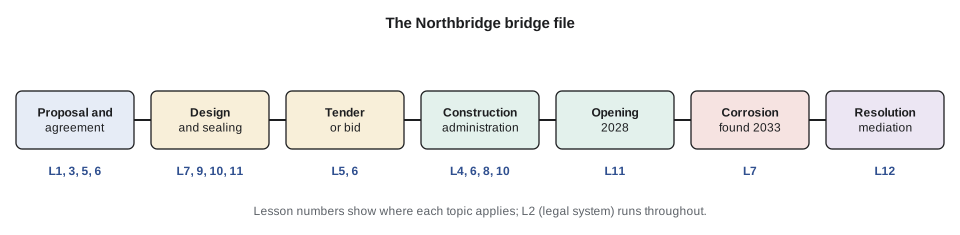
Stage 1: winning and signing the work
The project begins with a request for proposals from the Rural Municipality of Clearwater. Northbridge's first questions are professional ones (lesson 1): does the firm hold a certificate of authorization in Saskatchewan, and does it have engineers licensed there and competent in steel bridge design? Maya Okafor is, so the firm proposes. The municipality uses qualifications-based selection with a fee envelope (lesson 5), and Northbridge is ranked first.
The municipality's draft agreement contains a highest-standard clause, an unlimited indemnity with a duty to defend, and unlimited liability. Northbridge negotiates a reasonable standard of care, an indemnity limited to its own negligence, and a cap equal to its insurance limit, applying to claims in contract, tort or otherwise (lessons 3, 6 and 7). It confirms in writing that the client declined full-time field review in favour of periodic visits, and its proposal and the signed agreement are reconciled into one document before work starts, avoiding the counter-offer trap of lesson 3.
Stage 2: design and the duty to say no
During design, three ethical and practical pressures arrive. The client asks Northbridge to cut the geotechnical investigation to two boreholes to save money; Maya explains in writing why four are needed and what risk the client takes with fewer, and the client agrees to four (lessons 7 and 10). A steel supplier offers Maya's team a weekend at a fishing lodge; the firm's gift policy and the codes require her to decline (lesson 10). And Daniel Ruiz, now an engineer-in-training with growing responsibility, designs the connections under Maya's direct supervision, with every calculation checked before Maya authenticates the drawings (lesson 11).
Daniel's faster bolted connection raises the intellectual property questions of lesson 9. Under his employment agreement the invention belongs to Northbridge, and under its services agreement the client has a licence to use it on this bridge. Because Daniel described it at a conference before anyone filed, the firm has a year to decide whether a domestic patent is worth pursuing, and has already lost rights in absolute-novelty countries.
Stage 3: tender and construction
The municipality tenders construction (lesson 5). Northbridge recommends disqualifying the two lowest bids as non-compliant and awarding to Riverbend, the lowest compliant bidder, and writes down its reasons. The construction contract is CCDC 2 with supplementary conditions Northbridge drafted and explained to the client (lesson 6).
During construction Northbridge wears two hats: designer, and the owner's contract administrator who must decide fairly between owner and contractor (lessons 4 and 6). It grants the contractor time for a flood and an owner design change, assesses liquidated damages correctly for the remaining delay, and reviews shop drawings for general conformance only, while the fabricator's engineer takes responsibility for the connection details it designs. Daniel's warning about the temporary crossing (lesson 8) and Maya's decision to hold a pour until cracking near two connections was understood (lesson 10) are the two moments where safety depended on an engineer refusing to let schedule decide.
Stage 4: the claim
Five years after opening, corrosion closes the bridge and the municipality sues Northbridge, Riverbend and the steel fabricator for about $900,000 (lesson 7). Northbridge notified its insurer when the inspection report first arrived, as its claims-made policy requires. Its records, kept since the project, contain the drainage calculations, the shop drawing review comments and the field reports. The question now is how to resolve the claim.
How disputes are resolved
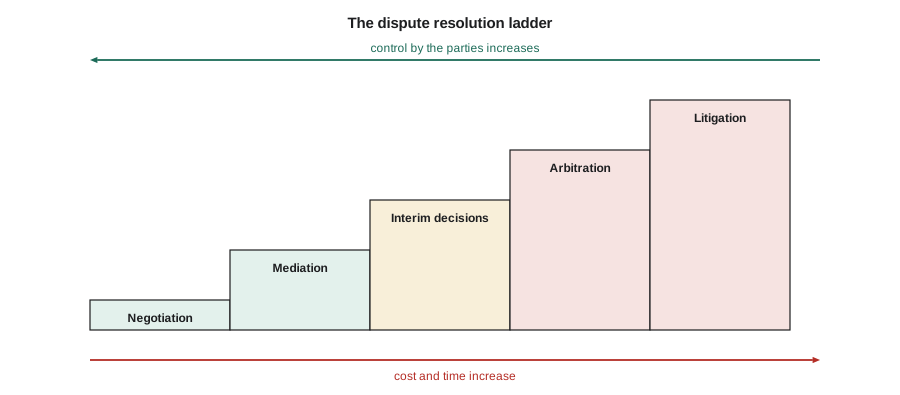
Disputes can be resolved in several ways, usually arranged as an escalation ladder in the contract. Each step up costs more, takes longer and hands more control to a third party.
- Negotiation between the parties, often at escalating levels of management, is the cheapest and fastest. Most standard forms require it first.
- Mediation brings in a neutral third party who helps the parties reach their own settlement but cannot impose one. It is confidential, flexible and usually concluded in a day or two of meetings after weeks of preparation. Mediation succeeds in a large majority of construction cases.
- Adjudication is a fast, interim decision by an adjudicator, usually within weeks, binding unless and until the dispute is finally decided by arbitration or a court. Ontario introduced statutory adjudication for payment disputes in its Construction Act in 2019, Saskatchewan's prompt payment and adjudication amendments to The Builders' Lien Act took effect in 2022, and the federal Prompt Payment for Construction Work Act applies to federal construction projects. Dispute boards, standing panels of neutral experts that follow a project and decide issues as they arise, serve a similar purpose on large projects.
- Arbitration is private adjudication by an arbitrator or panel the parties choose, under provincial arbitration statutes such as Saskatchewan's Arbitration Act, 1992, or the CCDC 40 rules for construction arbitration. The award is final and binding, with very limited rights of appeal. Arbitration is confidential, lets parties choose technically expert arbitrators, and can be faster than court, though large arbitrations can be just as expensive.
- Litigation in the courts is public, follows formal rules of procedure and evidence, allows appeals, and can join every party to a multi-party dispute, which arbitration often cannot do without everyone's agreement. It is also slow: complex construction cases can take years to reach trial.
The engineer's role in disputes takes several forms. As a party, the engineer must preserve records and cooperate with its insurer. As contract administrator, it makes the first-level decisions under the contract and must do so impartially. And as an expert witness, an engineer gives opinion evidence to help a tribunal understand technical issues. An expert's duty is to the tribunal, not to the party paying the fee: the opinion must be independent, objective and within the expert's competence, and courts in both countries reject experts who act as advocates. Codes of ethics apply with full force to expert testimony.
Choosing a path for the corrosion claim
Northbridge's insurer, its defence lawyer and Maya sit down to compare the options. The program uses their estimates: the probability that Northbridge would be found negligent, its likely share, the worst case, and the cost and time of each route.
# Northbridge's insurer compares ways to resolve the corrosion claim.
# All figures are estimates in dollars; probabilities are judgment calls.
SHARE = 243_000        # Northbridge's likely share if found liable
WORST = 607_500        # worst-case payment (joint and several: the contractor may be unable to pay)
P_LIABLE = 0.60        # chance Northbridge is found negligent
P_WORST = 0.15         # chance of the worst case, given liability

verdict = P_LIABLE * ((1 - P_WORST) * SHARE + P_WORST * WORST)
options = {
    # name: (expected payment, own legal and expert costs, months)
    "Pay the demand": (180_000, 15_000, 2),
    "Mediate":        (150_000, 40_000, 8),
    "Arbitrate":      (verdict, 150_000, 18),
    "Go to trial":    (verdict, 260_000, 40),
}
print(f"Expected award if decided: {verdict:,.0f}")
for name, (pay, cost, months) in options.items():
    print(f"{name:14} payment {pay:9,.0f}  costs {cost:8,.0f}  total {pay + cost:9,.0f}  ~{months} months")
best = min(options, key=lambda n: sum(options[n][:2]))
print(f"Lowest expected total: {best}")Expected award if decided: 178,605 Pay the demand payment 180,000 costs 15,000 total 195,000 ~2 months Mediate payment 150,000 costs 40,000 total 190,000 ~8 months Arbitrate payment 178,605 costs 150,000 total 328,605 ~18 months Go to trial payment 178,605 costs 260,000 total 438,605 ~40 months Lowest expected total: Mediate
Mediation comes out lowest, slightly ahead of simply paying the municipality's demand and far ahead of a full arbitration or trial, whose legal and expert costs swamp any difference in the award. The numbers are judgment calls, but they explain why so few construction claims go to trial. The joint and several worst case matters too: if Riverbend's insurer is thin, Northbridge could end up paying far more than its share, a risk that settling removes.
The mediation succeeds. Northbridge's insurer pays its share, the contractor and fabricator pay theirs, the municipality accepts responsibility for its missed inspections, and nobody admits liability. Northbridge also does something no settlement requires: it reviews its standard drainage details, issues a technical bulletin to its engineers, and adds a corrosion detailing check to its design review checklist. That is the professional response to a failure, and it is what regulators and courts look for when they ask whether a firm learns from its mistakes.
What runs through the whole file
Looking back across the file, a few habits did most of the work.
- Know the rules of the place: licences, firm authorization, procurement law, safety and environmental statutes, limitation periods and liability rules all depend on the province or state.
- Get it in writing: proposals reconciled with agreements, scope changes authorized, client decisions against advice confirmed, warnings documented.
- Match contracts to insurance: standard of care, indemnities and caps that the firm can actually insure.
- Check, and check changes: independent checking before sealing, and fresh calculations whenever a design or a shop drawing changes an assumption.
- Put the public first, early: decline gifts, hold the pour, stop the shoring removal, recommend the extra boreholes. Small, early decisions avoid large, late failures.
- Keep records and learn: records won the arguments years later, and a firm that improves its practice after a claim protects the next public it serves.
Worked problem
One last decision
Months after the settlement, a junior engineer at the municipality calls Daniel Ruiz, now a P.Eng., and mentions casually that the municipality has decided to defer the second phase of corrosion repairs on the bridge to next year's budget, even though the repair report said those connections should be repaired within six months. The bridge has reopened. Northbridge is no longer engaged on the bridge. What should Daniel do?
Show solution
- Facts first: Daniel should find out whether the report actually set that deadline, who wrote it, and whether the deferral is confirmed.
- Northbridge has no contract, but Daniel's paramount duty to the public does not depend on a contract. Information that a public structure may be unsafe triggers that duty.
- Daniel should raise the concern in writing with the municipality's responsible official, and with the engineer who wrote the repair report, asking whether the deferral has been assessed for safety.
- If he receives no satisfactory answer and believes the public is at risk, he should escalate to the regulator or another appropriate authority, sharing only what is needed, and document every step.
- He should also tell his own firm's principal, because the issue touches a former Northbridge project and the settlement.
Answer: The duty to protect the public outlasts any engagement: Daniel must raise the concern, escalate if it is ignored, and document what he does.
Common mistakes
MistakeLaw, ethics and practice are separate subjects that apply at different times.
InsteadThey apply together at every stage of a project.
MistakeGoing to trial is the best way to clear an engineer's name.
InsteadLitigation is slow and costly; most disputes are best settled through negotiation or mediation.
MistakeAn expert witness should support the party paying the fee.
InsteadAn expert's duty is to the tribunal: independent, objective opinion within her competence.
MistakeOnce a claim is settled, the engineer's obligations end.
InsteadProfessionals learn from failures and keep their duty to the public.
MistakeArbitration can always join every party to a dispute.
InsteadArbitration usually binds only parties who agreed to it; litigation can join everyone.
Summary and key terms
- Licensure, firm authorization and competence come first, before any proposal.
- Contract terms negotiated at the start decide how risk and liability play out years later.
- Ethical pressures during design and construction are best handled early, in writing.
- As contract administrator, the engineer decides fairly; as designer, it checks every change.
- Disputes climb a ladder: negotiation, mediation, adjudication or dispute boards, arbitration, litigation.
- Legal and expert costs often outweigh differences in expected awards, which is why most claims settle.
- Expert witnesses owe their duty to the tribunal.
- The duty to the public outlasts the contract.
- Mediation
- Facilitated negotiation in which a neutral helps the parties settle but cannot impose a result.
- Adjudication
- A fast, interim, binding decision on a construction dispute.
- Arbitration
- Private, binding adjudication by arbitrators chosen by the parties.
- Litigation
- Resolution of a dispute in the public courts.
- Dispute board
- A standing panel of neutral experts that follows a project and resolves issues as they arise.
- Expert witness
- A person qualified to give opinion evidence on technical matters to a court or tribunal.
- Settlement
- An agreement resolving a dispute, often without any admission of liability.
- Escalation clause
- A contract term requiring disputes to pass through set steps before arbitration or litigation.
Practice problems
Work each problem on paper first, then reveal the answer to check.
Why did Northbridge reconcile its proposal and the signed agreement before starting?
Show answer
To avoid the client's counter-offer terms becoming binding through conduct.
In the program, why are arbitration and trial so much more expensive than mediation?
Show answer
Their legal and expert costs are far larger, while the expected award is similar.
Name one advantage of litigation over arbitration in a multi-party construction dispute.
Show answer
Courts can join all parties; arbitration usually needs everyone's agreement.
To whom does an expert witness owe her duty?
Show answer
To the court or tribunal, not to the party paying her.
What did Northbridge do after the settlement that no contract required?
Show answer
Reviewed its drainage details, issued a technical bulletin and updated its design review checklist.
Does Daniel's duty in the final example depend on Northbridge having a contract?
Show answer
No. The paramount duty to the public applies whenever an engineer learns of a danger.
Lesson quiz · 5 questions
Score 60% or more to complete this lesson.
Create a free account to save your progress, take quizzes and earn a certificate.