
ENGG-404 · Lesson 9 of 12 · 23 min
Intellectual property and confidentiality
Engineers create things of value that are not physical: designs, drawings, calculations, software, test data, processes and know-how. Intellectual property law decides who owns these creations, what others may do with them, and for how long. Confidentiality law protects valuable information that is never published at all. Engineers need a working knowledge of both, because they constantly create intellectual property for employers and clients, use other people's, and sign agreements that allocate it.
This lesson covers the four main types of intellectual property, patents, copyright, trademarks and industrial designs, then trade secrets and confidential information, and finally the contract terms that decide who owns and may reuse engineering work. As before, nothing here is legal advice; intellectual property is a specialized field, and patent work in particular is done by registered patent agents and attorneys.
Patents
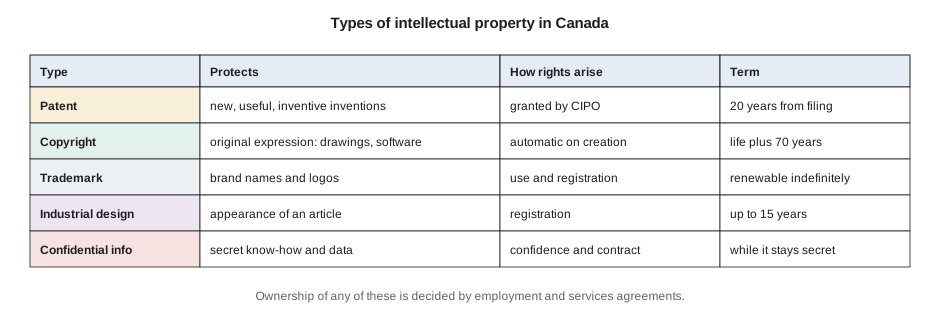
A patent gives its owner the exclusive right to make, use and sell an invention for 20 years from the filing date of the application, in exchange for disclosing the invention fully to the public. In Canada patents are granted under the Patent Act by the Canadian Intellectual Property Office (CIPO). An invention must be patentable subject matter (a new and useful art, process, machine, manufacture or composition of matter, or an improvement of one), new, non-obvious to a person skilled in the art, and useful. Abstract theorems, mere scientific principles and methods of medical treatment are not patentable, and computer-implemented inventions are patentable only where the computer is part of a practical solution, not merely a tool for running an abstract idea.
Canada has been a first-to-file country since 1989: if two people independently make the same invention, the patent goes to the first to file. Novelty is judged against everything made available to the public anywhere before the filing date, with one important exception: an inventor's own disclosure, or one derived from the inventor, does not count against the application if it was made less than one year before the Canadian filing date. That grace period is far from universal. Many countries, including those under the European Patent Convention, require absolute novelty, so a public disclosure before filing destroys the right to a patent there.
Patents are territorial: a Canadian patent gives no rights in the United States and vice versa. International agreements make multi-country filing manageable. Under the Paris Convention, an applicant who files in one member country has 12 months to file in others while keeping the first filing date as its priority date. Under the Patent Cooperation Treaty (PCT), a single international application preserves the right to enter national phase in most countries, usually 30 months from the priority date.
Suppose Daniel Ruiz develops a bolted connection for the Clearwater bridge's stringers that is faster to erect than any he can find in the literature, and presents it at a conference before anyone thinks about patents. The program works out the deadlines that follow.
# Filing deadlines after Daniel shows his connection design at a conference.
from datetime import date, timedelta

disclosure = date(2027, 5, 12)   # public presentation of the invention
provisional = date(2027, 9, 1)   # first application filed

def add_months(d, months):
    y, m = divmod(d.month - 1 + months, 12)
    return date(d.year + y, m + 1, min(d.day, 28))

grace_end = add_months(disclosure, 12)
print(f"Public disclosure:            {disclosure}")
print(f"Grace period ends (CA, US):   {grace_end}  (applicant's own disclosure only)")
print(f"Absolute novelty countries:   lost on {disclosure} (for example Europe)")
print(f"First application filed:      {provisional}")
print(f"Priority deadline (12 months): {add_months(provisional, 12)}  (convert or file abroad)")
print(f"PCT national phase (30 mo):   {add_months(provisional, 30)}")
print(f"Patent term ends (20 years): {add_months(add_months(provisional, 12), 240)} if filed at priority deadline")Public disclosure: 2027-05-12 Grace period ends (CA, US): 2028-05-12 (applicant's own disclosure only) Absolute novelty countries: lost on 2027-05-12 (for example Europe) First application filed: 2027-09-01 Priority deadline (12 months): 2028-09-01 (convert or file abroad) PCT national phase (30 mo): 2030-03-01 Patent term ends (20 years): 2048-09-01 if filed at priority deadline
The output shows why engineers should talk to a patent professional before presenting, publishing or demonstrating anything that might be an invention. Daniel's conference talk has already cost the firm patent rights in absolute-novelty countries; it leaves a year to file at home. Who owns the invention is a separate question: it depends on Daniel's employment agreement and, failing a clear term, on the law of the jurisdiction. Most engineering employers require employees to assign inventions made in the course of employment. Northbridge's agreement with the client may also give the client rights in inventions made on its project.
Using someone else's patent is a separate risk. A design that falls within the claims of an unexpired patent infringes it, even if the designer had never heard of the patent. Engineers specifying proprietary systems usually rely on the supplier's warranty and indemnity against infringement claims; engineers developing new products or processes should have a freedom-to-operate search done before committing to manufacture.
Copyright
Copyright protects original expression: the form in which ideas are expressed, not the ideas themselves. Under the Copyright Act, engineering drawings, specifications, reports, calculation sheets, photographs, software and even a building's architectural design are protected works. Copyright arises automatically when the work is created; registration is optional but provides evidence of ownership. Since December 30, 2022, the general term in Canada is the life of the author plus 70 years. Copyright gives the owner the sole right to reproduce the work or a substantial part of it, to publish it and to adapt it.
Ownership is the question engineers most often get wrong. The author is the first owner, with an important exception: under section 13(3) of the Copyright Act, when an employee creates a work in the course of employment, the employer owns the copyright unless they agree otherwise. Independent contractors, including consulting firms working for a client, own the copyright in what they create unless they assign it in writing. So, absent a contract term, Northbridge (not the municipality that paid for the design) owns the copyright in the bridge drawings, and the municipality has an implied licence to use them for the purpose they were created for: building, operating and maintaining that bridge. Canadian authors also have moral rights, the right to be associated with the work and to the integrity of the work, which cannot be assigned but can be waived.
Copyright does not protect the engineering principles, standard details or functional ideas shown in a drawing; anyone may design a similar bridge using the same principles. It protects against copying the drawings themselves or a substantial part of their expression. Engineers must still be careful when they reuse material from previous employers, from manufacturers' literature or from the internet: copying another firm's drawings or specification text without permission is infringement, and passing them off as your own work is also professional misconduct.
Trademarks and industrial designs
Trademarks protect words, logos and other signs that distinguish one business's goods or services from others'. Engineering firms register their names and logos as trademarks, and engineers encounter trademarks when they specify products by brand name. The usual specification practice is to name a product and add or approved equal, which avoids favouring one manufacturer unfairly and keeps public procurement open, as lesson 5 discussed.
Industrial designs protect the visual features of shape, configuration, pattern or ornament of a manufactured article, such as the appearance of a light fixture or a railing. Under the Industrial Design Act, registration lasts until the later of ten years after registration or 15 years after filing. Purely functional features are not protected; they belong to patent law if anywhere.
Trade secrets and confidential information
Much valuable engineering knowledge is never patented: a firm's design spreadsheets, cost databases, test results, client lists and hard-won know-how. This is protected, if at all, as confidential information. Canadian law has no general trade secrets statute; protection comes from contracts and from the equitable action for breach of confidence. In Lac Minerals Ltd. v. International Corona Resources Ltd. (1989), the Supreme Court of Canada held that a mining company that used confidential geological information disclosed during negotiations to acquire the property itself was liable, and imposed a constructive trust over the mine. To succeed, the plaintiff must show the information was confidential, was communicated in confidence, and was misused to its detriment.
Trade secret protection lasts as long as the information stays secret, which can be forever, but it vanishes once the information becomes public, and it gives no protection against someone who independently develops or reverse-engineers the same thing. The choice between patenting and keeping something secret is a business decision: patent if competitors could learn the invention from the product, keep it secret if they could not.
Engineers protect confidential information in practical ways: non-disclosure agreements before sharing information with potential partners or suppliers, access controls on project files, confidentiality clauses in employment and services agreements, and marking documents as confidential. When engineers change jobs, they may take their general skill and knowledge with them, but not their former employer's confidential documents or specific confidential information. Downloading project files on the way out the door is one of the most common sources of litigation between engineering firms.
Confidentiality in the codes of ethics
Every Canadian code of ethics requires engineers to keep their clients' and employers' information confidential unless they have permission to disclose it. The duty is not absolute: it gives way when disclosure is required by law, and when the engineer's paramount duty to protect the public requires it, for example when a client hides a condition that endangers people. Regulators' guidance suggests that the engineer first raise the issue with the client and, if that fails, report to the appropriate authority, disclosing only what is needed.
Engineers also owe confidentiality to former clients. An engineer who worked for one client on a dispute may not later use that client's confidential information against it for a new client, and conflicts of this kind may prevent the engineer or firm from taking the new work at all.
Who owns the project documents
Standard engineering agreements deal with ownership expressly. ACEC Document 31 generally provides that the consultant retains copyright in its documents and grants the client a licence to use them for the project, and that the client may not reuse them for another project or an extension without the consultant's consent. Clients, especially public owners and developers, often propose instead that they own everything. The issues to negotiate are the same either way: what the client may use the documents for, whether it may modify them, whether it may give them to other consultants, and who carries the risk of reuse.
Reuse is where engineers get hurt. A design prepared for one site, code edition and set of loads may be dangerous elsewhere. Firms should insist that reuse or modification by others is at the client's risk, that the client indemnifies the engineer against claims arising from it, and that anyone who modifies the documents removes the original engineer's seal and takes responsibility for the changes. Digital files make this more urgent, because native CAD and model files are easy to alter; many firms issue sealed PDFs as the record documents and provide native files only under a separate electronic data agreement.
Worked problem
Reusing the bridge design
Two years after the Clearwater bridge opens, the municipality asks a different consulting firm to design a second pedestrian bridge at another creek, and gives that firm Northbridge's CAD files and calculations to save money. Northbridge's agreement was ACEC Document 31 without amendment. The municipality also asks Northbridge's former employee, who now works at the other firm, to help.
Show solution
- Under the agreement, Northbridge owns the copyright and the municipality's licence covers the original project only, so giving the files to another firm for a new bridge is outside the licence.
- Northbridge can object, or it can consent in writing on terms: a fee for the licence, removal of its name and seal, a statement that the new firm takes full responsibility, and an indemnity from the client for claims arising from reuse.
- The other firm should not use the files without confirming that the client has the right to give them; if it modifies them, it must take full professional responsibility for the new design.
- The former employee may use her general skill and experience, but not Northbridge's confidential calculation spreadsheets or other confidential information she took with her.
Answer: Ownership terms decide whether reuse is allowed, and professional responsibility always moves to whoever adapts the design for the new site.
Common mistakes
MistakeThe client paid for the drawings, so the client owns the copyright.
InsteadAbsent a written assignment, the consultant that created them usually owns the copyright, and the client has a licence.
MistakeA one-year grace period means public disclosure before filing is safe.
InsteadIt applies only in some countries; absolute-novelty countries lose the right at once.
MistakeCopyright stops others from designing a similar structure.
InsteadCopyright protects expression, not ideas or engineering principles.
MistakeConfidentiality is absolute.
InsteadIt gives way to legal requirements and to the paramount duty to protect the public.
MistakeAn engineer who changes jobs may take her own project files.
InsteadFiles and specific confidential information belong to the former employer; only general skill goes with her.
Summary and key terms
- Patents protect new, useful, non-obvious inventions for 20 years from filing in exchange for full disclosure.
- Canada and the US both give the inventor a one-year grace period for her own disclosures, but many countries require absolute novelty.
- Copyright protects original expression, including drawings and software, for life plus 70 years.
- Employers own employees' copyright; consultants own theirs unless assigned in writing (Copyright Act s. 13(3)).
- Trademarks protect brands; industrial designs or design patents protect appearance.
- Confidential information is protected by contract and breach of confidence (Lac Minerals).
- Confidentiality duties in the codes yield to the paramount duty to the public.
- Services agreements should control ownership, licences and the risks of reuse.
- Patent
- An exclusive right to an invention for a limited term in exchange for public disclosure.
- Prior art
- Everything publicly available before the filing date that bears on novelty or obviousness.
- Grace period
- A period during which an inventor's own disclosure does not defeat a later patent application.
- Copyright
- Exclusive rights in original expression, such as drawings, text and software.
- Moral rights
- An author's rights of attribution and integrity, which can be waived but not assigned.
- Industrial design
- Protection for the ornamental appearance of a manufactured article.
- Breach of confidence
- Misuse of information communicated in confidence.
- Instrument of service
- A drawing or specification treated as the consultant's work product, licensed to the client for the project.
Practice problems
Work each problem on paper first, then reveal the answer to check.
What three tests must an invention meet besides patentable subject matter?
Show answer
Novelty, non-obviousness (inventiveness) and utility.
In the program, when does the grace period for Daniel's conference talk end?
Show answer
May 12, 2028, one year after the disclosure.
Who owns copyright in drawings an employee prepares at work?
Show answer
The employer, unless they agreed otherwise.
Why might a firm keep a process secret instead of patenting it?
Show answer
Secrecy can last indefinitely and competitors cannot learn the process from the product.
What should happen to the original engineer's seal when someone else modifies a design?
Show answer
It should be removed, and the person making the changes takes responsibility.
When may an engineer disclose a client's confidential information?
Show answer
With consent, when the law requires it, or when necessary to protect the public from danger.
Lesson quiz · 5 questions
Score 60% or more to complete this lesson.
Create a free account to save your progress, take quizzes and earn a certificate.