
ENGG-404 · Lesson 5 of 12 · 22 min
Bidding and procurement
Public owners rarely just pick a contractor. They invite bids, competitive written offers submitted by a deadline against the same documents, and award the contract under statutes and regulations designed to be fair to bidders and to get value for public money. Consulting engineers are at the center of this process. They prepare the bid documents, answer bidders' questions, issue addenda, open and evaluate bids and recommend an award. They are also competitors themselves when agencies procure engineering services, which federal law and most states require to be selected on qualifications rather than price.
In this lesson the City of Westbrook bids out the construction of the pedestrian bridge that Northbridge designed, with Northbridge as its consultant through the bidding. We look first at the law of public construction bidding, then at the procurement of engineering services themselves.
Public bidding statutes
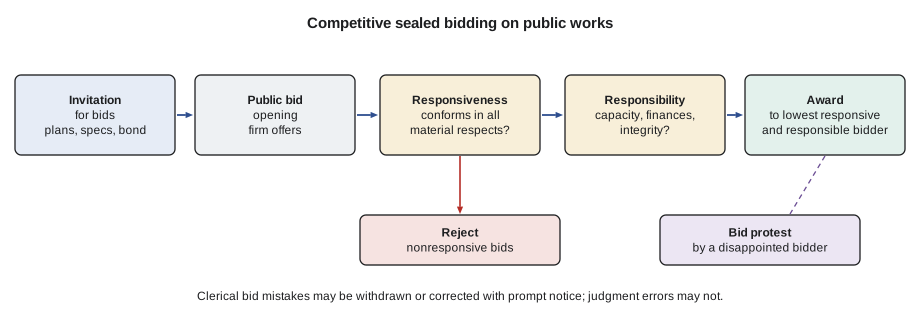
In the United States, public construction bidding is governed mainly by statute: the Federal Acquisition Regulation (FAR) for federal agencies, and state procurement codes and municipal ordinances for state and local work. Most public construction contracts must be awarded by competitive sealed bidding to the lowest responsive and responsible bidder. A bid is responsive if it conforms in all material respects to the invitation for bids; a bidder is responsible if it has the capacity, experience, financial resources and integrity to perform. Because these rules come from statutes rather than contract, a disappointed bidder's remedy is usually a bid protest rather than a claim for damages.
A bid is usually a firm offer that cannot be withdrawn after bid opening for the period stated in the invitation, often 60 or 90 days, and bidders typically provide a bid bond or bid guarantee, often 5 to 10 percent of the bid price, to secure that promise. If the low bidder refuses to sign the contract, the owner can award to the next bidder and claim the difference, up to the bond amount. Unlike Canadian law, US procurement law generally allows a bidder to withdraw, or seek correction of, a bid with a clear clerical mistake, such as an arithmetic error, if it gives prompt notice with convincing evidence; FAR 14.407 sets out the federal procedure. Judgment errors, such as underestimating the cost of work, are not excused.
Responsiveness and responsibility
The engineer evaluating bids for a public owner applies two separate tests, both grounded in statute and the invitation for bids.
- Responsiveness is judged from the bid itself at opening. A bid that omits a required bid bond, qualifies the price, or fails to acknowledge an addendum that affects price, quantity or quality is usually nonresponsive and must be rejected. Minor informalities that do not affect price, quality, quantity or delivery can usually be waived, or the bidder allowed to cure them, under rules such as FAR 14.405.
- Responsibility is judged from information available up to award, such as experience, financial capacity, safety record, licensing and past performance. A finding of nonresponsibility must be reasonable and documented, and some jurisdictions let the bidder respond before the decision is final. Some owners prequalify bidders before bidding to deal with responsibility in advance.
- Bid shopping, in which a prime contractor uses one subcontractor's price to pressure another after award, is widely condemned, and some states have anti-bid-shopping statutes requiring primes to list major subcontractors in their bids. Under Drennan v. Star Paving Co. (1958), a California decision followed in many states, a subcontractor's bid that the prime relied on can be binding on the subcontractor through promissory estoppel.
- Follow the documents and the statute. Award must be made on the basis of the criteria stated in the invitation, and owners may not change the specifications after bid opening to suit one bidder. When all bids exceed the budget, the owner may usually reject all bids and rebid, or in some jurisdictions negotiate with the low bidder within narrow limits.
Disappointed bidders challenge awards through bid protests. For federal procurement, protests can be filed with the agency, with the Government Accountability Office (GAO) or with the US Court of Federal Claims, under strict deadlines measured in days. State and local protests follow the procedures in the relevant code or ordinance, often with an administrative hearing followed by limited judicial review. Remedies usually focus on correcting the procurement, such as re-evaluating or re-competing, rather than awarding lost profits; bid preparation costs are sometimes recoverable.
Public works requirements
Public works contracts carry statutory requirements that engineers must build into the bid documents and enforce. On federally funded construction, the Davis-Bacon Act requires contractors to pay locally prevailing wages, and many states have their own prevailing wage laws. Buy America and Build America, Buy America requirements apply to iron, steel, manufactured products and construction materials on many federally funded infrastructure projects, including most highway and transit work. Disadvantaged Business Enterprise (DBE) programs set participation goals on federally assisted transportation projects. Bonding requirements under the Miller Act and state Little Miller Acts apply to the winning contractor. Failing to include a required provision can jeopardize the owner's funding.
The engineer's role in the process
The engineer who prepares and administers the procurement on the owner's behalf owes duties to the owner under its services agreement, and must act fairly toward all bidders. Several practical rules follow.
- Write clear, complete documents. Ambiguous instructions to bidders produce disputes about compliance. State which requirements are mandatory, how irregularities will be treated, and the evaluation criteria.
- Answer questions by addendum to everyone. A clarification given to one bidder by phone is unfair to the others and may be unenforceable. Issue every material clarification in writing to all bidders, and require bidders to acknowledge each addendum.
- Evaluate consistently and document reasons. Check each bid against the same list, record the reasons for any finding of non-compliance, and give the owner a written recommendation.
- Keep the owner informed of legal risk. A recommendation to waive an irregularity or to accept a bid with a qualification should be accompanied by advice to consult the owner's lawyer.
- Avoid conflicts. An engineer must not have an undisclosed interest in any bidder, and should not provide advice to bidders on the same project.
On the Westbrook bridge, four bids arrive by the deadline. Northbridge checks each against the mandatory requirements in the invitation for bids: a bid bond for 10 percent of the price, acknowledgment of addenda 1 and 2 (addendum 2 added a lighting conduit that affects price), a signature by an authorized officer, and receipt before the deadline.
# Evaluate bids: only responsive bids can be accepted.
REQUIRED = ["bid_bond", "addenda_1_2", "signed", "on_time"]

bids = [
    {"name": "Prairie Steel LLC", "price": 2_690_000, "bid_bond": True,
     "addenda_1_2": False, "signed": True, "on_time": True},
    {"name": "Riverbend Civil Co.", "price": 2_805_000, "bid_bond": True,
     "addenda_1_2": True, "signed": True, "on_time": True},
    {"name": "Greystone Builders", "price": 2_740_000, "bid_bond": False,
     "addenda_1_2": True, "signed": True, "on_time": True},
    {"name": "Northern Span Corp.", "price": 2_870_000, "bid_bond": True,
     "addenda_1_2": True, "signed": True, "on_time": True},
]

responsive = []
for t in sorted(bids, key=lambda t: t["price"]):
    missing = [r for r in REQUIRED if not t[r]]
    status = "responsive" if not missing else "nonresponsive: " + ", ".join(missing)
    print(f"{t['name']:22} ${t['price']:>10,}  {status}")
    if not missing:
        responsive.append(t)

best = responsive[0]
print(f"Lowest responsive bid: {best['name']} at ${best['price']:,}")Prairie Steel LLC $ 2,690,000 nonresponsive: addenda_1_2 Greystone Builders $ 2,740,000 nonresponsive: bid_bond Riverbend Civil Co. $ 2,805,000 responsive Northern Span Corp. $ 2,870,000 responsive Lowest responsive bid: Riverbend Civil Co. at $2,805,000
The two lowest bids are nonresponsive. The failure to acknowledge an addendum that affects price is material, because the bidder could later argue that its price did not include the conduit; the missing bid bond is a material omission under almost every invitation. Awarding to either would invite a protest from Riverbend, the lowest responsive bidder, and could put federal funding at risk. Northbridge should recommend award to Riverbend, subject to confirming that it is responsible, with its reasons in writing.
Procuring engineering services
Engineering services are often procured differently from construction. The Brooks Act of 1972, now codified at 40 U.S.C. sections 1101 to 1104, requires federal agencies to select architects and engineers on the basis of demonstrated competence and qualifications, then negotiate a fair and reasonable fee with the most qualified firm, moving to the next firm only if negotiations fail. Price may not be a selection factor. Most states have adopted similar mini-Brooks Acts for state and local agencies, and federal highway funding rules require qualifications-based selection for engineering on federally funded projects. The argument is that design is a small fraction of life-cycle cost, and choosing the cheapest designer can increase construction and operating costs many times over.
Procurement of design-build projects is a hybrid. Many federal and state agencies use two-phase design-build selection under FAR 36.3 and state statutes, first shortlisting teams on qualifications and then selecting on a combination of technical proposals and price. Construction manager at risk and progressive design-build are also common, particularly for complex projects. Each method allocates design risk differently, which lesson 6 discusses.
| Method | How the winner is chosen | Common use |
|---|---|---|
| Low responsive bid | Lowest responsive and responsible price | Construction with complete design |
| Qualifications-based selection | Best qualified, then fee negotiated | Engineering and architectural services |
| Two-envelope | Technical score first, then price among qualifiers | Services and some design-build |
| Best value | Weighted combination of technical score and price | Design-build and complex projects |
| Prequalification | Shortlist on qualifications, then compete | Large or specialized projects |
After award, the engineer's work on the procurement is not quite done. Unsuccessful bidders often ask for a debriefing, a meeting or letter explaining how their submission was evaluated; offering one is good practice and, under many public policies and trade agreements, an obligation. Debriefings should explain the bidder's own scores and the reasons for any finding of non-compliance, without disclosing the confidential pricing or technical details of other bidders. The engineer should also keep a complete procurement file: the documents and addenda, the list of bidders who obtained documents, the questions and answers, the bid opening record, the evaluation sheets and the award recommendation. If a challenge comes, that file is the owner's best evidence that the process was fair, and the engineer's best evidence that it met its own standard of care.
Finally, the procurement method shapes the rest of the project. A low-bid construction contract based on complete drawings puts heavy weight on the quality of the design documents, because every gap becomes a change order. A best-value or design-build procurement transfers more design responsibility to the contractor's team and changes the engineer's role from designer to the owner's technical adviser. Choosing the method is therefore a risk allocation decision, and lesson 6 takes it up in detail.
Integrity in procurement
Bid-rigging, in which competitors agree on who will win or what they will bid, is a felony under section 1 of the Sherman Act, prosecuted by the Department of Justice Antitrust Division, with substantial fines and prison terms. The federal Anti-Kickback Act, the False Claims Act and state equivalents add civil and criminal liability for kickbacks and false claims on public contracts, and the False Claims Act lets whistleblowers who report fraud on government contracts share in the recovery. Contractors and engineers who commit serious misconduct can be suspended or debarred from federal contracting under FAR subpart 9.4. Engineers who become aware of collusion have an ethical duty to report it.
Worked problem
A late question from a bidder
Two days before bids are due, a bidder phones Daniel Ruiz to ask whether galvanized railings are acceptable in place of the specified stainless steel. Daniel thinks they would be fine and tells the bidder so. What should happen?
Show solution
- Daniel's answer, given only to one bidder, gives that bidder a price advantage and is unfair to the others. It is also unauthorized: an EIT should not change the specifications.
- Maya Okafor should decide, with the owner, whether to allow the substitution. If allowed, it must be issued as an addendum to all bidders, with enough time for them to price it, extending the closing if necessary.
- If not allowed, Northbridge should tell the bidder in writing that the specification stands, and consider issuing an addendum confirming it so that all bidders hear the same message.
- The firm should remind staff that bidder questions must be routed to the designated contact and answered in writing.
Answer: Clarifications must go to all bidders by addendum; one bidder's phone call must never change the competition.
Common mistakes
MistakeThe lowest bid must always win.
InsteadThe lowest responsive bid from a responsible bidder wins; the owner may usually reject all bids.
MistakeA missing addendum acknowledgment is always a minor irregularity.
InsteadIt is material if the addendum affects price, quantity or quality.
MistakeA privilege clause lets the owner do anything.
InsteadIt does not let the owner ignore statutory award rules or the stated criteria.
MistakeEngineering services should always go to the lowest fee.
InsteadThe Brooks Act and mini-Brooks Acts forbid price as a selection factor for A/E services.
MistakeAnswering one bidder's question by phone is helpful.
InsteadMaterial clarifications must go to all bidders by addendum.
Summary and key terms
- Public construction is awarded by statute to the lowest responsive and responsible bidder.
- Responsiveness is judged from the bid; responsibility from the bidder's capacity and record.
- Bid protests to the agency, GAO or Court of Federal Claims are the main remedy for disappointed bidders.
- The engineer must write clear documents, answer questions by addendum and evaluate consistently.
- The Brooks Act requires qualifications-based selection for federal A/E services.
- Bid-rigging is a serious crime; engineers must report collusion.
- Bid
- A competitive written offer submitted against common documents by a deadline.
- Responsive bid
- A bid that conforms in all material respects to the invitation for bids.
- Responsible bidder
- A bidder with the capacity, experience, finances and integrity to perform.
- Privilege clause
- A clause reserving the owner's right not to accept the lowest or any bid.
- Addendum
- A written change or clarification to bid documents issued to all bidders before closing.
- Bid bond
- A surety bond guaranteeing that the bidder will enter the contract if its bid is accepted.
- Qualifications-based selection
- Choosing a consultant on qualifications, then negotiating the fee.
- Bid shopping
- Using one bidder's price to pressure another to lower its price.
Practice problems
Work each problem on paper first, then reveal the answer to check.
What kind of bid mistake can usually be corrected or withdrawn under federal rules?
Show answer
A clear clerical or arithmetic error shown promptly with convincing evidence, not an error of judgment.
In the program, which bid wins if Prairie Steel had acknowledged both addenda?
Show answer
Prairie Steel, as the lowest compliant or responsive bid.
Why is a missing addendum acknowledgment material when the addendum changes price?
Show answer
Because the bidder could later claim its price did not include the change, which is unfair to the others.
How should the engineer answer bidder questions?
Show answer
In writing, by addendum to all bidders.
What does the Brooks Act require?
Show answer
Selection of A/E firms on qualifications, then negotiation of a fair fee.
What is bid-rigging?
Show answer
An agreement among competitors about who will win or what they will bid, which is a crime.
Lesson quiz · 5 questions
Score 60% or more to complete this lesson.
Create a free account to save your progress, take quizzes and earn a certificate.