
ENGG-404 · Lesson 2 of 12 · 24 min
The American legal system
Engineers do not need to become lawyers, but they do need a working map of the legal system. When a client sends a contract, when a regulator opens a file, when a site accident triggers an investigation or when a bridge owner sues, the engineer who understands where the rules come from, which court will hear the case and what the other side must prove is far better placed to protect the public, the firm and themselves. This lesson draws that map.
The United States has a federal legal system with two layers of government, each with its own constitution, legislature, courts and agencies. The US Constitution creates a national government of limited, listed powers and leaves the rest to the states. Every state except Louisiana follows the common law tradition inherited from England; Louisiana's private law draws on the civil law tradition. Tribal nations are a third sovereign, with their own governments and courts, and federal Indian law affects projects on or near tribal lands.
As in lesson 1, nothing here is legal advice. It is a general description meant to help you recognize issues and talk to lawyers usefully.
Sources of law
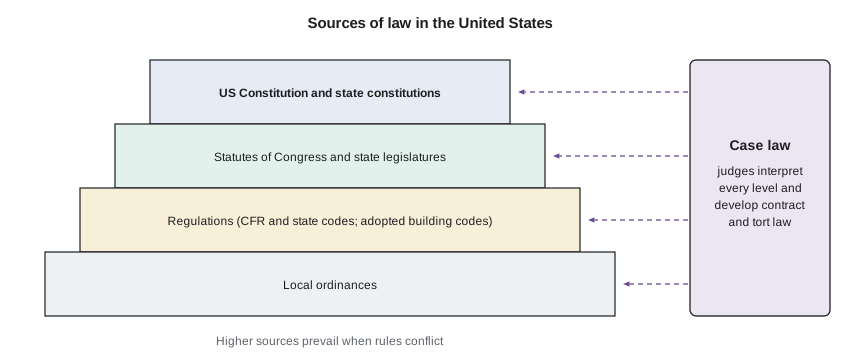
Law comes from a small number of sources, ranked in a clear order. When two rules conflict, the higher source wins.
At the top is the US Constitution. It lists federal powers, such as regulating interstate commerce, and the Supremacy Clause makes valid federal law override conflicting state law. The Tenth Amendment reserves other powers to the states, including the general police power to protect health and safety. That is why your license is a state license, why contract and tort law are mostly state law, and why a bridge over a navigable water may also need federal permits from the US Army Corps of Engineers. The Bill of Rights and the Fourteenth Amendment protect rights such as free speech and due process against government action; they rarely touch private contracts but matter when a public agency or licensing board acts against an engineer.
Next come statutes: laws passed by Congress or a state legislature, such as a state engineering practice act, the Occupational Safety and Health Act, a mechanics lien statute or the National Environmental Policy Act. Statutes often authorize regulations, detailed rules made by agencies such as OSHA, the Environmental Protection Agency or a state licensing board, published in the Code of Federal Regulations or a state administrative code. Building codes are a special case: the International Building Code is a model code written by the International Code Council that has no force until a state or city adopts it, often with amendments. Local ordinances, made under authority the state delegates, sit below state law.
Finally there is case law, the body of rules made by judges when they decide disputes. In the common law tradition, judges do more than apply statutes; they develop whole areas of law, such as contract and negligence, case by case. Judges also interpret statutes and decide whether laws are constitutional, and those interpretations become part of the law.
Precedent and how judges make law
The doctrine of precedent, often called by its Latin name stare decisis, means that courts follow earlier decisions on the same legal point. A lower court must follow a decision of a higher court in the same hierarchy. A court is usually expected to follow its own earlier decisions too, although top appellate courts can depart from them. Decisions from other jurisdictions are persuasive but not binding: a court may adopt reasoning from another province, state or country if it finds it convincing.
The binding part of a decision is the ratio decidendi (or holding): the legal principle needed to decide the case on its material facts. Comments that were not necessary to the result are obiter dicta, which may be influential but do not bind. Lawyers argue about which facts were material, so they can either apply a precedent to a new case or distinguish it as different. When you read a summary of a famous engineering case in this course, focus on the rule and the facts that mattered.
Within the federal system, the binding force of a decision depends on which court made it and on which law it decided. The US Supreme Court binds all courts on questions of federal law. A federal court of appeals binds the district courts within its circuit. State supreme courts have the last word on their own state's law, so a Kansas Supreme Court decision on contract law binds Kansas courts but only persuades courts in Missouri. Louisiana's civil code tradition works differently again, with the code as the primary source.
The courts
There are two parallel court systems. Federal courts, with the US Supreme Court at the top, 13 courts of appeals and 94 district courts, hear cases arising under federal law, cases involving the federal government and cases between citizens of different states where enough money is at stake (diversity jurisdiction). Every state has its own trial courts, often with a separate small claims level, an intermediate appellate court in most states, and a state supreme court. Most contract, tort and construction disputes start in state court unless diversity jurisdiction lets one party move the case to federal court. The US Supreme Court hears only a small fraction of the cases people ask it to review.
| Level | United States (Kansas example) | Role |
|---|---|---|
| Top court | US Supreme Court; Kansas Supreme Court for state law | Final appeals on questions of law |
| Appeal court | Kansas Court of Appeals; US Court of Appeals, Tenth Circuit | Reviews trial decisions for errors of law |
| Trial court | Kansas district courts; US District Court for Kansas | Hears evidence, finds facts, applies law |
| Lower court | Small claims divisions of district courts | Smaller civil claims and minor matters |
| Tribunals | Licensing boards, OSHA review commission | Specialized decisions, subject to judicial review |
Public law and private law
Law is often divided into public law, which governs the relationship between people and the state, and private law, which governs relationships between private parties. Criminal law, constitutional law, administrative law and regulatory offenses are public law. Contract, tort and property law are private law. Engineers meet both: a collapse can lead to a regulatory prosecution under safety legislation, a discipline hearing before the engineering regulator and a private lawsuit for damages, all arising from the same facts.
The three proceedings have different purposes, different parties and different standards of proof. A prosecution is brought by the state to punish and deter. A discipline hearing is brought by the regulator to protect the public. A civil action is brought by the injured party to obtain compensation. Each is decided on its own evidence, and an engineer may win one and lose another.
| Criminal or regulatory | Professional discipline | Civil lawsuit | |
|---|---|---|---|
| Brought by | The state (prosecutor) | The regulator | The injured party |
| Purpose | Punish and deter | Protect the public | Compensate |
| Standard of proof | Beyond a reasonable doubt (criminal); OSHA citations on a preponderance of the evidence | Usually preponderance of the evidence; some states require clear and convincing evidence | Preponderance of the evidence |
| Typical outcome | Fine, probation or prison | Reprimand, fine, suspension or revocation | Damages or an injunction |
American criminal law is mostly state law, although federal statutes create crimes too, including willful violations of OSHA standards that cause a worker's death. Most workplace safety enforcement, though, is civil: OSHA, or a state plan agency in states that run their own programs, inspects workplaces and issues citations with penalties, which the employer can contest before the Occupational Safety and Health Review Commission or the state equivalent. Environmental statutes such as the Clean Water Act carry both civil penalties and criminal liability for knowing violations. Engineers have faced prosecution for falsifying test reports or knowingly signing false certifications.
Administrative law and the regulators
Much of the law that touches engineers is administered by agencies and tribunals rather than courts: licensing bodies, safety regulators, environmental agencies, labor boards and municipal permit offices. Administrative law sets the rules for how these bodies must act. They must stay within the powers their statute gives them, follow fair procedures (notably, giving a person a fair hearing before deciding against them) and make decisions that can be justified.
When an engineer disagrees with an agency's decision, the usual route is an administrative appeal within the agency, followed by judicial review in court under the federal Administrative Procedure Act or a state equivalent. For decades, federal courts deferred to an agency's reasonable interpretation of an ambiguous statute under the Chevron doctrine. In Loper Bright Enterprises v. Raimondo (2024), the US Supreme Court overruled Chevron: courts must now use their own judgment about what a statute means, although they may give weight to an agency's expertise. Courts still defer substantially to agencies on findings of fact and on technical judgments within their expertise. State courts have their own deference rules, which vary.
Engineers working on infrastructure also need to know about government-to-government consultation with tribes. Under section 106 of the National Historic Preservation Act, federal agencies must consult with tribes about effects on historic properties of religious and cultural significance, and executive orders require federal agencies to consult with tribal governments on actions with tribal implications. On projects with federal funding or permits, engineers often prepare the information that supports these consultations and modify designs to avoid sensitive sites. Treaty rights, such as fishing rights, can also constrain projects that affect waters or lands.
Limitation periods
A statute of limitations is the deadline for starting a lawsuit. Miss it and the claim is lost, however strong it is. Each state sets its own periods, which vary by type of claim: personal injury and property damage claims often have two or three years, and written contract claims often have four to six years, usually measured from when the claim accrued, which many states treat as when the injury was or should have been discovered. Kansas, for example, generally allows two years for injury claims under K.S.A. 60-513. Many states also have statutes of repose for construction, discussed in lesson 7, which bar claims a fixed number of years after substantial completion of an improvement to real property, even if the defect has not yet been discovered. Kansas has a ten-year repose period for many tort claims.
Engineers care about limitation periods for two reasons. First, they determine how long the firm is exposed to claims after a project ends, which affects insurance and record keeping. Second, they decide whether a claim the firm wants to bring, such as an unpaid fee, is still alive. The short program below calculates the last day to sue for three defects on the bridge under assumed rules. Real deadlines need a lawyer.
from datetime import date

# Assumed rules for the example (check the current statute):
LIMITATION_YEARS = 2   # runs from when the injury is reasonably ascertainable
REPOSE_YEARS = 10      # runs from the act, regardless of discovery

def add_years(d, n):
    try:
        return d.replace(year=d.year + n)
    except ValueError:            # February 29
        return d.replace(year=d.year + n, day=28)

def deadline(act, discovered):
    limit = add_years(discovered, LIMITATION_YEARS)
    repose = add_years(act, REPOSE_YEARS)
    return min(limit, repose), limit, repose

claims = [
    ("Cracked deck coating", date(2027, 9, 30), date(2031, 4, 12)),
    ("Bearing corrosion", date(2027, 9, 30), date(2041, 6, 1)),
    ("Railing vibration", date(2027, 9, 30), date(2028, 2, 3)),
]
for name, act, found in claims:
    last, limit, rep = deadline(act, found)
    rule = "limitation" if last == limit else "repose"
    if rep < found:
        print(f"{name:22} discovered {found}  barred: repose expired {rep}")
    else:
print(f"{name:22} discovered {found} last day to sue {last} ({rule} period)")Cracked deck coating discovered 2031-04-12 last day to sue 2033-04-12 (limitation period) Bearing corrosion discovered 2041-06-01 barred: repose expired 2037-09-30 Railing vibration discovered 2028-02-03 last day to sue 2030-02-03 (limitation period)
The bearing corrosion claim shows how a statute of repose works: the corrosion was discovered in 2041, but the ten-year repose period, counted from completion in 2027, ended in 2037, so the claim was barred before anyone knew about it. Repose statutes protect designers and builders from claims decades after a project is done, which is why they are a major feature of US construction law.
Working with lawyers
Engineers and lawyers work together often: on contracts, claims, investigations, expert evidence and regulatory compliance. A few habits make the relationship productive. Bring the lawyer in early, before you sign a contract with unusual terms or respond to a claim letter, not after. Give the lawyer the facts, the documents and the technical background, including the facts that hurt. Understand that communications with your lawyer for the purpose of legal advice are usually protected by solicitor-client privilege (in the US, attorney-client privilege), but that ordinary business records, including project emails, are not, and may be disclosed in litigation. Write project correspondence as if a judge will read it, because one may.
Worked problem
Mapping the proceedings after an incident
During construction of the Westbrook pedestrian bridge, a temporary support designed by the contractor's engineer buckles, and a worker is injured. Northbridge reviewed the contractor's temporary works submittal and returned it marked reviewed. What legal proceedings could follow, and who would bring them?
Show solution
- Regulatory: OSHA, or the state plan agency, inspects and may cite the contractor, and possibly other employers on a multi-employer worksite, with civil penalties that can be contested.
- Criminal: if a willful violation of an OSHA standard caused a death, federal prosecution would be possible; state criminal charges are also possible but rare.
- Discipline: the engineering regulator may investigate the temporary works engineer and anyone at Northbridge whose review fell below the standard.
- Civil: the injured worker's claim against the employer is usually limited to workers' compensation, but third-party claims against others such as Northbridge are possible, and the owner and contractor may sue each other.
Answer: Up to four proceedings could follow, each with its own purpose and standard of proof. Northbridge should notify its insurer and lawyer at once and preserve all records.
Common mistakes
MistakeA building code applies everywhere as soon as it is published.
InsteadA model code has no legal force until a province, state or city adopts it, often with amendments.
MistakeA decision from any court binds every other court.
InsteadOnly higher courts in the same hierarchy bind; others are persuasive.
MistakeIf the engineer wins the criminal case, the civil case must fail too.
InsteadEach proceeding has its own standard of proof and evidence; outcomes can differ.
MistakeLimitation periods can always be extended if the claim is strong.
InsteadMissing a limitation period usually ends the claim regardless of merit.
MistakeEverything sent to or copied to a lawyer is privileged.
InsteadPrivilege protects communications made to get legal advice, not ordinary project records.
Summary and key terms
- US law has federal and state layers under a written constitution, with mostly state common law for contracts and torts.
- Law comes from the constitution, statutes, regulations, local laws and case law, in that order of priority.
- Precedent binds lower courts in the same hierarchy; the holding binds, obiter dicta do not.
- One failure can bring regulatory, criminal, discipline and civil proceedings, each with its own standard of proof.
- After Loper Bright, courts decide statutory meaning themselves but still defer on facts and technical judgments.
- Consultation with tribes is required for many federally funded or permitted projects.
- Limitation periods, and in the US statutes of repose, set firm deadlines for claims.
- Stare decisis
- The doctrine that courts follow earlier decisions of higher courts on the same legal point.
- Ratio decidendi
- The legal principle necessary to decide a case, which binds later courts.
- Obiter dicta
- Comments in a judgment that were not necessary to the result and do not bind.
- Statute
- A law passed by a legislature.
- Regulation
- A detailed rule made under authority delegated by a statute.
- Judicial review
- A court proceeding to examine whether a public body acted lawfully and reasonably.
- Strict liability offense
- A regulatory offense proven by showing the act occurred, unless the accused proves due diligence or a similar defense.
- Limitation period
- The deadline for starting a lawsuit.
Practice problems
Work each problem on paper first, then reveal the answer to check.
Why is a model building code not law when it is first published?
Show answer
Because only a legislature or a body with delegated authority can make law; the code takes effect when adopted.
What is the difference between the holding of a case and obiter dicta?
Show answer
The holding is the principle needed to decide the case and binds later courts; obiter dicta are other comments that do not bind.
Name the three kinds of proceeding that can follow a structural failure, apart from criminal charges.
Show answer
Regulatory prosecution or citation, professional discipline and civil lawsuits.
Rerun the program with a repose period of 15 years. What happens to the bearing corrosion claim?
Show answer
Repose would end on 2042-09-30, so the last day to sue becomes 2042-09-30 under the repose period, earlier than the two-year limitation date.
Why should project emails be written carefully?
Show answer
Because they are ordinary business records that can be disclosed and read in litigation.
Which federal law requires consultation with tribes about historic properties?
Show answer
Section 106 of the National Historic Preservation Act.
Lesson quiz · 5 questions
Score 60% or more to complete this lesson.
Create a free account to save your progress, take quizzes and earn a certificate.