
ELEC-130 · Lesson 11 of 12 · 29 min
Renovations and older homes
Much residential electrical work is not in new houses but in existing ones: adding circuits for a renovation, upgrading a service, replacing a panel, finishing a basement, or making an older house safe. Older homes contain wiring methods and equipment that were legal when installed but would not be accepted today, and some have hazards that call for repair. Renovation work also has its own techniques, since walls are already closed. This lesson covers assessing an older electrical system, the main legacy wiring types and how to deal with them, the rules for extending and modifying existing wiring, service upgrades and panel replacements, and how to fish cable and add circuits in finished buildings.
Assessing an existing system
Before quoting or starting work, an electrician surveys the existing installation:
- Service: size of the service and main breaker or fuses, condition of the mast, meter base and service entrance cable, and grounding and bonding (water pipe bond, electrodes).
- Panel: make and model, condition, available spaces, signs of overheating (discoloured insulation, melted plastic), double-tapped breakers, and whether the panel is on lists of problem equipment.
- Branch wiring: cable types visible in the basement and attic, presence of a bonding conductor, aluminum branch wiring, knob-and-tube, signs of amateur work (open splices, cords used as permanent wiring, missing covers).
- Devices: two-slot receptacles, warm or discoloured devices, loose receptacles, missing GFCIs where now required.
- Load: the current calculated load and what the renovation will add (Lesson 1).
A written summary helps the homeowner decide what to fix now and what to plan, and protects the electrician by recording conditions found.
Legacy wiring methods
Knob-and-tube
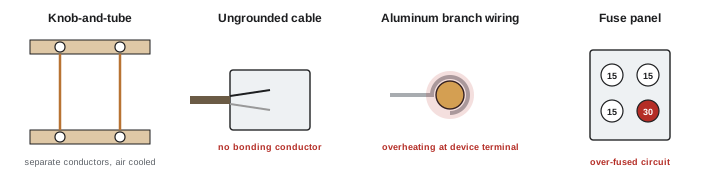
Houses built before about 1950 may have knob-and-tube wiring: single conductors with rubber and cloth insulation, supported on porcelain knobs and passing through porcelain tubes, separated so that heat dissipates into open air. It was a sound method when installed, but after 70 to 100 years the insulation is often brittle, there is no bonding conductor, circuits are often overloaded or altered, and covering the conductors with thermal insulation (common in attic retrofits) traps their heat. Many insurers will not cover houses with active knob-and-tube, and replacement is the usual recommendation, especially before insulating.
Early cable without a bonding conductor
Cable installed before the 1960s often has only two insulated conductors, with no bonding (grounding) conductor, supplying two-slot receptacles. Replacing a two-slot receptacle with a three-slot one is not allowed unless a bonding path is provided, because the third slot would falsely suggest a ground. Accepted options are:
- Install a new bonding conductor to the box, run to an acceptable point in the bonding system.
- Replace the circuit with new cable.
- Protect the receptacle with a GFCI (a GFCI receptacle or breaker) and install three-slot receptacles labelled "No equipment ground" and "GFCI protected". The GFCI protects people from shock even without a ground, although it does not provide a fault path for surge protectors or equipment that needs one.
The CEC permits the replacement of non-bonded receptacles under specific conditions, including GFCI protection, and requires labelling; tamper-resistant receptacles are required for replacements in locations where new receptacles would need them.
Aluminum branch wiring
Between roughly 1965 and the mid-1970s, some houses were wired with aluminum branch-circuit conductors (15 A and 20 A circuits). Aluminum of that era expands and creeps more than copper and forms an oxide layer, so its connections at devices not designed for it loosen and overheat over time, causing fires. Remedies include:
- Replacing devices with ones marked CO/ALR, rated for aluminum.
- Pigtailing each aluminum conductor to a short copper conductor with a connector listed for joining aluminum to copper (for example special crimp connectors or listed set-screw connectors), so that copper connects to the devices.
- Rewiring with copper.
Ordinary twist-on connectors are not listed for aluminum-to-copper connections unless specifically marked. Larger aluminum conductors (for feeders, ranges and services) made with modern alloys and proper terminals are common and acceptable today.
Fuse panels and problem equipment
Fuse panels with screw-in plug fuses still serve many older houses. Their main hazard is over-fusing: replacing a 15 A fuse with a 20 A or 30 A one to stop "blowing", which removes protection from the wire. Type S fuses with size-rejecting adapters prevent this. Fuse panels are also usually small (60 A or 100 A) and lack spaces for new circuits.
Some breaker panels from past decades have documented problems with breakers that fail to trip or with poor bus connections; Federal Pacific Electric (Stab-Lok) and Zinsco panels are the best-known examples. Insurers and home inspectors commonly flag them, and replacement is often recommended.
Extending and modifying existing wiring
When a circuit is extended or a device is replaced, the new work must meet the current code, even though the rest of the house does not have to be brought up to date. In practice this means:
- Extensions and new outlets need the protection now required for that location: AFCI for most living-area circuits, GFCI in kitchens, bathrooms, basements, garages and outdoors, tamper-resistant receptacles.
In Canada, when a branch circuit supplying receptacles is extended or modified in a dwelling, AFCI protection is generally required for the extended part, and some provinces have specific provisions for renovations; check the local amendments.
- The existing circuit must have the capacity for the added load, and the panel must have a space (or a listed tandem breaker where the panel allows it).
- Splices to old wiring are made in accessible boxes, with care for brittle insulation; heat-shrink or sleeving can protect short lengths, but deteriorated wiring should be replaced back to sound cable.
Worked problem
Adding a kitchen island circuit
A renovation adds an island with two receptacles to a kitchen whose counter circuits are already fully used. The panel is a 100 A panel with two spare single-pole spaces. What is required?
Show solution
- New counter receptacles need their own circuit(s) meeting current kitchen rules: typically a 20 A circuit (or split 15 A), with GFCI and AFCI protection as required by the adopted edition.
- Use a spare space with a dual-function (AFCI/GFCI) breaker, or a combination of breaker and GFCI receptacle.
- Route cable to the island through the floor, protected where exposed in the basement.
- Recheck the house's load calculation if the renovation also adds appliances.
Answer: One new 20 A circuit with the required protection, using one spare space. The second space is kept for future needs, and if the renovation adds an induction range or similar, the service capacity must be checked.
Service upgrades and panel replacements
Upgrading a service, for example from 60 A or 100 A to 200 A, is one of the most common major residential jobs, driven by renovations, heat pumps and EVs (Lessons 8 and 10). The process:
- Load calculation and design: confirm the new size, plan the location of the meter base and panel, and the grounding electrode system (Lesson 3).
- Permit and utility coordination: the utility schedules disconnection and reconnection, may need to replace the service drop or lateral, and sets requirements for the meter base and mast.
- Installation: new meter base, service mast or conduit, service conductors, panel, grounding electrodes and bonding (water pipe, gas pipe as required), then transferring each branch circuit to the new panel, extending conductors in a junction box where they are too short.
- Inspection and reconnection: the inspector approves the service before the utility reconnects.
When circuits are moved to a new panel, each is checked: correct breaker size for its conductor (old circuits sometimes had oversized fuses), required AFCI or GFCI protection under the rules for replaced panels, labels for the directory, and any aluminum terminations rated correctly.
Worked problem
Planning the outage
A service upgrade needs the house without power while the meter base, mast and panel are replaced. The electrician estimates 6 hours of work after disconnection. The homeowner has a sump pump and a freezer. What should be arranged?
Show solution
- Schedule the utility disconnect early in the day, in dry weather.
- Provide a temporary supply for the sump pump (a portable generator connected directly to the pump's cord, not to house wiring) if groundwater is a risk.
- Keep the freezer closed; a full freezer stays frozen for about a day.
Answer: Morning disconnection, a generator for the sump pump only, and the freezer kept closed. Good communication with the homeowner and utility makes a service change routine.
Fishing cable in finished walls
Adding outlets without opening walls is a craft of its own:
- Plan routes from accessible spaces: an unfinished basement below, an attic above, or a closet.
- Use old-work boxes, which clamp to the drywall or plaster, cut into the wall at the outlet location after checking for studs, pipes and existing cables with a stud finder and an inspection camera.
- Drill through top and bottom plates with long flexible bits, and pull cable with fish tape, glow rods or fish chains.
- Across ceilings, run parallel to joists where possible; crossing joists may require small access holes that are patched afterwards.
- Keep cables away from heating ducts and plumbing, protect them where they pass through framing near the face, and seal penetrations in fire separations and top plates.
Where fishing is impractical, surface raceway (metal or plastic) is an approved alternative that leaves walls intact.
Troubleshooting in older houses
Faults in older wiring often come from deteriorated connections. A systematic approach (building on Lesson 9):
- Gather symptoms: which outlets are dead or flickering, what was happening when it started, which breaker tripped.
- Map the circuit: find all outlets on it by switching off the breaker and testing.
- Divide and test: in a dead or intermittent circuit, check the first and last working outlets; the fault is usually at a connection between them, often at a backstabbed receptacle or a loose splice.
- Measure, not guess: use a multimeter under load (a plug-in heater or load tester) to find connections that pass voltage with no load but fail under current.
- Look for heat: an infrared camera or simply touching cover plates after a load test reveals hot connections.
Worked problem
Flickering lights in a 1960s house
Lights flicker in two rooms when the microwave runs, and one receptacle is warm. The house has aluminum branch wiring. What is the likely cause and repair?
Show solution
- Flicker with load on one circuit points to a high-resistance connection carrying that load.
- Aluminum wiring at a device not rated for it is a known cause; the warm receptacle is a warning of overheating.
Answer: A deteriorating aluminum connection, probably at or near the warm receptacle. Turn off the circuit, inspect every device and splice on it, and remediate with listed copper pigtail connectors or CO/ALR devices; recommend remediation of the whole house.
Common mistakes
MistakeInstalling three-slot receptacles on ungrounded circuits without protection.
InsteadProvide a bonding path, or GFCI protection with "No equipment ground" labels.
MistakeJoining aluminum and copper with ordinary twist-on connectors.
InsteadUse connectors listed for aluminum-to-copper, or CO/ALR devices.
MistakeInsulating over active knob-and-tube wiring.
InsteadReplace it, or have it evaluated before insulation is added.
MistakeMoving old circuits to a new panel without checking conductor sizes.
InsteadMatch each breaker to its conductor and add required protection.
MistakeIgnoring the current code when extending old circuits.
InsteadNew work must meet current AFCI, GFCI and tamper-resistant rules.
Summary and key terms
- Survey the service, panel, branch wiring, devices and load before quoting renovation work.
- Knob-and-tube, ungrounded cable, aluminum branch wiring and fuse panels each have known hazards and remedies.
- Ungrounded circuits may get three-slot receptacles only with a bonding path or GFCI protection and labels.
- Extensions and modifications must meet current protection requirements.
- Service upgrades need load calculations, permits, utility coordination and careful circuit transfer.
- Fish cable through accessible spaces with old-work boxes, and troubleshoot by mapping, dividing and measuring under load.
- Knob-and-tube
- Early wiring of separate conductors on porcelain knobs and tubes.
- Non-bonded receptacle
- A two-slot receptacle without a bonding connection.
- CO/ALR
- A marking on devices rated for aluminum conductors.
- Pigtailing
- Splicing a short conductor to connect a device.
- Over-fusing
- Installing a fuse larger than the conductor allows.
- Type S fuse
- A plug fuse with a size-rejecting adapter.
- Old-work box
- A box that mounts in an existing finished wall.
- Fish tape
- A flexible steel or plastic tape for pulling cable through walls.
- Surface raceway
- A raceway mounted on the wall surface.
- Service upgrade
- Replacing a service with one of higher capacity.
Practice problems
Work each problem on paper first, then reveal the answer to check.
Why is insulating over knob-and-tube a concern?
Show answer
The conductors rely on open air to dissipate heat.
Three options for a two-slot receptacle replacement on an ungrounded circuit?
Show answer
Add a bonding conductor, rewire, or GFCI protection with labels.
What label goes on a GFCI-protected ungrounded three-slot receptacle?
Show answer
"No equipment ground" (and "GFCI protected").
Why do old aluminum connections overheat?
Show answer
Expansion, creep and oxide loosen connections at unsuitable devices.
What device marking is required for aluminum 15 A circuits?
Show answer
CO/ALR.
What prevents over-fusing in a fuse panel?
Show answer
Type S fuses with size-rejecting adapters.
Must an extended old circuit meet current AFCI rules?
Show answer
Generally yes, with limited exceptions.
What does the inspector approve before the utility reconnects?
Show answer
The new service installation.
Name two tools for fishing cable.
Show answer
Fish tape, glow rods, flexible bits, fish chains.
How do you find a high-resistance connection?
Show answer
Measure voltage under load and check for heat.
Lesson quiz · 5 questions
Score 60% or more to complete this lesson.
Create a free account to save your progress, take quizzes and earn a certificate.