
ELEC-110 · Lesson 8 of 12 · 31 min
Batteries and DC power systems
Batteries are everywhere an electrician works: in emergency lighting, fire alarm panels, security systems, UPS systems, generator starting, telecommunications rooms, substations, solar and energy storage systems, cordless tools and electric vehicle chargers. Installing, testing and maintaining them safely requires understanding how they are rated, how cells are combined, how they charge and discharge, how temperature and age affect them, and the particular hazards they present: high short-circuit currents, explosive gases, corrosive electrolyte and, for lithium-ion, thermal runaway. This lesson covers these topics and the DC power systems built around batteries.
Battery ratings
A battery is described by several ratings:
- Nominal voltage: the typical voltage during discharge, set by the cell chemistry and number of cells in series (Lesson 2).
- Capacity: the charge it can deliver, in ampere-hours (Ah), at a specified discharge rate and temperature. A 100 Ah battery rated at the 20-hour rate can deliver 5 A for 20 hours.
- Energy: capacity times voltage, in watt-hours (Wh) or kilowatt-hours (kWh).
- Discharge rate or C-rate: current expressed as a multiple of capacity. For a 100 Ah battery, 1C is 100 A and 0.2C is 20 A.
- Cold cranking amps (for starting batteries): the current deliverable at −18 °C for 30 seconds while staying above a minimum voltage.
- Cycle life: how many charge-discharge cycles it can deliver before capacity falls to a set fraction, usually 80%, which depends strongly on depth of discharge.
Worked problem
Battery energy and C-rate
A lithium iron phosphate battery is 51.2 V, 200 Ah. What is its energy? What current is 0.5C, and how long can it supply that current?
Show solution
- Energy: \(51.2 \times 200 = 10{,}240\) Wh ≈ 10.2 kWh.
- 0.5C current: \(0.5 \times 200 = 100\) A; time \(200/100 = 2\) h.
Answer: About 10.2 kWh; 100 A for 2 hours. At 100 A it delivers about 5.1 kW, enough to run a small home's essential loads for a couple of hours.
Capacity depends on how fast you discharge
A battery does not deliver its full rated capacity at every current. At high discharge rates, internal resistance losses and chemical limitations reduce the usable capacity, especially for lead-acid batteries. A lead-acid battery rated 100 Ah at the 20-hour rate (5 A) might deliver only about 80 Ah at a 5-hour rate (16 A) and around 50 Ah to 60 Ah when discharged in under an hour. Lithium-ion batteries are much less affected. Battery data sheets give capacity at several rates, and UPS and emergency lighting batteries are sized from tables of watts or amperes per cell for the required runtime.
Temperature also matters. Cold reduces available capacity (a lead-acid battery at −10 °C may deliver only 60% to 70% of its 25 °C capacity) and slows charging; heat increases capacity slightly but shortens life dramatically: as a rule of thumb, lead-acid battery life halves for every 8 °C to 10 °C above 25 °C.
Worked problem
Runtime for emergency lighting
An emergency lighting unit must supply 72 W at 12 V for 90 minutes (a common US requirement; 30 minutes is common in Canada). If the battery delivers only 85% of its rating at this rate and should never be discharged below 80% depth, what Ah rating is needed?
Show solution
- Current: \(72/12 = 6\) A. Charge needed: \(6 \times 1.5 = 9\) Ah.
- Allow for rate: \(9/0.85 = 10.6\) Ah. Allow for depth of discharge: \(10.6/0.8 = 13.2\) Ah.
Answer: At least 13.2 Ah, so a standard 14 Ah or larger battery, plus a further allowance for ageing (often 25%) to meet the requirement at end of life. Monthly and annual tests confirm the unit still meets its runtime (ELEC-220).
Cells in series and parallel
Cells and batteries are combined to reach the voltage and capacity a system needs:
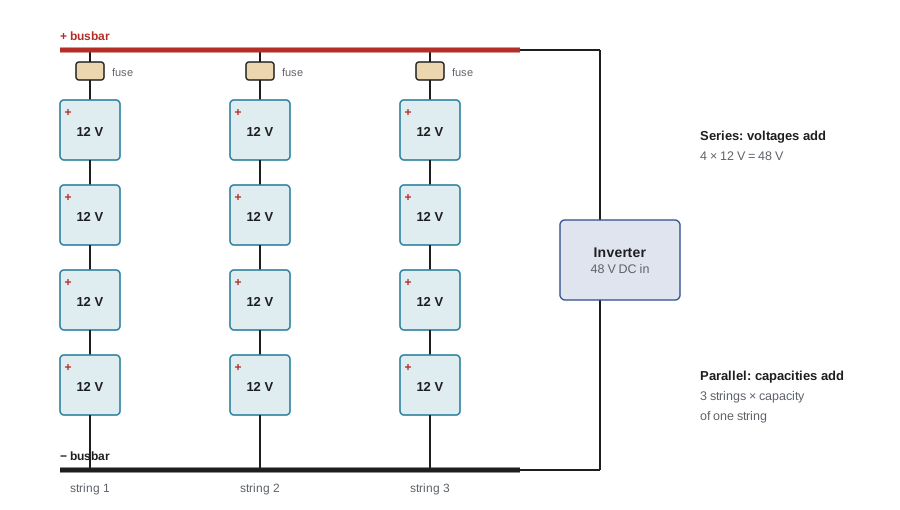
- Series: voltages add, capacity (Ah) stays the same. Six 2 V lead-acid cells make a 12 V battery; forty 12 V batteries make a 480 V UPS string.
- Parallel: capacities add, voltage stays the same. Two 12 V, 100 Ah batteries in parallel make 12 V, 200 Ah.
- Series-parallel: strings of series batteries connected in parallel, used in large systems.
In any combination, batteries should be of the same type, capacity, age and state of charge. A weak battery in a series string limits the whole string and is driven into deep discharge or reverse charge; mismatched parallel batteries circulate current between themselves (Lesson 6). Lithium-ion systems rely on a battery management system to balance cells and protect them.
Worked problem
Building a battery bank
A solar storage system needs 48 V nominal and 20 kWh using 12 V, 200 Ah batteries. How many batteries are needed, and how are they arranged?
Show solution
- Series for voltage: \(48/12 = 4\) batteries per string.
- Energy per string: \(48 \times 200 = 9.6\) kWh. Strings needed: \(20/9.6 = 2.08\), so 3 strings.
- Total: \(4 \times 3 = 12\) batteries, giving 28.8 kWh nominal.
Answer: Twelve batteries in three parallel strings of four. Using two strings would give only 19.2 kWh. Each string should have its own fuse or breaker, and cables should be equal lengths so strings share current evenly.
Charging
Batteries must be charged correctly to last. Lead-acid batteries are typically charged in stages:
- Bulk: constant current until the voltage reaches the absorption setpoint (around 2.4 V per cell).
- Absorption: constant voltage while the current tapers off as the battery fills.
- Float: a lower constant voltage (around 2.25 V to 2.27 V per cell) that keeps the battery full indefinitely, used in UPS and standby systems.
- Equalize (flooded batteries only): a periodic controlled overcharge to balance cells and stir electrolyte.
Lithium-ion batteries use constant current followed by constant voltage, with no float stage; their battery management system stops charging when cells are full and prevents charging below freezing, which can cause permanent damage. Charging voltages are temperature compensated for lead-acid batteries, lower in heat and higher in cold. Overcharging causes gassing, water loss, heat and, in extreme cases, thermal runaway; undercharging causes sulfation and capacity loss.
Worked problem
Float voltage for a string
A UPS string has 40 VRLA batteries of 6 cells each. The float setting is 2.27 V per cell at 25 °C, with temperature compensation of −3 mV per cell per °C. What is the string float voltage at 25 °C and at 35 °C?
Show solution
- Cells: \(40 \times 6 = 240\).
- At 25 °C: \(240 \times 2.27 = 544.8\) V.
- At 35 °C: per-cell \(2.27 - 0.003 \times 10 = 2.24\) V; string \(240 \times 2.24 = 537.6\) V.
Answer: 544.8 V at 25 °C, reduced to 537.6 V at 35 °C. Without compensation, a warm battery room would overcharge the batteries and shorten their life.
Battery hazards
Batteries store a lot of energy and are always live; they cannot be switched off. The main hazards are:
- Short circuits: even a 12 V battery can deliver hundreds or thousands of amperes (Lesson 6), welding tools and jewellery to terminals and causing severe burns. Use insulated tools, remove rings and watches, and cover terminals.
- Arc flash and shock: large battery strings at hundreds of volts DC present arc flash and shock hazards like any other electrical system; DC arcs are harder to extinguish than AC arcs.
- Hydrogen gas: lead-acid batteries release hydrogen while charging, especially when overcharged. Hydrogen is explosive at concentrations above 4% in air, so battery rooms need ventilation and no ignition sources.
- Corrosive electrolyte: sulfuric acid in lead-acid batteries and alkaline electrolyte in nickel-cadmium batteries burn skin and eyes. Use face shields, gloves and aprons, and provide eyewash stations.
- Weight: large batteries are heavy; use proper lifting equipment and techniques.
- Thermal runaway: lithium-ion cells can overheat uncontrollably after damage, overcharge or internal defects, releasing flammable and toxic gases and fire that is hard to extinguish (DCE-440).
In Canada, battery installations follow the Canadian Electrical Code (Section 26 for storage batteries and Section 64 for energy storage systems), with workplace electrical safety per CSA Z462 and provincial occupational health and safety rules.
Worked problem
Hydrogen ventilation
A battery room charging generates hydrogen at 0.02 m³/h. Ventilation must keep hydrogen below 1% (one quarter of the 4% lower explosive limit). What minimum ventilation rate is needed?
Show solution
- Required airflow: \(0.02/0.01 = 2\) m³/h.
Answer: At least 2 m³/h of fresh air, which is small; but during an overcharge fault hydrogen generation can be many times higher, so codes and standards specify ventilation based on the maximum charging current, and some rooms have hydrogen detectors that alarm and increase ventilation.
Testing and maintenance
Battery maintenance programs typically include:
- Visual inspection: corrosion, swelling, leaks, cracked cases and loose connections.
- Voltage readings: string and individual battery or cell voltages on float; a cell that floats low may be failing.
- Internal resistance or impedance measurements: compared with a baseline, a rise of 20% to 50% indicates deterioration (Lesson 6).
- Connection resistance: high resistance at a terminal causes heat and voltage drop under load; torque connections to specification.
- Thermal scans: hot connections or cells.
- Capacity (load) testing: discharging the battery at a known rate to confirm it still meets its rated runtime, the only definitive test.
Batteries are replaced when capacity falls below about 80% of rating, as capacity tends to decline quickly after that point.
DC power systems
Many systems use DC directly:
- Telecommunications: central offices and network rooms traditionally run on −48 V DC from rectifiers with battery backup; the positive terminal is grounded.
- Substations and power plants: 125 V or 250 V DC battery systems power protective relays, breaker trip coils and controls, so protection works even if AC fails.
- Data centres: UPS DC buses at roughly 400 V to 800 V, and 48 V DC power shelves in modern server racks.
- Solar and storage: PV arrays and battery systems are DC up to 600 V, 1,000 V or 1,500 V depending on the application.
- Vehicles and EV charging: 12 V and 48 V auxiliary systems and 400 V to 800 V traction batteries; DC fast chargers deliver DC directly to the vehicle battery.
- Control circuits: 24 V DC is the most common voltage for PLCs, sensors and control panels (ELEC-330).
DC systems need DC-rated switches, breakers and fuses: because DC has no current zero crossing, arcs do not extinguish themselves as they do in AC, so DC devices use magnetic arc blowouts and longer contact gaps. Using an AC-only device on DC can lead to sustained arcing and fire.
Common mistakes
MistakeAssuming a battery's Ah rating applies at any discharge rate.
InsteadUse the manufacturer's data for the actual rate and temperature.
MistakeMixing old and new batteries in a string.
InsteadMatch type, capacity, age and state of charge.
MistakeWearing rings or using uninsulated tools on batteries.
InsteadRemove jewellery and use insulated tools; batteries are always live.
MistakeUsing AC-rated breakers or switches on DC circuits.
InsteadUse devices rated for the DC voltage and current.
MistakeRelying on float voltage alone to judge battery health.
InsteadMeasure internal resistance and perform capacity tests.
Summary and key terms
- Batteries are rated by nominal voltage, Ah capacity, energy, C-rate and cycle life.
- Usable capacity falls at high discharge rates and low temperatures; heat shortens life.
- Series adds voltage; parallel adds capacity; batteries must be matched.
- Lead-acid charging uses bulk, absorption and float stages with temperature compensation; lithium-ion uses CC-CV with a BMS.
- Hazards include high short-circuit current, arc flash, hydrogen, corrosive electrolyte and thermal runaway.
- Maintenance combines inspection, voltage, impedance, connection and capacity tests.
- DC systems power telecom, substations, data centres, solar, vehicles and controls, and need DC-rated devices.
- Ampere-hour (Ah)
- Capacity: current multiplied by time.
- C-rate
- Discharge or charge current as a multiple of capacity.
- Depth of discharge
- The fraction of capacity that has been used.
- Cycle life
- Number of charge-discharge cycles before capacity falls to a set level.
- Float charge
- A constant voltage that keeps a standby battery fully charged.
- Temperature compensation
- Adjusting charge voltage for battery temperature.
- Sulfation
- Crystal buildup in undercharged lead-acid batteries that reduces capacity.
- Battery management system
- Electronics that monitor and protect lithium-ion cells.
- Capacity test
- A controlled discharge to measure a battery's actual capacity.
- DC-rated device
- A switch, breaker or fuse designed to interrupt DC arcs.
Practice problems
Work each problem on paper first, then reveal the answer to check.
Energy of a 24 V, 150 Ah battery?
Show answer
3.6 kWh.
0.2C for a 400 Ah battery?
Show answer
80 A.
Why does a lead-acid battery deliver less capacity at high current?
Show answer
Internal resistance losses and chemical limitations.
How does heat affect lead-acid battery life?
Show answer
Life roughly halves for every 8 to 10 °C above 25 °C.
Four 12 V, 100 Ah batteries in series. Voltage and capacity?
Show answer
48 V, 100 Ah.
Two strings of four 12 V, 100 Ah batteries in parallel. Energy?
Show answer
48 V × 200 Ah = 9.6 kWh.
Name the lead-acid charging stages.
Show answer
Bulk, absorption, float (and equalize for flooded).
Why is hydrogen a hazard in battery rooms?
Show answer
It is explosive above 4% in air.
What is the only definitive battery health test?
Show answer
A capacity (load) test.
Why can't AC breakers be assumed safe on DC?
Show answer
DC has no zero crossing, so arcs may not extinguish.
Lesson quiz · 5 questions
Score 60% or more to complete this lesson.
Create a free account to save your progress, take quizzes and earn a certificate.