
ELEC-110 · Lesson 5 of 12 · 38 min
Series and parallel circuits
Real circuits contain more than one load. The receptacles on a kitchen circuit, the lights on a switch, the elements in a heater and the resistors in a control circuit are connected either one after another (in series), side by side (in parallel), or in combinations of both. How they are connected decides how voltage and current divide among them, what happens when one fails, and how much current the circuit draws. Building wiring is almost entirely parallel; series connections appear in switches, fuses, overloads, control circuits and some lighting.
This chapter gives the rules for series and parallel circuits, shows how to solve combination circuits step by step, introduces Kirchhoff's two laws, and explains how opens and shorts behave in each type of circuit.
Series circuits
In a series circuit, components are connected end to end so there is only one path for current. The same current flows through every component.
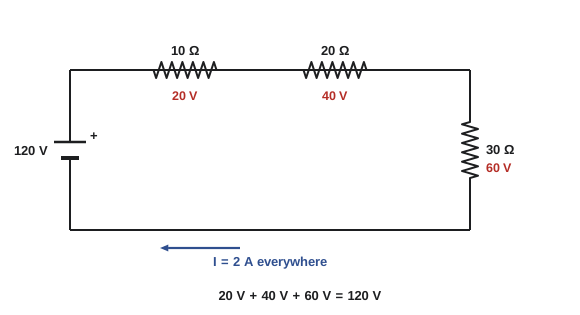
The rules for series circuits:
- Current is the same through every component: \(I_T = I_1 = I_2 = I_3\).
- Resistances add: \(R_T = R_1 + R_2 + R_3 + \cdots\).
- The voltage drops add up to the source voltage: \(V_T = V_1 + V_2 + V_3 + \cdots\).
- Powers add: \(P_T = P_1 + P_2 + P_3 + \cdots\).
Worked problem
Solving a series circuit
Resistors of 10 Ω, 20 Ω and 30 Ω are connected in series to 120 V. Find the total resistance, the current, each voltage drop and each power.
Show solution
- \(R_T = 10 + 20 + 30 = 60\) Ω.
- \(I = V/R_T = 120/60 = 2\) A, the same in every resistor.
- Voltage drops: \(V_1 = 2 \times 10 = 20\) V, \(V_2 = 40\) V, \(V_3 = 60\) V. Check: 20 + 40 + 60 = 120 V ✓.
- Powers: \(P_1 = 2 \times 20 = 40\) W, \(P_2 = 80\) W, \(P_3 = 120\) W; total 240 W = 120 V × 2 A ✓.
Answer: 60 Ω, 2 A, drops of 20, 40 and 60 V, powers of 40, 80 and 120 W. The largest resistance takes the largest share of the voltage and power
Voltage dividers
Because voltage divides in proportion to resistance, two resistors in series make a voltage divider, used to produce a lower voltage for a sensor or control input:
Worked problem
A voltage divider
A 24 V DC control supply feeds 10 kΩ and 2 kΩ resistors in series. What voltage appears across the 2 kΩ resistor?
Show solution
- \(V_\text{out} = 24 \times 2/(10 + 2) = 24 \times 0.1667 = 4\) V.
Answer: 4 V. Dividers work only if the load connected across the output draws very little current; Lesson 7 shows how even a meter can upset one
Worked problem
Two lamps in series
Two 100 W, 120 V incandescent lamps are accidentally wired in series across 120 V. Treating their resistance as constant, how much power does each produce?
Show solution
- Each lamp: \(R = V^2/P = 120^2/100 = 144\) Ω.
- In series: \(R_T = 288\) Ω, \(I = 120/288 = 0.417\) A.
- Each lamp: \(P = I^2R = 0.417^2 \times 144 = 25\) W.
Answer: Only about 25 W each, 50 W total: each lamp gets half the voltage, and power goes with voltage squared. (In reality the filaments run cooler, their resistance falls, and they give slightly more, but they glow dimly.) A mistake like this is a common reason for a light that "works but is dim"
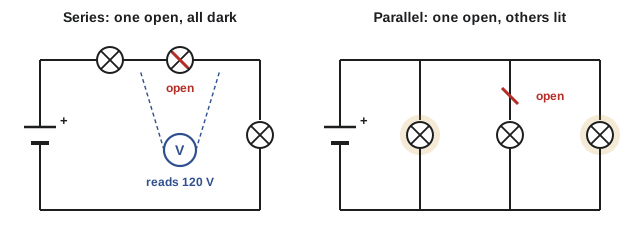
Series circuits have one serious drawback for building loads: if any component opens (a lamp burns out or a connection fails), current stops everywhere and every load goes off. Old strings of holiday lights wired in series showed this: one dead bulb darkened the whole string. Fifty bulbs in series on 120 V each get only 2.4 V.
Series connection is exactly what you want for control and protection. A switch, fuse, breaker or motor overload is placed in series with the load so that opening it stops the current. Safety interlocks are wired in series so that any one of them can stop a machine.
Parallel circuits
In a parallel circuit, every component is connected directly across the same two points, so each has its own path. The same voltage appears across every branch.
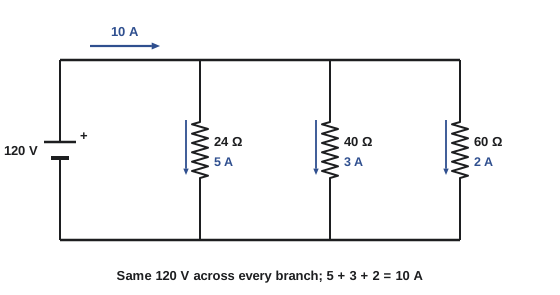
The rules for parallel circuits:
- Voltage is the same across every branch: \(V_T = V_1 = V_2 = V_3\).
- Branch currents add: \(I_T = I_1 + I_2 + I_3 + \cdots\).
- Total resistance is found from the reciprocals: \(\frac{1}{R_T} = \frac{1}{R_1} + \frac{1}{R_2} + \frac{1}{R_3} + \cdots\). It is always less than the smallest branch resistance.
- Powers add.
Two shortcuts: for two resistors, \(R_T = \frac{R_1 R_2}{R_1 + R_2}\) ("product over sum"); for \(n\) equal resistors \(R\), \(R_T = R/n\).
Worked problem
Solving a parallel circuit
Loads of 24 Ω, 40 Ω and 60 Ω are connected in parallel across 120 V. Find each branch current, the total current and the total resistance.
Show solution
- Branch currents: \(120/24 = 5\) A, \(120/40 = 3\) A, \(120/60 = 2\) A.
- Total current: \(5 + 3 + 2 = 10\) A.
- Total resistance: \(R_T = V/I_T = 120/10 = 12\) Ω. Check with reciprocals: \(1/24 + 1/40 + 1/60 = 0.0417 + 0.025 + 0.0167 = 0.0833\), so \(R_T = 12\) Ω ✓.
Answer: 5, 3 and 2 A in the branches, 10 A total, 12 Ω total, which is less than the smallest branch (24 Ω), as it must be
Building wiring is parallel. Every receptacle and light on a branch circuit sees the full 120 V, each load works independently, and switching one off does not affect the others. The price is that the currents add up in the shared conductors and breaker.
Worked problem
An overloaded kitchen circuit
On a 120 V kitchen counter circuit protected by a 20 A breaker, someone runs a 1500 W kettle, a 900 W toaster and a 1100 W microwave at the same time. What is the total current? Will the breaker trip?
Show solution
- Kettle: 1500/120 = 12.5 A. Toaster: 900/120 = 7.5 A. Microwave: 1100/120 = 9.17 A.
- Total: 12.5 + 7.5 + 9.17 = 29.2 A.
Answer: About 29 A on a 20 A breaker. The breaker will trip, after a delay that depends on how far over its rating the current is. This is why electrical codes require more than one counter receptacle circuit in a kitchen
Combination circuits
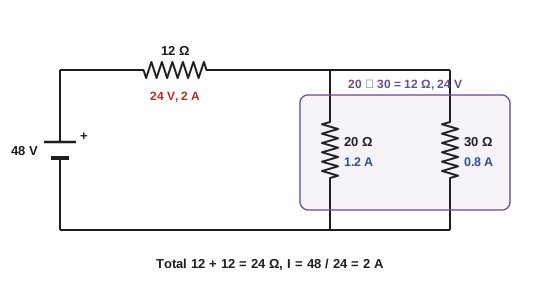
Most real circuits combine series and parallel parts. Solve them by simplifying step by step: replace each group of parallel resistors with its equivalent, then add series resistances, until one equivalent resistance remains. Then work back out to find each current and voltage.
Worked problem
Solving a combination circuit
A 12 Ω resistor is in series with a parallel pair of 20 Ω and 30 Ω, across 48 V. Find the total current and the current in each resistor.
Show solution
- Parallel pair: \(R_P = (20 \times 30)/(20 + 30) = 600/50 = 12\) Ω.
- Total: \(R_T = 12 + 12 = 24\) Ω. Total current: \(I_T = 48/24 = 2\) A (this flows through the 12 Ω series resistor).
- Voltage across the series resistor: \(2 \times 12 = 24\) V; across the parallel pair: \(48 - 24 = 24\) V.
- Branch currents: \(24/20 = 1.2\) A and \(24/30 = 0.8\) A. Check: 1.2 + 0.8 = 2 A ✓.
Answer: Total current 2 A; 2 A through the 12 Ω resistor, 1.2 A through 20 Ω and 0.8 A through 30 Ω
Kirchhoff's laws
The series and parallel rules are special cases of two general laws, published by Gustav Kirchhoff in 1845, that apply to every circuit. Lesson 6 uses them to solve circuits that cannot be reduced to series and parallel combinations:
- Kirchhoff's current law (KCL): the total current flowing into any junction equals the total current flowing out. Charge does not pile up anywhere.
- Kirchhoff's voltage law (KVL): around any closed loop, the voltage rises (sources) equal the voltage drops (loads). Energy given to each coulomb is all used up by the time it returns.
Worked problem
Using KCL at a panel
A single-phase 120/240 V panel feeds three 120 V loads on line 1 drawing 8 A, 5 A and 3 A. How much current flows in the line 1 conductor feeding them? If the line 2 loads total 10 A, what current flows in the neutral?
Show solution
- KCL at the line 1 bus: \(8 + 5 + 3 = 16\) A.
- In a 120/240 V system, line 1 and line 2 currents flow in opposite directions in the shared neutral, so the neutral carries only the difference: \(16 - 10 = 6\) A.
Answer: 16 A in line 1 and 6 A in the neutral. Balancing 120 V loads between the two lines reduces neutral current, which is why panel circuits alternate between lines
Opens and shorts
Knowing how faults behave in each kind of circuit is the basis of troubleshooting (Lesson 12).
- An open in a series circuit stops current everywhere. The full source voltage appears across the open point, which is how you find it: measure voltage across each component in turn, and the one showing the full supply voltage is open.
- An open in one branch of a parallel circuit stops only that branch. Total current falls by that branch's current; the other loads keep working.
- A short across one component of a series circuit removes its resistance: current rises and the other components get more voltage.
- A short across a parallel branch is a short across the supply. Current is limited only by the wiring and source resistance and can be hundreds or thousands of amperes, which is what the overcurrent device must interrupt.
Worked problem
Finding an open in a series string
A string of 4 identical heating elements is wired in series across 240 V and has stopped heating. You measure 0 V across elements 1, 2 and 4, and 240 V across element 3. Which element is faulty?
Show solution
- With no current flowing, intact elements have no voltage drop across them (V = IR = 0).
- The open element has the full source voltage across it.
Answer: Element 3 is open. Remember to de-energize and lock out before removing it, and confirm with an ohmmeter on the disconnected element
Common mistakes
MistakeAdding parallel resistances directly.
InsteadAdd reciprocals, or use product over sum for two. The total is always less than the smallest branch.
MistakeAssuming each series component gets the full supply voltage.
InsteadSeries voltage divides in proportion to resistance.
MistakeForgetting that parallel branch currents add in the shared conductors.
InsteadEvery load on a circuit adds current to the same breaker and wires.
MistakeExpecting 0 V across an open component.
InsteadIn a series circuit, the open component has the full source voltage across it.
MistakeCalculating the neutral current of a 120/240 V circuit as the sum of both lines.
InsteadThe neutral carries the difference between line 1 and line 2 currents.
Summary and key terms
- Series: one path; same current; \(R_T = R_1 + R_2 + \cdots\); voltages add to the source; an open stops everything.
- Voltage divider: \(V_\text{out} = V_\text{in} R_2/(R_1 + R_2)\).
- Parallel: same voltage; currents add; \(1/R_T = \sum 1/R_i\); two resistors: product over sum; \(n\) equal: \(R/n\).
- Building wiring is parallel, so loads add current on the shared breaker and conductors.
- Combination circuits: simplify parallel groups, add series parts, then work back out.
- KCL: current in = current out at a junction. KVL: rises = drops around a loop.
- Opens and shorts behave differently in series and parallel circuits; use voltage readings to locate them.
- Series circuit
- A circuit with only one path, so the same current flows through every component.
- Parallel circuit
- A circuit in which components are connected across the same two points, each with its own path.
- Equivalent resistance
- The single resistance that would draw the same current as a group of resistances.
- Voltage divider
- Two or more series resistors used to produce a fraction of the supply voltage.
- Branch
- One path in a parallel circuit.
- Kirchhoff's current law
- The sum of currents into a junction equals the sum out.
- Kirchhoff's voltage law
- Around any closed loop, voltage rises equal voltage drops.
- Neutral
- The grounded circuit conductor that carries return current, in a 120/240 V system the difference between line currents.
Practice problems
Work each problem on paper first, then reveal the answer to check.
Resistors of 15 Ω, 25 Ω and 40 Ω are in series across 240 V. Find the current and each voltage drop.
Show answer
R_T = 80 Ω; I = 3 A; drops 45 V, 75 V, 120 V.
Find the total resistance of 6 Ω and 12 Ω in parallel.
Show answer
(6 × 12)/18 = 4 Ω.
Five identical 100 Ω resistors are in parallel. What is the total resistance?
Show answer
100/5 = 20 Ω.
Loads of 30 Ω, 60 Ω and 20 Ω are in parallel on 120 V. Find the total current.
Show answer
4 + 2 + 6 = 12 A.
A 12 V supply feeds a divider of 3.3 kΩ (top) and 1.5 kΩ (bottom). Find the output voltage.
Show answer
12 × 1.5/4.8 = 3.75 V.
A 10 Ω resistor is in series with a parallel pair of 30 Ω and 60 Ω across 60 V. Find the total current and the current in the 30 Ω resistor.
Show answer
Parallel = 20 Ω; R_T = 30 Ω; I_T = 2 A; V_parallel = 40 V; I_30 = 1.33 A.
A 15 A, 120 V circuit has a 600 W lamp load and a 1000 W space heater. Is it overloaded for continuous use?
Show answer
5 + 8.33 = 13.3 A, above the 12 A continuous limit: yes, for continuous use.
A 120/240 V panel has 22 A of 120 V load on line 1 and 15 A on line 2. What is the neutral current?
Show answer
22 − 15 = 7 A.
In a series circuit of three lamps, one lamp is shorted. What happens to the other two?
Show answer
Total resistance falls, current rises, and the other two lamps get more voltage and glow brighter (and may burn out).
Why are receptacles wired in parallel rather than series?
Show answer
So each gets full voltage and works independently; in series, one unplugged or failed load would stop all the others and the voltage would divide.
Lesson quiz · 5 questions
Score 60% or more to complete this lesson.
Create a free account to save your progress, take quizzes and earn a certificate.