
ELEC-110 · Lesson 4 of 12 · 36 min
Resistance and resistors
Resistance appears in every circuit: in the conductors that carry current, in the loads that do work, and in the components that control current in electronics and controls. Lesson 3 used Ohm's law to relate voltage, current and resistance. This lesson looks at resistance itself: what determines the resistance of a wire or component, how resistance changes with temperature, the types of resistors and how they are marked, how resistors are rated for power, and devices whose resistance changes with temperature, light, voltage or position. These ideas explain why wires heat up, why lamps draw a surge at switch-on, how temperature sensors work, and how to read and replace components in control circuits.
What determines resistance
The resistance of a uniform conductor depends on four things: the material, the length, the cross-sectional area and the temperature. Longer conductors have more resistance, because electrons must travel farther through the material; thicker conductors have less, because there are more paths side by side. The relationship is:
where \(R\) is resistance in ohms, \(\rho\) (rho) is the resistivity of the material in ohm-metres (Lesson 2 lists values), \(L\) is the length in metres and \(A\) is the cross-sectional area in square metres. For copper at 20 °C, \(\rho = 1.72 \times 10^{-8}\) Ω·m.
Worked problem
Resistance of a copper conductor
Find the resistance of 30 m of copper conductor with a cross-sectional area of 2.08 mm² (the area of a 14 AWG conductor) at 20 °C.
Show solution
- Area: \(2.08 \text{ mm}^2 = 2.08 \times 10^{-6}\) m².
- Resistance: \(R = 1.72 \times 10^{-8} \times 30 / 2.08 \times 10^{-6} = 0.248\) Ω.
Answer: About 0.25 Ω for 30 m of conductor. A circuit has two conductors (out and back), so a 30 m run has about 0.5 Ω of loop resistance, which matters for voltage drop (Lesson 11).
Worked problem
Doubling length and area
A conductor has 0.4 Ω. What is the resistance of a conductor of the same material that is twice as long with twice the cross-sectional area? Three times as long with half the area?
Show solution
- Twice as long, twice the area: \(0.4 \times 2/2 = 0.4\) Ω.
- Three times as long, half the area: \(0.4 \times 3 \times 2 = 2.4\) Ω.
Answer: 0.4 Ω and 2.4 Ω. Because resistance is proportional to length and inversely proportional to area, you can scale known values instead of recalculating from resistivity.
Conductance
Conductance is the opposite of resistance: how easily a component lets current flow. Its symbol is \(G\) and its unit is the siemens (S):
Conductance is convenient for parallel circuits, where conductances simply add (Lesson 5). A 10 Ω resistor has a conductance of 0.1 S; two in parallel have 0.2 S, which is 5 Ω.
Resistance and temperature
The resistance of most metals rises with temperature, because the atoms vibrate more and impede the flow of electrons. For copper, resistance rises by about 0.393% per °C; for aluminum, about 0.403% per °C. The resistance at a new temperature is:
where \(\alpha\) is the temperature coefficient of resistance. Conductor tables list resistance at a standard temperature (often 75 °C for code calculations), because conductors under load run warm.
Worked problem
A warm conductor
A copper feeder has a resistance of 0.120 Ω at 20 °C. What is its resistance at its operating temperature of 75 °C?
Show solution
- Temperature rise: \(75 - 20 = 55\) °C.
- \(R_2 = 0.120 \times (1 + 0.00393 \times 55) = 0.120 \times 1.216 = 0.146\) Ω.
Answer: About 0.146 Ω, 22% higher than at room temperature. Voltage drop and losses are therefore larger in a loaded, warm conductor than a cold resistance measurement suggests.
Incandescent lamp filaments show a dramatic version of this effect. A tungsten filament's resistance at its operating temperature (around 2,500 °C) is roughly 10 to 15 times its cold resistance. When the lamp is switched on, the cold filament draws a large inrush current for a fraction of a second, which is why lamps usually fail at switch-on. Some materials, such as carbon and semiconductors, have negative temperature coefficients: their resistance falls as they heat up.
Worked problem
Lamp inrush
A 100 W, 120 V incandescent lamp has a cold resistance of 10 Ω. What are its hot resistance, normal current and inrush current?
Show solution
- Hot resistance: \(R = V^2/P = 120^2/100 = 144\) Ω.
- Normal current: \(I = 100/120 = 0.83\) A.
- Inrush: \(I = 120/10 = 12\) A, about 14 times normal (peak values with AC are higher still).
Answer: Hot resistance 144 Ω, normal current 0.83 A, inrush about 12 A. Inrush currents from lamps, transformers, motors and power supplies explain why breakers and fuses have time delays and why circuits with many such loads can trip at switch-on.
Resistors
A resistor is a component made to have a specific resistance. Resistors limit current, divide voltages, set timing in circuits, pull signals to known levels, and turn electrical energy into heat in heaters and load banks. They are specified by three main ratings:
- Resistance, in ohms, with standard values in series such as E12 (10, 12, 15, 18, 22, 27, 33, 39, 47, 56, 68, 82 and their multiples by powers of ten).
- Tolerance: how close the actual value is guaranteed to be to the marked value, such as ±5% or ±1%.
- Power rating: the maximum power it can dissipate continuously without overheating, such as 1/4 W, 1 W or 50 W.
Types include carbon film and metal film resistors (small, for electronics), wirewound resistors (for higher power and precision), large ceramic or grid resistors (for motor starting, braking and load banks), and surface-mount resistors on circuit boards.
Reading resistor markings
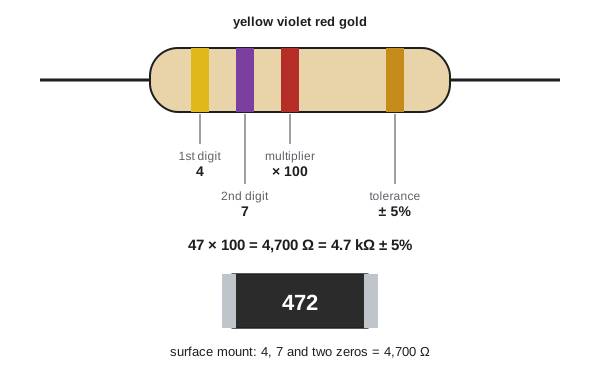
Small through-hole resistors are marked with coloured bands. With four bands, the first two give digits, the third a multiplier (the number of zeros), and the fourth the tolerance. Five-band resistors use three digit bands. Surface-mount resistors use number codes: "472" means 47 followed by 2 zeros, 4,700 Ω.
| Band | Digit | Multiplier |
|---|---|---|
| Black | 0 | × 1 |
| Brown | 1 | × 10 |
| Red | 2 | × 100 |
| Orange | 3 | × 1,000 |
| Yellow | 4 | × 10,000 |
| Green | 5 | × 100,000 |
| Blue | 6 | × 1,000,000 |
| Violet | 7 | — |
| Grey | 8 | — |
| White | 9 | — |
Worked problem
Decoding bands
A resistor has bands yellow, violet, red, gold. What are its value and range? Another reads brown, black, orange, gold.
Show solution
- Yellow (4), violet (7), red (× 100): 4,700 Ω = 4.7 kΩ, ±5%: 4,465 Ω to 4,935 Ω.
- Brown (1), black (0), orange (× 1,000): 10,000 Ω = 10 kΩ, ±5%: 9.5 kΩ to 10.5 kΩ.
Answer: 4.7 kΩ ±5% and 10 kΩ ±5%. Always confirm with an ohmmeter after removing at least one end of the resistor from the circuit, since other components in parallel affect the reading (Lesson 7).
Power ratings and heat
A resistor dissipates power as heat, \(P = I^2 R = V^2/R\) (Lesson 3). If the power exceeds the rating, the resistor overheats, changes value, burns or fails open. Good practice is to choose a power rating at least twice the calculated dissipation and to allow space and airflow for cooling; resistors in enclosures and at high ambient temperatures must be derated further.
Worked problem
Choosing a power rating
An indicator LED circuit drops 22 V across a 1.5 kΩ resistor. What power does the resistor dissipate, and what rating should be used?
Show solution
- \(P = V^2/R = 22^2/1500 = 0.323\) W.
- With a 2× margin: at least 0.65 W, so a 1 W resistor.
Answer: About 0.32 W, so a 1 W resistor. A 1/4 W resistor would run far beyond its rating, overheat and fail.
Variable resistors
Some resistors are designed to be adjusted. A potentiometer has three terminals: the two ends of a resistive track and a sliding contact (the wiper). Used as a voltage divider, it gives an adjustable output voltage, as in speed setting knobs on drives and volume controls. A rheostat uses only two terminals (one end and the wiper) as an adjustable resistance in series with a load, historically used for dimming and motor speed control but wasteful because it turns the dropped voltage into heat.
Worked problem
A speed potentiometer
A 10 kΩ potentiometer is connected across a drive's 10 V reference. The wiper is set 35% of the way from the 0 V end. What voltage does the drive receive, and what speed reference does that represent if 10 V means 60 Hz?
Show solution
- Wiper voltage: \(0.35 \times 10 = 3.5\) V.
- Speed reference: \(3.5/10 \times 60 = 21\) Hz.
Answer: 3.5 V, a 21 Hz speed reference. If the wiper wears or the wire to it breaks, the drive may lose its reference; drives can be programmed to detect and respond to a lost reference.
Resistors that sense the world
Several devices change resistance in response to physical conditions and are widely used as sensors:
- Thermistors: NTC (negative temperature coefficient) thermistors decrease in resistance as temperature rises; they are used in temperature sensors and to limit inrush current. PTC thermistors increase sharply above a set temperature and are used as resettable fuses and in motor winding protection.
- Resistance temperature detectors (RTDs): precision platinum resistors, such as the Pt100, which has 100 Ω at 0 °C and rises about 0.385 Ω per °C; they are accurate and stable and used in HVAC, process control and data centres.
- Photoresistors (light-dependent resistors): resistance falls with light; used in simple light sensors such as photocells for outdoor lighting.
- Varistors (metal oxide varistors, MOVs): resistance falls sharply above a threshold voltage; used in surge protective devices to clamp voltage spikes.
- Strain gauges: resistance changes when stretched; used in load cells and pressure sensors.
Worked problem
Reading an RTD
A Pt100 RTD in a chilled water line measures 104.6 Ω. What is the water temperature? What would it read at 25 °C?
Show solution
- Temperature: \((104.6 - 100)/0.385 = 11.9\) °C.
- At 25 °C: \(100 + 0.385 \times 25 = 109.6\) Ω.
Answer: About 12 °C, and 109.6 Ω at 25 °C. Lead resistance can add error, which is why RTDs often use three or four wires so the instrument can compensate.
Common mistakes
MistakeMeasuring a resistor while it is still connected in a circuit.
InsteadIsolate at least one end; parallel paths change the reading.
MistakeChoosing a resistor's power rating equal to the calculated dissipation.
InsteadAllow at least a 2× margin and consider ambient temperature.
MistakeUsing cold resistance readings to calculate operating current of lamps or heaters.
InsteadResistance changes with temperature; use rated values.
MistakeForgetting that a circuit has two conductors.
InsteadUse the loop length (out and back) for conductor resistance.
MistakeReplacing a failed resistor without finding why it failed.
InsteadCheck for overload or a faulty component that caused it.
Summary and key terms
- Resistance R = ρL/A depends on material, length, area and temperature.
- Conductance G = 1/R, measured in siemens.
- Metal resistance rises with temperature: R₂ = R₁[1 + α(T₂ − T₁)], about 0.39% per °C for copper.
- Cold filaments and loads draw inrush current at switch-on.
- Resistors are rated by resistance, tolerance and power; colour bands and number codes mark values.
- Choose power ratings with at least a 2× margin.
- Potentiometers and rheostats adjust resistance; thermistors, RTDs, photoresistors, varistors and strain gauges sense conditions.
- Resistivity
- The resistance of a material per unit length and area, in ohm-metres.
- Conductance
- The reciprocal of resistance, in siemens.
- Temperature coefficient
- The fractional change in resistance per degree.
- Inrush current
- A brief high current when a load is switched on.
- Tolerance
- The allowed deviation of a component from its marked value.
- Power rating
- The maximum power a component can dissipate safely.
- Potentiometer
- A three-terminal adjustable resistor used as a voltage divider.
- Thermistor
- A resistor whose resistance changes strongly with temperature.
- RTD
- Resistance temperature detector, usually platinum.
- Varistor
- A resistor whose resistance drops sharply above a threshold voltage.
Practice problems
Work each problem on paper first, then reveal the answer to check.
Resistance of 50 m of copper with area 3.31 mm² at 20 °C?
Show answer
1.72e-8 × 50 / 3.31e-6 = 0.26 Ω.
A wire is 0.6 Ω. Same material, half the length, double the area?
Show answer
0.15 Ω.
Conductance of a 25 Ω resistor?
Show answer
0.04 S.
Copper at 1.00 Ω at 20 °C. Resistance at 90 °C?
Show answer
1.00 × (1 + 0.00393 × 70) = 1.275 Ω.
A 60 W, 120 V lamp. Hot resistance?
Show answer
240 Ω.
Bands red, red, orange, gold. Value?
Show answer
22 kΩ ±5%.
Surface-mount code 103?
Show answer
10 kΩ.
12 V across 220 Ω. Power and suitable rating?
Show answer
0.65 W; use a 2 W resistor (at least 1.3 W).
Pt100 reads 115.4 Ω. Temperature?
Show answer
40 °C.
Which device is used in surge protectors?
Show answer
A metal oxide varistor (MOV).
Lesson quiz · 5 questions
Score 60% or more to complete this lesson.
Create a free account to save your progress, take quizzes and earn a certificate.