
DCE-310 · Lesson 9 of 12 · 30 min
Grounding, bonding, lightning and surge protection
Grounding and bonding are among the most misunderstood topics in electrical engineering, partly because one word, "ground", is used for several different things. Lesson 4 covered system grounding, the connection of a power system's neutral to earth. This lesson covers the rest: the bonding that makes faults clear quickly and keeps metal surfaces safe to touch, grounding electrodes and their resistance to earth, the step and touch voltages that make substations dangerous during faults, the bonding networks that protect telecommunications and IT equipment, and the lightning and surge protection that guards a facility against the largest currents it will ever see.
What bonding is for
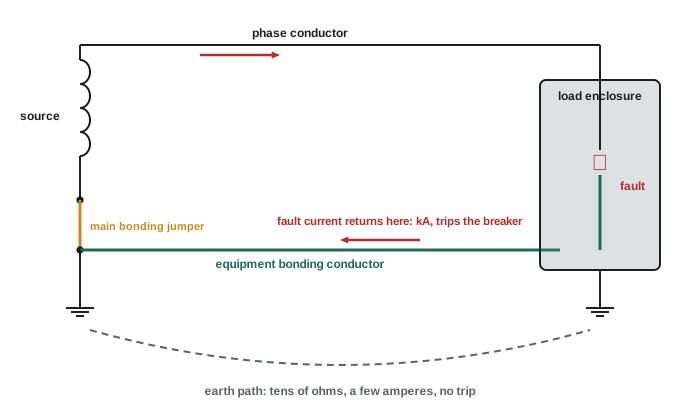
When a phase conductor faults to a metal enclosure, two things must happen: the fault must be cleared quickly by the overcurrent device, and nobody touching the enclosure in the meantime should receive a dangerous shock. Both depend on a low-impedance path from the enclosure back to the source, provided by the equipment bonding (grounding) conductor, metal raceways and the main bonding jumper that connects that system to the neutral at the source. The earth itself is not part of this path: its resistance is far too high to carry enough current to trip a breaker.
Worked problem
Why the bonding conductor matters
On a 600Y/347 V system, a phase faults to a motor enclosure. The phase conductor resistance to the fault is 0.02 Ω and the bonding conductor back to the source is 0.03 Ω. (a) Find the fault current and the enclosure voltage while the fault persists. (b) Repeat with the bonding conductor missing, so that current must return through the earth (25 Ω electrode at the motor and 5 Ω at the source).
Show solution
- (a) \(I = 347/(0.02 + 0.03) = 6{,}940\) A. Enclosure voltage to remote ground: \(6{,}940 \times 0.03 = 208\) V, for the few cycles until the breaker trips.
- (b) \(I = 347/(0.02 + 25 + 5) = 11.6\) A. Enclosure voltage: \(11.6 \times 25 = 289\) V.
Answer: With the bonding conductor, thousands of amperes flow and the breaker trips in milliseconds. Without it, only about 10 A flows through the earth: no breaker trips, and the enclosure stays at a lethal voltage indefinitely. A ground rod is not a substitute for a bonding conductor; this misunderstanding has killed people.
One neutral-to-ground bond
The neutral and the bonding system are connected at one point only: the service, or the source of each separately derived system such as a transformer or generator. Additional neutral-to-ground connections downstream create parallel paths, so normal neutral current flows on bonding conductors, raceways, cable trays and building steel. This "objectionable current" causes nuisance tripping of ground fault protection, magnetic fields that disturb equipment, and shock and fire hazards. Hunting down improper bonds is a common commissioning and troubleshooting task, using clamp meters on bonding conductors (which should normally carry almost nothing).
Generators and transfer switches require particular care. If a transfer switch does not switch the neutral (a three-pole switch), the generator neutral must not be bonded at the generator; if it does (a four-pole switch), the generator is a separately derived system with its own bond. Getting this wrong defeats ground fault protection on the service or the generator.
Grounding electrodes
The grounding electrode system connects the electrical system to the earth to limit voltages from lightning, surges and accidental contact with higher-voltage lines, and to stabilize voltage to earth. Electrodes include ground rods, concrete-encased electrodes (the reinforcing steel in footings), ground rings around the building, metal water pipes and building steel, all bonded together.
The resistance of an electrode to remote earth depends mainly on the soil resistivity \(\rho\) and the electrode's size. For a single rod of length \(L\) and radius \(a\):
Worked problem
One rod is rarely enough
A 3 m ground rod of 16 mm diameter is driven into soil of resistivity 100 Ω·m. Find its resistance.
Show solution
- \(a = 0.008\) m; \(4L/a = 12/0.008 = 1{,}500\); \(\ln 1{,}500 = 7.31\).
- \(R = \dfrac{100}{2\pi \times 3}(7.31 - 1) = 5.31 \times 6.31 = 33.5\) Ω.
Answer: About 34 Ω. Doubling the length helps only moderately, and rods placed close together share the same soil and add less than expected; a rod spaced at least its own length from another is a common rule. Data centres therefore use extensive ground rings, ground grids and the concrete-encased steel of the building foundations, which together can reach a few ohms or less.
Soil resistivity is measured on site before design with the Wenner four-pin method: four probes are driven in a line at equal spacing \(a\), a current is passed between the outer pair and the voltage measured between the inner pair, and the apparent resistivity is \(\rho = 2\pi a R\), where \(R\) is the measured voltage-to-current ratio. Repeating at several spacings reveals how resistivity changes with depth. For example, \(R = 5.3\) Ω at \(a = 3\) m gives \(\rho = 2\pi \times 3 \times 5.3 = 100\) Ω·m.
The Canadian Electrical Code (Section 10) specifies acceptable grounding electrodes and their installation; utility substations and the grounding grids of large facilities are designed to IEEE 80.
Step and touch voltages
During a ground fault at a substation, thousands of amperes flow into the ground grid, raising its potential relative to remote earth (the ground potential rise, GPR). The voltage differences that matter for safety are local: between a person's hand on a grounded structure and their feet (touch voltage), and between their two feet a metre apart (step voltage). IEEE 80 sets tolerable limits based on the current a body can survive for the fault duration. For a 50 kg person, the tolerable touch voltage is
where \(\rho_{s}\) is the resistivity of the surface layer, \(C_{s}\) a derating factor for its thickness and \(t_{s}\) the fault duration in seconds.
Worked problem
Why substations have crushed rock
Find the tolerable touch voltage for a 0.5 s fault (a) on native soil with \(\rho_{s} = 100\) Ω·m (\(C_{s} = 1\)), and (b) with a 0.1 m layer of crushed rock of \(\rho_{s} = 3{,}000\) Ω·m (\(C_{s} \approx 0.7\)).
Show solution
- \(0.116/\sqrt{0.5} = 0.164\).
- (a) \((1000 + 1.5 \times 1 \times 100) \times 0.164 = 189\) V.
- (b) \((1000 + 1.5 \times 0.7 \times 3{,}000) \times 0.164 = 4{,}150 \times 0.164 = 681\) V.
Answer: About 189 V on bare soil but 681 V on crushed rock, which adds resistance in series with the person's feet. That, together with a closely meshed ground grid that keeps local voltage differences small and fast protection that shortens \(t_{s}\), is why every substation yard is covered in gravel. The fence, gates and nearby metal must be bonded or isolated so that dangerous voltages are not carried outside.
Bonding for IT and telecommunications
Electronic equipment is sensitive to voltage differences between interconnected devices. A telecommunications bonding network, designed to ANSI/TIA-607 and related standards, ties every rack, cable tray, ladder rack, raised-floor pedestal and equipment ground terminal into a low-impedance, equipotential system:
- A primary bonding busbar (PBB) in the entrance room, bonded to the building's electrical service grounding.
- Secondary bonding busbars (SBB) in each telecommunications space and data hall, connected to the PBB by a telecommunications bonding backbone.
- Within data halls, a mesh common bonding network: a grid of copper conductors, often under the raised floor or overhead, to which each rack is bonded with a short conductor.
The aim is not a "clean" isolated ground, an idea that has caused many problems when it led to equipment being disconnected from the safety bonding system, but a single, interconnected, low-impedance system in which everything rises and falls together during a surge or fault.
Lightning protection
A lightning stroke carries a peak current of typically 30 kA, and sometimes over 200 kA, rising in a few microseconds. A lightning protection system intercepts strokes with air terminals on the roof, carries the current down the building through down conductors (or the structural steel) and disperses it into the earth through the grounding system, without letting it flash over to internal wiring or damage the structure. Design follows NFPA 780 in North America and IEC 62305 internationally, starting with a risk assessment that weighs lightning frequency, building size, contents and the consequences of damage; for data centres the risk assessment almost always justifies protection.
Worked problem
Ground potential rise from a stroke
A 30 kA stroke enters a building's grounding system, whose resistance to remote earth is 2 Ω. What is the momentary rise in the building's potential? What happens to a copper communications cable that enters from a carrier's cabinet 200 m away, grounded to remote earth?
Show solution
- Ground potential rise: \(30{,}000 \times 2 = 60{,}000\) V, ignoring inductance (which makes it worse).
- The building, and everything bonded to it, rises by about 60 kV relative to remote earth; the incoming cable's conductors stay near remote earth.
- About 60 kV appears between the cable and the building equipment it connects to.
Answer: Tens of kilovolts appear across any connection between the building and a remote ground, which will break down insulation and destroy equipment unless every incoming conductor (power, telecommunications, control, metal pipes) is bonded at its entrance or protected by a surge protective device. That is why entrance points are kept together and bonded to a common point, and why fibre, which carries no current, is preferred for links between buildings.
Surge protection
Surges reach equipment from lightning, utility switching and switching within the facility. Surge protective devices (SPDs) divert surge current to the bonding system and limit the voltage reaching equipment. They are applied in coordinated layers:
- At the service entrance (Type 1 or Type 2 SPDs), handling the largest currents from outside.
- At distribution boards and switchboards (Type 2), limiting surges generated within the facility and residual surges from outside.
- At or in the equipment (Type 3 and built-in protection).
SPDs are rated by their maximum continuous operating voltage, their nominal discharge current and their voltage protection rating (let-through voltage). Their effectiveness depends heavily on installation: long or looped connecting leads add inductance, and since \(V = L\,di/dt\), a surge rising at 10 kA/µs through 1 µH of lead inductance (roughly a metre of wire) adds 10 kV. SPD leads must therefore be as short and straight as possible.
In Canada, SPDs must be certified to CSA C22.2 No. 269 series standards, and the Canadian Electrical Code sets requirements for their installation.
Common mistakes
MistakeRelying on a ground rod instead of a bonding conductor to clear faults.
InsteadFault current must return through a low-impedance bonding path to the source.
MistakeBonding neutral to ground at downstream panels.
InsteadBond only at the service or the source of each separately derived system.
MistakeIsolating IT equipment from the safety bonding system for a "clean ground".
InsteadUse a single interconnected bonding network.
MistakeBringing services into a building at separate, unbonded entrances.
InsteadBond all entering conductors and metal at a common entrance point.
MistakeInstalling SPDs with long, looped leads.
InsteadKeep SPD leads short and straight to limit inductive voltage.
Summary and key terms
- Bonding provides the low-impedance path that clears faults and limits touch voltage; earth cannot.
- Neutral and ground are bonded at one point per source; extra bonds cause objectionable current.
- Electrode resistance depends on soil resistivity and size; one rod is rarely enough.
- Wenner tests measure soil resistivity: ρ = 2πaR.
- Substations limit step and touch voltages with meshed grids, crushed rock and fast protection.
- TIA-607 bonding networks keep IT equipment equipotential.
- Lightning protection and coordinated SPDs, installed with short leads, protect against surges.
- Bonding
- Connecting metal parts together to form a continuous, low-impedance path.
- Equipment bonding conductor
- The conductor that returns fault current from enclosures to the source.
- Main bonding jumper
- The connection between neutral and the bonding system at the service.
- Objectionable current
- Neutral current flowing on bonding paths due to improper bonds.
- Grounding electrode
- A conductor in contact with the earth.
- Soil resistivity
- The resistivity of soil, in Ω·m.
- Ground potential rise
- The rise in a grounding system's potential during a fault or stroke.
- Touch voltage
- The voltage between a hand on a grounded object and the feet.
- Step voltage
- The voltage between the feet one metre apart.
- SPD
- Surge protective device, which diverts surge current and limits voltage.
Practice problems
Work each problem on paper first, then reveal the answer to check.
Why can't the earth clear a ground fault on a low-voltage system?
Show answer
Its resistance is too high to carry enough current to trip the overcurrent device.
277 V, phase 0.01 Ω, bonding 0.04 Ω. Fault current and enclosure voltage?
Show answer
5,540 A and 222 V.
Where are neutral and ground bonded?
Show answer
At the service and at the source of each separately derived system only.
Rod resistance at ρ = 300 Ω·m, other values as in the example?
Show answer
About 100 Ω.
Wenner test: a = 2 m, R = 8 Ω. Resistivity?
Show answer
About 100 Ω·m.
Tolerable touch voltage on crushed rock for 0.25 s (ρs = 3,000, Cs = 0.7)?
Show answer
4,150 × 0.232 ≈ 963 V.
Why is a substation fence bonded to the grid?
Show answer
So touch voltages on it stay within tolerable limits.
Name the busbar in the entrance room under TIA-607.
Show answer
Primary bonding busbar (PBB).
A 20 kA stroke into a 5 Ω ground. Ground potential rise?
Show answer
100 kV.
Surge rising at 5 kA/µs through 2 µH of lead. Added voltage?
Show answer
10 kV.
Lesson quiz · 5 questions
Score 60% or more to complete this lesson.
Create a free account to save your progress, take quizzes and earn a certificate.