
DCE-310 · Lesson 11 of 12 · 30 min
Electrical code requirements
Every electrical installation in a data centre must comply with the electrical code in force where it is built. The code is the legal minimum for safety: it aims to protect people and property from shock and fire, not to make a data centre reliable or efficient. Reliability is the owner's business and goes far beyond the code, but nothing in a reliable design may fall below it, and the inspector's approval is required before the building can be energized and occupied.
This chapter explains how the Canadian Electrical Code is organized and enforced, then works through the requirements that most affect data centre power distribution: conductor and overcurrent sizing for continuous load, ground fault protection, grounding and bonding, working space, arc flash marking, standby and emergency power, high-voltage installations and energy storage. It ends with workplace electrical safety and the testing that precedes energization. Rule numbers refer to the 2024 (26th) edition, CSA C22.1:24; always check the edition and provincial amendments in force for a specific project.
How the code is adopted and enforced
The Canadian Electrical Code, Part I (CSA C22.1) is published by CSA Group, normally every three years; the 2024 edition is the 26th. It is a model code with no force of law until a province or territory adopts it, which each does by regulation, often with its own amendments and on its own schedule. Ontario adopts it as the Ontario Electrical Safety Code, enforced by the Electrical Safety Authority (ESA); British Columbia enforces it through Technical Safety BC; Québec adopts it as Chapter V (Electricity) of its Construction Code, administered by the Régie du bâtiment du Québec; other provinces have their own safety authorities or municipal inspection departments. In each case the inspection authority is the final interpreter of the code for a given installation.
Electrical work requires a permit (in most provinces, obtained by a licensed electrical contractor), and the installation is inspected before it is energized. All electrical equipment must be approved, meaning certified by an accredited certification body such as CSA Group, UL (with the cUL or cULus mark) or Intertek, to the applicable product standard in the CEC, Part II (Rule 2-024). Uncertified equipment, including some imported equipment, must be field evaluated before it can be connected.
The code is divided into sections. Sections 0 to 16 are general rules that apply to every installation: for example Section 2 (general rules), Section 4 (conductors), Section 8 (circuit loading and demand factors), Section 10 (grounding and bonding), Section 12 (wiring methods) and Section 14 (protection and control). Higher-numbered sections, such as Section 26 (installation of electrical equipment), Section 36 (high-voltage installations), Section 46 (emergency systems, unit equipment, exit signs and life safety systems) and Section 64 (renewable energy and energy storage systems), add to or modify the general rules for particular equipment and occupancies.
Continuous loads: conductors and overcurrent devices
IT load is continuous, running near its maximum for three hours or more, and the codes protect conductors and devices from the heat of continuous current by requiring margin.
In the CEC, Rule 8-104 limits the continuous load on a circuit to 80% of the rating of its overcurrent device (and the corresponding conductor ampacity), unless the device and assembly are marked for continuous operation at 100% of their rating, in which case the limit is 100%. Conductor ampacities come from Rule 4-004 and Tables 1 to 4, with correction factors for ambient temperature and for more than three current-carrying conductors in a raceway, and the termination temperature rating of the equipment (commonly 75 °C) limits which ampacity column can be used.
Worked problem
Sizing a feeder for continuous load
A feeder supplies 400 A of continuous IT load. What minimum overcurrent device rating and conductor ampacity are required with standard-rated equipment, and with a 100%-rated breaker and assembly?
Show solution
- Standard-rated: load ≤ 80% of rating, so rating ≥ \(400/0.8 = 500\) A. Choose a 500 A breaker and conductors with at least 500 A ampacity (after any correction factors).
- 100%-rated breaker and assembly: a 400 A device may carry the full 400 A continuously, with conductors sized as the listing and code require for 100%-rated equipment.
- Note that \(1/0.8 = 1.25\): the two ways of stating the rule give the same answer.
Answer: 500 A with standard equipment, or 400 A with a 100%-rated breaker and assembly. The 100%-rated option saves a frame size on large feeders, which is why it is common on data centre mains and UPS feeders.
Ground fault protection of equipment
On large solidly grounded wye systems, an arcing ground fault can draw too little current to trip an ordinary breaker quickly, yet enough to burn down a switchboard. The codes therefore require ground fault protection (GFP) that detects relatively low ground-fault currents and trips the main breaker.
Rule 14-102 requires ground fault protection on solidly grounded services and feeders operating at more than 150 V to ground and less than 750 V phase to phase, where the overcurrent device is rated 1000 A or more. A 600Y/347 V service of 1000 A or more therefore needs GFP; a 208Y/120 V system (120 V to ground) does not.
For data centres, GFP brings a reliability risk: a ground fault on one branch could trip the main breaker if the GFP is not coordinated, taking down everything. Good designs add GFP at the feeder level below the main, coordinated so the feeder trips first, and some codes permit or require this additional level for critical facilities. Ground fault settings must be part of the coordination study, and GFP must be tested in the field before energization.
Worked problem
Does this service need GFP?
Which of these need ground fault protection under Rule 14-102? (a) A 3000 A, 600Y/347 V solidly grounded main switchboard; (b) a 1200 A, 208Y/120 V switchboard; (c) an 800 A, 600Y/347 V feeder.
Show solution
- (a) 347 V to ground (> 150 V), 600 V phase to phase (< 750 V), 3000 A (≥ 1000 A): GFP required.
- (b) Only 120 V to ground: not required by the code (though an owner may still specify it).
- (c) Below 1000 A: not required.
Answer: Only (a). Where GFP is installed on a main, adding coordinated GFP on large feeders below it prevents a single ground fault from tripping the entire switchboard.
Grounding and bonding
Lesson 4 covers system grounding and Lesson 9 the engineering of bonding, electrodes, lightning and surge protection; this section summarizes the code requirements.
Grounding and bonding serve three purposes: to limit voltages from lightning, line surges and contact with higher-voltage lines; to stabilize the system voltage to earth; and, most importantly for safety, to provide a low-impedance path that carries fault current back to its source so that overcurrent devices trip quickly when a live conductor touches a metal enclosure.
Section 10 of the CEC covers grounding and bonding. A solidly grounded system has its neutral connected to a grounding electrode and bonded to the equipment bonding system at one point only: the service (or, for a separately derived system, at the transformer). Every PDU or 415 V transformer in a data centre is a separately derived system, so its secondary neutral must be bonded to ground at the transformer and connected to the building's grounding system. Bonding the neutral to ground at a second point downstream creates parallel neutral currents on enclosures, conduits and cable trays, a common source of electrical noise, interference with sensitive equipment and false ground-fault trips.
Data centres also install a telecommunications bonding network, following standards such as TIA-607: a primary bonding busbar in the entrance room, secondary busbars in each data hall, and bonding of racks, cable trays and raised-floor pedestals, all connected back to the building ground. A well-bonded data hall keeps all metal at essentially the same potential, protecting both people and equipment.
Working space and access
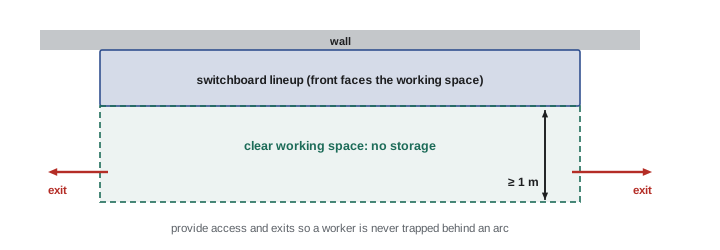
Equipment that may be examined, adjusted or serviced while energized must have enough clear space in front of it for a person to work safely and to escape quickly.
Rule 2-308 requires a minimum working space of 1 m in front of electrical equipment such as switchboards, panelboards and control centres, with enough headroom and width to work safely, and the space must not be used for storage. The code also has requirements for access to and exits from the working space around large equipment. Data centre designers routinely provide much more than the minimum in front of switchgear, to allow breakers to be withdrawn and to stay outside arc flash boundaries where possible.
Arc flash marking and available fault current
Rule 2-306 requires electrical equipment that is likely to require examination, adjustment, servicing or maintenance while energized to be marked to warn workers of potential shock and arc flash hazards. The 2024 edition strengthened these requirements. The detailed hazard information (incident energy or PPE category, boundaries) comes from the arc flash study performed under CSA Z462 (Lesson 7).
Standby, emergency and energy storage systems
Codes distinguish carefully between power systems required for life safety and those installed for business reasons, because the rules for each differ greatly.
Section 46 covers emergency systems, unit equipment, exit signs and life safety systems: the loads, such as egress lighting and fire alarm systems, that the National Building Code requires to have emergency power. The generators that supply them must meet CSA C282, Emergency electrical power supply for buildings. A data centre's large standby generators for the IT and cooling load are usually not part of the emergency system; they are a business decision, and the life-safety loads are kept on separate, code-compliant emergency circuits (which may be supplied from the same generators only where the code and the authorities permit, with priority and separation). Lithium-ion UPS batteries and other energy storage systems are covered by Section 64, which gained new requirements in the 2024 edition, together with building and fire code requirements.
Information technology rooms
The CEC has no separate section devoted to information technology equipment rooms; data halls are wired under the general rules, with building and fire code requirements for fire separation, detection and suppression. Many owners also adopt NFPA 75 (Standard for the Fire Protection of Information Technology Equipment) and ANSI/TIA-942 as design criteria, and insurers may require them.
Workplace electrical safety and maintenance
The CEC governs installations; the safety of the people who work on them is governed by provincial occupational health and safety law and by CSA Z462, Workplace electrical safety, which many provinces reference. CSA Z462 requires an electrical safety program, risk assessments for shock and arc flash, an electrically safe work condition (lockout, tagout and verification of absence of voltage) as the normal method of work, energized work permits for justified exceptions, and training. Equipment maintenance is addressed by CSA Z463, Maintenance of electrical systems.
Testing and commissioning
Before energization, the inspector checks that the installation complies with the code. A data centre owner requires far more. Acceptance testing, typically to the ANSI/NETA Acceptance Testing Specifications, verifies each piece of equipment: insulation resistance of cables and buses, contact resistance and timing of breakers, primary and secondary injection testing of trip units and relays, transformer turns ratio and insulation, and ground fault protection operation. Protective device settings from the coordination study are applied and verified.
Commissioning then proves that the systems work together, in stages often called levels 1 to 5: factory witness testing, site inspection, component start-up, functional tests of each system, and finally an integrated systems test (IST). In the IST, the utility supply is deliberately failed under a full simulated IT load (provided by rented load banks), and the team verifies that UPS systems carry the load, generators start and accept it, cooling keeps temperatures in range, and everything returns to normal when the utility is restored. A data centre is not ready for customers until it has passed its integrated systems test.
Common mistakes
MistakeDesigning to the newest code edition without checking which edition the jurisdiction enforces.
InsteadConfirm the adopted edition and local amendments for every site; they differ between jurisdictions.
MistakeSizing feeders for continuous IT load at 100% of standard-rated breakers.
InsteadProvide 125% capacity (equivalently, load to 80%) unless the device and assembly are rated for 100%.
MistakeBonding neutral to ground at panelboards downstream of a transformer.
InsteadBond once at the service or separately derived source; downstream bonds create objectionable neutral current.
MistakeInstalling GFP only at the main of a critical switchboard.
InsteadAdd coordinated GFP on feeders so one ground fault does not trip the whole board.
MistakeTreating data centre standby generators as the emergency system.
InsteadKeep life-safety loads on code-compliant emergency circuits; IT standby is usually an optional system.
Summary and key terms
- The CEC (CSA C22.1, 2024 edition) is adopted by each province with amendments and enforced by provincial or municipal inspection authorities; equipment must be certified.
- Continuous load is limited to 80% of standard-rated devices (Rule 8-104), 100% with 100%-rated assemblies.
- GFP is required on solidly grounded systems over 150 V to ground and under 750 V phase to phase with devices of 1000 A or more (Rule 14-102).
- Bond neutral to ground once, at the service or separately derived source such as each PDU transformer; add a telecommunications bonding network.
- Working space is at least 1 m (Rule 2-308); equipment worked on live is marked for shock and arc flash (Rule 2-306).
- Emergency systems (Section 46, CSA C282) are separate from business standby; energy storage falls under Section 64.
- CSA Z462 governs workplace electrical safety and CSA Z463 maintenance.
- Acceptance testing (NETA) and commissioning up to an integrated systems test prove the installation before it carries IT load.
- Authority having jurisdiction (AHJ)
- The organization or official responsible for enforcing a code and approving installations.
- Continuous load
- A load expected to run at maximum current for three hours or more.
- Ampacity
- The current a conductor can carry continuously without exceeding its temperature rating.
- Ground fault protection of equipment
- Protection that opens a circuit on low-level ground faults that would not trip normal overcurrent devices.
- Separately derived system
- A system, such as a transformer secondary, whose conductors have no direct connection to the supply conductors.
- Main bonding jumper
- The connection between the grounded (neutral) conductor and the equipment grounding system at the service or source.
- Working space
- The clear space required in front of electrical equipment for safe operation and maintenance.
- Emergency system
- A system legally required to supply life-safety loads such as egress lighting and fire alarms.
- Optional standby system
- A standby system installed at the owner's choice to protect business operations.
- Acceptance testing
- Testing of installed equipment and systems before energization and handover.
- Integrated systems test
- A commissioning test of the whole facility, including utility failure and recovery.
- CEC
- The Canadian Electrical Code, Part I (CSA C22.1), the model installation code adopted by the provinces and territories.
- CSA Z462
- The Canadian standard for workplace electrical safety.
Practice problems
Work each problem on paper first, then reveal the answer to check.
A feeder supplies 280 A of continuous load and 40 A of non-continuous load. What minimum standard-rated overcurrent device is required?
Show answer
280 × 1.25 + 40 = 390 A (equivalently 280/0.8 + 40); the next standard size is 400 A.
Can a 600 A standard-rated breaker supply 520 A of continuous IT load?
Show answer
No: 80% of 600 A is 480 A. Use a larger breaker (650 or 700 A) or a 600 A breaker in a 100%-rated assembly.
Does a 1200 A, 600Y/347 V solidly grounded switchboard main require ground fault protection?
Show answer
Yes: 347 V to ground, 600 V phase to phase and a 1200 A device meet the Rule 14-102 criteria.
Why must each PDU transformer have its own neutral-to-ground bond?
Show answer
It is a separately derived system with no conductive connection to the supply neutral; without a bond at the transformer, ground faults on its secondary would have no low-impedance path back to the source and would not trip the breakers.
What problem results from bonding neutral to ground at every panelboard?
Show answer
Neutral current divides between the neutral and the grounding paths (enclosures, conduits, trays), causing noise, interference, shock risk and nuisance ground-fault trips.
What minimum working space depth does Rule 2-308 require in front of a switchboard?
Show answer
At least 1 m, kept clear of storage.
Why do life-safety loads stay on separate emergency circuits even when they share a generator with the IT load?
Show answer
Emergency systems have stricter requirements (transfer time, separation, coordination, priority), and separating them ensures a failure in the large standby system cannot disable egress lighting or fire alarm power.
Name three tests performed during acceptance testing of switchgear.
Show answer
Any three: insulation resistance; contact resistance; breaker timing; primary or secondary injection of trip units and relays; ground fault protection test; verification of protective settings; transformer turns ratio.
What happens during an integrated systems test, and why are load banks used?
Show answer
The utility supply is failed under full load to prove UPS, generators, transfer equipment and cooling work together and recover; load banks simulate the IT load because no customer equipment is installed yet.
A company builds identical data centres in two jurisdictions that enforce different code editions. What should its design standard do?
Show answer
Meet the stricter requirement of every edition it builds under (or the newest, checked against local amendments), and document a site-specific code review for each project.
Lesson quiz · 5 questions
Score 60% or more to complete this lesson.
Create a free account to save your progress, take quizzes and earn a certificate.