
DCE-210 · Lesson 5 of 12 · 30 min
Storage networks and data protection
Every application needs somewhere to keep its data, and in a data centre that storage is almost always reached over a network. Storage traffic behaves differently from ordinary application traffic: it is sensitive to loss and latency, comes in large bursts, and grows whenever drives fail and data is rebuilt or copied to another site. This lesson explains the kinds of storage, the networks that carry them, the protocols from Fibre Channel to NVMe over Fabrics, and the replication and backup traffic that protects data against failure and disaster.
Block, file and object storage
Storage is presented to applications in three main ways:
- Block storage presents a raw disk (a volume or LUN) made of numbered fixed-size blocks. The server's operating system puts its own file system on it. Databases and virtual machine disks use block storage because it gives the lowest latency and the most control.
- File storage presents a shared file system with folders and files, reached over a network protocol such as NFS (common on Linux) or SMB (common on Windows). Many servers can share the same files.
- Object storage stores data as objects, each with a unique key and metadata, in a flat namespace reached over HTTP with an API such as Amazon S3. It scales to billions of objects and exabytes, and holds backups, media, logs, data lakes and AI training data.
These map onto three architectures: direct-attached storage (DAS), with drives inside or cabled directly to one server; storage area networks (SANs), dedicated networks carrying block storage from shared arrays; and network-attached storage (NAS) and object stores reached over the ordinary IP network. Hyperscale operators increasingly use software-defined storage: ordinary servers full of drives, with software spreading data across many of them over the Ethernet fabric.
Fibre Channel
Fibre Channel (FC) is the traditional SAN technology in enterprise data centres. Despite its name, it runs over copper or fibre. Its defining feature is that it is lossless: a sender may transmit only when the receiver has granted it buffer credits, so frames are never dropped for lack of buffer space. Storage protocols were designed to expect a perfectly reliable link, and FC provides one.
- Speeds are marketed as 16GFC, 32GFC, 64GFC and 128GFC; the 128GFC generation (Gen 8) was introduced in late 2025.
- Each device has a 64-bit World Wide Name, and switches assign 24-bit fabric addresses.
- Zoning on the switches controls which servers can see which storage ports, and LUN masking on the array controls which volumes each server can use.
- Best practice is two completely separate fabrics, A and B. Every server has a connection to each, and every array has ports on each, so a failure or misconfiguration of one entire fabric leaves the other running.
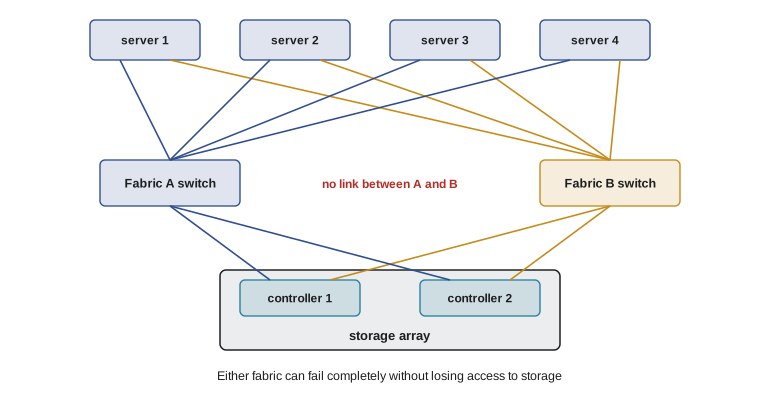
FC networks remain common in banks, governments and large enterprises because of their predictability and isolation, but they require separate switches, adapters and skills. Most new capacity, especially in clouds, runs storage over Ethernet.
Storage over Ethernet
Several protocols carry block storage over Ethernet and IP:
- iSCSI carries SCSI commands over TCP/IP. It works on any IP network, and TCP's retransmission handles loss, but latency and CPU use are higher than with FC.
- FCoE (Fibre Channel over Ethernet) carries FC frames directly in Ethernet frames on a lossless Ethernet class. It was promoted for converging LAN and SAN but is now rarely deployed.
- NVMe over Fabrics (NVMe-oF) extends the NVMe protocol, designed for fast flash drives with many parallel queues, across a network. It runs over RDMA (RoCE or InfiniBand), over plain TCP (NVMe/TCP), or over Fibre Channel (FC-NVMe). NVMe/TCP has become popular because it needs no special network configuration and delivers latency close to local flash for many workloads.
Flash drives respond in tens of microseconds, compared with milliseconds for spinning disks, so the network and protocol stack now make up a large share of storage latency. That is why storage traffic drives demand for low-latency fabrics, RDMA and DPUs that handle storage protocols in hardware (Lesson 4).
Worked problem
How much bandwidth does a database need?
A database server performs 400,000 random reads per second of 8 KiB each, plus 100,000 writes per second of 8 KiB, all from a remote NVMe array. Writes are mirrored to a second controller. What network bandwidth does the server need?
Show solution
- Reads: \(400{,}000 \times 8{,}192 \times 8 = 26.2\) Gb/s.
- Writes from the server: \(100{,}000 \times 8{,}192 \times 8 = 6.6\) Gb/s.
- The mirroring happens inside the array, between its controllers, so it does not cross the server's link.
- Total on the server link: about \(26.2 + 6.6 = 32.8\) Gb/s, plus protocol overhead of a few percent.
Answer: About 33 to 35 Gb/s, more than a 25 Gb/s port can carry. The server needs a 50 Gb/s or 100 Gb/s port (two, for redundancy). Note that reads and writes travel in opposite directions on a full-duplex link, so each direction is loaded separately: 26.2 Gb/s toward the server and 6.6 Gb/s away from it.
Distributed storage and rebuild traffic
Software-defined and object storage systems protect data by spreading it across many servers, so that losing a drive, a server or even a rack loses no data. Two methods are common:
- Replication: each piece of data is stored as two or three complete copies on different servers or racks. Writing 1 TB with three-way replication sends 3 TB across the network and uses 3 TB of capacity.
- Erasure coding: data is split into \(k\) data fragments and \(m\) parity fragments, any \(k\) of which can rebuild the original. An 8+3 scheme survives the loss of any three fragments while using only \(11/8 = 1.375\) times the raw data in capacity.
Erasure coding saves capacity but costs network traffic when something fails, because rebuilding a lost fragment requires reading \(k\) surviving fragments from other servers.
Worked problem
Rebuilding a failed drive
An object store uses 8+3 erasure coding across many servers. A 20 TB drive fails, and its fragments must be rebuilt elsewhere. The cluster limits rebuild traffic to 100 Gb/s so that customers are not affected. (a) How much data must be read? (b) How long does the rebuild take?
Show solution
- (a) Each lost fragment needs 8 surviving fragments of the same size: \(8 \times 20 = 160\) TB read across the network.
- (b) \(160 \times 10^{12} \times 8 / 100 \times 10^{9} = 12{,}800\) s, about 3.6 hours.
Answer: 160 TB must be read, taking about 3.6 hours at 100 Gb/s. With three-way replication only 20 TB would be read (one copy), but capacity use would be 3× instead of 1.375×. Storage designers trade capacity, network traffic and rebuild time; larger drives make rebuilds longer, which is why rebuild bandwidth is a design input for the network.
Replication between sites
To survive the loss of a whole data centre, data is copied to a second site. Two figures define the requirement:
- Recovery point objective (RPO): how much recent data the business can afford to lose, measured in time. An RPO of zero means no committed transaction may be lost.
- Recovery time objective (RTO): how quickly service must be restored after a disaster.
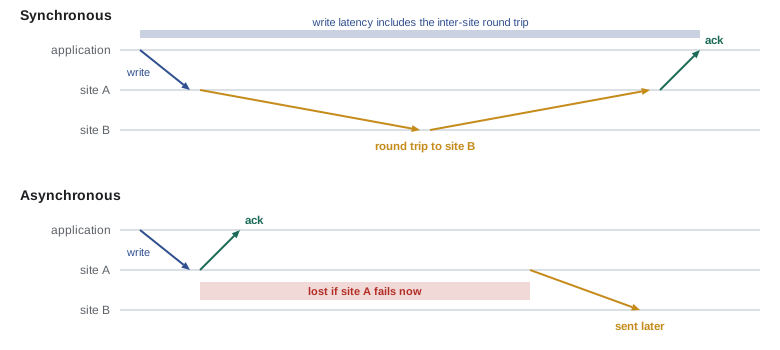
Synchronous replication writes every change to both sites before acknowledging it to the application, giving an RPO of zero. But each write waits for a round trip between sites, so distance adds directly to write latency: at about 5 µs per kilometre each way, every 100 km adds about 1 ms per write. Synchronous replication is therefore normally limited to sites within about 100 km of each other, and is one reason cloud availability zones are built within a metro area.
Asynchronous replication acknowledges writes locally and sends changes to the remote site a few seconds or minutes later. It works over any distance but the RPO is greater than zero: whatever was in transit when disaster struck is lost.
Worked problem
Sizing a replication link
A database changes 3 TB of data per day, but 40% of the changes happen in a busy four-hour window. Changes are replicated asynchronously and must not fall more than 15 minutes behind. What link bandwidth is needed? Allow 70% maximum utilization.
Show solution
- Data in the busy window: \(0.40 \times 3 = 1.2\) TB in 4 h.
- Average rate in the busy window: \(1.2 \times 10^{12} \times 8 / 14{,}400 = 667\) Mb/s.
- For the replica to keep within 15 minutes, the link must carry the busy-hour rate continuously: allowing 70% utilization, \(667 / 0.70 = 952\) Mb/s.
- The daily average for comparison: \(3 \times 10^{12} \times 8 / 86{,}400 = 278\) Mb/s.
Answer: About 1 Gb/s. Sizing for the daily average (278 Mb/s) would let the replica fall hours behind during the busy window, breaking the RPO. Compression and deduplication can reduce the bandwidth needed considerably.
Backup and the 3-2-1 rule
Replication protects against site failure but faithfully copies mistakes and malicious changes: if ransomware encrypts the primary data, replication encrypts the copy too. Backups keep point-in-time copies that can be restored to a moment before the damage. The traditional 3-2-1 rule calls for three copies of data, on two different kinds of media, with one copy off site; a common modern extension (3-2-1-1-0) adds one immutable or offline copy that cannot be altered and zero errors on restore tests.
Backups move large volumes of data on a schedule, so they are a major source of network traffic. Backup networks are often separated from production traffic, or carried in a low-priority QoS class (Lesson 2), and backup windows are sized so that full and incremental backups finish before the business day.
Canadian organizations often must keep certain data in Canada: some provinces restrict or attach conditions to storing personal information held by public bodies outside Canada (Nova Scotia's rules are among the strictest), and federal institutions follow Treasury Board direction on data residency. Replication and backup sites must respect these rules.
Storage for AI
AI training (Lesson 11) creates distinctive storage traffic. Training data is read repeatedly from object or parallel file systems at high bandwidth, and the model state is saved periodically as a checkpoint so that training can resume after a failure. Large models produce checkpoints of many terabytes, and the cluster is idle while it writes them unless writes are made asynchronous.
Worked problem
Checkpoint bandwidth
A training job saves a 12 TB checkpoint every hour and wants each save to take no more than 2 minutes. What aggregate write bandwidth does the storage network need?
Show solution
- \(12 \times 10^{12} \times 8 / 120 = 8 \times 10^{11}\) b/s = 800 Gb/s.
Answer: 800 Gb/s of aggregate write bandwidth, spread across many storage servers and network links. Large AI clusters therefore have a dedicated storage network or a large share of the front-end network for storage, and often write checkpoints first to fast local flash and then drain them to shared storage in the background.
Common mistakes
MistakeConnecting fabric A and fabric B switches together for "extra redundancy".
InsteadKeep the two SAN fabrics completely independent so one fault cannot affect both.
MistakeSizing replication links for the daily average.
InsteadSize for the busiest period that must stay within the RPO.
MistakeTreating replication as a backup.
InsteadReplication copies corruption and ransomware; keep immutable point-in-time backups too.
MistakeIgnoring rebuild traffic when sizing a storage network.
InsteadInclude rebuild and rebalancing traffic after drive and server failures.
MistakePlanning synchronous replication between distant sites.
InsteadEach 100 km adds about 1 ms to every write; use asynchronous replication beyond metro distances.
Summary and key terms
- Storage is presented as blocks, files or objects, over DAS, SANs, NAS or software-defined storage.
- Fibre Channel is lossless, using buffer credits, and is deployed as two independent fabrics.
- iSCSI, NVMe/TCP and NVMe over RDMA carry block storage over Ethernet.
- Replication and erasure coding protect data; erasure coding saves capacity but increases rebuild traffic.
- RPO and RTO set replication requirements; synchronous replication is limited by distance.
- Backups protect against corruption and ransomware that replication would copy.
- AI training creates heavy read and checkpoint write traffic.
- Block storage
- Storage presented as a raw volume of numbered blocks.
- Object storage
- Storage of objects by key and metadata over an HTTP API.
- SAN
- A storage area network carrying block storage from shared arrays.
- Buffer credits
- Fibre Channel's mechanism allowing a sender to transmit only into free receiver buffers.
- Zoning
- Switch configuration controlling which devices can see each other in a SAN.
- NVMe-oF
- NVMe over Fabrics: the NVMe protocol carried over a network.
- Erasure coding
- Splitting data into k data and m parity fragments, any k of which rebuild it.
- RPO
- Recovery point objective: the acceptable amount of data loss, in time.
- RTO
- Recovery time objective: the acceptable time to restore service.
- Synchronous replication
- Writing to both sites before acknowledging each write.
Practice problems
Work each problem on paper first, then reveal the answer to check.
Which storage type suits a database's data files best?
Show answer
Block storage.
How does Fibre Channel avoid dropping frames?
Show answer
Credit-based flow control: senders transmit only into buffers the receiver has granted.
Why are SAN fabrics A and B kept separate?
Show answer
So a failure or misconfiguration in one cannot affect the other.
200,000 reads per second of 16 KiB. Bandwidth?
Show answer
200,000 × 16,384 × 8 ≈ 26.2 Gb/s.
Capacity overhead of 10+4 erasure coding?
Show answer
14/10 = 1.4 times.
A 16 TB drive fails under 10+4 erasure coding. Data read to rebuild?
Show answer
160 TB.
Extra write latency for synchronous replication over 60 km of fibre?
Show answer
About 0.6 ms (round trip of 120 km at 5 µs/km).
What is the RPO of synchronous replication?
Show answer
Zero.
Why is replication not a backup?
Show answer
It copies deletions, corruption and ransomware to the replica.
A 6 TB checkpoint must be written in 60 s. Bandwidth?
Show answer
800 Gb/s.
Lesson quiz · 5 questions
Score 60% or more to complete this lesson.
Create a free account to save your progress, take quizzes and earn a certificate.