
BIOL-360 · Lesson 12 of 12 · 31 min
Capstone: environment, teratology and the ethics of embryo research
The genome does not develop in a vacuum. Embryos respond to temperature, nutrition, chemicals, infections and the physiology of the mother, and some of these influences cause malformations while others adjust development in ways that persist for life. At the same time, the power of modern developmental biology to culture human embryos, to build embryo-like structures from stem cells and to edit genomes raises ethical questions that societies have answered in different ways. This capstone lesson brings together the course's themes in three parts: environmental influences on development, including teratology and the developmental origins of adult disease; the governance of human embryo research and genome editing in Canada and the United States; and an integrated case that applies the course's mechanisms to a real problem.
Developmental plasticity
Many organisms produce different forms in different environments, a capacity called developmental plasticity. Water fleas of the genus Daphnia grow defensive helmets and spines when they detect chemicals released by predators. Spadefoot toad tadpoles in drying ponds develop into carnivorous morphs with large jaws when they eat shrimp. The castes of honeybees, queens and workers, are genetically similar but develop differently because queens are fed royal jelly. In reptiles, as lesson 10 showed, temperature can determine sex. Plasticity is adaptive when the environment during development predicts the environment the adult will face, and it relies on the same signalling pathways and hormones used in normal development, often acting through epigenetic changes in gene expression.
Developmental origins of health and disease
In humans, conditions in the womb influence health decades later. David Barker observed in the 1980s that people born with low birth weight in parts of England had higher rates of heart disease in adulthood. The Dutch Hunger Winter of 1944–45, when a German blockade reduced food rations in the western Netherlands to under 1,000 kilocalories a day, provided a natural experiment. People who were exposed to famine early in gestation had higher rates of obesity, cardiovascular disease and schizophrenia as adults, and in 2008 a study found that they had altered DNA methylation of the imprinted growth gene IGF2 some 60 years later. These findings led to the field of developmental origins of health and disease (DOHaD), which proposes that the fetus adjusts its development to predicted conditions, and that a mismatch between predicted and actual conditions, such as poor nutrition before birth followed by abundant food after, increases disease risk. Low nephron number, mentioned in lesson 9, is one mechanism linking fetal growth to adult blood pressure.
Principles of teratology
A teratogen is an agent that causes congenital malformations. The study of teratogens was shaped by James Wilson, who in 1959 set out principles that still guide the field. Susceptibility depends on the genotype of the embryo and on its interaction with the environment. It depends on the developmental stage at exposure. Teratogens act through specific mechanisms on developing cells and tissues. The outcomes of abnormal development are death, malformation, growth restriction and functional disorder. Access of the agent to the embryo depends on its nature, and effects increase with dose from no effect to lethality.
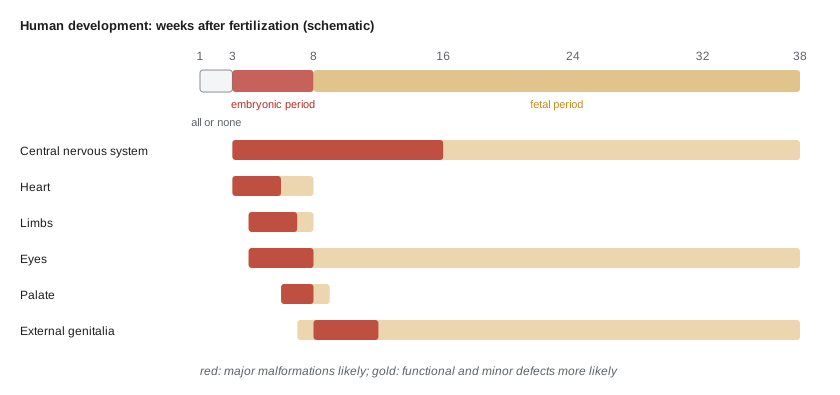
The timing principle is particularly important. In humans, exposure during the first two weeks after fertilization tends to produce an all-or-none effect: either the embryo dies or it recovers fully, because early cells are still largely interchangeable. The embryonic period, from about week 3 to week 8, when organs are forming, is the time of greatest sensitivity to major structural malformations. Each organ has its own critical period: the heart is most sensitive around weeks 3 to 6, the limbs around weeks 4 to 7, and the palate around weeks 6 to 9. During the fetal period, from week 9 until birth, teratogens are more likely to cause growth restriction, functional deficits and minor anomalies, although the central nervous system remains vulnerable throughout pregnancy.
import math
# Illustrative teratogen dose-response: probability of a malformation depends on dose and
# on the sensitivity of the organ at the time of exposure (a peaked window).
def sensitivity(week, peak, width):
    return math.exp(-0.5 * ((week - peak) / width) ** 2)
def p_malformation(dose, week, peak=5.5, width=1.2, ed50=1.0, hill=3.0):
    eff = dose * sensitivity(week, peak, width)          # effective dose at the target tissue
    return eff ** hill / (ed50 ** hill + eff ** hill)
print("dose (relative)   wk 3    wk 5    wk 6    wk 8    wk 12")
for dose in (0.5, 1.0, 2.0, 4.0):
    row = [p_malformation(dose, w) for w in (3, 5, 6, 8, 12)]
    print(f"     {dose:4.1f}       " + "  ".join(f"{100 * p:5.1f}%" for p in row))
# a threshold: the largest dose with less than 1% risk at the most sensitive week
safe = max(d / 100 for d in range(1, 400) if p_malformation(d / 100, 5.5) < 0.01)
print(f"dose below which risk stays under 1% even at peak sensitivity: about {safe:.2f}")dose (relative) wk 3 wk 5 wk 6 wk 8 wk 12
0.5 0.0% 8.8% 8.8% 0.0% 0.0%
1.0 0.1% 43.5% 43.5% 0.1% 0.0%
2.0 1.2% 86.0% 86.0% 1.2% 0.0%
4.0 8.7% 98.0% 98.0% 8.7% 0.0%
dose below which risk stays under 1% even at peak sensitivity: about 0.21The model, with invented parameters, illustrates Wilson's principles: the same dose has very different effects depending on timing, risk rises steeply with dose once a threshold is passed, and outside the sensitive window even high doses produce little structural damage to the organ. Real teratogens differ in their windows, dose responses and mechanisms, and interindividual differences in metabolism and genotype make risk hard to predict for any one pregnancy.
Thalidomide
Thalidomide was marketed from 1957 in West Germany as a sedative and was widely used for morning sickness. By 1961 doctors had linked it to a surge of babies born with phocomelia, severely shortened or absent limbs, as well as defects of the ears, eyes, heart and internal organs. Over 10,000 children were affected worldwide. The sensitive window was narrow, roughly days 20 to 36 after fertilization, and a single dose during this period could cause malformations. Thalidomide was later found to bind the protein cereblon, part of a ubiquitin ligase complex, and to cause degradation of transcription factors including SALL4, which is needed for limb and other organ development; mutations in human SALL4 cause similar limb defects. Thalidomide is now used, under strict controls, to treat leprosy complications and multiple myeloma.
In Canada, thalidomide was approved in 1961 and remained available until early 1962, months after it had been withdrawn in West Germany and the United Kingdom, and samples circulated for longer. Well over 100 Canadians were born with thalidomide-related injuries. After decades of advocacy by survivors, the federal government established a support program in 2015, which was expanded in 2019. The tragedy led to stronger drug safety regulation in Canada, including requirements for evidence of safety before approval.
Other major teratogens
Retinoids, derivatives of vitamin A, are among the most potent human teratogens. Isotretinoin, a highly effective acne drug, causes malformations of the ear, heart, thymus and brain in a high proportion of exposed pregnancies, by disrupting the retinoic acid signalling that patterns the hindbrain, neural crest and pharyngeal arches, as described in lessons 6 and 8. It is prescribed under pregnancy prevention programmes in both countries; in the United States this is the iPLEDGE risk management program. Valproic acid, an anticonvulsant, increases the risk of neural tube defects and of later developmental and behavioural problems. Infections can also be teratogenic: rubella caused an epidemic of congenital deafness, cataracts and heart defects in the 1960s before vaccination, and the Zika virus outbreak of 2015 and 2016 in the Americas caused microcephaly by infecting neural progenitor cells. Diethylstilbestrol (DES), a synthetic estrogen given to pregnant women from the 1940s to the 1970s, caused reproductive tract abnormalities and a rare vaginal cancer in daughters exposed before birth, the first demonstration of a delayed transplacental carcinogen and an early example of endocrine disruption.
Alcohol and fetal alcohol spectrum disorder
Alcohol is the most common preventable cause of developmental disability. Ethanol crosses the placenta readily and affects development through several mechanisms, including death of neural crest and neural progenitor cells, disruption of Sonic hedgehog signalling, oxidative stress and altered cell migration. Heavy exposure early in pregnancy can produce the facial features of fetal alcohol syndrome, a smooth philtrum, thin upper lip and short palpebral fissures, which arise from damage to cranial neural crest and midline tissues during gastrulation and neurulation. Exposure at any stage can cause brain damage with lifelong effects on learning, memory, attention and behaviour, with or without the facial features; the full range is called fetal alcohol spectrum disorder (FASD).
The Canada FASD Research Network (CanFASD) gives 4 per cent as its best estimate of FASD prevalence in the general Canadian population, based on studies in Alberta and in Ontario elementary schools, which would make it more common than autism, cerebral palsy and Down syndrome combined. Rates are much higher in some groups, including people in the justice and child welfare systems. Canadian guidelines published in 2016 support diagnosis by multidisciplinary teams, and Canada's Guidance on Alcohol and Health (2023) states that there is no known safe amount of alcohol during pregnancy.
Why human embryo research is regulated
Human embryos and embryo-like structures occupy a special moral position for many people, and views differ widely, from the position that an embryo deserves full moral protection from fertilization to the view that moral status develops gradually. Regulation reflects a compromise. A key landmark is the 14-day rule, recommended in 1984 by the Warnock Committee in the United Kingdom, which limits culture of human embryos in the laboratory to 14 days after fertilization or the appearance of the primitive streak, whichever comes first. The rationale was developmental: before the streak forms, an embryo can still split to form twins, so it is not yet a single individual, and the streak marks the beginning of gastrulation and the nervous system. For decades the rule was not tested because embryos could not be cultured that long, but in 2016 two laboratories, led by Magdalena Zernicka-Goetz and Ali Brivanlou, cultured human embryos to about day 13, approaching the limit.
In 2021 the International Society for Stem Cell Research (ISSCR) revised its guidelines, removing its absolute prohibition on culture beyond 14 days and recommending instead that any such proposal be considered by specialized review and public discussion, where national laws allow. In August 2025 the ISSCR issued a targeted update on stem-cell-based embryo models: all three-dimensional embryo models now require specialized oversight, the earlier distinction between integrated and non-integrated models was dropped, transfer of any human embryo model to the uterus of a living human or animal remains prohibited, and culturing embryo models in an artificial system designed to bring them to viability, ectogenesis, was explicitly prohibited. ISSCR guidelines are professional standards, not law; their force depends on adoption by funders, journals and institutions.
Heritable genome editing
In November 2018 the Chinese scientist He Jiankui announced the birth of twin girls whose embryos he had edited with CRISPR–Cas9 to disrupt the CCR5 gene, aiming to confer resistance to HIV. The edits were mosaic and imprecise, there was no unmet medical need, and consent was inadequate. He was widely condemned, and in December 2019 a Chinese court sentenced him to three years in prison. The episode prompted international reviews. In 2021 the World Health Organization published a governance framework for human genome editing, and the Third International Summit on Human Genome Editing in London in 2023 concluded that heritable human genome editing remains unacceptable at this time. Editing of somatic cells, which is not inherited, is a different matter: in 2023 the first CRISPR-based therapy, for sickle cell disease and β-thalassemia, was approved in several jurisdictions.
Regulation in Canada and the United States
Canada regulates human embryo research mainly through federal criminal law. The Assisted Human Reproduction Act (2004) prohibits, among other things, creating a human clone; creating an in vitro embryo for any purpose other than creating a human being or improving or instructing in assisted reproduction; keeping an embryo outside the body after the fourteenth day of development, not counting time frozen; altering the genome of a human cell or embryo in a way that can be transmitted to descendants; creating chimeras; and sex selection except for sex-linked disorders. Violations can be punished by fines of up to $500,000, imprisonment of up to ten years, or both. Research on surplus IVF embryos is permitted with consent. Federally funded research involving human pluripotent stem cells must also follow guidelines of the Canadian Institutes of Health Research, overseen by its Stem Cell Oversight Committee, and the Tri-Council Policy Statement on ethical conduct for research involving humans (TCPS 2). Because the prohibition on germline alteration is criminal law, Canada has one of the strictest regimes among research-intensive countries, a point some Canadian scientists and ethicists have argued should be revisited as techniques improve.
| Issue | Canada | United States |
|---|---|---|
| Main legal instrument | Assisted Human Reproduction Act (federal criminal law, 2004) | Federal funding restrictions; state laws; FDA authority over clinical products |
| Embryo culture limit | 14 days in law | No federal statutory limit; 14 days followed by most institutions and ISSCR-based policies |
| Creating embryos for research | Prohibited (except to improve assisted reproduction) | Not federally fundable (Dickey–Wicker); legal with private funds in many states |
| Heritable genome editing | Criminal offence | FDA barred from reviewing applications by appropriations rider since 2015 |
| Embryonic stem cell research | Permitted on surplus IVF embryos with consent; CIHR oversight | NIH funds registry lines; new registry approvals paused January 2026 |
| Embryo models from stem cells | Treatment under AHRA debated; institutional and CIHR review | No specific federal law; institutional oversight using ISSCR guidance |
Both countries face the same scientific trend: embryo models built from stem cells are becoming more complete, and it is not always clear whether laws written for embryos created by fertilization apply to them. The ISSCR's 2025 update, discussed above, is one attempt to set common standards. Students entering research should expect this area of law and policy to keep changing, and to consult institutional research ethics boards before beginning any work involving human embryos, embryo models or human pluripotent stem cells.
Capstone: integrating the course
Consider how the course's themes combine in a single clinical problem: a child born with a cleft lip and palate, a heart defect and a small jaw. Lessons 3 and 8 explain that the face, palate and jaw are built largely from cranial neural crest cells that migrate into the pharyngeal arches. Lesson 9 explains that the outflow tract of the heart also depends on cardiac neural crest. A defect affecting neural crest specification, migration or survival could therefore explain all three features, a neurocristopathy. Lesson 6 suggests candidate pathways, including Sonic hedgehog, FGF and retinoic acid signalling, and this lesson points to possible environmental contributors, such as retinoid exposure, alcohol or maternal diabetes, acting during the sensitive window of weeks 3 to 8. Genetic testing might find a deletion on chromosome 22 including TBX1, which causes DiGeorge (22q11.2 deletion) syndrome. Organoids or iPSC-derived neural crest cells from the child, lesson 11, could be used to study the mechanism. And any proposal to correct such a mutation in embryos would confront the legal and ethical limits just described. Developmental biology is a single science, connecting molecules, cells, organisms, evolution, medicine and society.
Worked problem
Advising on a medication exposure
A patient in a genetics clinic learns she is about 7 weeks pregnant, counted from her last menstrual period, which corresponds to about 5 weeks after fertilization. She took a course of isotretinoin that ended two weeks ago. Using the principles in this lesson, outline the developmental considerations that a clinical team would weigh.
Show solution
- Gestational age counted from the last period is about two weeks more than age since fertilization, so the embryo is about 5 weeks post-fertilization.
- Exposure ended two weeks ago, about 3 weeks after fertilization, and isotretinoin and its metabolites can persist for some days, so exposure may have overlapped the start of the embryonic period.
- Weeks 3 to 8 are the period of organogenesis, when retinoid-sensitive structures such as the hindbrain, neural crest-derived face and heart outflow tract are forming.
- The team would assess the precise timing and dose, arrange detailed ultrasound and specialist counselling, and report the exposure through the pregnancy prevention program.
Answer: Timing relative to fertilization, persistence of the drug and the organ-specific sensitive windows all matter. This example shows why retinoids are dispensed under pregnancy prevention programmes and why counselling relies on developmental timelines. Real decisions require qualified clinicians and up-to-date drug-specific data.
Common mistakes
MistakeAssuming the embryo is most vulnerable in the first two weeks.
InsteadEarly exposures tend to be all-or-none; major malformations are most likely during organogenesis, weeks 3 to 8.
MistakeThinking teratogens affect all embryos equally.
InsteadSusceptibility depends on dose, timing, genotype and maternal metabolism.
MistakeBelieving FASD always involves characteristic facial features.
InsteadMost affected people do not have the full facial phenotype; brain effects can occur without it.
MistakeTreating the 14-day rule as a scientific fact.
InsteadIt is a policy compromise based on developmental landmarks, written into law in some countries such as Canada and in guidelines elsewhere.
MistakeAssuming the United States bans human embryo research by federal law.
InsteadIt restricts federal funding; privately funded research is governed by state law and institutional oversight.
MistakeEquating somatic and heritable genome editing.
InsteadSomatic editing affects only the treated person and is approved for some diseases; heritable editing changes future generations and remains prohibited or blocked.
Summary and key terms
- Developmental plasticity lets environments shape phenotypes; DOHaD links prenatal conditions to adult disease.
- Teratogenic effects depend on genotype, timing, mechanism, dose and access; weeks 3 to 8 are the period of greatest structural sensitivity.
- Thalidomide caused limb defects through cereblon-dependent degradation of SALL4; it reshaped drug regulation in both countries.
- Retinoids, valproate, infections such as rubella and Zika, and DES are major teratogens.
- Alcohol causes FASD, a common and preventable developmental disability; no safe amount in pregnancy is known.
- The 14-day rule, ISSCR guidance (2021, 2025) and international responses to heritable editing frame embryo research.
- Canada regulates through the criminal Assisted Human Reproduction Act; the United States through funding limits, an FDA rider and state laws.
- developmental plasticity
- The capacity of a genotype to produce different phenotypes in different developmental environments.
- DOHaD
- Developmental origins of health and disease: the influence of early-life conditions on later health.
- teratogen
- An agent that causes congenital malformations.
- critical period
- The developmental window during which a tissue is most sensitive to disruption.
- phocomelia
- Severe shortening or absence of the long bones of the limbs.
- cereblon
- A component of a ubiquitin ligase that thalidomide binds, triggering degradation of target proteins.
- fetal alcohol spectrum disorder
- The range of lifelong effects of prenatal alcohol exposure.
- endocrine disruptor
- A chemical that interferes with hormone signalling.
- 14-day rule
- A limit on culturing human embryos beyond 14 days or the appearance of the primitive streak.
- stem-cell-based embryo model
- A three-dimensional structure made from stem cells that models aspects of embryonic development.
- heritable genome editing
- Editing of embryos or germ cells that would pass changes to descendants.
- Assisted Human Reproduction Act
- The Canadian federal law that prohibits certain activities involving human embryos and reproduction.
Practice problems
Work each problem on paper first, then reveal the answer to check.
What did the Dutch Hunger Winter studies show?
Show answer
Prenatal famine exposure was linked to adult obesity, heart disease and altered IGF2 methylation decades later.
State three of Wilson's principles of teratology.
Show answer
Susceptibility depends on genotype, on developmental stage, and effects increase with dose (also mechanism, outcomes and access).
Why are exposures in the first two weeks often all-or-none?
Show answer
Early cells are largely interchangeable; damage either kills the embryo or is fully compensated.
How does thalidomide cause limb defects?
Show answer
It binds cereblon and causes degradation of SALL4 and other transcription factors needed for limb development.
Why are retinoids teratogenic?
Show answer
They disrupt retinoic acid signalling that patterns the hindbrain, neural crest and pharyngeal arches.
What is the developmental rationale for the 14-day rule?
Show answer
The primitive streak appears around day 14, after which twinning is no longer possible and the nervous system begins to form.
What did the ISSCR change in 2025?
Show answer
All 3D embryo models require oversight, the integrated/non-integrated distinction was dropped, and ectogenesis and uterine transfer are prohibited.
Name two activities prohibited by Canada's Assisted Human Reproduction Act.
Show answer
Heritable genome alteration and culturing embryos beyond 14 days (also cloning, creating embryos for research, chimeras).
What does the Dickey–Wicker Amendment do?
Show answer
It prohibits federal funding for research that creates or destroys human embryos.
Why is heritable genome editing treated differently from somatic editing?
Show answer
Heritable changes affect descendants who cannot consent and risks are hard to assess; somatic edits affect only the treated person.
Lesson quiz · 5 questions
Score 60% or more to complete this lesson.
Create a free account to save your progress, take quizzes and earn a certificate.