
BIOL-360 · Lesson 11 of 12 · 29 min
Stem cells, regeneration and organoids
Development does not stop at birth. Adult tissues constantly replace cells lost to wear and injury: the lining of the human gut is renewed every few days, red blood cells every four months, and the skin every month or so. Some animals go much further, regrowing whole limbs, hearts or even heads. These abilities depend on stem cells and on the reactivation of developmental programmes. This lesson examines how stem cells are defined and maintained, how pluripotency can be captured and induced, how some animals regenerate, and how stem cells are being used to build organoids and to develop therapies. BIOL-214 lesson 12 introduced stem cells in the context of the cell cycle; here we look at them as a developmental problem.
What makes a stem cell
A stem cell is defined by two properties: it can self-renew, producing more stem cells, and it can differentiate, producing specialized cells. Stem cells are classified by potency. A totipotent cell, such as the zygote and the cells of very early mammalian embryos, can give rise to all embryonic and extraembryonic tissues, including the placenta. A pluripotent cell, such as those of the inner cell mass and the embryonic stem cells derived from it, can form all cells of the embryo proper but not the trophectoderm-derived placenta. Multipotent cells, such as blood stem cells, can form several cell types of one tissue. Unipotent progenitors form only one. As development proceeds, potency generally narrows.
Stem cells were first defined experimentally in Toronto. In 1961 James Till and Ernest McCulloch, at the Ontario Cancer Institute, injected bone marrow cells into irradiated mice and found nodules in the spleen, each a colony derived from a single cell and containing several types of blood cell. In 1963, with Andrew Becker and Lou Siminovitch, they showed that these colonies contained cells that could form new colonies, demonstrating self-renewal. Their work founded stem cell biology and led to bone marrow transplantation as a treatment for leukaemia and other blood disorders. A single hematopoietic stem cell can reconstitute the entire blood system of a mouse, as shown later by transplanting individual purified cells.
Asymmetric division and the niche
A stem cell can maintain its numbers while producing differentiated cells in two ways. It may divide asymmetrically, giving one stem cell and one differentiating daughter, or a population of stem cells may divide symmetrically, with some divisions producing two stem cells and others two differentiating cells, balanced on average. Drosophila neuroblasts divide asymmetrically by segregating fate determinants such as Prospero and Numb into one daughter. In many mammalian tissues, population asymmetry is more common, with stem cell numbers maintained by competition for limited space in a niche.
The niche is the microenvironment that maintains stem cells. In the Drosophila ovary, germline stem cells sit next to cap cells that secrete the BMP-like protein Dpp; the daughter cell that remains in contact stays a stem cell, while the one displaced away differentiates. In the mammalian intestine, stem cells expressing Lgr5, identified by Hans Clevers's group in 2007, sit at the base of crypts between Paneth cells, which provide Wnt, EGF and Notch ligands. Stem cells divide symmetrically and compete for niche space; those pushed out of the niche differentiate as they move up the crypt. Because competition is random, over time one stem cell's descendants come to occupy an entire crypt, a process called neutral drift.
import random
random.seed(5)
# Neutral drift of stem cell clones in an intestinal crypt niche (simplified).
# N stem cells in a ring; at each event one random cell is replaced by a copy of an adjacent cell.
N, crypts = 14, 2000
def time_to_monoclonal():
    clones = list(range(N))            # each stem cell starts as its own clone
    t = 0
    while len(set(clones)) > 1:
        i = random.randrange(N)
        j = (i + random.choice((-1, 1))) % N
        clones[i] = clones[j]          # cell i is lost, adjacent cell j divides into its place
        t += 1
    return t
times = sorted(time_to_monoclonal() for _ in range(crypts))
events_per_week = 14 * 7               # roughly one replacement per stem cell per day (illustrative)
med = times[len(times) // 2]
print(f"median replacements to monoclonality: {med}")
print(f"median time: about {med / events_per_week:.0f} weeks")
print(f"10th to 90th percentile: {times[crypts // 10] / events_per_week:.0f} to {times[9 * crypts // 10] / events_per_week:.0f} weeks")median replacements to monoclonality: 380 median time: about 4 weeks 10th to 90th percentile: 2 to 9 weeks
The simulation reproduces the logic of lineage-tracing experiments, in which stem cells in mouse crypts are labelled with different colours and crypts gradually become a single colour over weeks to months. Neutral drift matters for cancer: a stem cell carrying a mutation in a gene such as APC that biases competition in its favour can take over a crypt quickly, and this clonal expansion is an early step in colorectal cancer.
Embryonic stem cells
In 1981, Martin Evans and Matthew Kaufman, and independently Gail Martin, derived embryonic stem (ES) cells from the inner cell mass of mouse blastocysts. ES cells can be grown indefinitely in culture and, when injected into a host blastocyst, contribute to all tissues of the resulting chimeric mouse, including the germ line. Combined with homologous recombination, they enabled the targeted gene knockouts that have been used throughout this course, for which Evans, Mario Capecchi and Oliver Smithies shared the 2007 Nobel Prize. Human ES cells were derived by James Thomson in 1998 from embryos donated after IVF treatment. Pluripotency is maintained by a core network of transcription factors, Oct4, Sox2 and Nanog, which activate one another and their own genes and repress differentiation genes. Mouse and human ES cells differ: mouse ES cells resemble the naive pre-implantation epiblast, while conventional human ES cells resemble the later, primed epiblast.
Induced pluripotency
In 2006 Kazutoshi Takahashi and Shinya Yamanaka tested 24 candidate genes and found that four, Oct4, Sox2, Klf4 and c-Myc, delivered by retroviruses, could reprogram mouse fibroblasts into induced pluripotent stem cells (iPSCs) that resembled ES cells. In 2007 Yamanaka's group and James Thomson's group independently made human iPSCs. Reprogramming is slow and inefficient, often taking weeks and succeeding in under 1 per cent of cells, because it requires remodelling chromatin, silencing the somatic programme, activating the endogenous pluripotency network and resetting DNA methylation. Methods have been refined to avoid integrating viruses and c-Myc, which can cause tumours, using episomal plasmids, Sendai virus, synthetic mRNAs or small molecules. Cells can also be converted directly from one differentiated type to another without passing through pluripotency, as when fibroblasts are converted into neurons with a few neural transcription factors.
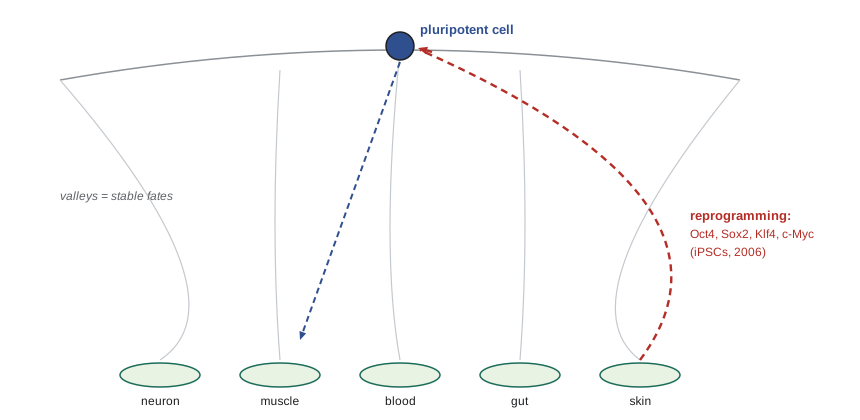
Waddington's epigenetic landscape, which he drew in 1957, provides a useful metaphor. A cell is a ball rolling downhill through branching valleys, each representing a developmental path, and coming to rest in a valley representing a stable differentiated state. In molecular terms, the valleys are stable states of gene regulatory networks, maintained by feedback among transcription factors and by chromatin. Reprogramming pushes the ball back up the hill. A simple example of how a network creates two valleys is a pair of transcription factors that repress each other, such as PU.1 and GATA1, which choose between myeloid and red blood cell fates.
# A two-gene toggle switch (mutual repression) creates two stable cell states.
# dA/dt = a / (1 + B^n) - A ;  dB/dt = a / (1 + A^n) - B   (dimensionless)
def settle(A, B, a=4.0, n=2, dt=0.01, steps=4000):
    for _ in range(steps):
        dA = a / (1 + B ** n) - A
        dB = a / (1 + A ** n) - B
        A += dt * dA; B += dt * dB
    return A, B
print(" start (A, B)      end (A, B)        fate")
for A0, B0 in ((1.2, 1.0), (1.0, 1.2), (3.0, 0.1), (0.1, 3.0), (2.0, 2.0)):
    A, B = settle(A0, B0)
    fate = "A-type (e.g. GATA1, red cell)" if A > B + 0.5 else "B-type (e.g. PU.1, myeloid)" if B > A + 0.5 else "undecided"
    print(f" ({A0:.1f}, {B0:.1f})   ->  ({A:4.2f}, {B:4.2f})    {fate}")
# with weak repression (n = 1) there is only one stable state: no decision
A, B = settle(1.2, 1.0, n=1)
print(f"with n = 1, start (1.2, 1.0) ends at ({A:.2f}, {B:.2f}): a single mixed state")start (A, B) end (A, B) fate (1.2, 1.0) -> (3.73, 0.27) A-type (e.g. GATA1, red cell) (1.0, 1.2) -> (0.27, 3.73) B-type (e.g. PU.1, myeloid) (3.0, 0.1) -> (3.73, 0.27) A-type (e.g. GATA1, red cell) (0.1, 3.0) -> (0.27, 3.73) B-type (e.g. PU.1, myeloid) (2.0, 2.0) -> (1.38, 1.38) undecided with n = 1, start (1.2, 1.0) ends at (1.56, 1.56): a single mixed state
Small initial differences are amplified, and the system settles into one of two stable states: high A with low B, or high B with low A. A perfectly balanced start remains undecided, an unstable state that any noise would tip. With weak, non-cooperative repression (n = 1) the switch disappears and the system settles at a single mixed state. This is a minimal model of a cell fate decision, and it shows why cooperativity and feedback, features of real transcription factor networks, are needed for cells to make clean, stable choices.
Regeneration
Animals differ enormously in their ability to regenerate. Planarian flatworms can regrow a complete animal from a fragment as small as 1/279 of the body, as Thomas Hunt Morgan reported in 1898, because they contain abundant pluripotent stem cells called neoblasts; transplanting a single neoblast can rescue an irradiated planarian. Hydra regenerates by reorganizing existing tissue, a process called morphallaxis. Among vertebrates, salamanders such as the axolotl regrow limbs, tails, parts of the heart and spinal cord, and even parts of the brain, while zebrafish regenerate fins, heart muscle, retina and spinal cord. Mammals can regenerate the liver, which restores its mass after two thirds is removed, the tips of digits in mice and young children, and deer antlers each year, but not limbs.
Limb regeneration in salamanders begins with wound healing, as epidermis covers the stump to form a wound epidermis. Cells beneath dedifferentiate and proliferate to form a blastema, a mass of progenitor cells that regrows the missing structures. Lineage tracing in the axolotl by Elly Tanaka's group showed that blastema cells largely retain their tissue of origin: muscle forms muscle and cartilage forms cartilage, although connective tissue cells are more flexible. The blastema regenerates only the parts distal to the cut, obeying a rule of distal transformation, and nerves are required, supplying factors such as neuregulin. Developmental genes, including Shh, FGFs and Hox genes, are reactivated in a pattern resembling the limb bud. Why mammals cannot regenerate limbs remains an open question. Hypotheses include the evolution of rapid scarring to prevent infection, the loss of positional memory in adult cells, and the costs of maintaining cells able to re-enter the cycle, which may increase cancer risk.
| Organism or tissue | Regenerative capacity | Main cellular source |
|---|---|---|
| Planarian | Whole body from small fragments | Pluripotent neoblasts |
| Hydra | Whole body, including head | Reorganization of existing tissue (morphallaxis) and stem cells |
| Axolotl limb | Complete limb, repeatedly | Dedifferentiated, lineage-restricted blastema cells |
| Zebrafish heart | Up to about 20 per cent of the ventricle | Proliferation of existing cardiomyocytes |
| Mammalian liver | Restores mass after partial removal | Proliferation of hepatocytes |
| Human fingertip (children) | Distal tip only | Nail bed and blastema-like cells |
Organoids
Organoids are three-dimensional structures grown from stem cells that self-organize into miniature versions of organs. In 2009 Toshiro Sato and Hans Clevers showed that a single Lgr5-positive intestinal stem cell, embedded in a gel of extracellular matrix with Wnt agonists, EGF and the BMP antagonist Noggin, grows into a mini-gut with crypt-like and villus-like domains containing all the intestinal cell types. Pluripotent stem cells can be guided through developmental stages to form organoids of the brain, retina, kidney, liver, lung and other organs. Madeline Lancaster and Jürgen Knoblich reported cerebral organoids in 2013 and used them to model microcephaly. Organoids grown from patients' cells are used to study disease and to test drugs: for example, intestinal organoids from people with cystic fibrosis swell in response to drugs that restore function of the CFTR channel, which helps predict which patients will benefit.
Organoids have limitations. They lack blood vessels, immune cells and the full arrangement of tissues of a real organ, they vary from batch to batch, and brain organoids lack the inputs and outputs of a real nervous system. Researchers are adding vasculature, combining organoids of different regions into assembloids, and growing them on chips that provide flow. As organoids and stem-cell-based embryo models become more complete, they raise ethical questions discussed in lesson 12.
Stem cell therapies
Hematopoietic stem cell transplantation remains the most established stem cell therapy. Pluripotent stem cell therapies are now in clinical trials. In 2014 a team in Japan transplanted retinal pigment epithelium made from a patient's own iPSCs into a woman with macular degeneration, the first iPSC-derived transplant. Trials of dopamine neurons derived from ES or iPS cells for Parkinson's disease have reported encouraging early results, with two studies published in 2025, and of insulin-producing islet cells derived from ES cells for type 1 diabetes, where some recipients have become independent of injected insulin while taking immunosuppressive drugs. These remain clinical trials, and their long-term safety and effectiveness are not yet established. At the same time, clinics in many countries market unproven stem cell treatments directly to patients. Health Canada and the US Food and Drug Administration have both warned that such products generally require regulatory approval and can cause serious harm, including blindness and tumours.
Worked problem
Interpreting a regeneration experiment
An axolotl forelimb is amputated through the upper arm (humerus). Before amputation, cartilage cells of the upper arm had been labelled with a fluorescent protein. After regeneration, labelled cells are found in the cartilage of the new humerus, radius, ulna and digits, but not in muscle or epidermis. In a second axolotl, the limb is amputated and its nerve supply cut; no blastema forms. What do the results show?
Show solution
- Labelled cartilage cells contributed only to cartilage, so cartilage-derived blastema cells are lineage-restricted rather than pluripotent.
- They contributed to elements distal to the cut (radius, ulna, digits) as well as the humerus, so they can adopt more distal positional identities, consistent with the rule of distal transformation.
- They did not form muscle or epidermis, which come from their own sources.
- Without nerves, no blastema forms, showing that nerve-derived factors are required for regeneration.
Answer: Salamander limb regeneration uses lineage-restricted progenitors that can be reset to more distal positional identities, and it depends on nerve-derived signals. This differs from planarian regeneration, which relies on pluripotent neoblasts.
Common mistakes
MistakeUsing totipotent and pluripotent interchangeably.
InsteadTotipotent cells form embryonic and extraembryonic tissues, including placenta; pluripotent cells form the embryo proper only.
MistakeAssuming stem cells always divide asymmetrically.
InsteadMany mammalian stem cells divide symmetrically and are balanced at the population level by niche competition.
MistakeThinking iPSCs are identical to ES cells in every respect.
InsteadThey are very similar but can retain epigenetic memory of their origin and vary between lines.
MistakeBelieving the axolotl blastema is made of pluripotent cells.
InsteadMost blastema cells keep their lineage identity; they are reset in position, not potency.
MistakeTreating organoids as complete organs.
InsteadThey lack blood vessels, immune cells and full tissue organization, though they model many features.
MistakeAssuming any clinic offering stem cell treatment is offering an approved therapy.
InsteadMost such products are unproven and unapproved; regulators in Canada and the US have warned of serious harms.
Summary and key terms
- Stem cells self-renew and differentiate; potency ranges from totipotent to unipotent.
- Till and McCulloch defined stem cells in Toronto in 1961 using spleen colonies from bone marrow.
- Niches maintain stem cells; in intestinal crypts, competition causes neutral drift to monoclonality.
- ES cells from the inner cell mass are maintained by an Oct4, Sox2 and Nanog network; four factors can induce pluripotency in somatic cells.
- Cell fates correspond to stable states of gene networks, as in a mutual-repression toggle switch.
- Planarians regenerate from neoblasts; salamanders form lineage-restricted blastemas; mammals regenerate only some tissues.
- Organoids self-organize from stem cells and model organs and diseases; pluripotent stem cell therapies are in clinical trials.
- stem cell
- A cell that can both self-renew and give rise to differentiated cells.
- totipotent
- Able to form all embryonic and extraembryonic cell types.
- pluripotent
- Able to form all cell types of the embryo proper.
- niche
- The microenvironment that maintains stem cells.
- neutral drift
- Random replacement among equivalent stem cells leading to dominance by one clone.
- embryonic stem cell
- A pluripotent cell line derived from the inner cell mass of a blastocyst.
- induced pluripotent stem cell
- A pluripotent cell produced by reprogramming a somatic cell.
- epigenetic landscape
- Waddington's metaphor of development as a ball rolling down branching valleys.
- neoblast
- A pluripotent stem cell in planarians that drives regeneration.
- blastema
- A mass of proliferating progenitor cells that forms at a wound and regenerates lost structures.
- organoid
- A three-dimensional, self-organizing structure grown from stem cells that resembles an organ.
- direct reprogramming
- Conversion of one differentiated cell type into another without a pluripotent intermediate.
Practice problems
Work each problem on paper first, then reveal the answer to check.
What two properties define a stem cell?
Show answer
Self-renewal and the ability to differentiate.
How did Till and McCulloch show that spleen colonies came from single cells capable of self-renewal?
Show answer
Colonies were clonal and contained cells that could form new colonies when transplanted.
What is the role of Paneth cells in the intestinal crypt?
Show answer
They form part of the niche, providing Wnt, EGF and Notch signals to Lgr5 stem cells.
Why do crypts become monoclonal over time?
Show answer
Stem cells compete neutrally for niche space, and random replacement eventually lets one clone take over.
Name the four Yamanaka factors and one reason for replacing c-Myc.
Show answer
Oct4, Sox2, Klf4 and c-Myc; c-Myc is an oncogene and increases tumour risk.
In a toggle switch, why is cooperativity (n > 1) important?
Show answer
It creates two stable states; without it there is a single mixed state and no clean decision.
How do planarian and salamander regeneration differ?
Show answer
Planarians use pluripotent neoblasts; salamanders use dedifferentiated, lineage-restricted blastema cells.
What is the rule of distal transformation?
Show answer
A blastema regenerates only structures distal to the amputation plane.
Give one research use and one limitation of organoids.
Show answer
Testing drugs on patient-derived tissue (such as CFTR modulators); they lack blood vessels and immune cells.
Why do regulators warn against unproven stem cell clinics?
Show answer
Their products are generally unapproved, lack evidence of benefit and can cause serious harm.
Lesson quiz · 5 questions
Score 60% or more to complete this lesson.
Create a free account to save your progress, take quizzes and earn a certificate.