
BIOL-330 · Lesson 7 of 12 · 31 min
Microbial genetics and horizontal gene transfer
Bacteria and archaea are haploid and reproduce asexually, so one might expect their genomes to change only slowly, by mutation within each lineage. In fact prokaryotic genomes are among the most fluid in biology. Mutation is rapid because populations are enormous and generations short, and genes move between cells, sometimes between distantly related species, by horizontal gene transfer. Much of what makes one strain of E. coli a harmless gut resident and another a deadly pathogen, or one Klebsiella susceptible and another resistant to every antibiotic, comes from genes acquired horizontally. BIOL-207 covered DNA replication, transcription, the lac operon and the molecular tools built from bacterial enzymes, and BIOL-201 described the Luria–Delbrück experiment showing that mutations arise before selection. This lesson concentrates on what is distinctive about prokaryotic genomes and the mechanisms that move genes among them.
Prokaryotic genomes
Prokaryotic genomes are compact. Most are between 1 and 10 million base pairs, and protein-coding genes fill about 85 to 90 per cent of the sequence, with short intergenic regions and few non-coding elements. Genome size tracks lifestyle. Free-living soil bacteria with varied metabolisms, such as Streptomyces and myxobacteria, have the largest genomes, up to 12 to 15 million base pairs. Obligate intracellular parasites and symbionts have lost genes they no longer need because the host supplies the products, so their genomes have shrunk; the insect symbiont Candidatus Carsonella ruddii has one of the smallest known, at about 160,000 base pairs.
| Organism | Genome size (Mb) | Approximate genes | Lifestyle |
|---|---|---|---|
| Candidatus Carsonella ruddii | 0.16 | 182 | Obligate symbiont of psyllid insects |
| Mycoplasma genitalium | 0.58 | 525 | Human pathogen with no cell wall |
| Prochlorococcus marinus (MED4) | 1.66 | 1,700 | Open-ocean cyanobacterium |
| Staphylococcus aureus | 2.8 | 2,600 | Commensal and pathogen |
| Escherichia coli K-12 | 4.64 | 4,300 | Gut commensal (laboratory strain) |
| Pseudomonas aeruginosa | 6.3 | 5,600 | Versatile environmental organism and opportunistic pathogen |
| Streptomyces coelicolor | 8.7 | 7,800 | Soil antibiotic producer with a linear chromosome |
| Haloferax volcanii (archaeon) | 4.0 | 4,000 | Halophile with a main chromosome and several megaplasmids |
Comparing many genomes from one species reveals a striking pattern. Each strain shares a core genome, the genes present in all strains, but also carries accessory genes found in only some strains. The total set across all strains is the pangenome. In E. coli, the core is about 3,000 genes, but each strain has 4,000 to 5,500 genes, and the pangenome of all sequenced strains contains well over 100,000 gene families. The accessory genes are largely those acquired by horizontal transfer: genomic islands carrying virulence or metabolic genes, prophages, plasmids and transposons. The pangenome concept explains how two members of one species can behave so differently and why identifying a species is not enough to predict virulence or resistance.
Mutation in prokaryotes
Spontaneous mutations arise mainly from replication errors, chemical damage to DNA and errors in repair. In E. coli the rate is roughly 10⁻¹⁰ per base pair per replication, which, over a genome of 4.6 million base pairs, gives about 0.001 mutations per genome per generation. John Drake noticed in 1991 that this genomic rate, about 0.003 per genome per replication, is remarkably similar across microbes with DNA genomes, a regularity known as Drake’s rule. RNA viruses mutate far faster, as lesson 9 explains.
A low per-cell rate does not mean that mutants are rare in a population. A culture of 10⁹ cells has made about 10⁹ replications, so every possible single-base change in the genome has probably occurred in some cell. A resistance mutation that arises at a rate of 10⁻⁸ per cell per generation is expected in about ten cells of such a culture before any antibiotic is added. This simple calculation explains why antibiotics that can be defeated by a single point mutation, such as rifampicin, select resistance quickly when used alone, and why tuberculosis is treated with combinations of drugs: the chance of a cell carrying independent resistance mutations to two drugs is the product of the separate rates, around 10⁻¹⁶, far smaller than the number of bacilli in even a large lesion.
import numpy as np

mu = 1e-8           # resistance mutations per cell division
for N in [1e6, 1e8, 1e9, 1e10]:
    expected = mu * N                    # approximate expected number of mutational events
    p_none = np.exp(-expected)           # Poisson probability of no mutational event
    print(f"N = {N:7.0e}: expected events = {expected:7.2f}, P(at least one resistant lineage) = {1 - p_none:.4f}")
# two drugs with independent mutation rates
mu1, mu2 = 1e-8, 1e-7
N = 1e10
print(f"double resistance by mutation in N = {N:.0e} cells: expected {mu1*mu2*N:.0e} cells")N = 1e+06: expected events = 0.01, P(at least one resistant lineage) = 0.0100 N = 1e+08: expected events = 1.00, P(at least one resistant lineage) = 0.6321 N = 1e+09: expected events = 10.00, P(at least one resistant lineage) = 1.0000 N = 1e+10: expected events = 100.00, P(at least one resistant lineage) = 1.0000 double resistance by mutation in N = 1e+10 cells: expected 1e-05 cells
Bacteria also change their mutation rates. Mutator strains, defective in mismatch repair, mutate a hundred times faster than normal and are common among isolates from chronic infections such as Pseudomonas in the lungs of people with cystic fibrosis, where they adapt quickly to the host and to antibiotics. Under stress, the SOS response induces error-prone DNA polymerases that copy damaged DNA but introduce mutations; some antibiotics, including fluoroquinolones, trigger the SOS response and so may increase the rate at which resistance emerges.
Horizontal gene transfer
Three classical mechanisms move DNA between bacterial cells: transformation, transduction and conjugation. Once inside the recipient, the incoming DNA must either replicate on its own, as plasmids do, or be integrated into the chromosome, usually by homologous recombination using the RecA protein, which requires sequence similarity, or by site-specific recombination and transposition, which do not.
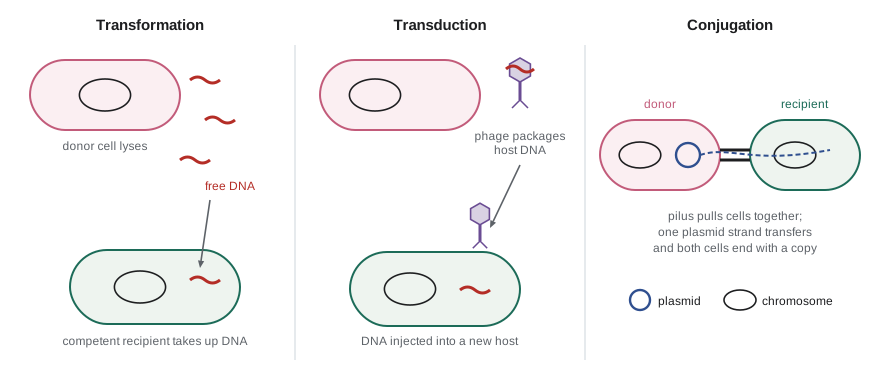
Transformation is the uptake of free DNA from the environment. It was the first mechanism discovered, in Griffith’s 1928 experiment with pneumococci, and it led Avery, MacLeod and McCarty to identify DNA as the genetic material in 1944 (BIOL-207). Naturally transformable bacteria, including Streptococcus pneumoniae, Neisseria, Haemophilus, Bacillus subtilis and Acinetobacter, become competent at particular times, assembling a machine related to type IV pili that binds double-stranded DNA, takes one strand into the cytoplasm and degrades the other. Some species take up DNA indiscriminately; Neisseria and Haemophilus prefer DNA carrying short uptake sequences that are common in their own genomes, so they mostly acquire DNA from relatives. Natural transformation lets Neisseria gonorrhoeae and S. pneumoniae build mosaic genes for penicillin-binding proteins from pieces of related species, producing penicillin resistance. Laboratory transformation of E. coli, which is not naturally competent, uses calcium chloride and heat shock or electroporation and is the foundation of gene cloning.
Transduction is the transfer of bacterial DNA by bacteriophages. In generalized transduction, a phage such as P1 or P22 occasionally packages a random piece of the host chromosome into its head instead of its own DNA, and the resulting transducing particle injects that DNA into a new host; any gene can be moved, at low frequency. In specialized transduction, a temperate phage such as lambda that has integrated at a particular chromosomal site occasionally excises imprecisely, taking adjacent host genes with it, so only genes next to the integration site are transferred. Phages also carry genes of their own that change their hosts, a process called lysogenic conversion: the genes for diphtheria toxin, cholera toxin, the Shiga toxins of E. coli O157:H7 and botulinum toxin are all carried on phages. Gene transfer agents, phage-like particles that package random host DNA and that some bacteria and archaea produce deliberately, blur the line between transduction and a dedicated exchange system.
Conjugation is the transfer of DNA through direct contact between cells, mediated by a plasmid or an integrated element that encodes the machinery. The best-studied system is the F (fertility) plasmid of E. coli. An F⁺ cell makes a pilus that attaches to an F⁻ recipient and retracts, pulling the cells together. A relaxase nicks one strand of the plasmid at the origin of transfer and leads it, single-stranded, through a type IV secretion system into the recipient, while the remaining strand is replicated in the donor. Both cells end up with a complete plasmid, so the recipient becomes F⁺ and can transfer in turn; this is why conjugative plasmids can spread through a population almost like an infection. If the F plasmid has integrated into the chromosome, the cell is called Hfr (high frequency of recombination) and transfers chromosomal genes in a fixed order starting from the integration site; interrupting mating at different times was used in the 1950s to map the E. coli chromosome in minutes of transfer time. Conjugation can cross wide taxonomic boundaries: some plasmids transfer between Gram-negative bacteria of many genera, and Agrobacterium uses a conjugation-like system to transfer DNA into plant cells, a property exploited to make genetically modified plants.
Plasmids
Plasmids are extrachromosomal DNA molecules, usually circular, that replicate independently. They range from a few thousand to over a million base pairs and from one to hundreds of copies per cell. Small, high-copy plasmids typically replicate by rolling-circle or theta mechanisms controlled by the plasmid itself; large plasmids are usually low copy number and have partitioning systems that segregate copies to each daughter cell, plus toxin–antitoxin addiction modules that kill daughter cells that lose the plasmid. Two plasmids that use the same replication control cannot coexist stably in one cell, a property called incompatibility that is used to classify plasmids into incompatibility groups.
Plasmids carry a remarkable variety of optional functions: resistance to antibiotics and heavy metals (R plasmids), toxins and other virulence factors, the ability to degrade unusual compounds such as toluene or herbicides, nitrogen-fixation and nodulation genes in Rhizobium, and the production of bacteriocins, proteins that kill related bacteria. Resistance plasmids were discovered in Japan in the late 1950s, when Shigella strains resistant to several drugs at once emerged and the resistance was shown to transfer to E. coli by conjugation. Today, plasmids carrying ESBL, carbapenemase and mcr genes (lesson 5) are major drivers of the global spread of resistance.
import numpy as np
from scipy.integrate import solve_ivp

# Mass-action model of plasmid spread by conjugation in a well-mixed culture (densities in cells/mL)
psiR, psiP = 1.0, 0.95     # growth rates (per h) of plasmid-free (R) and plasmid-bearing (P) cells: 5% cost
gamma = 1e-9               # conjugation rate constant (mL per cell per h)
tau = 0.001                # segregational loss per division
K = 1e9                    # carrying capacity
def rhs(t, z):
    R, P = z
    g = 1 - (R + P) / K
    dR = psiR * R * g - gamma * R * P + tau * psiP * P * g
    dP = psiP * P * g * (1 - tau) + gamma * R * P
    return [dR, dP]
sol = solve_ivp(rhs, (0, 24), [1e6, 1e3], t_eval=[0, 4, 8, 12, 16, 20, 24], rtol=1e-8)
for t, R, P in zip(sol.t, *sol.y):
    print(f"t = {t:4.0f} h   plasmid-free = {R:9.3g}   plasmid-bearing = {P:9.3g}   fraction with plasmid = {P/(R+P):.3f}")
gamma = 0.0
sol2 = solve_ivp(rhs, (0, 24), [1e6, 1e3], rtol=1e-8)
print(f"without conjugation, fraction at 24 h = {sol2.y[1][-1]/(sol2.y[0][-1]+sol2.y[1][-1]):.4f}")t = 0 h plasmid-free = 1e+06 plasmid-bearing = 1e+03 fraction with plasmid = 0.001 t = 4 h plasmid-free = 5.18e+07 plasmid-bearing = 4.46e+04 fraction with plasmid = 0.001 t = 8 h plasmid-free = 7.47e+08 plasmid-bearing = 2.12e+06 fraction with plasmid = 0.003 t = 12 h plasmid-free = 8.91e+08 plasmid-bearing = 1.03e+08 fraction with plasmid = 0.103 t = 16 h plasmid-free = 1.38e+08 plasmid-bearing = 8.62e+08 fraction with plasmid = 0.862 t = 20 h plasmid-free = 2.92e+06 plasmid-bearing = 9.97e+08 fraction with plasmid = 0.997 t = 24 h plasmid-free = 5.36e+04 plasmid-bearing = 1e+09 fraction with plasmid = 1.000 without conjugation, fraction at 24 h = 0.0007
The model, a simplified form of one introduced by Levin, Stewart and Rice in 1979, shows that infectious transfer can carry a costly plasmid to high frequency even though plasmid-bearing cells grow more slowly. Without conjugation, the plasmid-bearing minority simply declines. Transfer is most effective at high cell densities, which is why biofilms and the dense microbial communities of the gut are hot spots for plasmid exchange. Measured conjugation rates vary over many orders of magnitude between plasmids and conditions, so the parameters here are illustrative.
Transposons, integrons and genomic islands
Mobile genetic elements move genes within and between DNA molecules in a cell, and when they hop onto a plasmid or phage they can then move between cells. Insertion sequences are the simplest, 0.7 to 2.5 kilobases long, encoding only a transposase flanked by inverted repeats. Composite transposons consist of two insertion sequences flanking other genes, often for resistance; Tn10, for example, carries tetracycline resistance between two copies of IS10. Integrative and conjugative elements (ICEs) sit in the chromosome but can excise and transfer by conjugation, combining features of transposons and plasmids.
Integrons are genetic capture systems. An integron has an integrase gene, a recombination site and a promoter, and the integrase inserts circular gene cassettes, each usually carrying a single resistance gene, into the site in arrays. Genes near the promoter are expressed strongly. Class 1 integrons, often embedded in transposons on plasmids, are found in a large fraction of clinical Gram-negative isolates and in wastewater and farm environments, and their abundance has been proposed as an indicator of human pollution. Genomic islands, large chromosomal segments acquired by horizontal transfer, can be recognized by their unusual base composition and codon usage and often carry clusters of virulence genes, in which case they are called pathogenicity islands; the islands of Salmonella encode type III secretion systems that inject proteins into host cells.
Defences against foreign DNA
Because incoming DNA may be a phage, bacteria and archaea have evolved defences against it. Restriction–modification systems pair a restriction enzyme that cuts DNA at a specific sequence with a methylase that protects the cell’s own copies of that sequence; foreign DNA lacking the methylation pattern is cut. These enzymes became the basic tools of recombinant DNA technology. CRISPR–Cas systems, found in about 40 per cent of sequenced bacterial genomes and most archaeal genomes, provide adaptive immunity. When a cell survives infection, Cas proteins insert a short fragment of the invader’s DNA as a new spacer at one end of the CRISPR array. The array is transcribed and processed into CRISPR RNAs, each of which guides a Cas nuclease to destroy matching DNA or RNA on later infection. The system is heritable and records the history of infections, which is how it was first recognized: spacer sequences in Streptococcus thermophilus strains used in yogurt and cheese making matched the phages that attacked dairy fermentations, and Danisco researchers showed in 2007 that adding phage sequences as spacers made cultures resistant. The engineering of Cas9 for genome editing is described in BIOL-207. Since 2018 systematic searches have revealed dozens of further defence systems with names such as BREX, CBASS, gasdermins and retrons, some ancestral to parts of the animal innate immune system.
Defence and gene transfer are in tension. CRISPR and restriction systems block useful plasmids as well as harmful phages, and strains of Enterococcus faecalis that have acquired many resistance plasmids often lack functional CRISPR systems. Bacterial populations seem to balance protection against the benefits of acquiring new genes.
Archaeal genetics
Archaea share features with both bacteria and eukaryotes. Their genomes look bacterial, with circular chromosomes, operons and plasmids, but their DNA replication, transcription and translation machinery resemble those of eukaryotes: archaeal RNA polymerase is closely related to eukaryotic RNA polymerase II, they use TATA-binding protein and transcription factor B, and many have histones that wrap DNA into structures resembling nucleosomes. Several archaea, including Sulfolobus and Haloferax, have multiple replication origins. Horizontal transfer is common in archaea too, through viruses, plasmids and, in Haloferax, cell fusion and in Sulfolobus a pilus-mediated exchange triggered by DNA damage. The discovery of the Asgard archaea in deep-sea sediments, whose genomes encode many proteins previously thought unique to eukaryotes, strongly supports the view that eukaryotes arose from within the archaea.
Worked problem
Tracing the spread of a resistance gene
In one hospital, carbapenem-resistant Klebsiella pneumoniae, Enterobacter cloacae and E. coli isolates all carry the blaKPC gene. Whole-genome sequencing shows that the three species have unrelated chromosomes, but the blaKPC gene sits in the same transposon, Tn4401, on near-identical 45-kilobase plasmids. What does this suggest, and how should the investigation proceed?
Show solution
- Unrelated chromosomes rule out the spread of a single bacterial clone.
- The same transposon on near-identical plasmids in different species points to horizontal spread of a conjugative plasmid, a ‘plasmid outbreak’.
- Infection control should look for shared reservoirs where species meet and exchange plasmids, such as sink drains and wastewater plumbing, as well as patient-to-patient transmission.
- Typing methods that compare only chromosomes would miss the link, so plasmid sequencing, often using long-read technology, is needed.
Answer: The pattern indicates a plasmid-mediated outbreak; investigations of this kind have repeatedly implicated hospital sink drains as long-term reservoirs.
Common mistakes
MistakeThinking that bacteria reproduce sexually by conjugation.
InsteadConjugation is one-way gene transfer from donor to recipient and is not tied to reproduction.
MistakeAssuming low mutation rates make resistant mutants rare.
InsteadIn populations of 10⁹ or more cells, mutants at rates of 10⁻⁸ are almost certain to be present before treatment.
MistakeTreating the genome of one strain as representative of the species.
InsteadAccessory genes vary widely; the pangenome is far larger than any single genome.
MistakeExpecting transformation to work in every bacterium.
InsteadNatural competence is limited to certain species and conditions; others need laboratory methods.
MistakeAssuming plasmids disappear without antibiotic selection.
InsteadConjugation, addiction systems and compensatory evolution often keep them in populations.
MistakeDescribing CRISPR only as a laboratory tool.
InsteadIt evolved as an adaptive immune system of bacteria and archaea against phages and plasmids.
Summary and key terms
- Prokaryotic genomes are compact and their size tracks lifestyle; each species has a core genome and a large pangenome of accessory genes.
- Mutation rates are about 0.003 per genome per replication for DNA microbes, but huge populations mean that resistant mutants usually exist before treatment; combination therapy counters single-step resistance.
- Transformation takes up free DNA, transduction moves DNA in phage particles, and conjugation transfers plasmids through cell contact.
- Plasmids carry optional genes for resistance, virulence and metabolism and can spread infectiously by conjugation despite a growth cost.
- Insertion sequences, transposons, integrons and genomic islands assemble and move gene packages.
- Restriction–modification and CRISPR–Cas systems defend against foreign DNA; archaeal information-processing machinery resembles that of eukaryotes.
- pangenome
- The complete set of genes found across all strains of a species.
- horizontal gene transfer
- Movement of genetic material between cells other than by descent.
- transformation
- Uptake and incorporation of free DNA from the environment.
- transduction
- Transfer of bacterial DNA from one cell to another by a bacteriophage.
- conjugation
- Transfer of DNA from a donor to a recipient through direct cell contact.
- plasmid
- An extrachromosomal DNA molecule that replicates independently of the chromosome.
- Hfr strain
- A strain with the F plasmid integrated into its chromosome, able to transfer chromosomal genes.
- transposon
- A DNA segment that can move from one location to another in a genome.
- integron
- A genetic element that captures and expresses gene cassettes using an integrase.
- lysogenic conversion
- A change in a host’s properties caused by genes carried on a prophage.
Practice problems
Work each problem on paper first, then reveal the answer to check.
Why do obligate intracellular bacteria have small genomes?
Show answer
The host supplies many metabolites, so genes for making them are lost.
In a culture of 5 × 10⁹ cells, how many resistance mutational events are expected at a rate of 2 × 10⁻⁹?
Show answer
About 10.
Why is tuberculosis treated with several drugs at once?
Show answer
A cell would need independent mutations to all drugs, which is vanishingly rare.
Which mechanism of gene transfer is resistant to DNase in the medium?
Show answer
Transduction (DNA inside phage) and conjugation (DNA passes directly between cells); transformation is blocked by DNase.
What is the difference between generalized and specialized transduction?
Show answer
Generalized transfers random host DNA; specialized transfers only genes next to a prophage integration site.
Why does an F⁺ × F⁻ mating usually convert the recipient to F⁺?
Show answer
The whole plasmid is transferred and replicated, so both cells end up with a copy.
What is plasmid incompatibility?
Show answer
The inability of two plasmids with the same replication control to coexist stably in one cell.
Name two toxins encoded by bacteriophages.
Show answer
Cholera toxin, diphtheria toxin, Shiga toxins or botulinum toxin.
How do class 1 integrons gather several resistance genes?
Show answer
Their integrase inserts successive gene cassettes into a recombination site to form an array.
How does a CRISPR array record past infections?
Show answer
It stores short spacers copied from invaders’ DNA, newest at one end.
Lesson quiz · 5 questions
Score 60% or more to complete this lesson.
Create a free account to save your progress, take quizzes and earn a certificate.