
BIOL-330 · Lesson 5 of 12 · 32 min
Antimicrobial agents and resistance
Antimicrobial drugs are chemicals that kill microorganisms or stop their growth at concentrations that a patient can tolerate. Their discovery in the twentieth century transformed medicine: before antibiotics, a scratch could lead to fatal sepsis, pneumonia killed a large fraction of those it struck, and surgery, cancer chemotherapy and organ transplantation as practised today would have been impossible. Within a few years of each new drug’s introduction, however, resistant strains appeared, and today antimicrobial resistance (AMR) is recognized as one of the most serious threats to global health. This lesson explains how antibiotics work, how their activity is measured, how bacteria become resistant and what is being done about it. The choice of drugs for particular infections is a matter for health and medicine courses; here the focus is on the microbiology.
From Salvarsan to the golden age
The first synthetic antimicrobial was Salvarsan, an arsenic compound developed by Paul Ehrlich and Sahachiro Hata in 1909 to treat syphilis, the product of Ehrlich’s search for a ‘magic bullet’ that would kill microbes but spare the patient. The sulfonamides followed in the 1930s, after Gerhard Domagk showed that the dye Prontosil cured streptococcal infections in mice. Alexander Fleming noticed in 1928 that a contaminating Penicillium mould killed staphylococci around it on a plate, but penicillin became a medicine only when Howard Florey, Ernst Chain, Norman Heatley and colleagues purified it in Oxford in 1940 and showed its power in patients. Mass production by deep-tank fermentation in the United States, using a high-yielding strain found on a mouldy cantaloupe in Peoria, Illinois, made penicillin available to Allied forces by 1944.
Selman Waksman’s systematic screening of soil actinomycetes then yielded streptomycin in 1943, the first drug effective against tuberculosis, and launched the golden age of antibiotic discovery from the 1940s to the 1960s, when most of the classes still in use were found. Since then, discovery has slowed dramatically. Very few new classes reached the clinic between the 1960s and today, and most new drugs are modified versions of old ones. The reasons are scientific (screening soil organisms keeps rediscovering the same compounds, and getting drugs across the Gram-negative envelope is hard) and economic (antibiotics are used for short courses and new ones are held in reserve, so sales are low).
Selective toxicity and the main targets
An antimicrobial is useful only if it harms the microbe much more than the host, a property called selective toxicity. It is quantified by the therapeutic index, the ratio of the dose toxic to the host to the dose effective against the microbe. Bacteria have many targets that human cells lack or that differ from their human counterparts: peptidoglycan, 70S ribosomes, bacterial forms of DNA gyrase and topoisomerase IV, RNA polymerase, and the folate synthesis pathway. Antifungal and antiviral drugs are harder to develop because fungi are eukaryotes like us and viruses use host cell machinery. Antibiotics are described as broad-spectrum if they act on both Gram-positive and Gram-negative bacteria and narrow-spectrum if they act on a limited group. Broad-spectrum drugs are useful when the cause of an infection is unknown but do more damage to the normal microbiota and select resistance in more species.
| Target | Drug class | Examples | Mechanism | Usual effect |
|---|---|---|---|---|
| Cell wall synthesis | β-lactams | Penicillins, cephalosporins, carbapenems | Bind penicillin-binding proteins and block peptidoglycan cross-linking | Bactericidal |
| Cell wall synthesis | Glycopeptides | Vancomycin | Bind the d-Ala–d-Ala end of wall precursors, blocking their incorporation | Bactericidal (Gram-positive only) |
| Protein synthesis (30S) | Aminoglycosides | Gentamicin, streptomycin | Cause misreading of mRNA | Bactericidal |
| Protein synthesis (30S) | Tetracyclines | Doxycycline | Block binding of aminoacyl-tRNA | Bacteriostatic |
| Protein synthesis (50S) | Macrolides | Erythromycin, azithromycin | Block the peptide exit tunnel | Bacteriostatic |
| DNA replication | Fluoroquinolones | Ciprofloxacin, levofloxacin | Trap DNA gyrase and topoisomerase IV on cut DNA | Bactericidal |
| Transcription | Rifamycins | Rifampicin (rifampin) | Inhibit bacterial RNA polymerase | Bactericidal |
| Folate synthesis | Sulfonamides and trimethoprim | Sulfamethoxazole–trimethoprim | Block successive steps in folate synthesis, which humans do not perform | Bacteriostatic alone, often cidal together |
| Membrane | Polymyxins | Colistin, polymyxin B | Bind lipid A and disrupt the outer membrane | Bactericidal (Gram-negative) |
The distinction between bactericidal and bacteriostatic drugs is less absolute than the table suggests. It depends on the organism, the concentration and the growth phase, and a bacteriostatic drug works in patients because the immune system clears the inhibited bacteria. Drugs that act on growth processes, such as β-lactams, kill growing cells but not dormant ones. That is one reason for persisters, a small fraction of genetically susceptible cells that survive treatment because they are dormant and that can regrow when the drug is removed. Persistence is not resistance, but it contributes to relapsing and chronic infections, especially in biofilms.
Measuring activity: the MIC
The basic measure of an antibiotic’s activity against a bacterial isolate is the minimum inhibitory concentration (MIC), the lowest concentration that prevents visible growth after overnight incubation under standard conditions. In the reference broth microdilution method, the drug is diluted in a series of two-fold steps across the wells of a microtitre plate, each well is inoculated with a standard number of bacteria (about 5 × 10⁵ CFU per mL), and the plate is read after 16 to 20 hours. Because the concentrations are two-fold steps, an MIC is not a precise number but an interval: an MIC of 4 µg/mL means growth at 2 µg/mL and none at 4. A difference of one dilution step is within normal test variation. Subculturing clear wells onto drug-free agar gives the minimum bactericidal concentration (MBC), the lowest concentration that kills 99.9 per cent of the inoculum.
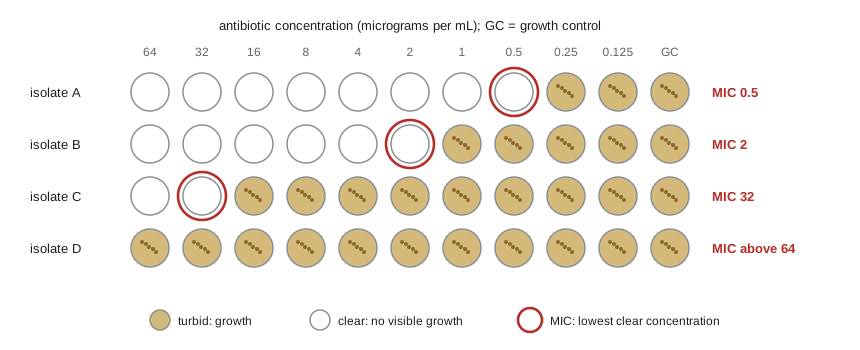
An MIC on its own does not say whether a drug will work. Laboratories interpret MICs using clinical breakpoints, concentrations that divide isolates into susceptible, susceptible at increased exposure (or intermediate) and resistant categories, based on the drug’s pharmacokinetics in patients, outcome data and the distribution of MICs in wild-type populations. Two organizations set most breakpoints: the Clinical and Laboratory Standards Institute (CLSI), whose standards are used by most laboratories in Canada and the United States, and the European Committee on Antimicrobial Susceptibility Testing (EUCAST), used in Europe and many other countries. EUCAST also publishes epidemiological cut-off values (ECOFFs), the highest MIC of the wild-type population without acquired resistance mechanisms, which are used in surveillance. Disk diffusion, in which drug-impregnated paper disks are placed on a lawn of bacteria and the diameter of the zone of inhibition is measured, is a cheaper and widely used alternative that is calibrated against MICs.
import numpy as np

conc = np.array([64, 32, 16, 8, 4, 2, 1, 0.5, 0.25, 0.125])   # ug/mL, two-fold series
# 1 = turbid (growth), 0 = clear; last column of each row is the growth control
plate = {
    "isolate A": [0, 0, 0, 0, 0, 0, 0, 0, 1, 1, 1],
    "isolate B": [0, 0, 0, 0, 0, 0, 1, 1, 1, 1, 1],
    "isolate C": [0, 1, 1, 1, 1, 1, 1, 1, 1, 1, 1],
    "isolate D": [1, 1, 1, 1, 1, 1, 1, 1, 1, 1, 1],
}
S_bp, R_bp = 2, 8      # illustrative breakpoints: S if MIC <= 2, R if MIC >= 8 (I in between)
def read_mic(row):
    wells, control = np.array(row[:-1]), row[-1]
    if control != 1:
        return None, "invalid (no growth in control)"
    clear = conc[wells == 0]
    if clear.size == 0:
        return np.inf, "> 64"
    # skipped wells (growth above a clear well) would also invalidate the read
    mic = clear.min()
    if np.any(wells[conc > mic] == 1):
        return None, "invalid (skipped well)"
    return mic, f"{mic:g}"
for name, row in plate.items():
    mic, txt = read_mic(row)
    cat = "-" if mic is None else ("S" if mic <= S_bp else ("R" if mic >= R_bp else "I"))
print(f"{name}: MIC = {txt:>6s} ug/mL category = {cat}")isolate A: MIC = 0.5 ug/mL category = S isolate B: MIC = 2 ug/mL category = S isolate C: MIC = 64 ug/mL category = R isolate D: MIC = > 64 ug/mL category = R
The code mirrors what a technologist checks: the growth control must be turbid, the wells must change from turbid to clear only once (a ‘skipped well’ suggests contamination or a pipetting error), and the MIC is then compared with breakpoints for that organism and drug. Breakpoints in the code are invented for illustration; real breakpoints differ for each organism–drug pair and are revised as evidence changes.
Pharmacodynamics explains why the way a drug is given matters as much as its MIC. For β-lactams, killing depends mainly on the time the free drug concentration stays above the MIC, so they are given frequently or by continuous infusion. For aminoglycosides and fluoroquinolones, killing depends on the peak concentration or the area under the concentration–time curve relative to the MIC, so they are given as large, less frequent doses. Concentrations between the MIC of the susceptible population and the concentration that would block even first-step resistant mutants define the mutant selection window, the range in which resistant mutants are enriched; dosing that spends long periods in this window favours resistance.
How resistance works
Some bacteria are intrinsically resistant to some drugs because they lack the target or the drug cannot reach it: mycoplasmas have no wall for β-lactams to attack, and vancomycin cannot cross the Gram-negative outer membrane. Acquired resistance arises in normally susceptible species by mutation or by gaining resistance genes from other bacteria by horizontal gene transfer (lesson 7). The biochemical mechanisms fall into four groups.
| Mechanism | How it works | Examples |
|---|---|---|
| Drug inactivation | Enzymes destroy or modify the drug | β-lactamases, including extended-spectrum β-lactamases (ESBLs) and carbapenemases (KPC, NDM, OXA-48); aminoglycoside-modifying enzymes |
| Target modification or protection | The target changes so the drug binds poorly, or is shielded | PBP2a encoded by mecA in MRSA; methylation of 23S rRNA (erm genes) against macrolides; gyrase mutations against fluoroquinolones; vanA genes replacing d-Ala–d-Ala with d-Ala–d-Lac in VRE; mcr genes modifying lipid A against colistin |
| Reduced entry | Fewer or altered porins in the outer membrane | Loss of the OprD porin in Pseudomonas aeruginosa causes carbapenem resistance |
| Efflux | Membrane pumps expel the drug | Tetracycline-specific Tet pumps; multidrug pumps such as AcrAB–TolC in E. coli |
The β-lactamases illustrate how quickly resistance evolves. Penicillinase-producing S. aureus was already common in hospitals by the late 1940s. Methicillin, a β-lactam that resists penicillinase, was introduced in 1959, and methicillin-resistant S. aureus (MRSA) was reported in 1961; its resistance comes from mecA, a gene for an extra penicillin-binding protein with low affinity for nearly all β-lactams, carried on a mobile genetic element. In Gram-negative bacteria, plasmid-borne extended-spectrum β-lactamases that destroy third-generation cephalosporins spread worldwide from the 1980s onwards, driving greater use of carbapenems, and plasmid-borne carbapenemases such as KPC and NDM-1 followed. Resistance to colistin, an old and toxic drug brought back as a last resort, became transmissible when the plasmid gene mcr-1 was reported from China in 2015 and soon found on every inhabited continent, linked to colistin use in livestock.
Resistance carries a cost when the drug is absent: resistance mutations often slow growth, and plasmids impose a metabolic burden. In principle, stopping antibiotic use should let susceptible strains outcompete resistant ones. In practice, compensatory mutations reduce the cost without losing resistance, resistance genes are often linked on the same plasmid with genes for other advantages, and low concentrations of antibiotics in the environment, far below the MIC, can still select for resistance. Reversal is therefore slow and incomplete.
import numpy as np

rng = np.random.default_rng(330)
# Wild-type MICs follow a log-normal shape around 0.5 ug/mL; a resistant subpopulation sits around 16
steps = 2.0 ** np.arange(-4, 8)                      # 0.0625 ... 128
wt = rng.normal(np.log2(0.5), 0.8, 900)
res = rng.normal(np.log2(16), 0.9, 100)
mics = 2.0 ** np.ceil(np.concatenate([wt, res]))      # round up to the next dilution step
mics = np.clip(mics, steps[0], steps[-1])
vals, counts = np.unique(mics, return_counts=True)
for v, c in zip(vals, counts):
    print(f"{v:8.4g} ug/mL  {c:4d}  " + "#" * (c // 10))
# crude ECOFF: highest MIC containing 99% of a wild-type normal fit to the lower mode
low = np.log2(mics[mics <= 2])
mu, sd = low.mean(), low.std(ddof=1)
ecoff = 2 ** np.ceil(mu + 2.33 * sd)
print(f"approximate ECOFF = {ecoff:g} ug/mL; isolates above it: {(mics > ecoff).mean():.0%}") 0.125 ug/mL 3
0.25 ug/mL 74 #######
0.5 ug/mL 330 #################################
1 ug/mL 388 ######################################
2 ug/mL 99 #########
4 ug/mL 8
8 ug/mL 17 #
16 ug/mL 38 ###
32 ug/mL 34 ###
64 ug/mL 6
128 ug/mL 3
approximate ECOFF = 4 ug/mL; isolates above it: 10%Real ECOFFs are set with more careful statistics from tens of thousands of MICs pooled from many laboratories, but the principle is the same: the wild-type population forms a bell-shaped distribution on the log scale, and isolates with higher MICs carry acquired resistance mechanisms. Because breakpoints and ECOFFs are set separately, an isolate can be above the ECOFF (it has a resistance mechanism) but still below the clinical breakpoint (the drug may still work at a high dose). Surveillance programmes track the proportion of isolates above the ECOFF because it signals the spread of resistance genes early.
The scale of the problem
The Global Research on Antimicrobial Resistance (GRAM) project estimated in The Lancet in 2022 that bacterial AMR was directly responsible for about 1.27 million deaths worldwide in 2019 and associated with nearly 5 million. A follow-up study published in 2024 projected that, without stronger action, direct deaths could rise to nearly 2 million a year by 2050. The burden is highest in sub-Saharan Africa and South Asia, where access to diagnostics and effective drugs is limited. Six pathogens, E. coli, S. aureus, Klebsiella pneumoniae, Streptococcus pneumoniae, Acinetobacter baumannii and Pseudomonas aeruginosa, accounted for most AMR deaths in 2019.
The World Health Organization’s Bacterial Priority Pathogens List, updated in May 2024, ranks resistant bacteria to guide research and development. Its critical group contains carbapenem-resistant Acinetobacter baumannii, Enterobacterales resistant to third-generation cephalosporins or to carbapenems, and rifampicin-resistant Mycobacterium tuberculosis. The high-priority group includes fluoroquinolone-resistant Salmonella Typhi, Shigella and non-typhoidal Salmonella, vancomycin-resistant Enterococcus faecium, carbapenem-resistant Pseudomonas aeruginosa, Neisseria gonorrhoeae resistant to third-generation cephalosporins or fluoroquinolones, and methicillin-resistant S. aureus. Medium-priority pathogens include macrolide-resistant group A streptococci and Streptococcus pneumoniae. The 2024 list contains 24 pathogens in 15 families (as reviewed October 2026).
Stewardship, surveillance and One Health
Every use of an antibiotic selects for resistance somewhere, in the target pathogen or in the trillions of bystander bacteria of the patient’s microbiota. Antimicrobial stewardship aims to use antibiotics only when they are needed and to choose the right drug, dose and duration when they are. In hospitals, stewardship teams review prescriptions, promote rapid diagnostics and switch patients from broad- to narrow-spectrum drugs once culture results are known. In the community, stewardship means not prescribing antibiotics for viral infections such as colds, and using shorter courses where evidence supports them. Infection prevention, vaccination and clean water reduce the number of infections that need treating in the first place; pneumococcal conjugate vaccines, for example, have reduced resistant pneumococcal disease.
Most antibiotics by weight are used in animals, not people, historically including growth promotion in livestock. The One Health approach recognizes that resistance moves between people, animals, food and the environment, so surveillance and policy must cover all of them. Wastewater from hospitals, farms and pharmaceutical factories, and the soils and rivers that receive it, are reservoirs where resistance genes mix.
In Canada, the Pan-Canadian Action Plan on Antimicrobial Resistance, released by federal, provincial and territorial governments in June 2023, sets out a five-year agenda organized around five pillars: research and innovation, surveillance, stewardship, infection prevention and control, and leadership. The Public Health Agency of Canada runs national surveillance through the Canadian Antimicrobial Resistance Surveillance System (CARSS), which draws on programmes such as the Canadian Integrated Program for Antimicrobial Resistance Surveillance (CIPARS) for food animals and retail meat. Health Canada ended growth-promotion claims for medically important antimicrobials in animals and moved them to prescription-only status in 2018. The year 1 progress report covered June 2023 to May 2024 (status reviewed October 2026). For comparison, the United States has worked under successive National Action Plans for Combating Antibiotic-Resistant Bacteria (CARB), the most recent covering 2020 to 2025, with surveillance led by the CDC.
New approaches
Several strategies aim to restore effective treatment. β-lactamase inhibitors, such as clavulanic acid, avibactam and vaborbactam, are combined with β-lactams to protect them from destruction; cefiderocol, a siderophore cephalosporin approved in 2019, enters Gram-negative cells through iron-uptake systems like a Trojan horse. New discovery methods include culturing previously uncultured soil bacteria (teixobactin, lesson 1) and machine learning screens of chemical libraries, which identified halicin in 2020 and abaucin, a narrow-spectrum compound against A. baumannii, in 2023. Alternatives to conventional antibiotics include bacteriophage therapy (lesson 9), monoclonal antibodies against toxins, vaccines against resistant pathogens and approaches that disarm virulence rather than kill. Because developers cannot recover their costs from sales of drugs held in reserve, governments are experimenting with ‘pull’ incentives, such as the United Kingdom’s subscription model, which pays a fixed annual fee for access to new antibiotics regardless of volume used.
Worked problem
Interpreting a susceptibility report
An E. coli isolate from a urine culture has MICs of ampicillin > 32 µg/mL, ceftriaxone 16 µg/mL, meropenem ≤ 0.25 µg/mL and nitrofurantoin 16 µg/mL. The laboratory flags it as a probable ESBL producer. What does the pattern suggest about the mechanism?
Show solution
- Resistance to ampicillin and to a third-generation cephalosporin (ceftriaxone) with retained susceptibility to a carbapenem (meropenem) is the classic ESBL pattern.
- ESBLs hydrolyse penicillins and cephalosporins, including third-generation drugs, but not carbapenems.
- Confirmation uses tests showing that the cephalosporin MIC falls in the presence of clavulanic acid, or a molecular test for ESBL genes such as CTX-M.
- Because ESBL genes are usually on plasmids, often with other resistance genes, the isolate may be resistant to unrelated drugs too, and infection control may need to consider spread to other patients.
Answer: The pattern points to a plasmid-borne extended-spectrum β-lactamase. Treatment choices, including whether an oral drug such as nitrofurantoin is suitable for a bladder infection, belong to the prescriber using local breakpoints and guidelines.
Common mistakes
MistakeSaying that patients become resistant to antibiotics.
InsteadBacteria become resistant; patients may carry resistant bacteria.
MistakeTreating an MIC as a precise value.
InsteadAn MIC is an interval between two-fold steps, and one-step differences are within test variation.
MistakeComparing MIC numbers between drugs to choose the most potent.
InsteadEach drug has its own breakpoints and pharmacokinetics; a lower MIC does not mean a better drug.
MistakeAssuming resistance disappears quickly once a drug is withdrawn.
InsteadCompensatory mutations, linked genes and environmental selection slow reversal.
MistakeConfusing persisters with resistant mutants.
InsteadPersisters are dormant, genetically susceptible cells; their offspring are killed normally by the drug.
MistakeUsing antibiotics for viral infections “just in case”.
InsteadAntibiotics do not act on viruses and only select resistance in the patient’s bacteria.
Summary and key terms
- Antimicrobials rely on selective toxicity, targeting bacterial structures such as peptidoglycan, 70S ribosomes, gyrase, RNA polymerase, folate synthesis and the outer membrane.
- The MIC, measured by two-fold broth microdilution, is interpreted with clinical breakpoints from CLSI or EUCAST; ECOFFs define the wild-type population for surveillance.
- Pharmacodynamics links dosing to killing; drug concentrations inside the mutant selection window enrich resistant mutants.
- Resistance mechanisms are inactivation, target modification or protection, reduced entry and efflux, acquired by mutation or horizontal gene transfer.
- AMR was directly responsible for about 1.27 million deaths in 2019; the WHO 2024 priority list places carbapenem-resistant A. baumannii, resistant Enterobacterales and rifampicin-resistant TB in its critical group.
- Stewardship, infection prevention, vaccination, One Health surveillance and new drug incentives are complementary responses.
- selective toxicity
- The ability of a drug to harm a microbe at concentrations harmless to the host.
- minimum inhibitory concentration
- The lowest drug concentration that prevents visible growth under standard conditions.
- minimum bactericidal concentration
- The lowest drug concentration that kills 99.9 per cent of the inoculum.
- breakpoint
- An MIC or zone diameter used to classify isolates as susceptible, intermediate or resistant.
- ECOFF
- Epidemiological cut-off value: the upper limit of the wild-type MIC distribution.
- β-lactamase
- An enzyme that hydrolyses the β-lactam ring and inactivates penicillins and related drugs.
- MRSA
- Methicillin-resistant Staphylococcus aureus, resistant to nearly all β-lactams through the mecA gene.
- efflux pump
- A membrane transporter that expels drugs from the cell.
- persister
- A dormant, genetically susceptible cell that survives antibiotic treatment.
- antimicrobial stewardship
- Coordinated efforts to improve how antimicrobials are prescribed and used.
Practice problems
Work each problem on paper first, then reveal the answer to check.
Why do β-lactams not harm human cells?
Show answer
Human cells have no peptidoglycan and no penicillin-binding proteins.
Name a drug class that targets the 50S ribosomal subunit.
Show answer
Macrolides (also lincosamides, oxazolidinones and chloramphenicol).
Wells at 8, 16 and 32 µg/mL are clear, and the well at 4 µg/mL is turbid. What is the MIC?
Show answer
8 µg/mL.
If the growth-control well is clear, what should be reported?
Show answer
The test is invalid and must be repeated.
How does mecA make S. aureus resistant to methicillin?
Show answer
It encodes PBP2a, a transpeptidase with low affinity for β-lactams that keeps building the wall.
Which resistance mechanism involves the AcrAB–TolC system?
Show answer
Multidrug efflux in E. coli and related bacteria.
Why are ESBL-producing bacteria often resistant to several unrelated drug classes?
Show answer
ESBL genes are usually on plasmids that also carry other resistance genes.
For which drug class is time above MIC the main driver of killing?
Show answer
β-lactams.
What is the difference between intrinsic and acquired resistance?
Show answer
Intrinsic resistance is a property of the whole species; acquired resistance arises in normally susceptible strains by mutation or gene transfer.
Give two parts of the One Health approach to AMR.
Show answer
Surveillance and stewardship in human medicine, animals and agriculture, plus monitoring resistance in the environment.
Lesson quiz · 5 questions
Score 60% or more to complete this lesson.
Create a free account to save your progress, take quizzes and earn a certificate.