
BIOL-321 · Lesson 4 of 12 · 27 min
Mutation, recombination and gene flow
Selection and drift sort existing variation, but they do not create it. Every allele that selection favours or drift fixes began as a mutation, and recombination shuffles mutations into new combinations on which selection can act. Gene flow moves alleles between populations, spreading adaptations and opposing local divergence. BIOL-201 explained the molecular kinds of mutation and their repair, and showed how mutation and selection reach a balance for harmful recessive alleles. This lesson asks evolutionary questions: how many mutations arise, what their effects on fitness are, why sex and recombination are so common despite their costs, and how gene flow and population structure shape variation across a species’ range.
How many mutations?
Mutation rates can now be measured directly by sequencing the genomes of parents and offspring. In humans, the rate of new single-base substitutions is about 1.2 × 10⁻⁸ per base per generation. With roughly 6 billion bases in a diploid genome, each child carries about 60 to 70 new point mutations not present in either parent, plus a few small insertions and deletions and occasional larger changes. Most come from the father, and the number rises with paternal age by about one or two extra mutations per year, because sperm-producing cells keep dividing throughout a man’s life. Rates differ among organisms: per base per generation, they are lower in bacteria and higher in many RNA viruses, which lack proofreading.
| Organism | Approximate mutation rate | Notes |
|---|---|---|
| RNA viruses (e.g. influenza) | About 10⁻⁴ to 10⁻⁶ per base per replication | No proofreading; very fast evolution |
| Escherichia coli | About 2 × 10⁻¹⁰ per base per generation | Roughly one mutation per 1,000 genomes per division |
| Fruit fly (Drosophila) | About 3 × 10⁻⁹ per base per generation | |
| Human | About 1.2 × 10⁻⁸ per base per generation | About 60–70 new point mutations per child |
Interestingly, organisms with large genomes have lower per-base rates, so that the number of mutations per genome per generation varies much less than the per-base rate. Michael Lynch has proposed the drift-barrier hypothesis to explain this: selection pushes mutation rates down because most mutations are harmful, but in species with small effective sizes, drift prevents selection from refining the rate further. This is an example of how population-genetic forces shape even the machinery of heredity.
The distribution of fitness effects
Most new mutations that affect fitness are harmful, a smaller fraction are nearly neutral and a very small fraction are beneficial. The full spread of effects, the distribution of fitness effects (DFE), can be estimated from mutation-accumulation experiments, in which lines are kept so small that selection is almost powerless and mutations accumulate, and from patterns of polymorphism in genome data. In humans and fruit flies, estimates suggest that most new amino acid–changing mutations are deleterious, with a wide range from very mildly to strongly harmful. Mutations in non-coding DNA are mostly neutral or very slightly harmful.
import numpy as np
rng = np.random.default_rng(321)
# A gamma-distributed DFE for deleterious amino-acid mutations (shape 0.2; illustrative mean |s| = 0.01)
shape, mean_s = 0.2, 0.01
s = rng.gamma(shape, mean_s/shape, 200_000)          # selection coefficients (harm)
for Ne in (1_000, 10_000, 100_000):
    nearly_neutral = np.mean(Ne*s < 1)                # behave as effectively neutral
    strongly = np.mean(Ne*s > 100)
    print(f"Ne = {Ne:7,d}: effectively neutral {100*nearly_neutral:5.1f}%, "
f"strongly selected {100*strongly:5.1f}%")Ne = 1,000: effectively neutral 49.7%, strongly selected 1.2% Ne = 10,000: effectively neutral 31.6%, strongly selected 23.5% Ne = 100,000: effectively neutral 19.9%, strongly selected 50.3%
The same set of mutations behaves very differently depending on population size. In a population with an effective size of 1,000, a large share of these mutations are effectively neutral and can drift to high frequency; in a population of 100,000, most are strongly enough selected to be removed efficiently. This is the nearly neutral theory from lesson 3 applied to the whole distribution, and it helps explain why species with small effective sizes, including humans compared with fruit flies, carry relatively more slightly harmful variation.
Mutation accumulation and Muller’s ratchet
In a population that reproduces without recombination, such as an asexual organism, a mitochondrial genome or a non-recombining sex chromosome, harmful mutations can accumulate irreversibly. Hermann Muller pointed out in 1964 that the class of individuals carrying the fewest mutations can be lost by chance, and without recombination it can never be recreated except by an unlikely back mutation. Each such loss is a click of the ratchet, and the population’s fitness declines step by step.
import numpy as np
rng = np.random.default_rng(3213)

def ratchet(N=200, U=0.5, s=0.02, gens=2000, sex=False):
    k = np.zeros(N, int)                      # number of deleterious mutations per genome
    clicks, best = 0, 0
    for t in range(gens):
        w = (1 - s)**k
        parents = rng.choice(N, N, p=w/w.sum())
        if sex:                                # free recombination: offspring get a mix of two parents
            mates = rng.choice(N, N, p=w/w.sum())
            k = rng.binomial(k[parents] + k[mates], 0.5)
        else:
            k = k[parents]
        k = k + rng.poisson(U, N)
        if k.min() > best:
            clicks += k.min() - best; best = k.min()
    return clicks, k.mean()

for sex in (False, True):
    c, m = ratchet(sex=sex)
print(f"{'sexual ' if sex else 'asexual '} least-loaded class moved up {c:3d} times; mean load {m:6.1f}")asexual least-loaded class moved up 494 times; mean load 501.2 sexual least-loaded class moved up 19 times; mean load 25.8
In the asexual population, the least-loaded class keeps being lost and the burden of mutations climbs steadily. With recombination, offspring with fewer mutations than either parent are produced each generation, so the best class is continually rebuilt and the ratchet is held in check. This is one reason why the human Y chromosome, which does not recombine over most of its length, has lost most of the genes it once shared with the X, and why mitochondrial genomes rely on special mechanisms, such as bottlenecks in egg cells, to purge harmful mutations.
Why sex?
Sexual reproduction poses one of the deepest puzzles in evolution. An asexual female produces only daughters, each of which can reproduce, while a sexual female produces sons and daughters, and only the daughters bear offspring. All else being equal, an asexual lineage should grow twice as fast, the twofold cost of sex. Sex also breaks up favourable combinations of genes and requires finding a mate. Yet nearly all animals and plants reproduce sexually at least sometimes, and lineages that have abandoned sex entirely tend to be young twigs on the tree of life, suggesting that they usually go extinct.
| Hypothesis | Idea | Supporting evidence |
|---|---|---|
| Muller’s ratchet | Recombination prevents irreversible accumulation of harmful mutations | Degeneration of non-recombining chromosomes and asexual lineages |
| Kondrashov’s deterministic hypothesis | If harmful mutations interact so that each extra one hurts more, sex purges them efficiently | Requires many mutations per genome and synergistic epistasis; evidence mixed |
| Fisher–Muller adaptation | Sex combines beneficial mutations that arose in different individuals | Experiments in yeast and algae: sexual populations adapt faster in new environments |
| Red Queen | Sex creates rare genotypes that escape coevolving parasites | New Zealand mud snails: sexual forms more common where parasites are abundant |
The Red Queen hypothesis takes its name from the character in Lewis Carroll’s Through the Looking-Glass who must keep running to stay in the same place. Parasites evolve to exploit the commonest host genotypes, so hosts that produce variable offspring keep a step ahead. Studies of the New Zealand freshwater snail Potamopyrgus antipodarum, in which sexual and asexual forms live together, by Curtis Lively and colleagues found that sexual snails are more common where trematode parasites are abundant, and that asexual clones that become common are later attacked more heavily. Most biologists now think several advantages of sex act together, with their relative importance varying among organisms.
Recombination and the efficiency of selection
Recombination also matters within genomes. In regions of low recombination, selection at one site interferes with selection at linked sites, a phenomenon called Hill–Robertson interference. A beneficial mutation that arises on a chromosome carrying a harmful mutation may be dragged down with it, and a favoured allele that sweeps to fixation carries linked neutral variants with it, reducing diversity nearby (a selective sweep). Purifying selection against harmful mutations similarly removes linked neutral diversity (background selection). As a result, genetic diversity across the genome tracks the local recombination rate, a pattern seen in flies, humans and many other species and discussed further in BIOL-322.
Gene flow and population structure
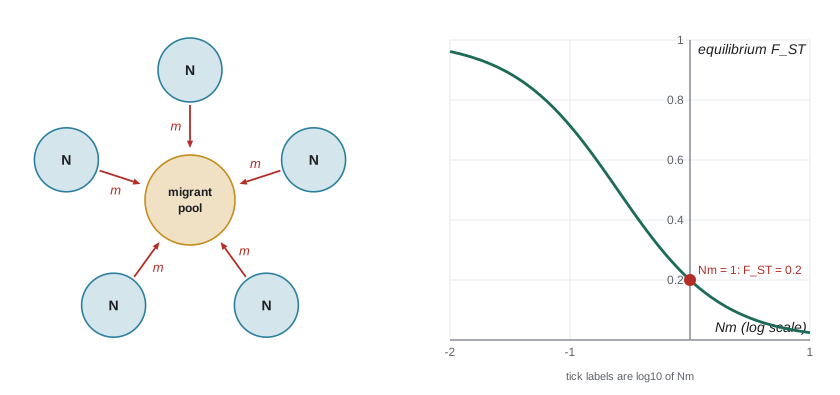
Gene flow, or migration, is the movement of alleles between populations through dispersing individuals or gametes such as pollen. It makes populations more similar and opposes divergence caused by drift and local selection. A simple model, Wright’s island model, imagines many subpopulations of size N exchanging a fraction m of migrants each generation. At equilibrium between drift, which makes subpopulations differ, and migration, which homogenizes them, the fixation index F_ST, which measures the fraction of total genetic variation due to differences among subpopulations, is approximately 1/(4Nm + 1).
Worked problem
How much migration prevents divergence?
Under the island model, what is the equilibrium F_ST if each subpopulation receives (a) one migrant every 10 generations, (b) one migrant per generation and (c) 10 migrants per generation?
Show solution
- Nm is the number of migrants per generation, so (a) Nm = 0.1, (b) Nm = 1 and (c) Nm = 10.
- (a) F_ST = 1/(4 × 0.1 + 1) = 1/1.4 ≈ 0.71.
- (b) F_ST = 1/(4 + 1) = 0.20.
- (c) F_ST = 1/(40 + 1) ≈ 0.024.
- Note that the result depends on the number of migrants, not the fraction: one migrant per generation has the same effect in a population of 100 or 100,000.
Answer: About 0.71, 0.20 and 0.02: roughly one migrant per generation is enough to prevent strong divergence by drift alone.
import numpy as np
rng = np.random.default_rng(3214)
# Island model: 20 demes of N = 50 diploids; migrants drawn from the global pool each generation
def fst_sim(N=50, m=0.01, demes=20, gens=1500):
    p = np.full(demes, 0.5)
    vals = []
    for t in range(gens):
        p = (1 - m)*p + m*p.mean()                 # migration
        p = rng.binomial(2*N, p) / (2*N)           # drift within each deme
        if t > 1000:
            pbar = p.mean()
            if 0 < pbar < 1: vals.append(p.var() / (pbar*(1 - pbar)))
    return np.mean(vals)

for m in (0.001, 0.005, 0.02, 0.1):
    Nm = 50*m
print(f"m = {m:5.3f} (Nm = {Nm:4.2f}): simulated F_ST = {fst_sim(m=m):.3f}, island-model prediction {1/(4*Nm + 1):.3f}")m = 0.001 (Nm = 0.05): simulated F_ST = 0.813, island-model prediction 0.833 m = 0.005 (Nm = 0.25): simulated F_ST = 0.438, island-model prediction 0.500 m = 0.020 (Nm = 1.00): simulated F_ST = 0.157, island-model prediction 0.200 m = 0.100 (Nm = 5.00): simulated F_ST = 0.049, island-model prediction 0.048
The simulations follow the predicted relationship: when Nm is well below 1, subpopulations drift apart; when it is several or more, they stay similar. Real populations depart from the island model because migration is usually between neighbours, producing isolation by distance, in which genetic differences increase with geographic distance. In humans, F_ST between continental groups is about 0.1 or a little higher, meaning that around 85 to 90 per cent of human genetic variation is found within any population rather than between them, a point that lesson 11 returns to.
Gene flow and local adaptation
When selection differs between habitats, gene flow can swamp local adaptation by importing alleles suited to elsewhere. Adaptation can persist only if selection is strong relative to migration, roughly when s exceeds m. A famous example is heavy-metal tolerance in grasses growing on mine waste in Britain: tolerant and non-tolerant populations stay distinct over distances of only a few metres because selection against non-tolerant plants on contaminated soil, and against tolerant plants on clean soil, is very strong. Gene flow can also spread adaptations. Insecticide resistance alleles in mosquitoes have spread across continents, and alleles introduced from one species to another by hybridization, adaptive introgression, have helped species adapt, as when modern humans acquired immune and high-altitude variants from archaic humans (lesson 11).
Gene flow can even move genes between distant branches of the tree of life. In bacteria, horizontal gene transfer by plasmids, viruses and uptake of free DNA is common, and it is the main way antibiotic resistance genes spread between species. Resistance plasmids carrying genes such as those for extended-spectrum β-lactamases or carbapenemases can move between Escherichia coli, Klebsiella and other bacteria within a patient’s gut. Horizontal transfer complicates the tree of life for microbes and is one reason why bacterial evolution can be so rapid.
Common mistakes
MistakeMutations are caused by the environment to meet an organism’s needs.
InsteadMutations arise randomly with respect to their usefulness; the Luria–Delbrück experiment (BIOL-201) showed this for bacteria.
MistakeMost mutations are beneficial or neutral.
InsteadAmong mutations that affect fitness, most are harmful; beneficial ones are rare.
MistakeSex has no cost compared with asexual reproduction.
InsteadProducing males halves the growth rate of a lineage, the twofold cost of sex.
MistakeGene flow always helps a population adapt.
InsteadGene flow can swamp local adaptation if migration is strong relative to selection.
MistakeF_ST depends on the fraction of migrants.
InsteadIn the island model it depends on the number of migrants per generation, Nm.
MistakeRecombination only matters for the offspring of crosses.
InsteadIt also affects how efficiently selection acts across the genome and how much diversity linked sites keep.
Summary and key terms
- Human parents pass on about 60 to 70 new point mutations per child, mostly from the father and increasing with paternal age.
- Most fitness-affecting mutations are harmful; whether a mutation behaves as neutral depends on N_e s.
- Without recombination, Muller’s ratchet causes irreversible accumulation of harmful mutations.
- Sex has a twofold cost; proposed advantages include purging mutations, combining beneficial mutations and escaping parasites (the Red Queen).
- Low recombination causes Hill–Robertson interference, selective sweeps and background selection that reduce linked diversity.
- Gene flow homogenizes populations; under the island model, F_ST ≈ 1/(4Nm + 1).
- Gene flow can swamp local adaptation or spread adaptive alleles, and horizontal gene transfer spreads resistance among bacteria.
- mutation rate
- The probability of a new mutation per site, gene or genome per generation.
- distribution of fitness effects
- The spread of fitness consequences among new mutations.
- mutation accumulation
- An experiment in which tiny populations allow mutations to build up with little selection.
- Muller’s ratchet
- The irreversible loss of the least-mutated class in non-recombining populations.
- twofold cost of sex
- The halving of lineage growth caused by producing males.
- Red Queen hypothesis
- The idea that sex is favoured because it helps hosts keep up with coevolving parasites.
- Hill–Robertson interference
- Reduced efficiency of selection at linked sites in regions of low recombination.
- gene flow
- The movement of alleles between populations.
- F_ST
- The proportion of genetic variation due to differences among subpopulations.
- horizontal gene transfer
- Movement of genes between organisms other than by descent.
Practice problems
Work each problem on paper first, then reveal the answer to check.
With a mutation rate of 1.2 × 10⁻⁸ per base and 6 × 10⁹ bases per diploid genome, how many new mutations does a child carry?
Show answer
About 72; observed values are about 60 to 70.
Why do older fathers transmit more new mutations?
Show answer
Sperm-producing cells keep dividing throughout life, so more replication errors accumulate.
A mutation has s = 0.0005 in a population with N_e = 1,000. Is it effectively neutral?
Show answer
Yes, because N_e s = 0.5, which is less than 1.
Why can’t an asexual population recover its least-mutated class once lost?
Show answer
Without recombination, mutation-free genomes cannot be reassembled from different individuals.
What is the twofold cost of sex?
Show answer
Sexual females produce sons who do not bear offspring, halving the growth rate relative to asexual females.
What pattern in New Zealand mud snails supports the Red Queen hypothesis?
Show answer
Sexual snails are more common where parasites are abundant.
What is a selective sweep?
Show answer
The rise to fixation of a favoured allele that reduces diversity at linked sites.
Under the island model, what is F_ST with Nm = 2?
Show answer
1/(8 + 1) ≈ 0.11.
When can local adaptation persist despite gene flow?
Show answer
When selection against immigrant alleles is strong relative to the migration rate.
How do resistance genes spread between bacterial species?
Show answer
By horizontal gene transfer, especially on plasmids.
Lesson quiz · 5 questions
Score 60% or more to complete this lesson.
Create a free account to save your progress, take quizzes and earn a certificate.