
BIOL-321 · Lesson 1 of 12 · 29 min
Evolutionary biology as a science: history and evidence
Theodosius Dobzhansky wrote in 1973 that nothing in biology makes sense except in the light of evolution. Half a century later, that claim is stronger than ever: the same theory that explains the branching tree of life also predicts how quickly bacteria become resistant to antibiotics, why influenza vaccines must be updated every year, which genes underlie human disease and how crop pests escape control. BIOL-108 introduced natural selection, drift, speciation and the tree of life, and BIOL-201 showed how genes are inherited and how allele frequencies change in populations. This course goes deeper. It treats evolution as a working science, with mathematical models that make quantitative predictions, experiments that test them and comparative methods that reconstruct the past. This first lesson looks at how the theory developed, how scientists argue about it today and what kinds of evidence support it.
Evolutionary biology is one of the best-supported bodies of knowledge in science. Some people see a conflict between evolution and their religious beliefs, and many others find no such conflict; this course treats evolution as science, on the evidence, and leaves questions of meaning and faith to each student.
Before Darwin
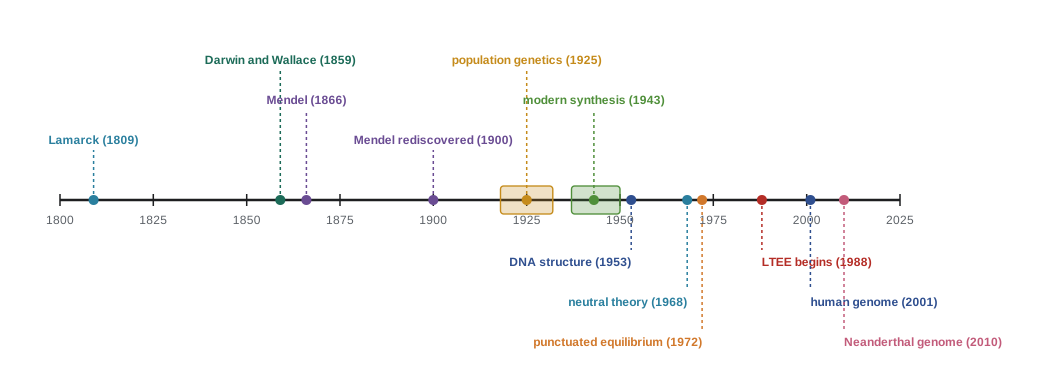
Ideas that species might change are old, but the modern study began in the eighteenth and nineteenth centuries, when naturalists began to classify species systematically and to read the fossil record. Carl Linnaeus built the hierarchical system of classification still used today, without intending it as a family tree. Georges Cuvier showed that some fossil animals, such as mammoths and mastodons, had no living counterparts, establishing that extinction is real. Jean-Baptiste Lamarck proposed in 1809 that lineages transform over time, driven partly by the inheritance of characteristics acquired during an organism’s life. His mechanism was wrong in its general form, but he deserves credit for treating species change as a natural process. Geologists such as James Hutton and Charles Lyell argued that the Earth was very old and had been shaped by slow, continuing processes, giving later biologists the vast time that gradual evolution would require.
Darwin and Wallace
Charles Darwin developed his theory over two decades after the voyage of HMS Beagle (1831–1836), drawing on biogeography, the breeding of domestic animals and plants, and Thomas Malthus’s argument that populations tend to outgrow their resources. Alfred Russel Wallace reached the same idea independently while collecting in the Malay Archipelago. Their papers were presented together to the Linnean Society of London in 1858, and Darwin’s book On the Origin of Species appeared in 1859. The book made two claims. The first, descent with modification, is that all species are related through common ancestry, branching like a tree. The second, natural selection, is a mechanism: individuals vary, much of the variation is inherited, more offspring are produced than can survive, and individuals with variants better suited to their environment leave more descendants, so those variants spread.
The first claim was accepted by most biologists within a couple of decades. The second was more controversial for longer, partly because Darwin did not know how inheritance worked. Under the then-popular idea of blending inheritance, new variants would be diluted by half in every generation, and selection would have little to act on. Gregor Mendel’s experiments on peas, published in 1866, showed that inheritance is particulate, but his work was overlooked until 1900.
The modern synthesis
When Mendel’s work was rediscovered, some geneticists at first thought that large mutations, not selection on small differences, drove evolution. The conflict was resolved between about 1918 and 1950 in what Julian Huxley called the modern synthesis. Ronald Fisher showed in 1918 that many genes of small effect produce continuous, bell-shaped variation, reconciling Mendelian inheritance with the quantitative traits Darwin studied. Fisher, J. B. S. Haldane and Sewall Wright built the mathematical foundations of population genetics, showing how selection, mutation, migration and random drift change allele frequencies. Field naturalists and palaeontologists, including Dobzhansky, Ernst Mayr, George Gaylord Simpson and G. Ledyard Stebbins, then showed that these processes could explain variation in natural populations, the origin of species and the patterns of the fossil record.
The synthesis did not end the debate. In the 1960s, protein and then DNA sequencing revealed far more variation than expected. Motoo Kimura proposed in 1968 that most molecular differences between species are selectively neutral and spread by random drift, the neutral theory, discussed in lesson 3. Arguments about the relative importance of selection and drift at the molecular level continued for decades and have shaped how genome data are interpreted today.
| Period | Development | Key figures |
|---|---|---|
| 1809 | First general theory of lineage transformation | Lamarck |
| 1858–1859 | Common descent and natural selection | Darwin, Wallace |
| 1866, rediscovered 1900 | Particulate inheritance | Mendel; de Vries, Correns |
| 1918–1932 | Mathematical population genetics | Fisher, Haldane, Wright |
| 1937–1950 | The modern synthesis with systematics and palaeontology | Dobzhansky, Mayr, Simpson, Stebbins |
| 1953 onward | DNA structure and molecular biology | Watson, Crick, Franklin, Wilkins |
| 1968–1973 | Neutral and nearly neutral theories of molecular evolution | Kimura, Ohta |
| 1970s | Punctuated equilibrium; kin selection and game theory become mainstream | Eldredge and Gould; Hamilton, Maynard Smith |
| 1980s onward | Evolutionary developmental biology (evo-devo) | Many |
| 2000s onward | Genomics, ancient DNA and experimental evolution at large scale | Many |
Is a further synthesis needed?
Since the 2000s, some biologists have argued for an extended evolutionary synthesis. They emphasize processes they consider under-weighted in standard theory: developmental bias, in which the way organisms develop makes some variants more likely than others; phenotypic plasticity, in which one genotype produces different forms in different environments; niche construction, in which organisms modify their environments and so the selection they face; and non-genetic inheritance, such as transgenerational epigenetic effects and culture. Others reply that these processes are real and interesting but are already accommodated by existing theory, and that renaming the framework adds little. The debate is lively and unresolved; what both sides agree on is that common descent, natural selection, drift, mutation and gene flow are established, and that the argument is about emphasis and explanation, not whether evolution happens.
Lines of evidence
Evidence for evolution comes from independent sources that agree with each other. This consistency, called consilience, is what makes the conclusion so secure. A single line of evidence could perhaps be explained another way, but it would take an extraordinary coincidence for the fossil record, the geographic distribution of species, comparative anatomy and development, molecular sequences and direct observation all to point to the same tree of descent unless that tree were real.
| Line of evidence | What it shows | Example |
|---|---|---|
| Fossil record | Sequences of forms in rock layers, including transitional fossils | Tiktaalik (fish to tetrapod), found on Ellesmere Island, Nunavut, in 2004; early whales with legs |
| Biogeography | Related species cluster geographically; islands have endemic species related to the nearest mainland | Galápagos finches and Hawaiian honeycreepers; marsupials in Australia |
| Homology | Shared structures inherited from a common ancestor, even when used differently | Forelimb bones of humans, bats, whales and horses |
| Vestigial traits | Reduced structures that once had a function | Pelvic bones in whales; broken vitamin C gene (GULO) in primates |
| Molecular evidence | Sequence similarity matches the tree from anatomy; shared mistakes such as pseudogenes and endogenous retroviruses | Humans and chimpanzees share retroviral insertions at the same sites |
| Direct observation | Evolution measured in real time | Antibiotic resistance; Galápagos finch beaks; the E. coli long-term experiment |
Molecular evidence deserves special attention, because it allows a quantitative test. If species share ancestors, then the tree built from one gene should resemble the tree built from another gene, and both should resemble the tree built from anatomy. They do, with differences that are themselves predicted by theory (lesson 8). Shared errors are particularly powerful. Humans, chimpanzees, gorillas and orangutans all carry the same inactivating mutations in the GULO gene, which makes vitamin C in most other mammals; this is why we need vitamin C in our diet. A designer starting from scratch would have no reason to put the same broken gene in the same place in related species, but common descent predicts exactly that.
Evolution observed
Evolution is not only inferred from the past; it is measured happening now. Peter and Rosemary Grant studied Darwin’s finches on the small Galápagos island of Daphne Major from 1973 for four decades. After a severe drought in 1977, when only large, hard seeds were left, medium ground finches with deeper beaks survived better, and the next generation had beaks about 4 per cent deeper on average. When wet years favoured small seeds, selection reversed. In the peppered moth, the dark form became common near industrial cities in Britain in the nineteenth century, when soot darkened tree bark, and declined again after clean air laws; in 2016 the mutation responsible was traced to a transposable element inserted in the gene cortex.
The most detailed record comes from the laboratory. In 1988, Richard Lenski founded twelve populations of Escherichia coli from a single ancestor and has transferred them to fresh medium every day since, freezing samples every 500 generations so that ancestors can be revived and compared with their descendants. The populations have passed 75,000 generations, and since 2022 the experiment has been continued by Jeffrey Barrick’s laboratory at the University of Texas at Austin. Fitness relative to the ancestor has risen in every population, quickly at first and then more slowly, and one population evolved the ability to use citrate, a new nutrient, after more than 30,000 generations.
import numpy as np
from scipy.optimize import curve_fit

# Illustrative relative-fitness measurements (ancestor = 1.0), shaped like the
# published long-term evolution experiment data; not the real values
gens = np.array([0, 2000, 5000, 10000, 20000, 30000, 40000, 50000])
w    = np.array([1.00, 1.30, 1.43, 1.52, 1.62, 1.68, 1.72, 1.76])

hyperbolic = lambda t, a, b: 1 + a*t/(t + b)          # approaches a ceiling 1 + a
power      = lambda t, a, b: (b*t + 1)**a             # keeps rising without limit

for name, f, p0 in [("hyperbolic", hyperbolic, (0.8, 3000)), ("power law", power, (0.1, 0.01))]:
    p, _ = curve_fit(f, gens, w, p0=p0, maxfev=20000)
    rss = np.sum((w - f(gens, *p))**2)
print(f"{name:10s} params {np.round(p, 4)} RSS {rss:.4f} predicted w at 100,000 gens = {f(100000, *p):.2f}")hyperbolic params [7.8110000e-01 4.0505416e+03] RSS 0.0055 predicted w at 100,000 gens = 1.75 power law params [0.0937 0.0084] RSS 0.0002 predicted w at 100,000 gens = 1.88
Both curves fit the early data well, but they make different predictions far into the future: the hyperbolic model levels off at a ceiling, while the power law keeps rising, slowly, forever. Wiser, Ribeck and Lenski showed in 2013 that the real data are fit better by the power law, and that fitness was still increasing after 50,000 generations. This is an example of how evolutionary biology makes and tests quantitative predictions. Because samples are frozen, the researchers can replay evolution from any point, which is how they showed that the citrate innovation depended on earlier mutations that set the stage.
Antibiotic and pesticide resistance
Resistance is natural selection in action, and it is one of the most important practical problems evolution explains. When an antibiotic kills most bacteria in a population, any cell carrying a resistance mutation or a resistance gene acquired from another bacterium survives and multiplies. The same logic applies to insecticides, herbicides and cancer drugs. The World Health Organization estimated in 2019 that bacterial antimicrobial resistance was directly responsible for about 1.27 million deaths worldwide. Lesson 12 returns to how evolutionary thinking can slow resistance.
Worked problem
How fast does resistance spread?
In a hospital ward, 1 per cent of Staphylococcus aureus carry a resistance gene. During antibiotic treatment, resistant cells have relative fitness 1 and sensitive cells 0.5 per generation. Assuming haploid selection, how many generations until resistant cells are half the population?
Show solution
- For haploid selection, the ratio of resistant to sensitive cells, p/q, multiplies by the fitness ratio each generation: here by 1/0.5 = 2.
- Start: p/q = 0.01/0.99 ≈ 0.0101. Target: p/q = 1.
- Generations t satisfy 0.0101 × 2^t = 1, so t = log(99)/log(2) ≈ 6.6.
- With bacterial generations of about an hour under good conditions, this could happen within a day.
Answer: About 7 generations, which shows why resistance can rise within a single course of treatment.
import numpy as np
# Haploid selection: resistant (fitness 1) vs sensitive (fitness w_s), starting at 1% resistant
def gens_to_half(p0, ws):
    p, t = p0, 0
    while p < 0.5:
        p = p / (p + (1 - p)*ws)
        t += 1
    return t

for ws in (0.5, 0.8, 0.95, 0.99):
print(f"sensitive fitness {ws:4.2f}: {gens_to_half(0.01, ws):5d} generations to reach 50% resistant")sensitive fitness 0.50: 7 generations to reach 50% resistant sensitive fitness 0.80: 21 generations to reach 50% resistant sensitive fitness 0.95: 90 generations to reach 50% resistant sensitive fitness 0.99: 458 generations to reach 50% resistant
Strong selection spreads resistance in a handful of generations; weak selection takes hundreds. This is why the dose and duration of treatment, and whether antibiotics are present at low levels in the environment, matter so much. Even small advantages, given enough generations, become decisive.
How evolutionary biologists work
Evolutionary biology uses all the methods of science. Some questions can be answered by direct experiment: experimental evolution in microbes, flies and plants, or field experiments such as moving lizards to islands. Others concern the deep past and are answered by comparison, testing whether patterns across species fit predictions from a hypothesis, and by modelling. A good evolutionary hypothesis makes predictions that could be wrong. For example, if whales evolved from land mammals, then intermediate fossils should be found in rocks of a particular age, and they were, in Pakistan and India in the 1980s and 1990s. If birds descended from dinosaurs, then feathered dinosaurs should exist, and many have been found since 1996. If all life shares a common ancestor, then the genetic code should be nearly universal, as it is.
The rest of this course follows the main processes and patterns of evolution. Lessons 2 to 6 cover the mechanisms: selection, drift, mutation, recombination, gene flow, quantitative traits, sexual selection and social evolution. Lessons 7 to 10 cover the patterns that result: speciation, phylogenies and macroevolution. Lesson 11 applies these tools to our own species, and lesson 12 looks at evolution in medicine, agriculture and conservation.
Common mistakes
MistakeDarwin invented the idea that species change.
InsteadMany earlier thinkers, including Lamarck, proposed transformation; Darwin and Wallace supplied natural selection as the mechanism and amassed the evidence for common descent.
MistakeMendelian genetics contradicted Darwin.
InsteadEarly geneticists argued about it, but the modern synthesis showed that particulate inheritance is exactly what natural selection needs.
MistakeEvolution is just a theory, so it is a guess.
InsteadIn science, a theory is a well-tested explanation supported by many lines of evidence; evolution has been tested for over 150 years.
MistakeEvolution cannot be observed because it is too slow.
InsteadIt is observed directly in bacteria, viruses, insects, finches and many laboratory experiments.
MistakeThe extended evolutionary synthesis rejects natural selection.
InsteadIts proponents accept selection; they argue that development, plasticity and niche construction deserve more emphasis.
MistakeSimilar structures always mean close relationship.
InsteadHomologous structures do, but similar structures can also evolve independently (convergence), as lesson 8 explains.
Summary and key terms
- Lamarck proposed lineage transformation; Darwin and Wallace proposed common descent and natural selection in 1858–1859.
- The modern synthesis (about 1918–1950) united Mendelian genetics, population genetics, systematics and palaeontology.
- Neutral theory added the role of drift at the molecular level; the extended synthesis debate concerns emphasis, not whether evolution occurs.
- Evidence comes from fossils, biogeography, homology, vestigial traits, molecular sequences and direct observation, which agree with one another.
- Shared genetic errors, such as the broken GULO gene in primates, are strong evidence of common descent.
- Evolution has been measured directly in Galápagos finches, peppered moths and the E. coli long-term experiment, now past 75,000 generations.
- Antibiotic and pesticide resistance are natural selection in action, and their spread depends strongly on the strength of selection.
- descent with modification
- Darwin’s claim that all species are related by common ancestry and change over time.
- natural selection
- Differential survival and reproduction of individuals with heritable variants.
- modern synthesis
- The mid-twentieth-century union of Mendelian genetics with Darwinian evolution.
- population genetics
- The study of how allele frequencies change in populations.
- neutral theory
- The theory that most molecular variation is selectively neutral and changes by drift.
- extended evolutionary synthesis
- A proposal to give more weight to development, plasticity, niche construction and non-genetic inheritance.
- consilience
- Agreement among independent lines of evidence.
- homology
- Similarity due to inheritance from a common ancestor.
- vestigial trait
- A reduced structure or gene that has lost its ancestral function.
- experimental evolution
- Observing evolution under controlled conditions in the laboratory or field.
Practice problems
Work each problem on paper first, then reveal the answer to check.
What problem did blending inheritance pose for Darwin’s theory?
Show answer
Variation would be halved each generation, leaving little for selection to act on.
What did Fisher show in 1918?
Show answer
That many genes of small effect produce continuous variation consistent with Mendelian inheritance.
State the two main claims of the Origin of Species.
Show answer
Descent with modification (common ancestry) and natural selection as a mechanism.
Why is the broken GULO gene evidence for common descent?
Show answer
Related primates share the same inactivating mutations at the same place, as expected from a common ancestor.
What happened to medium ground finch beaks after the 1977 drought?
Show answer
The next generation had deeper beaks on average because deep-beaked birds survived better.
Why does the E. coli experiment freeze samples every 500 generations?
Show answer
So ancestors can be revived, compared with descendants and used to replay evolution.
Name two processes emphasized by advocates of an extended synthesis.
Show answer
Any two of developmental bias, plasticity, niche construction and non-genetic inheritance.
A resistant allele at 1 per cent has fitness 1, and sensitive cells have 0.8. Roughly how many generations to reach 50 per cent?
Show answer
About 21 generations, since log(99)/log(1.25) ≈ 20.6.
Give a prediction that the hypothesis of whale ancestry from land mammals made and that was confirmed.
Show answer
Intermediate fossils with legs in rocks of the right age, found in Pakistan and India.
Where was Tiktaalik found, and why is it important?
Show answer
On Ellesmere Island in Nunavut; it is a transitional fossil between fish and four-legged animals.
Lesson quiz · 5 questions
Score 60% or more to complete this lesson.
Create a free account to save your progress, take quizzes and earn a certificate.