
BIOL-321 · Lesson 12 of 12 · 32 min
Capstone: evolution in medicine, agriculture and conservation
Evolution is not only a historical science. Wherever populations are large, generations are short and selection is strong, evolution happens fast enough to matter in our own lifetimes: bacteria evolve resistance to antibiotics, insects and weeds to pesticides and herbicides, tumours to chemotherapy and fish populations to fishing. Understanding evolutionary processes helps us slow unwanted evolution, harness useful evolution and protect the capacity of wild populations to adapt. This capstone applies the ideas of the course to medicine, agriculture and conservation, works through an invented data set on antibiotic resistance and closes with a look at how evolution is taught.
Evolutionary medicine
Evolutionary medicine asks why our bodies are vulnerable to disease, using evolutionary reasoning alongside the usual questions of mechanism. Randolph Nesse and George Williams outlined several explanations in the 1990s: mismatch between our bodies and modern environments (for example, diets high in sugar and fat, or reduced exposure to microbes possibly contributing to allergies and autoimmune disease); coevolution with pathogens that evolve faster than we do; trade-offs, in which a trait that helps in one way harms in another; constraints imposed by history, such as the crossing of the airway and food passage in the throat; and selection for reproductive success rather than health or longevity. Symptoms such as fever and coughing can be defences rather than defects, which is one reason to think carefully before suppressing them.
Cancer is an evolutionary process within the body. A tumour is a population of cells that varies genetically, and cells with mutations that increase division or survival are favoured. Treatment imposes strong selection, so resistant clones often expand and cause relapse. Adaptive therapy, tested in clinical trials for prostate cancer by Robert Gatenby and colleagues, aims to keep a population of drug-sensitive cells that compete with resistant ones by giving drugs intermittently, rather than at the maximum tolerated dose.
Pathogen virulence also evolves. A simple trade-off model suggests that virulence evolves to an intermediate level that maximizes transmission over the course of an infection: killing the host too quickly cuts off transmission, while very mild infections may produce too few infectious particles. The myxoma virus released in Australia in 1950 to control rabbits evolved from extremely high lethality to intermediate virulence, while rabbits evolved resistance, a classic case of coevolution documented by Frank Fenner and colleagues.
Antibiotic resistance and stewardship
Antibiotic resistance is one of the most serious threats to public health. Resistance arises through mutation or, very often, through horizontal gene transfer of resistance genes on plasmids, transposons and integrons, which can move between species. Each use of antibiotics selects for resistance, both in the target pathogen and in the many bacteria of the body’s microbiome. Resistance often has a fitness cost in the absence of the drug, but compensatory mutations can reduce that cost, so resistance may persist after antibiotic use declines.
Several evolutionary principles guide antibiotic stewardship, the coordinated effort to use antibiotics only when necessary and in the right way:
| Principle | Evolutionary rationale | Practical measure |
|---|---|---|
| Reduce unnecessary use | Selection for resistance is proportional to exposure | Avoid antibiotics for viral infections; use diagnostics |
| Use the narrowest effective drug | Broad-spectrum drugs select resistance in many species, including the microbiome | Culture and sensitivity testing to target treatment |
| Appropriate dose and duration | Concentrations in the mutant selection window favour resistant mutants; unnecessarily long courses extend exposure | Dose to clear infection; evidence supports shorter courses for many infections |
| Combination therapy (some infections) | Simultaneous resistance to two drugs is far rarer than to one | Standard for tuberculosis and HIV |
| Prevent transmission | Resistant strains spread between patients | Hand hygiene, infection control, vaccination |
| Limit agricultural use | Use in animals selects resistance that can reach people | Restrictions on growth-promoting antibiotics |
The mutant selection window is the range of drug concentrations between the minimum concentration that inhibits susceptible cells and the concentration that inhibits single-step resistant mutants. At concentrations inside this window, resistant mutants are selectively favoured, so dosing strategies try to minimize time spent in it. The trade-off is that higher doses can cause more side effects and may select more strongly on bystander bacteria. Shorter courses are now recommended for many common infections, because they reduce total exposure without worse outcomes for patients; the older advice always to finish a long course is being revised by evidence, although patients should follow their prescriber’s instructions.
Capstone data analysis: resistance in a hospital
The following analysis uses an invented data set. Over 16 years, a hospital laboratory recorded the fraction of Escherichia coli urinary isolates resistant to an antibiotic, along with the hospital’s use of that drug in defined daily doses (DDD) per 1,000 patient-days. In year 9, a stewardship program cut use roughly in half. We ask: how strong was selection before and after the program, and is the decline consistent with a fitness cost of resistance?
If resistance has a selective advantage s per year, the logit of the resistant fraction p changes linearly with time, with slope s:
import numpy as np
from scipy import stats
rng = np.random.default_rng(321)
years = np.arange(16)
use = np.where(years < 9, 60 + 2.0*years, 32.0)            # DDD per 1,000 patient-days (invented)
# Underlying model: annual selection s = a*use - cost (invented parameters)
a, cost = 0.006, 0.22
logit = np.empty(16); logit[0] = np.log(0.05/0.95)
for t in range(1, 16):
    logit[t] = logit[t-1] + a*use[t-1] - cost
p_true = 1/(1 + np.exp(-logit))
n = 400                                                    # isolates tested per year
resistant = rng.binomial(n, p_true)
p_obs = resistant / n
print("year  use  resistant/400  fraction")
for t in years:
    print(f"{t:4d} {use[t]:5.0f}  {resistant[t]:13d}  {p_obs[t]:8.3f}")
lg = np.log(p_obs/(1 - p_obs))
before = stats.linregress(years[:9], lg[:9])
after = stats.linregress(years[9:], lg[9:])
print(f"\nselection before stewardship: s = {before.slope:+.3f} per year (SE {before.stderr:.3f})")
print(f"selection after stewardship:  s = {after.slope:+.3f} per year (SE {after.stderr:.3f})")
mean_use_before = use[:8].mean()
print(f"mean use before = {mean_use_before:.0f}, after = {use[9:].mean():.0f} DDD per 1,000 patient-days")year use resistant/400 fraction 0 60 22 0.055 1 62 29 0.072 2 64 26 0.065 3 66 35 0.087 4 68 46 0.115 5 70 43 0.107 6 72 62 0.155 7 74 61 0.152 8 76 72 0.180 9 32 66 0.165 10 32 93 0.233 11 32 79 0.198 12 32 84 0.210 13 32 76 0.190 14 32 86 0.215 15 32 82 0.205 selection before stewardship: s = +0.166 per year (SE 0.015) selection after stewardship: s = +0.020 per year (SE 0.026) mean use before = 67, after = 32 DDD per 1,000 patient-days
Before the program, the logit of resistance rose steadily, implying a selection coefficient of about 0.17 per year, with a small standard error. After use was halved, the fitted slope fell to about 0.02 per year, which is not significantly different from zero: the program appears to have stopped the rise, but not yet reversed it. With two periods and two use levels, we can solve for the parameters of the linear model s = a × use − cost and ask how far use would have to fall for resistance to decline.
import numpy as np
# Solve s = a*use - cost from the two fitted periods (slopes from the previous analysis, rounded)
s_before, s_after = 0.166, 0.020
use_before, use_after = 67.0, 32.0
A = np.array([[use_before, -1.0], [use_after, -1.0]])
a, cost = np.linalg.solve(A, [s_before, s_after])
print(f"selection per unit use a = {a:.5f}; fitness cost of resistance = {cost:.3f} per year")
print(f"use level at which resistance is selectively neutral: {cost/a:.0f} DDD per 1,000 patient-days")
lg = lambda p: np.log(p/(1 - p))
for target_use in (20.0, 10.0):
    s_new = a*target_use - cost
    years = (lg(0.10) - lg(0.20))/s_new
print(f"if use fell to {target_use:.0f}: s = {s_new:+.3f} per year; years for resistance to fall from 20 % to 10 % = {years:.0f}")selection per unit use a = 0.00417; fitness cost of resistance = 0.113 per year use level at which resistance is selectively neutral: 27 DDD per 1,000 patient-days if use fell to 20: s = -0.030 per year; years for resistance to fall from 20 % to 10 % = 27 if use fell to 10: s = -0.072 per year; years for resistance to fall from 20 % to 10 % = 11
The estimates suggest a modest fitness cost of about 0.11 per year, so that resistance becomes disadvantageous only below a threshold of roughly 27 DDD per 1,000 patient-days. Even below that level the decline would be slow: halving the resistant fraction would take about 27 years if use fell to 20 DDD and about 11 years even if use fell to 10 DDD, under a third of its current level. The estimates are also uncertain: the data were generated from a model with a true cost of 0.22 and a true post-program slope of about −0.03, and sampling error in 400 isolates per year is enough to shift the fitted values considerably, which is why real stewardship evaluations use longer series, more isolates and confidence intervals. The asymmetry of rapid rise and slow fall has been observed in real hospitals and countries, and reflects compensatory evolution, co-selection of resistance genes linked on plasmids with genes for resistance to other drugs or metals, and continued import of resistant strains. The practical lesson is that preventing resistance is far easier than reversing it. The model is a simplification: it ignores transmission between patients, community acquisition and variation in testing, and the data are invented for teaching.
Evolution in agriculture
Farmers have been applying evolution for about 10,000 years. Domestication of plants and animals involved strong artificial selection, often on a few genes of large effect, such as the gene tb1 in maize, whose regulatory changes produced the single-stalked architecture distinguishing maize from its ancestor teosinte, and genes controlling seed shattering in wheat and rice. Domestication also reduced genetic diversity through bottlenecks, which is why wild relatives are valuable sources of genes for disease resistance and climate tolerance, conserved in seed banks such as the Svalbard Global Seed Vault and Plant Gene Resources of Canada.
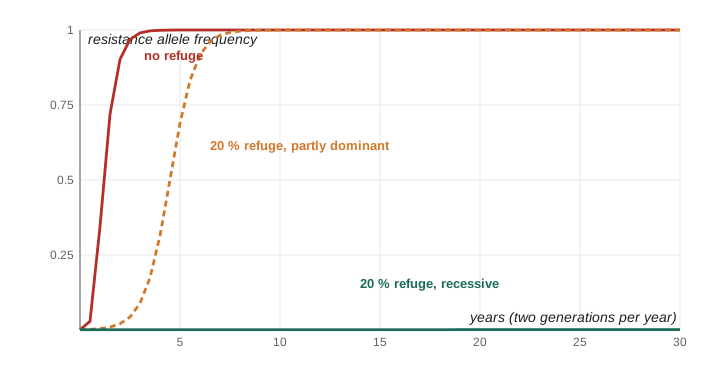
Agriculture also drives unwanted evolution. More than 500 species of arthropods have evolved resistance to at least one pesticide, and herbicide-resistant weeds, such as glyphosate-resistant Palmer amaranth in the United States and glyphosate-resistant kochia in the Canadian Prairies, cost farmers heavily. Crops engineered to produce Bacillus thuringiensis (Bt) toxins are protected from some insect pests, but pests can evolve resistance. The high-dose refuge strategy uses evolutionary principles: Bt crops produce enough toxin to kill heterozygous resistant insects, making resistance functionally recessive, while nearby refuges of non-Bt plants produce many susceptible insects. Rare resistant homozygotes from Bt fields are likely to mate with susceptible insects from the refuge, and their heterozygous offspring are killed.
import numpy as np
# Deterministic model of Bt resistance evolution with a refuge (illustrative parameters)
def years_to_resistance(refuge, h, q0=0.001, s=0.99, gens_per_year=2, max_years=60):
    q = q0
    for g in range(max_years * gens_per_year):
        p = 1 - q
        # h = dominance of resistance. Fitness in Bt fields: rr = 1; rs = 1 - (1 - h)*s; ss = 1 - s. Refuge: all = 1.
        w_rr = 1.0; w_rs = refuge + (1 - refuge)*(1 - (1 - h)*s); w_ss = refuge + (1 - refuge)*(1 - s)
        wbar = q*q*w_rr + 2*p*q*w_rs + p*p*w_ss
        q = (q*q*w_rr + p*q*w_rs) / wbar
        if q > 0.5:
            return (g + 1) / gens_per_year
    return float("inf")
for h in (0.0, 0.3):
    for refuge in (0.05, 0.20, 0.50):
        y = years_to_resistance(refuge, h)
        label = f"{y:5.1f}" if np.isfinite(y) else ">60"
print(f"dominance h = {h:.1f}, refuge {refuge:4.0%}: years until resistance allele exceeds 50 % = {label}")dominance h = 0.0, refuge 5%: years until resistance allele exceeds 50 % = 35.0 dominance h = 0.0, refuge 20%: years until resistance allele exceeds 50 % = >60 dominance h = 0.0, refuge 50%: years until resistance allele exceeds 50 % = >60 dominance h = 0.3, refuge 5%: years until resistance allele exceeds 50 % = 2.5 dominance h = 0.3, refuge 20%: years until resistance allele exceeds 50 % = 4.5 dominance h = 0.3, refuge 50%: years until resistance allele exceeds 50 % = 13.0
When resistance is fully recessive (h = 0), even a small refuge delays resistance for many years, because heterozygotes die in Bt fields and survive only in refuges. When resistance is partly dominant, heterozygotes survive in Bt fields and resistance evolves much faster, so larger refuges are needed. This is why regulators in Canada and the United States require refuges, commonly 20 % of corn area for hybrids with a single Bt trait and smaller refuges for pyramided hybrids producing two or more toxins, which make resistance to all toxins at once far less likely. Field cases where resistance evolved quickly, such as western corn rootworm resistance to some Bt toxins, often involved resistance that was not fully recessive or low compliance with refuge requirements.
Evolution in conservation
Conservation biology increasingly considers the evolutionary potential of populations. Small populations lose genetic variation through drift (Lesson 3) and suffer inbreeding depression (BIOL-201), which can reduce survival and reproduction and lead to an extinction vortex. Genetic rescue, introducing individuals from other populations to restore diversity, has been used successfully. The Florida panther had declined to perhaps 20 to 30 individuals with kinked tails, heart defects and poor sperm quality; after eight female pumas from Texas were released in 1995, the population increased several-fold and the frequency of these defects declined. In contrast, the wolves of Isle Royale in Lake Superior declined to two closely related individuals by 2016, after a single immigrant arrived in 1997 and his genes swept through the population, and new wolves, including some from Ontario and Michigan, were introduced from 2018.
Evolutionary rescue occurs when a population facing environmental change adapts fast enough to avoid extinction; it is more likely in large populations with high genetic variation and when change is gradual. Assisted gene flow, moving individuals with adaptive alleles into populations that need them, has been proposed for trees facing climate change and for corals facing warming seas. British Columbia’s climate-based seed transfer system, for example, allows seed for reforestation to be moved to locations whose projected climate matches the seed’s origin.
Human harvesting is itself a selective force. In many commercial fisheries, intense fishing of large individuals has favoured earlier maturation at smaller size, a phenomenon called fisheries-induced evolution, documented for Atlantic cod off Newfoundland and Labrador before the 1992 moratorium. Trophy hunting of bighorn sheep at Ram Mountain, Alberta, selected for smaller horns over several decades, as reported by David Coltman and colleagues in 2003. Managing for evolution means considering not just how many individuals are taken but which ones.
Finally, evolutionary biology provides tools for conservation planning. Phylogenetic diversity measures the total branch length of the tree of life represented by a set of species, and programs such as the Zoological Society of London’s EDGE of Existence identify species that are both evolutionarily distinct and globally endangered. Genetic data are used to identify evolutionarily significant units and designatable units, populations that merit separate management. In Canada, the Committee on the Status of Endangered Wildlife in Canada (COSEWIC) assesses designatable units, for example distinct populations of caribou.
Teaching evolution: law and curriculum
In Canada, education is a provincial and territorial responsibility under the Constitution Act, 1867, so each province and territory sets its own science curriculum. Evolution is part of secondary biology across the country; in Ontario, for example, Grade 11 University Preparation Biology (SBI3U) includes a strand on evolution covering natural selection, the evidence for evolution and speciation. Canada has no history of court cases over teaching evolution comparable to that of the United States, although individual curriculum decisions have occasionally attracted public debate. Religious schools, including publicly funded Catholic schools in Ontario, Alberta and Saskatchewan, teach the provincial science curriculum. For comparison, in the United States the place of evolution in public schools has been shaped by a series of trials and court decisions. In the Scopes trial of July 1925, the teacher John Scopes was convicted in Dayton, Tennessee, of violating the Butler Act, a state law forbidding the teaching of human evolution; his conviction was overturned on a technicality in 1927, and the law was repealed in 1967. In Epperson v. Arkansas (1968), the US Supreme Court struck down an Arkansas ban on teaching evolution as a violation of the Establishment Clause of the First Amendment. In Edwards v. Aguillard (1987), it struck down a Louisiana law requiring that “creation science” be taught alongside evolution. In Kitzmiller v. Dover Area School District, decided on 20 December 2005, Judge John E. Jones III of the federal district court in Pennsylvania ruled that requiring a statement about intelligent design in biology classes was unconstitutional, finding that intelligent design is not science and could not be separated from its religious antecedents. (Legal summaries checked October 2026.)
Scientific organizations around the world, including national academies of science, regard evolution as the unifying theory of biology. Many religious traditions and many scientists who are religious see no conflict between their faith and evolutionary biology, while others continue to perceive one; a respectful classroom acknowledges this while teaching the science on its evidence.
Worked problem
Applying evolution to a farm decision
A grain farmer has sprayed the same herbicide on a field every year for six years, and some kochia plants now survive spraying. What evolutionary advice would reduce the spread of resistance?
Show solution
- Recognize that repeated use of one mode of action exerts strong, consistent selection for resistant plants.
- Rotate or combine herbicides with different modes of action, so that plants resistant to one are killed by another, analogous to combination therapy.
- Prevent seed production by survivors, for example by targeted removal, because each survivor contributes resistant seed to the soil seed bank.
- Use non-chemical controls such as crop rotation, competitive crops and tillage where appropriate, which reduce reliance on any single selective agent.
Answer: Reduce selection by diversifying control methods and stopping resistant plants from reproducing; the same logic applies to drugs and pesticides.
Common mistakes
MistakeBacteria become resistant because they get used to antibiotics.
InsteadResistant variants already present or arising by mutation or gene transfer are selected; individual bacteria do not adapt by practice.
MistakeOnce antibiotic use stops, resistance quickly disappears.
InsteadFitness costs can be small or compensated, and resistance genes are co-selected, so declines are slow.
MistakePathogens always evolve to become harmless.
InsteadVirulence evolves according to trade-offs with transmission and can increase or decrease.
MistakeRefuges for Bt crops waste land without benefit.
InsteadRefuges supply susceptible insects that mate with rare resistant ones, delaying resistance.
MistakeGenetic rescue always succeeds.
InsteadIt can succeed, as with Florida panthers, but immigrants can also sweep through a population, as on Isle Royale, and need planning.
MistakeCourts in Canada and the United States have taken the same approach to teaching evolution.
InsteadUS court cases shaped teaching under the Establishment Clause; in Canada, provincial curricula include evolution without comparable litigation.
Summary and key terms
- Evolutionary medicine explains vulnerability to disease through mismatch, coevolution, trade-offs, constraints and selection for reproduction.
- Cancer and pathogens evolve under treatment; adaptive therapy and virulence trade-off models apply evolutionary thinking.
- Antibiotic stewardship reduces selection for resistance by limiting and targeting use; resistance rises quickly but falls slowly.
- The capstone analysis estimated selection from the slope of logit resistance and inferred a fitness cost of resistance (invented data).
- The high-dose refuge strategy delays Bt resistance by making resistance functionally recessive and supplying susceptible mates.
- Conservation uses genetic rescue, evolutionary rescue and assisted gene flow, and recognizes harvest-induced evolution.
- Evolution is the unifying theory of biology; its teaching was shaped by court cases in the United States and by provincial curricula in Canada.
- evolutionary medicine
- The application of evolutionary theory to understanding health and disease.
- mismatch
- A disparity between traits shaped by past environments and current conditions.
- antibiotic stewardship
- Coordinated efforts to optimize antibiotic use and slow resistance.
- mutant selection window
- Drug concentrations at which resistant mutants are favoured over susceptible cells.
- compensatory mutation
- A mutation that reduces the fitness cost of another, such as resistance.
- adaptive therapy
- Cancer treatment that maintains sensitive cells to suppress resistant ones.
- high-dose refuge strategy
- Combining toxic crops with refuges of non-toxic plants to delay resistance.
- genetic rescue
- Introducing individuals to restore genetic diversity and fitness in a small population.
- evolutionary rescue
- Adaptation that allows a population to avoid extinction under environmental change.
- fisheries-induced evolution
- Genetic change in exploited fish populations caused by selective harvesting.
Practice problems
Work each problem on paper first, then reveal the answer to check.
Give two evolutionary explanations for vulnerability to disease.
Show answer
Mismatch with modern environments and trade-offs (also coevolution, constraints, selection for reproduction).
Why might adaptive therapy outperform maximum-dose chemotherapy?
Show answer
Sensitive cells are kept to compete with and suppress resistant cells.
What happened to the virulence of myxoma virus in Australia?
Show answer
It evolved from extreme lethality to intermediate virulence while rabbits evolved resistance.
Why is combination therapy used for tuberculosis?
Show answer
Simultaneous resistance to two or more drugs is much rarer than resistance to one.
The logit of resistance rose from −2.0 to 0.0 over 8 years. What is s?
Show answer
s = 2.0/8 = 0.25 per year.
Why does resistance often decline slowly after use falls?
Show answer
Small or compensated costs, co-selection on plasmids and import of resistant strains.
Why should Bt toxin doses be high?
Show answer
To kill heterozygotes, making resistance functionally recessive.
What made genetic rescue of the Florida panther successful?
Show answer
Introduced Texas pumas restored diversity, reducing inbreeding defects and increasing population growth.
What is fisheries-induced evolution? Give an example.
Show answer
Genetic change caused by selective harvest, such as earlier maturation in Atlantic cod.
How is the content of science curricula decided in Canada?
Show answer
By each province and territory, since education is a provincial and territorial responsibility.
Lesson quiz · 5 questions
Score 60% or more to complete this lesson.
Create a free account to save your progress, take quizzes and earn a certificate.