
BIOL-321 · Lesson 10 of 12 · 26 min
Macroevolution, evo-devo and the history of life
Microevolution, changes in allele frequencies within populations, is directly observable. Macroevolution concerns patterns above the species level and over long timescales: the origin of major groups and novel structures, adaptive radiations, mass extinctions and changes in diversity across the history of life. Most evolutionary biologists regard macroevolution as the accumulation of microevolutionary processes, together with processes that only become visible at large scales, such as differences among lineages in speciation and extinction rates. This lesson surveys the history of life, the dynamics of diversity, the debate over tempo and the developmental genetics that underlies the evolution of form.
A brief history of life
Earth formed about 4.54 billion years ago. The oldest widely accepted evidence of life comes from carbon isotopes and microfossils more than 3.5 billion years old, including stromatolites built by microbial mats in Western Australia, dated to about 3.48 billion years. For the first two billion years or so, life was entirely microbial. Photosynthesis by cyanobacteria gradually added oxygen to the atmosphere, culminating in the Great Oxidation Event about 2.4 billion years ago. Eukaryotic cells, which arose through the endosymbiosis of an alphaproteobacterium that became the mitochondrion, appear in the fossil record by about 1.6 billion years ago or earlier.
| Approximate time (Ma) | Event |
|---|---|
| 4,540 | Formation of Earth |
| above 3,500 | Earliest widely accepted evidence of life |
| about 2,400 | Great Oxidation Event |
| about 1,600 or earlier | Eukaryotes in the fossil record |
| about 575 to 539 | Ediacaran biota of soft-bodied organisms |
| 539 to about 510 | Cambrian explosion of animal body plans |
| about 470 to 420 | Plants and arthropods colonize land |
| about 375 | Tiktaalik and the fish–tetrapod transition |
| 252 | End-Permian extinction, the largest known |
| 66 | End-Cretaceous extinction; non-avian dinosaurs disappear |
| about 7 to 6 | Earliest possible hominins (Lesson 11) |
The Cambrian explosion, beginning about 539 million years ago, saw most animal phyla with mineralized skeletons appear in the fossil record within roughly 20 to 25 million years, preserved in deposits such as the Burgess Shale of British Columbia and Chengjiang in China. The explosion was rapid in geological terms but not instantaneous; molecular clocks suggest that animal lineages began to diverge earlier, in the Ediacaran or before. Proposed triggers include rising oxygen, ecological interactions such as predation, and the evolution of developmental gene networks capable of producing complex bodies.
Diversity through time and mass extinctions
Compiling the first and last appearances of thousands of marine genera, J. John Sepkoski and David Raup showed in the late 1970s and early 1980s that marine animal diversity has risen in fits and starts, interrupted by five mass extinctions in which a large fraction of species disappeared in a geologically short time.
| Extinction | Age (Ma) | Estimated loss of marine species | Leading proposed cause |
|---|---|---|---|
| End-Ordovician | about 445 | about 85 % | Glaciation and sea-level fall |
| Late Devonian | about 372 | about 75 % | Ocean anoxia, possibly linked to land plants and climate |
| End-Permian | 252 | about 90 % or more | Siberian Traps volcanism; warming, acidification and anoxia |
| End-Triassic | 201 | about 75 to 80 % | Central Atlantic Magmatic Province volcanism |
| End-Cretaceous | 66 | about 75 % | Chicxulub asteroid impact, with Deccan Traps volcanism |
Mass extinctions differ from background extinction not only in magnitude but in selectivity. During normal times, traits such as a large geographic range of species help a genus persist; during mass extinctions, David Jablonski found, many such traits matter little, but broad geographic range at the level of the whole clade remains protective. Survival can be a matter of luck, which Stephen Jay Gould and David Raup called the difference between good genes and good luck. Recovery takes millions of years: after the end-Permian event, reef ecosystems took roughly 8 to 10 million years to return. Mass extinctions reset the playing field, opening opportunities for survivors; the radiation of mammals after the end-Cretaceous extinction is the best-known example. Many biologists argue that human activity is now driving extinction rates far above background levels, raising the possibility of a sixth mass extinction (Lesson 12).
import numpy as np
rng = np.random.default_rng(321)
# Birth–death simulation of genus diversity with a mass extinction (all rates illustrative, per Myr)
lam, mu = 0.20, 0.18           # origination and background extinction rates per genus
T = 200; N = [200]
for t in range(1, T):
    n = N[-1]
    births = rng.binomial(n, lam)
    deaths = rng.binomial(n, mu)
    n = n + births - deaths
    if t == 80:                # mass extinction removes 80 % of genera
        n = rng.binomial(n, 0.20)
    if 80 < t <= 95:           # post-extinction rebound: higher origination
        n += rng.binomial(n, 0.08)
    N.append(max(n, 1))
N = np.array(N)
print(f"diversity just before the event (t = 79): {N[79]}")
print(f"diversity just after the event  (t = 80): {N[80]}")
recovered = np.argmax((np.arange(T) > 80) & (N >= N[79]))
print(f"first time step at or above pre-extinction diversity: t = {recovered} ({recovered - 80} Myr later)")
print(f"diversity at t = {T-1}: {N[-1]}")diversity just before the event (t = 79): 676 diversity just after the event (t = 80): 148 first time step at or above pre-extinction diversity: t = 97 (17 Myr later) diversity at t = 199: 5503
In this toy model, the extinction removes 80 % of genera in a single step, and even with a burst of origination afterward, recovery to the previous diversity takes many millions of years. Real recoveries are complicated by the loss of whole ecological guilds, such as reef builders, and by the time it takes for new ones to evolve.
Adaptive radiation
An adaptive radiation is the rapid diversification of a lineage into many species occupying different ecological niches. Classic examples include Darwin’s finches in the Galápagos, Anolis lizards in the Caribbean, cichlid fish in the East African Great Lakes, Hawaiian honeycreepers and silverswords and, at a larger scale, placental mammals after the end-Cretaceous extinction. Radiations are often triggered by ecological opportunity, such as colonizing an island with few competitors, surviving a mass extinction or evolving a key innovation, a trait that opens new ways of life, such as the pharyngeal jaws of cichlids or nectar spurs in columbines.
Caribbean Anolis lizards illustrate a striking pattern. On each of the four large islands, Cuba, Hispaniola, Jamaica and Puerto Rico, anoles have independently evolved a similar set of ecomorphs: trunk-ground species with long legs, twig species with short legs, crown giants and others. Phylogenies show that similar ecomorphs on different islands are not each other’s closest relatives; each island’s set evolved separately, a remarkable example of convergent evolution showing that natural selection can produce repeatable outcomes. Jonathan Losos and colleagues documented this in detail.
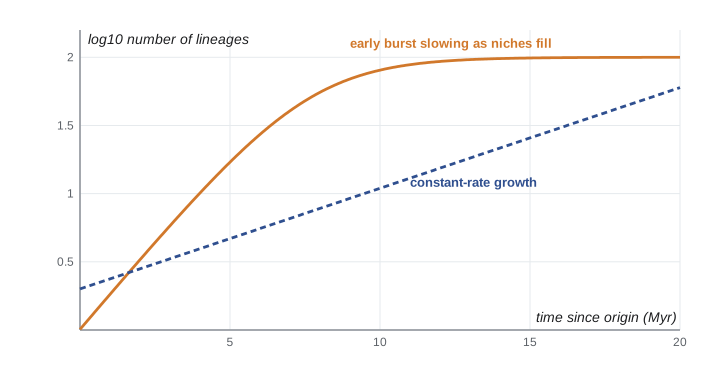
Many radiations show an early burst, in which diversification is fastest early and slows as niches fill. On a lineage-through-time plot, which shows the log number of lineages against time, a constant-rate process gives a roughly straight line (with a characteristic upturn near the present caused by recent lineages that have not yet had time to go extinct), while a slowdown gives a curve that flattens. Many clades show such slowdowns, though detecting them requires care, because incomplete sampling of species can produce similar patterns.
Tempo: gradualism and punctuated equilibrium
Darwin viewed evolution as generally gradual. In 1972, Niles Eldredge and Stephen Jay Gould proposed punctuated equilibrium: many species in the fossil record appear abruptly, remain largely unchanged (in stasis) for millions of years and then disappear, with most morphological change concentrated in speciation events, which are geologically brief, perhaps tens of thousands of years, and may occur in small, peripheral populations unlikely to be fossilized. They argued that stasis, not gradual change, is the dominant pattern.
The debate has been productive. Both patterns occur: some lineages, such as certain planktonic foraminifera, show gradual change, while others, such as bryozoans studied by Alan Cheetham, show stasis punctuated by rapid change. Fast change over thousands of years can look abrupt in the rock record, yet would be entirely gradual from the perspective of the organisms. Punctuated equilibrium is therefore not a challenge to natural selection or to Darwinian mechanisms, but a claim about the relative frequency of patterns and about stasis, which may be explained by stabilizing selection, habitat tracking as climate changes and the averaging of fluctuating selection over time. Evolution observed on short timescales can be rapid; Philip Gingerich noted in 1983 that rates measured over short intervals are typically much higher than those measured over long intervals, because over long periods change often reverses.
Evo-devo: the genetics of form
Evolutionary developmental biology, or evo-devo, studies how changes in development produce changes in form. A central discovery of the 1980s and 1990s was that animals as different as flies and mice use deeply conserved toolkit genes to build their bodies. Hox genes, which encode transcription factors, specify the identity of regions along the head-to-tail axis. In both flies and vertebrates they are arranged in clusters on chromosomes in the same order as the body regions they pattern, a property called collinearity. A mutation in the fly gene Antennapedia can cause legs to grow where antennae should be. Similarly, Pax6 in mice and its fly counterpart eyeless are master regulators of eye development; the mouse gene can trigger extra eyes on fly legs when expressed there, although the eyes formed are fly eyes.
This deep homology means that evolution of form often proceeds not by inventing new genes, but by changing when, where and how much existing genes are expressed. Changes in cis-regulatory elements, the enhancers that control expression of a nearby gene, are especially important, because an enhancer often controls expression in just one tissue, so it can change without disrupting the gene’s other functions. Sean Carroll and others have argued that cis-regulatory change is a major source of morphological evolution.
Worked problem
Losing pelvic spines in sticklebacks
Marine three-spined sticklebacks have pelvic spines that deter predatory fish. Many freshwater populations, which colonized lakes after the last glaciation, have lost them. Crosses mapped the loss to the gene Pitx1, yet the Pitx1 protein is unchanged in freshwater fish. How can a gene with an unchanged protein cause the loss?
Show solution
- Pitx1 is needed in several tissues, including the pituitary and jaws, so a protein-coding mutation would likely be harmful.
- Freshwater populations have deletions in a pelvic enhancer of Pitx1 that remove expression only in the developing pelvic region.
- The same enhancer has been deleted independently in many lakes, a sign of repeated selection, probably because spines are costly where predatory fish are absent and grasping insect predators can seize spines.
Answer: Loss of a tissue-specific enhancer removes Pitx1 expression in the pelvis while leaving its other roles intact (Chan and colleagues, 2010).
Gene duplication provides raw material for new functions. After duplication, one copy can maintain the original function while the other accumulates mutations. Common fates include loss of the extra copy, subfunctionalization, in which the two copies divide the original functions between them, and neofunctionalization, in which one copy gains a new function. Two rounds of whole-genome duplication early in vertebrate history, proposed by Susumu Ohno in 1970 and now well supported, help explain why vertebrates have four Hox clusters while most invertebrates have one, and teleost fish experienced an additional duplication. The globin family is a classic example: duplications produced alpha- and beta-globins and the fetal globins that bind oxygen more tightly than adult forms, allowing the fetus to take oxygen from maternal blood.
Novel structures often arise by co-opting existing genes and networks for new roles. The eyespots of butterfly wings use genes such as Distal-less, ancestrally involved in limb development. Feathers evolved in dinosaurs long before flight, initially perhaps for insulation and display, and were later co-opted for flight, an example of exaptation, a trait that evolved for one function and was later used for another. Intermediate fossils, such as feathered non-avian dinosaurs from China and Tiktaalik, discovered in 2004 on Ellesmere Island in Nunavut, document these transitions.
Common mistakes
MistakeMacroevolution requires completely different mechanisms from microevolution.
InsteadMacroevolution reflects microevolutionary processes plus differences among lineages in speciation and extinction over long periods.
MistakeThe Cambrian explosion was instantaneous.
InsteadIt took tens of millions of years, and animal lineages probably began to diverge earlier.
MistakeMass extinctions select only against poorly adapted species.
InsteadSurvival during mass extinctions often depends on traits such as broad clade range, or on luck, rather than adaptation to normal conditions.
MistakePunctuated equilibrium means evolution happens in single jumps.
InsteadIt means change is concentrated in speciation events that are rapid geologically but still take thousands of generations.
MistakeNew body forms require new genes.
InsteadMany changes in form arise from changes in the regulation of conserved toolkit genes.
MistakeFeathers evolved for flight.
InsteadFeathers arose in dinosaurs before flight and were later co-opted, an example of exaptation.
Summary and key terms
- Life has existed for more than 3.5 billion years; eukaryotes, animals, land colonization and vertebrate transitions came much later.
- Five mass extinctions interrupted the growth of diversity; survival depends on different factors than during normal times, and recovery takes millions of years.
- Adaptive radiations follow ecological opportunity or key innovations; Anolis ecomorphs show repeatable convergence.
- Punctuated equilibrium emphasizes stasis and change concentrated at speciation; both gradual and punctuated patterns occur.
- Conserved toolkit genes such as Hox and Pax6 build animal bodies; collinearity links gene order to body regions.
- Changes in cis-regulatory elements, such as the Pitx1 pelvic enhancer in sticklebacks, are a major source of evolutionary change in form.
- Gene and genome duplication, co-option and exaptation provide raw material for novelty.
- macroevolution
- Evolutionary change at or above the species level over long timescales.
- mass extinction
- The loss of a large fraction of species in a geologically short interval.
- adaptive radiation
- Rapid diversification of a lineage into many ecologically different species.
- key innovation
- A trait that opens new ecological opportunities and may promote diversification.
- punctuated equilibrium
- A pattern of long stasis interrupted by geologically rapid change at speciation.
- Hox genes
- Conserved genes encoding transcription factors that specify identity along the body axis.
- deep homology
- The sharing of genetic mechanisms underlying structures that are not themselves homologous.
- cis-regulatory element
- A DNA sequence, such as an enhancer, controlling expression of a nearby gene.
- neofunctionalization
- The acquisition of a new function by one copy of a duplicated gene.
- exaptation
- A trait that evolved for one function and was later co-opted for another.
Practice problems
Work each problem on paper first, then reveal the answer to check.
When did the Great Oxidation Event occur, and what caused it?
Show answer
About 2.4 billion years ago, caused by oxygen produced by cyanobacterial photosynthesis.
Name the largest mass extinction and its leading proposed cause.
Show answer
The end-Permian, about 252 Ma, linked to Siberian Traps volcanism.
What is a key innovation? Give an example.
Show answer
A trait that opens new ecological opportunities, such as the pharyngeal jaws of cichlids.
What do the Anolis ecomorphs show?
Show answer
Similar ecological forms evolved independently on different islands, showing repeatable convergent evolution.
What is the main claim of punctuated equilibrium?
Show answer
Species show long stasis, with most change concentrated in geologically brief speciation events.
Why are short-term rates of evolution often higher than long-term rates?
Show answer
Over long periods, change often reverses, so net change per unit time is smaller.
What is collinearity in Hox clusters?
Show answer
The order of genes on the chromosome matches the order of the body regions they pattern.
Why are cis-regulatory mutations often less harmful than coding mutations?
Show answer
They can change expression in one tissue without affecting the gene’s other roles.
What are the possible fates of a duplicated gene?
Show answer
Loss, subfunctionalization or neofunctionalization.
Where was Tiktaalik found, and why is it important?
Show answer
On Ellesmere Island, Nunavut; it is a transitional form between fish and tetrapods.
Lesson quiz · 5 questions
Score 60% or more to complete this lesson.
Create a free account to save your progress, take quizzes and earn a certificate.