
BIOL-108 · Lesson 9 of 12 · 23 min
Plant diversity and evolution
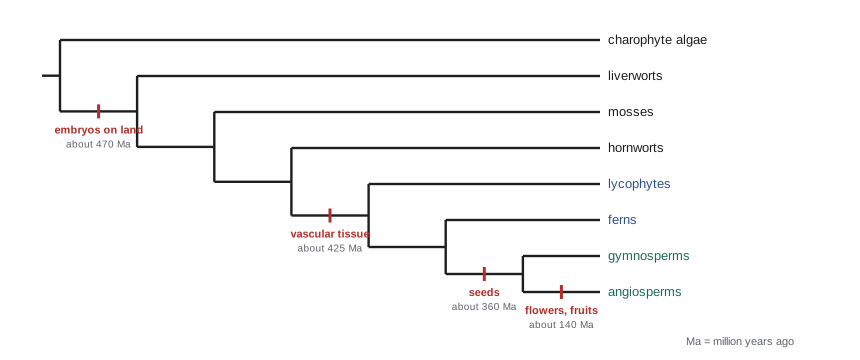
Plants turned the barren continents green. Their move onto land, beginning around 470 million years ago, transformed the atmosphere, soils and climate and made land habitable for animals. This lesson follows the evolution of land plants through four great innovations: the move from water to land, vascular tissue, seeds and flowers. It surveys the main living groups and explains why plants matter for ecosystems and people. BIOL-340 (Plant Biology) examines plant structure and physiology in depth; BIOL-107 covered photosynthesis.
From water to land
Land plants, or embryophytes, evolved from freshwater green algae called charophytes, their closest living relatives. Molecular trees and shared features, such as similar cell division and cellulose-making enzymes, place land plants within this group of algae. Life in water is easy in some ways: the water supports the body, prevents drying out and carries sperm to eggs. On land, plants faced four problems: drying out, getting water to all their cells, supporting themselves against gravity, and reproducing without water to carry gametes.
The first land plants solved these problems only partly. They had a waxy cuticle on their surfaces to reduce water loss; pores called stomata (in most lineages) to let carbon dioxide in; and, crucially, they protected their embryos inside the parent plant. The oldest evidence of land plants is fossil spores from about 470 million years ago, with whole plant fossils appearing by about 430 million years ago.
Alternation of generations
All land plants have a life cycle called alternation of generations, in which two multicellular forms alternate: a haploid gametophyte (one set of chromosomes) that makes gametes by mitosis, and a diploid sporophyte (two sets) that makes spores by meiosis. A spore grows into a new gametophyte, the gametophyte produces eggs and sperm, fertilization makes a zygote, and the zygote grows into a sporophyte. Over plant evolution, the balance between the two generations shifted dramatically.
| Group | Dominant, longer-lived generation | Sperm transport | Example |
|---|---|---|---|
| Mosses and other bryophytes | Gametophyte (the green leafy plant) | Swimming sperm need a film of water | Sphagnum peat moss |
| Ferns and lycophytes | Sporophyte (the frond); gametophyte small and free-living | Swimming sperm need water | Ostrich fern, whose young fronds are eaten as fiddleheads |
| Gymnosperms | Sporophyte (the tree); gametophyte microscopic, inside cones | Pollen carried by wind | Pines, spruces, firs |
| Angiosperms | Sporophyte; gametophyte reduced to a few cells inside the flower | Pollen carried by wind or animals | Maple, wheat, orchids |
Bryophytes: the non-vascular plants
Liverworts, mosses and hornworts, collectively called bryophytes, lack true vascular tissue, so water moves through them mostly by diffusion and capillary action. As a result they are small, usually only a few centimetres tall, and grow best in damp places, though many can dry out completely and revive when wet. Their swimming sperm need water to reach eggs. About 20,000 species are known.
Bryophytes are ecologically important beyond their size. They are pioneers on bare rock and soil, and they hold water and nutrients in forests. Peat mosses (Sphagnum) dominate peatlands, waterlogged ecosystems where dead plant material builds up faster than it decays. Peatlands cover only about 3 per cent of Earth's land but store roughly a third of all soil carbon, making them major carbon reservoirs.
Canada holds roughly a quarter of the world’s peatlands, covering about 12 per cent of the country, especially in the Hudson Bay Lowlands of northern Ontario and Manitoba and across the boreal forest. Their protection matters for climate, because draining or disturbing them releases stored carbon; it is one reason the Ring of Fire mining region in the Hudson Bay Lowlands draws attention from scientists and First Nations.
Vascular plants without seeds
About 425 million years ago, plants evolved vascular tissue: xylem, which conducts water and minerals upward and is stiffened by lignin, and phloem, which carries sugars. Vascular tissue allowed plants to grow tall, compete for light and develop true roots and leaves. The seedless vascular plants include lycophytes (club mosses, spike mosses and quillworts) and ferns, including horsetails.
In the Carboniferous period, 359 to 299 million years ago, tree-sized lycophytes up to 40 metres tall and giant horsetails formed vast swamp forests. Their buried remains, compressed and heated over millions of years, became most of the world's coal, which is why the period is named for carbon. The spread of forests drew down atmospheric carbon dioxide and may have contributed to a long ice age. Today ferns are diverse, with about 10,500 species, but lycophytes are small plants.
Seeds and gymnosperms
A seed is an embryo packaged with a food supply inside a protective coat. Seeds were a huge advance: they can wait, dormant, through cold or drought for years, and they can be dispersed far from the parent. Seed plants also evolved pollen, which carries the male gametophyte through the air, freeing fertilization from water entirely. Seed plants first appeared about 360 million years ago.
Gymnosperms (meaning naked seeds) bear their seeds exposed on the scales of cones rather than enclosed in fruit. The living groups are conifers, such as pines, spruces, firs, larches, cedars and redwoods; cycads; the single species Ginkgo biloba; and gnetophytes. Conifers are adapted to cold and dry conditions: needle-shaped leaves with thick cuticles reduce water loss and shed snow, and many contain resins that deter insects.
Conifers dominate the boreal forest, which stretches across Canada from Yukon to Newfoundland and Labrador and is the country’s largest ecosystem. Black spruce, white spruce, jack pine, balsam fir and tamarack (a larch, which drops its needles each autumn) are the characteristic trees. Some of Canada’s oldest trees are eastern white cedars clinging to the cliffs of the Niagara Escarpment in Ontario, where individuals more than 1,000 years old have been documented.
Angiosperms: flowering plants
Angiosperms are the most diverse plant group by far, with about 300,000 species. They appear in the fossil record about 140 million years ago and spread rapidly in the Cretaceous, a rise Darwin called an abominable mystery because it seemed so sudden. Their success rests on two structures. The flower is a reproductive shoot that often attracts animal pollinators with colour, scent and nectar; the ovary at its base encloses the ovules, which become seeds. The fruit develops from the ovary and helps disperse the seeds, by wind, water or animals that eat fruit and pass the seeds.
Angiosperms also have double fertilization: one sperm fertilizes the egg to form the embryo, while a second fuses with two other cells to form the endosperm, a food tissue for the seed. The endosperm of wheat, rice and maize feeds most of humanity. Angiosperms have traditionally been divided into monocots, with one seed leaf (grasses, lilies, orchids, palms), and dicots, with two. Molecular trees show that most former dicots form a clade, the eudicots (maples, roses, beans, sunflowers), while a few early lineages, such as water lilies and magnolias, branch off earlier.
Much of angiosperm diversity comes from coevolution with animals: reciprocal evolutionary change between interacting species. Flowers pollinated by bees tend to be blue or yellow with landing platforms and ultraviolet nectar guides; hummingbird flowers are often red and tubular; moth flowers are pale and night-scented. Fruit-eating birds and mammals disperse seeds and are rewarded with food. About three-quarters of leading food crop types benefit at least partly from animal pollination.
# Approximate numbers of described living species in each plant group
groups = {"liverworts": 7500, "mosses": 12000, "hornworts": 220, "lycophytes": 1300,
          "ferns": 10500, "gymnosperms": 1100, "angiosperms": 300000}
total = sum(groups.values())
for name, n in groups.items():
    print(f"{name:<12} {n:>7,}  {100 * n / total:5.1f}%")
print(f"{'total':<12} {total:>7,}")liverworts 7,500 2.3% mosses 12,000 3.6% hornworts 220 0.1% lycophytes 1,300 0.4% ferns 10,500 3.2% gymnosperms 1,100 0.3% angiosperms 300,000 90.2% total 332,620
Plant life cycles and climate
Plant growth and development depend closely on temperature. Agronomists and ecologists track accumulated warmth with growing degree days: for each day, the mean temperature above a base temperature (often 5 °C for many temperate plants, 10 °C for maize) is added up. Crops and wild plants reach stages such as leaf-out, flowering and maturity after a characteristic number of degree days. Warming climates are moving these dates earlier, which can cause mismatches with pollinators or late frosts.
import numpy as np
# Growing degree days (base 5 C) from a simulated spring of daily mean temperatures
rng = np.random.default_rng(9)
days = np.arange(1, 121)                                   # April 1 to July 29
temps = 2 + 18 * (days / 120) + rng.normal(0, 3, days.size)  # warming trend plus day-to-day noise
gdd = np.cumsum(np.clip(temps - 5, 0, None))
print(f"total by day {days[-1]}: {gdd[-1]:.0f} degree days")
for target, stage in [(100, "leaf-out"), (300, "flowering"), (600, "fruit set"), (1200, "seed ripening")]:
    if gdd[-1] < target:
        print(f"{stage:<13} needs {target:4d} degree days -> not reached in this period")
        continue
    day = int(np.argmax(gdd >= target)) + 1
print(f"{stage:<13} needs {target:4d} degree days -> reached on day {day} of the season")total by day 120: 797 degree days leaf-out needs 100 degree days -> reached on day 53 of the season flowering needs 300 degree days -> reached on day 83 of the season fruit set needs 600 degree days -> reached on day 107 of the season seed ripening needs 1200 degree days -> not reached in this period
In this simulated season, the plant leafs out in late May, flowers in late June and sets fruit in mid-July, but its seeds would not ripen until after the period shown. A warmer spring that adds 2 °C to every day would add about 240 degree days over the same 120 days and bring every stage forward by a week or more. Records kept by naturalists and citizen scientists, some going back more than a century, show this shift happening.
Plants and people
Humans depend on plants for almost everything: food, from about a dozen major crops; wood and paper; fibres such as cotton and flax; medicines, from aspirin (originally from willow bark) to the cancer drug paclitaxel (originally from the Pacific yew) and morphine; and oxygen and climate regulation. Indigenous peoples across North America developed deep knowledge of plants for food, medicine and materials, such as the use of birch bark for canoes and containers and of the cedar tree throughout Pacific Northwest coast cultures.
Plant diversity is under threat. A 2020 assessment estimated that about two in five plant species may be threatened with extinction, mainly from habitat loss, with climate change and invasive species adding pressure. Seed banks such as the Svalbard Global Seed Vault in Norway store copies of crop seeds from around the world, and national gene banks conserve local varieties and wild relatives of crops.
Common mistakes
MistakeMosses are just small versions of trees.
InsteadMosses are non-vascular bryophytes whose dominant generation is the haploid gametophyte; trees are vascular sporophytes.
MistakeFerns reproduce by seeds.
InsteadFerns reproduce by spores; seeds evolved later in gymnosperms and angiosperms.
MistakeFruits are only the sweet things we eat.
InsteadBotanically, a fruit is any mature ovary containing seeds, including tomatoes, peppers, grains and maple keys.
MistakeAll conifers keep their needles all year.
InsteadMost do, but larches such as tamarack drop their needles every autumn.
MistakeFlowering plants have existed as long as land plants.
InsteadLand plants appeared about 470 million years ago; flowering plants only about 140 million years ago.
Summary and key terms
- Land plants evolved from charophyte green algae about 470 million years ago, with cuticles, stomata and protected embryos.
- All land plants alternate a haploid gametophyte and diploid sporophyte; the sporophyte became dominant over time.
- Bryophytes lack vascular tissue and need water for fertilization; Sphagnum peatlands store huge amounts of carbon.
- Vascular tissue allowed lycophytes and ferns to grow tall; Carboniferous swamp forests formed coal.
- Seeds and pollen freed reproduction from water; gymnosperms bear naked seeds in cones.
- Angiosperms, with flowers, fruits and double fertilization, are the most diverse plants, shaped by coevolution with animals.
- Growing degree days link plant development to temperature, and climate change is shifting plant timing.
- alternation of generations
- A life cycle alternating between a haploid gametophyte and a diploid sporophyte.
- gametophyte
- The haploid multicellular stage that produces gametes by mitosis.
- sporophyte
- The diploid multicellular stage that produces spores by meiosis.
- bryophyte
- A non-vascular land plant: a liverwort, moss or hornwort.
- vascular tissue
- Xylem and phloem, which conduct water, minerals and sugars through a plant.
- seed
- An embryo with a food supply inside a protective coat.
- gymnosperm
- A seed plant with seeds exposed on cone scales, such as a conifer.
- angiosperm
- A flowering plant with seeds enclosed in an ovary that becomes a fruit.
- double fertilization
- Fertilization in angiosperms producing both an embryo and an endosperm.
- coevolution
- Reciprocal evolutionary change in interacting species.
Practice problems
Work each problem on paper first, then reveal the answer to check.
What four challenges did plants face moving onto land?
Show answer
Drying out, transporting water, support against gravity and reproduction without water.
Which generation is dominant in mosses, and which in pine trees?
Show answer
Gametophyte in mosses; sporophyte in pines.
Why are bryophytes usually small?
Show answer
They lack vascular tissue, so water moves mainly by diffusion and capillary action.
What is the link between Carboniferous plants and coal?
Show answer
Coal formed from the buried remains of giant lycophyte and horsetail swamp forests.
List two advantages of seeds.
Show answer
They protect and feed the embryo, can stay dormant through bad conditions and can be dispersed.
Distinguish gymnosperms from angiosperms.
Show answer
Gymnosperm seeds are exposed on cone scales; angiosperm seeds are enclosed in an ovary that becomes a fruit.
What does double fertilization produce?
Show answer
An embryo (from egg plus sperm) and endosperm (from a second sperm fused with two other cells).
A flower is red and tubular with lots of nectar and no scent. What pollinator is likely?
Show answer
A hummingbird.
A day has a mean temperature of 14 °C. How many growing degree days (base 5 °C) does it add?
Show answer
9 degree days.
Why do peatlands matter for climate?
Show answer
They store a large share of soil carbon, which is released if they are drained or disturbed.
Lesson quiz · 5 questions
Score 60% or more to complete this lesson.
Create a free account to save your progress, take quizzes and earn a certificate.