
BIOL-108 · Lesson 2 of 12 · 25 min
Natural selection and adaptation
Natural selection is the only known process that produces adaptations: the eye, the wing, the camouflage of a moth on a tree trunk, the antifreeze proteins of Arctic fish. It is a simple idea with far-reaching consequences, and it is also one of the most misunderstood ideas in science. This lesson sets out the logic of natural selection, how biologists measure fitness and selection, the different forms selection takes, and examples that have been watched happening in real populations.
The logic of natural selection
Darwin's argument can be stated as a short chain of observations and inferences. Each observation is easy to check; the conclusion follows almost automatically.
| Step | Statement | Example |
|---|---|---|
| 1. Variation | Individuals in a population differ in their traits | Beak depth varies among medium ground finches on one island |
| 2. Inheritance | Some of that variation is heritable: offspring resemble their parents | Parents with deep beaks tend to have chicks with deep beaks |
| 3. Overproduction | More offspring are produced than can survive and reproduce | Most finch chicks die before breeding, especially in drought years |
| 4. Differential success | Individuals with some heritable traits survive or reproduce better than others in a given environment | In drought, only large, hard seeds remain; deep-beaked birds can crack them |
| Conclusion | Favourable heritable traits become more common in the next generation | Average beak depth increases after a drought |
Two features of this logic are worth stressing. First, selection acts on individuals, but the evolutionary change appears in the population: no finch grew a deeper beak, but the population's average beak depth changed because deep-beaked birds left more offspring. Second, selection does not create the variation it acts on. Variation comes from mutation and the shuffling of genes in sexual reproduction (lesson 3), and arises without regard to what would be useful. Selection then sorts the variation that exists.
Fitness
In evolutionary biology, fitness has a precise meaning: an individual's contribution of offspring to the next generation, relative to others. It is not strength, speed or health in themselves. A strong animal that leaves no offspring has zero fitness; a modest one that raises many young has high fitness. Biologists usually express fitness as relative fitness, symbolized \(w\), with the most successful type set to 1.
Worked problem
Calculating relative fitness
In a population of beetles, green beetles leave on average 4.0 surviving offspring and brown beetles 5.0. What are their relative fitnesses and the selection coefficient against green?
Show solution
- Set the most successful type to fitness 1: w(brown) = 5.0 / 5.0 = 1.
- Divide the other by the same value: w(green) = 4.0 / 5.0 = 0.8.
- The selection coefficient s is the reduction in relative fitness: s = 1 − 0.8 = 0.2.
- Interpretation: green beetles leave 20 per cent fewer offspring than brown ones in this environment.
Answer: w(brown) = 1, w(green) = 0.8, and the selection coefficient against green is 0.2.
How fast does selection work?
A simple model shows how an advantageous allele spreads. Consider a haploid organism such as a bacterium, or think of alleles directly. If an allele A has frequency \(p\) and gives a fitness advantage \(s\) over the alternative, each generation its frequency changes according to:
Even a small advantage spreads remarkably quickly by evolutionary standards. The code below follows an allele that starts rare, at 1 in 1,000, with advantages of 1, 5 and 10 per cent.
# Spread of an advantageous allele: p' = p(1+s)/(1+ps)
def generations_to(p0, s, target):
    p, g = p0, 0
    while p < target:
        p = p * (1 + s) / (1 + p * s)
        g += 1
    return g

for s in (0.01, 0.05, 0.10):
    g50 = generations_to(0.001, s, 0.5)
    g99 = generations_to(0.001, s, 0.99)
print(f"s = {s:.2f}: from 0.1% to 50% in {g50:4d} generations, to 99% in {g99:4d}")s = 0.01: from 0.1% to 50% in 695 generations, to 99% in 1156 s = 0.05: from 0.1% to 50% in 142 generations, to 99% in 236 s = 0.10: from 0.1% to 50% in 73 generations, to 99% in 121
With a 10 per cent advantage the allele goes from rare to nearly universal in about a hundred and twenty generations, a blink of an eye in geological time. Even a 1 per cent advantage completes the job in about 1,150 generations. This is why antibiotic resistance can appear within a few years in bacteria that divide many times a day, and why insect and weed populations become resistant to pesticides within a decade or two.
Forms of selection
For traits that vary continuously, such as body size or beak depth, selection can change a population in three main ways depending on which individuals do best.
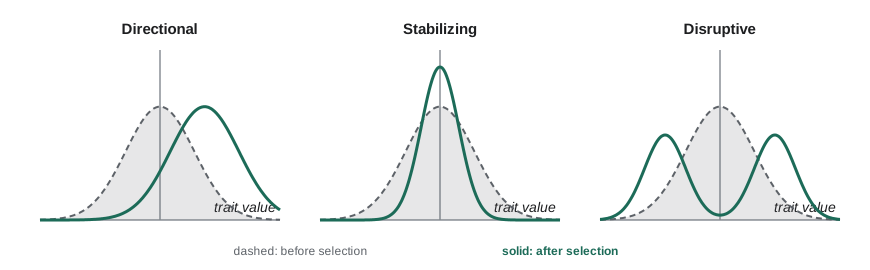
| Form | Which individuals are favoured | Effect on the population | Example |
|---|---|---|---|
| Directional | Those at one extreme | The mean shifts in one direction | Larger beaks in finches during drought; antibiotic resistance |
| Stabilizing | Those near the average | Variation decreases around a stable mean | Human birth weight: very small and very large babies historically had lower survival |
| Disruptive | Those at both extremes | Variation increases; the population may split into two forms | African seedcracker finches with either small or large bills, suited to soft or hard seeds |
Stabilizing selection is probably the most common form in a stable environment, which is why many species look much the same for long periods. Directional selection dominates when the environment changes. Disruptive selection is rarer, but it can be a first step toward the origin of new species (lesson 4).
Real examples of natural selection
Selection has been measured directly in wild and laboratory populations. Three cases are especially well documented.
Peppered moths in industrial England. Before the industrial revolution, most peppered moths in England were pale and speckled, camouflaged against lichen-covered bark. As soot from coal burning darkened trees in the 1800s, a dark (melanic) form became common near industrial cities, reaching over 90 per cent around Manchester. When clean-air laws reduced pollution after the 1950s, the pale form returned. Field experiments showed that birds ate more of the moths that stood out against the bark, and in 2016 researchers identified the mutation responsible: a transposable element inserted into a gene called cortex.
Galápagos finches. Since 1973, Peter and Rosemary Grant, evolutionary biologists at Princeton University, measured every medium ground finch on the small island of Daphne Major. In the 1977 drought, small soft seeds ran out and birds with deeper beaks survived better; the next generation's average beak depth was about 4 per cent larger. In later wet years, the advantage reversed. Selection can change direction as conditions change.
Antibiotic resistance. When a population of bacteria is exposed to an antibiotic, any cells carrying resistance genes survive and multiply while the rest die. Resistance genes may arise by mutation or be picked up from other bacteria by horizontal gene transfer (lesson 7). Overuse and misuse of antibiotics speed the process, which is why public health agencies promote antibiotic stewardship: using antibiotics only when needed and completing prescribed courses as directed.
In Canada, the Public Health Agency of Canada tracks antimicrobial resistance through the Canadian Antimicrobial Resistance Surveillance System, and the 2023 Pan-Canadian Action Plan on Antimicrobial Resistance sets national goals for stewardship in human and animal health.
import numpy as np
# Simulated antibiotic treatment: resistant cells survive, sensitive cells mostly die
rng = np.random.default_rng(42)
pop = 1_000_000
resistant_freq = 1e-5                      # 10 resistant cells per million to start
survive_sensitive, survive_resistant = 0.001, 0.9

for day in range(1, 6):
    resistant = rng.binomial(pop, resistant_freq)
    sensitive = pop - resistant
    r_after = rng.binomial(resistant, survive_resistant)
    s_after = rng.binomial(sensitive, survive_sensitive)
    resistant_freq = r_after / (r_after + s_after)
    print(f"day {day}: resistant fraction after treatment = {resistant_freq:.3f}")
# survivors regrow to a million cells before the next doseday 1: resistant fraction after treatment = 0.011 day 2: resistant fraction after treatment = 0.908 day 3: resistant fraction after treatment = 1.000 day 4: resistant fraction after treatment = 1.000 day 5: resistant fraction after treatment = 1.000
In this illustrative run, resistant cells go from 10 per million to about 1 per cent of the survivors after the first dose, and to essentially all of the population by the third. Real infections are more complicated, because the immune system also clears bacteria and doses vary, but the direction is the same: every exposure enriches the resistant fraction.
Artificial and sexual selection
Darwin opened the Origin with artificial selection: breeders choosing which animals and plants reproduce. Every breed of dog descends from wolves, and broccoli, cabbage, kale, cauliflower, kohlrabi and Brussels sprouts were all bred from one wild mustard, Brassica oleracea. Artificial selection shows how much heritable variation populations hold and how quickly selection can reshape them, though here humans rather than the environment decide who reproduces.
Sexual selection is selection for traits that improve mating success. It takes two forms: competition within one sex, usually males, such as antlers used in fights between male elk or moose; and choice by the other sex, usually females, such as the peacock's tail or the elaborate songs of many birds. Sexual selection can favour traits that are costly for survival, because the reproductive benefit outweighs the cost. It explains many differences between males and females, called sexual dimorphism.
Adaptation and its limits
An adaptation is a heritable trait that increases fitness in a particular environment and that evolved by natural selection for its current function. The streamlined body of a dolphin, the thick fur and small ears of an Arctic fox and the water-storing stems of cacti are adaptations. But not every trait is an adaptation, and selection cannot produce perfect organisms. Several constraints apply:
| Constraint | Explanation | Example |
|---|---|---|
| History | Selection modifies existing structures; it cannot start from scratch | The vertebrate eye has a blind spot because nerve fibres pass in front of the retina |
| Trade-offs | Improving one function can worsen another | Larger antlers win fights but cost energy and slow escape |
| Variation | Selection can only act on variation that exists | No mammal has evolved wheels |
| Changing environments | A trait adapted to past conditions may be poorly suited now | Human cravings for sugar and fat suited food-scarce ancestors |
| Chance | Genetic drift can override weak selection in small populations | Harmful alleles can become common on small islands (lesson 3) |
It is also important to avoid saying that organisms evolve a trait because they need it. Selection has no foresight. Bacteria do not become resistant because they want to survive; resistant variants already present simply survive and leave more descendants. Saying a trait evolved in order to do something is convenient shorthand, but the real process is the sorting of random variation by its consequences.
Common mistakes
MistakeOrganisms develop new traits because they need them.
InsteadVariation arises randomly with respect to need; selection favours existing variants that happen to work better.
MistakeFitness means being the strongest or fastest.
InsteadFitness is reproductive success relative to others; strength matters only if it leads to more surviving offspring.
MistakeNatural selection always produces perfect adaptations.
InsteadHistory, trade-offs, available variation, changing environments and chance all limit what selection can achieve.
MistakeAntibiotics cause bacteria to mutate into resistant forms.
InsteadAntibiotics kill sensitive cells and leave resistant cells, which already existed or arose by chance, to multiply.
MistakeSelection acts on populations directly.
InsteadSelection acts on individuals through their survival and reproduction; the change appears in the population’s allele frequencies.
Summary and key terms
- Natural selection follows from heritable variation, overproduction of offspring and differential survival and reproduction.
- Fitness is relative reproductive success; the selection coefficient measures the fitness disadvantage of one type.
- Advantageous alleles can spread from rare to common in tens to thousands of generations.
- Directional, stabilizing and disruptive selection shift, narrow or split trait distributions.
- Peppered moths, Galápagos finches and antibiotic resistance show selection measured in real populations.
- Artificial selection is breeding by humans; sexual selection favours traits that improve mating success.
- Adaptations are shaped and limited by history, trade-offs, available variation, changing environments and chance.
- fitness
- An individual’s contribution of offspring to the next generation, relative to others.
- relative fitness
- Fitness expressed relative to the most successful type, which is set to 1.
- selection coefficient
- The proportional reduction in fitness of one type compared with the best type.
- directional selection
- Selection favouring one extreme of a trait, shifting the population mean.
- stabilizing selection
- Selection favouring intermediate values, reducing variation.
- disruptive selection
- Selection favouring both extremes over intermediate values.
- adaptation
- A heritable trait that improves fitness and evolved by natural selection for that function.
- artificial selection
- Breeding in which humans choose which individuals reproduce.
- sexual selection
- Selection for traits that increase success in obtaining mates.
- sexual dimorphism
- Differences in appearance between males and females of a species.
Practice problems
Work each problem on paper first, then reveal the answer to check.
List the four observations behind natural selection.
Show answer
Variation, inheritance, overproduction of offspring and differential survival and reproduction.
Brown mice leave 6 surviving pups on average and white mice 3. What are their relative fitnesses?
Show answer
Brown 1.0, white 0.5; the selection coefficient against white is 0.5.
Using p′ = p(1+s)/(1+ps), what is p after one generation if p = 0.5 and s = 0.1?
Show answer
0.5 × 1.1 / 1.05 = 0.524.
Which form of selection reduces variation without changing the mean?
Show answer
Stabilizing selection.
What happened to finch beaks on Daphne Major after the 1977 drought, and why?
Show answer
Average beak depth increased because birds with deeper beaks could crack the large, hard seeds that remained and survived better.
Why did dark peppered moths decline after clean-air laws?
Show answer
Trees became paler again, so dark moths were more visible to birds and were eaten more often.
Explain why misuse of antibiotics speeds the evolution of resistance.
Show answer
Each exposure kills sensitive bacteria and leaves resistant ones to multiply, increasing the resistant fraction.
Give an example of sexual selection favouring a costly trait.
Show answer
The peacock’s tail, which attracts females but makes males more visible to predators and costly to grow.
Why does the human eye have a blind spot?
Show answer
Because it evolved from an ancestral design in which nerve fibres run in front of the retina; selection modifies existing structures.
Rewrite “giraffes grew long necks to reach high leaves” in correct evolutionary terms.
Show answer
Giraffes with heritably longer necks reached more food, survived and reproduced better, so longer necks became more common over generations.
Lesson quiz · 5 questions
Score 60% or more to complete this lesson.
Create a free account to save your progress, take quizzes and earn a certificate.