
BIOL-108 · Lesson 7 of 12 · 24 min
Bacteria, archaea and viruses
For more than half of life's history, the only living things were single-celled prokaryotes, and they still dominate the planet by numbers, diversity and chemical influence. This lesson surveys the two prokaryotic domains, Bacteria and Archaea, and then viruses, which are not cells at all but are everywhere life is. BIOL-107 covered prokaryotic cell structure; here the focus is on diversity, evolution and ecological roles. BIOL-330 (Microbiology) goes much further.
The three domains of life
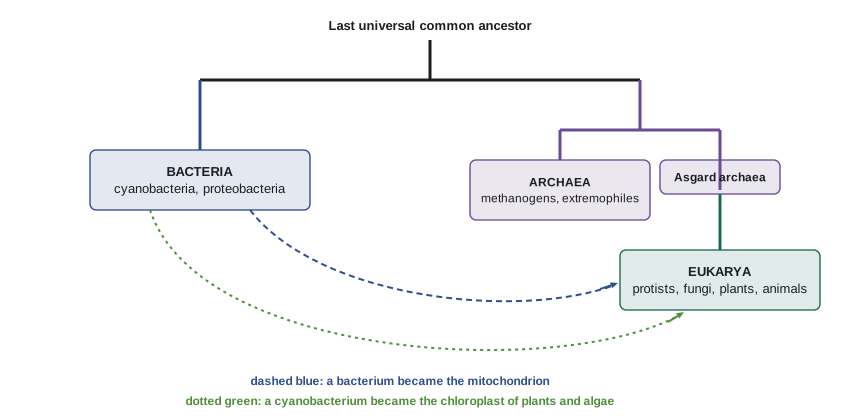
In 1977 Carl Woese and George Fox at the University of Illinois compared the sequences of ribosomal RNA, a molecule present in every cell, across many microbes. They found that prokaryotes fall into two groups as different from each other as either is from eukaryotes. Woese proposed three domains: Bacteria, Archaea and Eukarya. Later work showed that eukaryotes most likely arose from within the Archaea, from a lineage related to the recently discovered Asgard archaea, which then took in a bacterium that became the mitochondrion (lesson 8 and BIOL-107 lesson 1).
| Feature | Bacteria | Archaea | Eukarya |
|---|---|---|---|
| Nucleus | No | No | Yes |
| Membrane lipids | Fatty acids joined to glycerol by ester links | Branched isoprene chains joined by ether links; some form monolayers | Fatty acids joined to glycerol by ester links |
| Cell wall | Usually peptidoglycan | No peptidoglycan; various proteins or pseudopeptidoglycan | Cellulose (plants), chitin (fungi) or none (animals) |
| RNA polymerase | One simple type | Several, complex, resembling eukaryotic ones | Several, complex |
| Histone proteins on DNA | Rare | Present in many | Present |
| Sensitive to antibiotics such as streptomycin | Yes | No | No |
| Known to cause disease | Many species | None known | Some (protists, fungi, parasites) |
How prokaryotes evolve so fast
Prokaryotes have three features that make them extraordinarily adaptable. First, population sizes are enormous and generation times short: Escherichia coli can divide every 20 minutes in ideal laboratory conditions, about 26,000 generations a year, so a dozen years of continuous growth would match the roughly 300,000 generations the human lineage has had since it split from chimpanzees. Second, even a low mutation rate in a huge population produces enormous numbers of new mutations every day. Third, bacteria swap genes.
# How many new mutations arise each day in a bacterial population?
genome_bp = 4.6e6              # E. coli genome size in base pairs
mut_rate = 1e-10               # mutations per base pair per replication (order of magnitude)
cells = 1e10                   # cells produced in one day in a large culture or gut population
per_genome = genome_bp * mut_rate
total = per_genome * cells
print(f"mutations per genome copy: {per_genome:.5f}")
print(f"new mutations per day:     {total:,.0f}")
print(f"average hits per genome site per day: {total/genome_bp:.1f}")mutations per genome copy: 0.00046 new mutations per day: 4,600,000 average hits per genome site per day: 1.0
Even though fewer than one cell in two thousand carries any new mutation, a population of ten billion cells produces millions of new mutations every day, so on average every site in the genome is hit by a mutation somewhere in the population each day. That is why a single beneficial mutation, such as one giving antibiotic resistance, is almost guaranteed to arise in a large infection, and why combination therapies, which require several mutations at once, are used against tuberculosis and HIV.
Horizontal gene transfer is the movement of genes between organisms other than from parent to offspring. It occurs in three main ways: transformation, in which a cell takes up DNA from its environment; transduction, in which a virus carries DNA from one bacterium to another; and conjugation, in which two cells connect and one passes a plasmid, a small circular DNA molecule, to the other. Plasmids often carry antibiotic resistance genes, sometimes several at once, and can spread between quite different species. Horizontal transfer is so common in prokaryotes that their family tree looks more like a web at its base.
The diversity of Bacteria
Bacteria are classified today mainly by genome sequences, but some practical groupings remain useful. The Gram stain, developed by Hans Christian Gram in 1884, divides bacteria by cell wall structure: Gram-positive bacteria have a thick peptidoglycan layer that holds a purple dye; Gram-negative bacteria have a thin layer plus an outer membrane and stain pink. The difference matters medically, because the outer membrane blocks many antibiotics. Shape is another quick description: cocci (spheres), bacilli (rods) and spirilla or spirochetes (spirals).
| Group | Features | Examples and roles |
|---|---|---|
| Proteobacteria (Pseudomonadota) | Huge, diverse Gram-negative group | E. coli; Salmonella; nitrogen-fixing Rhizobium in legume roots; the ancestors of mitochondria |
| Cyanobacteria | Oxygen-producing photosynthesis | Caused the Great Oxidation Event; ancestors of chloroplasts; form blooms in lakes such as Lake Erie and Lake Winnipeg |
| Firmicutes (Bacillota) | Mostly Gram-positive; some form tough spores | Bacillus, Clostridium, Lactobacillus used in yogurt; Staphylococcus and Streptococcus |
| Actinobacteria (Actinomycetota) | Gram-positive, often branching | Streptomyces, source of most natural antibiotics; Mycobacterium tuberculosis |
| Spirochetes | Spiral, with internal flagella | Borrelia burgdorferi, the cause of Lyme disease, spread by blacklegged ticks |
| Chlamydias | Live only inside host cells | Chlamydia trachomatis, a common sexually transmitted infection |
Bacteria vary enormously in how they obtain energy and carbon. Photoautotrophs, such as cyanobacteria, use light and carbon dioxide. Chemoautotrophs obtain energy by oxidizing inorganic chemicals such as ammonia, hydrogen sulfide or iron, and are the base of food webs at deep-sea vents. Heterotrophs, including most familiar bacteria, feed on organic molecules. This metabolic diversity lets prokaryotes drive the planet's chemical cycles: nitrogen fixation, which converts atmospheric nitrogen into forms plants can use; nitrification and denitrification; decomposition; and much of global photosynthesis in the oceans.
The diversity of Archaea
Archaea were first found in extreme environments, and some are true extremophiles: thermophiles in hot springs and deep-sea vents, including Methanopyrus kandleri, which grows at 122 °C under pressure; halophiles in salt lakes and salt evaporation ponds, some coloured pink by light-harvesting pigments; and acidophiles in acidic mine drainage. But archaea are not limited to extremes. They are abundant in ordinary oceans, soils and lake sediments, where ammonia-oxidizing archaea play a major role in the nitrogen cycle.
Methanogens are archaea that produce methane as a by-product of their metabolism. They live in oxygen-free environments such as wetland sediments, rice paddies, landfills and the digestive tracts of cattle, termites and humans. Methane from cattle and wetlands is a significant greenhouse gas, so methanogens matter to climate science. Thawing permafrost in northern Canada, Alaska and Siberia may release more methane as microbial activity increases.
Prokaryotes and people
Only a small minority of bacteria cause disease, and no archaea are known to. The human body hosts roughly as many bacterial cells as human cells, about 38 trillion bacteria by one widely cited estimate, mostly in the large intestine. This microbiome helps digest fibre, makes vitamins such as vitamin K, trains the immune system and crowds out pathogens. Disruption of the microbiome, for example by broad-spectrum antibiotics, can allow Clostridioides difficile to flourish and cause serious diarrhea; transplants of healthy donor stool can cure recurrent infections.
Bacteria are also industrial workhorses. They make yogurt, cheese, sauerkraut and soy sauce; produce insulin and other medicines through genetic engineering; clean up oil spills and sewage; and supply the CRISPR-Cas system, originally a bacterial defence against viruses, that is now the main tool for editing genes. The pathogens among them include the causes of tuberculosis, cholera, whooping cough, strep throat, Lyme disease and food poisoning.
Viruses
A virus is a package of genetic material, either DNA or RNA, in a protein coat called a capsid, sometimes surrounded by a membrane envelope taken from its host. Viruses have no metabolism of their own and can reproduce only inside a host cell, using the cell's ribosomes and enzymes. Whether they count as alive is a matter of definition; most biologists treat them as biological entities at the edge of life. They infect every kind of organism, and they are the most abundant biological entities on Earth: a litre of seawater can contain tens of billions of virus particles, most of them bacteriophages that infect bacteria.
Bacteriophages show the two main viral life cycles. In the lytic cycle, the virus injects its genome, takes over the cell, makes many copies of itself and bursts the cell open, releasing new viruses. In the lysogenic cycle, the viral genome inserts into the host chromosome and is copied along with it, sometimes for many generations, until a trigger switches it to the lytic cycle. Some bacterial toxins, including those of cholera and diphtheria, are actually encoded by viral genes carried in this way.
# Lytic amplification: each infected cell bursts and releases many new phages
burst_size = 100             # new phages released per infected cell (typical order)
cycle_minutes = 30           # time for one infection cycle
phages = 1
for cycle in range(1, 6):
    phages *= burst_size
print(f"after {cycle * cycle_minutes:3d} minutes: up to {phages:,} phages (if hosts are plentiful)")after 30 minutes: up to 100 phages (if hosts are plentiful) after 60 minutes: up to 10,000 phages (if hosts are plentiful) after 90 minutes: up to 1,000,000 phages (if hosts are plentiful) after 120 minutes: up to 100,000,000 phages (if hosts are plentiful) after 150 minutes: up to 10,000,000,000 phages (if hosts are plentiful)
In two and a half hours, a single phage could in principle produce ten billion descendants, which is why phage therapy, the use of viruses to kill antibiotic-resistant bacteria, is being explored again. In practice growth stops when uninfected hosts run out. Animal viruses follow similar logic. Retroviruses such as HIV carry RNA genomes and use the enzyme reverse transcriptase to make a DNA copy that is inserted into the host chromosome. About 8 per cent of the human genome consists of the remains of ancient retroviruses, endogenous retroviruses, that infected our ancestors' germ cells; a few of their genes have been put to use, including one essential for forming the placenta.
Viruses evolve rapidly, especially RNA viruses, whose copying enzymes make many errors. Influenza viruses change their surface proteins slightly every year (antigenic drift), which is why the vaccine is updated annually, and occasionally swap whole gene segments between strains (antigenic shift), which can cause pandemics. SARS-CoV-2 variants such as Delta and Omicron arose by mutation and selection during the COVID-19 pandemic, and genomic surveillance tracked them in near real time using the phylogenetic methods of lesson 6.
In Canada, the Public Health Agency of Canada’s National Microbiology Laboratory in Winnipeg, which houses the country’s only level 4 containment laboratory, leads genomic surveillance of viruses and bacteria with provincial public health laboratories.
Prions are even simpler infectious agents: misfolded proteins that cause normal copies of the same protein to misfold. They cause fatal brain diseases, including bovine spongiform encephalopathy (mad cow disease) and chronic wasting disease, which affects deer, elk and moose and has spread across parts of the Canadian Prairies and many American states.
Common mistakes
MistakeAll bacteria are harmful germs.
InsteadMost bacteria are harmless or beneficial; they drive nutrient cycles, aid digestion and are used in food and medicine.
MistakeArchaea are just bacteria that live in extreme places.
InsteadArchaea are a separate domain, closer in many molecular features to eukaryotes, and many live in ordinary soils and oceans.
MistakeAntibiotics work against viruses.
InsteadAntibiotics target bacterial structures and processes; they have no effect on viruses, which lack them.
MistakeBacteria can only get new genes from their parent cell.
InsteadHorizontal gene transfer by transformation, transduction and conjugation moves genes between unrelated bacteria.
MistakeViruses are tiny bacteria.
InsteadViruses are not cells; they lack metabolism and ribosomes and reproduce only inside host cells.
Summary and key terms
- Ribosomal RNA comparisons revealed three domains: Bacteria, Archaea and Eukarya, with eukaryotes arising from within the Archaea.
- Archaea differ from bacteria in membrane lipids, cell walls and molecular machinery, and resemble eukaryotes in some features.
- Huge populations, short generations and horizontal gene transfer make prokaryotes evolve fast.
- Bacteria include photosynthetic cyanobacteria, nitrogen fixers, decomposers, antibiotic producers and a minority of pathogens.
- Archaea include extremophiles, methanogens and abundant ammonia oxidizers in soils and oceans.
- Viruses are genetic material in a protein coat that replicate only inside host cells, by lytic or lysogenic cycles.
- Rapid viral evolution drives annual flu vaccine updates and pandemic variants; prions are infectious misfolded proteins.
- domain
- The highest rank of classification: Bacteria, Archaea or Eukarya.
- horizontal gene transfer
- Movement of genes between organisms other than from parent to offspring.
- plasmid
- A small, circular DNA molecule separate from the main chromosome, often carrying useful genes.
- conjugation
- Transfer of DNA, usually a plasmid, between bacterial cells in direct contact.
- Gram stain
- A staining method that separates bacteria by cell wall structure into Gram-positive and Gram-negative.
- extremophile
- An organism that thrives in extreme conditions of heat, salt, acidity or pressure.
- methanogen
- An archaeon that produces methane as a metabolic by-product.
- microbiome
- The community of microorganisms living in or on a particular host or environment.
- bacteriophage
- A virus that infects bacteria.
- lysogenic cycle
- A viral life cycle in which the viral genome is inserted into the host chromosome and copied with it.
Practice problems
Work each problem on paper first, then reveal the answer to check.
What evidence led Woese to propose three domains?
Show answer
Comparisons of ribosomal RNA sequences showed archaea are as different from bacteria as from eukaryotes.
Name two features in which archaea resemble eukaryotes more than bacteria.
Show answer
Complex RNA polymerases and histone proteins on DNA; also insensitivity to some antibiotics.
Name the three ways bacteria exchange genes horizontally.
Show answer
Transformation, transduction and conjugation.
Why are Gram-negative bacteria often harder to treat?
Show answer
Their outer membrane blocks many antibiotics.
A population of 10^9 cells with genome 5 × 10^6 bp and mutation rate 10^−10 per bp per replication produces how many new mutations per generation?
Show answer
5 × 10^6 × 10^−10 × 10^9 = 500,000 mutations.
Why do methanogens matter for climate?
Show answer
They produce methane, a potent greenhouse gas, in wetlands, livestock and thawing permafrost.
Contrast lytic and lysogenic cycles.
Show answer
Lytic: the virus replicates and bursts the cell; lysogenic: the viral genome integrates and is copied with the host until triggered.
Why is the flu vaccine updated every year?
Show answer
Influenza surface proteins change by antigenic drift, so last year’s antibodies match less well.
What fraction of the human genome comes from ancient retroviruses?
Show answer
About 8 per cent.
Give two benefits the gut microbiome provides.
Show answer
Digesting fibre, making vitamins such as vitamin K, training the immune system and excluding pathogens.
Lesson quiz · 5 questions
Score 60% or more to complete this lesson.
Create a free account to save your progress, take quizzes and earn a certificate.