
BIOL-108 · Lesson 4 of 12 · 24 min
Species and speciation
Darwin called his book On the Origin of Species, yet the origin of species was the question it answered least directly. Lessons 2 and 3 showed how populations change. This lesson asks how one species becomes two: what a species is, what keeps species apart, how new species arise, and how fast it happens. Speciation is the bridge between microevolution within populations and the branching tree of life that lessons 5 and 6 explore.
What is a species?
Everyone can tell a moose from a white-tailed deer, but defining a species precisely is surprisingly hard, and biologists use several definitions, called species concepts, each suited to different organisms and questions.
| Species concept | A species is… | Strengths | Limitations |
|---|---|---|---|
| Biological species concept (Ernst Mayr) | A group of populations that actually or potentially interbreed in nature and are reproductively isolated from other such groups | Focuses on the process that keeps species separate | Cannot be applied to asexual organisms, fossils, or populations that never meet |
| Morphological | A group defined by distinctive body form and structure | Usable for fossils and museum specimens | Can split one variable species or lump look-alike (cryptic) species |
| Phylogenetic | The smallest group of individuals that share a common ancestor and form one branch of the tree of life | Works for any organism with genetic data | Can recognize very many small species |
| Ecological | A group occupying a distinct ecological niche | Links species to their role in the environment | Niches can overlap or shift |
The biological species concept is the most widely taught for animals, and it puts the emphasis where speciation research focuses: on reproductive isolation. Under this concept, two populations become separate species when they can no longer exchange genes freely. For bacteria, which reproduce asexually and swap genes horizontally (lesson 7), microbiologists rely mostly on genetic similarity instead.
Defining species is not just an academic exercise. Conservation law protects species, subspecies and distinct populations, so where the lines are drawn decides what gets protected. DNA barcoding, which compares a standard short gene region across specimens, was pioneered by Paul Hebert at the University of Guelph and has revealed many cryptic species: groups that look identical but are genetically distinct and do not interbreed.
Reproductive isolating barriers
Reproductive isolation is maintained by barriers that prevent members of different species from producing fertile offspring together. Biologists classify them by when they act: before fertilization (prezygotic barriers) or after it (postzygotic barriers).
| Barrier | Type | How it works | Example |
|---|---|---|---|
| Habitat isolation | Prezygotic | Species live in different habitats and rarely meet | Two garter snake species in one area, one mostly in water, one on land |
| Temporal isolation | Prezygotic | Species breed at different times | Eastern and western spotted skunks breed in late winter and late summer |
| Behavioural isolation | Prezygotic | Courtship signals are not recognized | Different songs in similar-looking flycatchers; firefly flash patterns |
| Mechanical isolation | Prezygotic | Reproductive structures do not fit | Snail shells coiling in opposite directions; flower shapes matched to specific pollinators |
| Gametic isolation | Prezygotic | Sperm cannot fertilize eggs of another species | Sea urchin sperm-binding proteins recognize only their own species’ eggs |
| Reduced hybrid viability | Postzygotic | Hybrids die or are weak | Some salamander hybrids fail to complete development |
| Reduced hybrid fertility | Postzygotic | Hybrids survive but are sterile | A mule, from a horse and a donkey, is almost always sterile |
| Hybrid breakdown | Postzygotic | First-generation hybrids are fertile but later generations fail | Some rice and cotton hybrids |
Prezygotic barriers are usually more important in practice because they prevent wasted reproductive effort. When hybrids are less fit than either parent species, selection can actually strengthen prezygotic barriers where the species meet, a process called reinforcement.
How speciation happens
Speciation requires that gene flow between two populations is reduced enough for them to diverge by selection, drift and mutation until reproductive barriers evolve. Biologists classify speciation by geography.
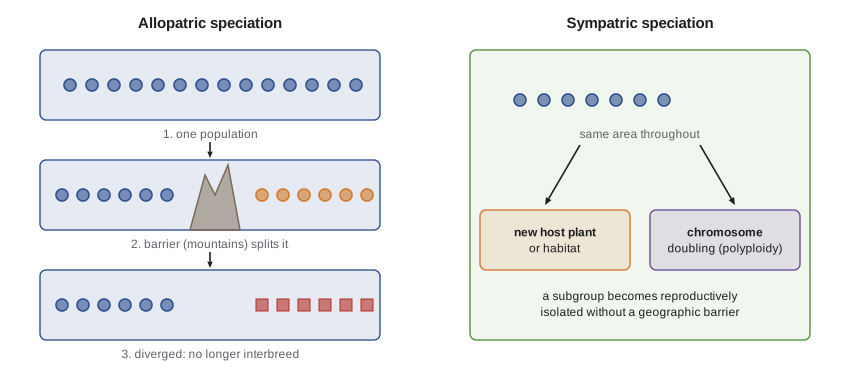
Allopatric speciation (from Greek for other homeland) begins when a population is split by a geographic barrier: a mountain range rising, a river changing course, a glacier advancing, or a few individuals reaching an island. With gene flow cut off, the separated populations diverge. If they later come back into contact and can no longer interbreed successfully, speciation is complete. Allopatric speciation is thought to be the most common route for animals.
The Pleistocene ice ages, which ended about 11,700 years ago, provide North American examples. Ice sheets covering most of Canada split many bird, fish and mammal populations into separate southern refuges, where they diverged. Many pairs of closely related eastern and western North American birds, such as some warblers and flycatchers, trace their split to these glacial separations.
Sympatric speciation (same homeland) occurs without geographic separation. It is rarer in animals but well documented in two forms. One is polyploidy, in which an error in cell division doubles the chromosome number. A tetraploid plant (four sets of chromosomes) cannot produce fertile offspring with its diploid parents, so it is instantly reproductively isolated. Polyploidy is very common in plants: wheat, cotton, potatoes, strawberries and canola all have polyploid origins, and many wild plant species arose this way. The other form is ecological: a subgroup begins using a new resource and mating there.
A classic Canadian example of speciation in progress involves threespine sticklebacks in a few small lakes on islands in the Strait of Georgia, British Columbia. After the last glaciation, each lake was colonized twice by marine sticklebacks, and the fish evolved into two forms: a large, bottom-feeding benthic form and a slender, open-water limnetic form. The two rarely interbreed, because females prefer mates of their own form and hybrids feed poorly in both habitats. Research led by Dolph Schluter at the University of British Columbia showed that the same pairs evolved independently in different lakes, a strong sign that natural selection drove the split. In Enos Lake on Vancouver Island, the pair collapsed into a hybrid swarm after an introduced crayfish disturbed the habitat, showing that young species can merge again.
Parapatric speciation is an intermediate case: two populations occupy adjacent areas with a narrow zone of contact, and strong local selection drives them apart despite some gene flow. Plants on old mine sites, tolerant of toxic metals, sometimes flower at slightly different times from neighbours on normal soil only metres away.
Measuring divergence
Population geneticists measure how differentiated populations are with \(F_{ST}\), the fixation index. It compares the genetic variation within populations with the variation in the combined population. \(F_{ST}\) near 0 means the populations share their alleles freely; near 1 means they have fixed different alleles. A simple version for one two-allele locus is \(F_{ST} = \frac{H_T - H_S}{H_T}\), where \(H_S\) is the average expected heterozygosity within populations and \(H_T\) the expected heterozygosity if all were pooled.
# F_ST for one locus in pairs of populations: (H_T - H_S) / H_T
def fst(p1, p2):
    hs = (2 * p1 * (1 - p1) + 2 * p2 * (1 - p2)) / 2   # mean within-population heterozygosity
    pbar = (p1 + p2) / 2
    ht = 2 * pbar * (1 - pbar)                           # heterozygosity of the pooled population
    return (ht - hs) / ht

pairs = [("neighbouring lakes, much gene flow", 0.52, 0.48),
         ("separate river basins", 0.70, 0.40),
         ("long-isolated islands", 0.95, 0.10)]
for label, p1, p2 in pairs:
print(f"{label:<36} p1 = {p1:.2f}, p2 = {p2:.2f}, F_ST = {fst(p1, p2):.3f}")neighbouring lakes, much gene flow p1 = 0.52, p2 = 0.48, F_ST = 0.002 separate river basins p1 = 0.70, p2 = 0.40, F_ST = 0.091 long-isolated islands p1 = 0.95, p2 = 0.10, F_ST = 0.724
Real studies use many loci, often thousands from whole genomes, and average them. Genome scans of diverging populations, such as benthic and limnetic sticklebacks, often find most of the genome lightly differentiated but a few regions, called islands of divergence, strongly differentiated. These regions often contain the genes under divergent selection.
Hybrid zones
When diverging populations meet, they may form a hybrid zone where interbreeding occurs. What happens next has three possible outcomes. Reinforcement: hybrids are unfit, so selection strengthens prezygotic barriers and speciation is completed. Fusion: barriers weaken and the populations merge, as in the Enos Lake sticklebacks. Stability: hybrids keep being produced in a narrow zone that persists for long periods.
North America has several well-studied hybrid zones. Blue-winged and golden-winged warblers hybridize where their ranges overlap in eastern North America, and the golden-winged warbler is declining partly because of this. Grizzly and polar bears have produced wild hybrids in the western Canadian Arctic, where warming has brought grizzlies north. Hybridization is not always a dead end: genes passed between species through hybridization, called introgression, can carry useful adaptations, and modern humans carry a few per cent of Neanderthal DNA from ancient interbreeding (lesson 11).
The tempo of speciation
How long does speciation take? It varies enormously. Polyploid plants can become a new species in a single generation. Cichlid fish in Lake Victoria in Africa produced hundreds of species in perhaps 15,000 years. Many bird and mammal species pairs, by contrast, took hundreds of thousands to millions of years to become fully isolated.
The fossil record raises a related question: does change happen gradually, or in bursts? In 1972 Niles Eldredge and Stephen Jay Gould proposed punctuated equilibrium: many species appear suddenly in the fossil record, change little for millions of years (stasis), then disappear. They argued that much change occurs in small, isolated populations during speciation, which are unlikely to leave fossils. Gradualism, the steady accumulation of change, also occurs. Both patterns are found, and neither contradicts natural selection; they differ in how the rate of change is distributed in time.
Adaptive radiation
An adaptive radiation is the rapid evolution of many species from a common ancestor into a variety of ecological roles. Radiations often follow the colonization of a new area with few competitors, or a mass extinction that empties ecological roles (lesson 5). Darwin's Galápagos finches, Hawaiian honeycreepers and silverswords, African lake cichlids and the diversification of mammals after the extinction of non-avian dinosaurs 66 million years ago are classic examples. Lesson 6 shows how phylogenetic trees reveal these radiations.
Ring species: speciation caught in space
Ring species show the gradual nature of speciation laid out on a map. The greenish warbler of Asia forms a ring of populations around the Tibetan Plateau. Neighbouring populations interbreed all the way around the ring, but where the two ends of the ring meet in central Siberia, the birds look different, sing different songs and do not interbreed: they behave as two species. Darren Irwin, now at the University of British Columbia, showed with genetic data that the populations around the ring form a near-continuous chain of change, interrupted in a few places by past breaks in the forest. The ensatina salamanders of California, which circle the Central Valley, are a famous North American case. Ring species illustrate a key point: because speciation is a gradual process, there are populations caught partway through it, and no single line can sort every population neatly into species. Biologists therefore treat species boundaries as hypotheses to be tested with new data, and conservation agencies sometimes protect distinct populations below the species level, such as designatable units in Canada or distinct population segments in the United States.
Common mistakes
MistakeA species is any group of organisms that look alike.
InsteadLook-alike groups can contain several reproductively isolated cryptic species; most concepts emphasize reproductive isolation or shared ancestry.
MistakeIf two species ever produce a hybrid, they are really one species.
InsteadMany good species occasionally hybridize; what matters is whether the hybrids are fertile and gene pools stay largely separate.
MistakeSpeciation always takes millions of years.
InsteadIt ranges from one generation in polyploid plants to millions of years; some cichlid radiations took only thousands.
MistakePunctuated equilibrium contradicts natural selection.
InsteadIt describes the timing of change, concentrated around speciation events, and is compatible with natural selection.
MistakeSympatric speciation is impossible.
InsteadIt is well documented, especially by polyploidy in plants and by host shifts in insects.
Summary and key terms
- Species concepts include biological, morphological, phylogenetic and ecological definitions, each with strengths and limits.
- Reproductive isolation is maintained by prezygotic barriers (habitat, timing, behaviour, mechanics, gametes) and postzygotic barriers (hybrid viability, fertility, breakdown).
- Allopatric speciation follows geographic separation; sympatric speciation occurs without it, often by polyploidy or host shifts.
- F_ST measures how differentiated populations are, from 0 (shared alleles) to 1 (different fixed alleles).
- Hybrid zones can lead to reinforcement, fusion or a stable zone; introgression can transfer useful genes.
- Speciation rates range from one generation to millions of years; punctuated and gradual patterns both occur.
- Adaptive radiations rapidly fill many ecological roles, often after colonization or mass extinction.
- biological species concept
- Defines a species as interbreeding natural populations reproductively isolated from other such groups.
- reproductive isolation
- The inability of members of different species to produce fertile offspring together.
- prezygotic barrier
- A reproductive barrier that acts before fertilization.
- postzygotic barrier
- A reproductive barrier that acts after fertilization, reducing hybrid viability or fertility.
- allopatric speciation
- Speciation following geographic separation of populations.
- sympatric speciation
- Speciation within a shared geographic area.
- polyploidy
- Having more than two complete sets of chromosomes.
- hybrid zone
- A region where diverging populations meet and interbreed.
- reinforcement
- Strengthening of prezygotic barriers by selection against unfit hybrids.
- adaptive radiation
- Rapid evolution of many species from one ancestor into diverse ecological roles.
Practice problems
Work each problem on paper first, then reveal the answer to check.
Why can the biological species concept not be applied to fossils?
Show answer
Interbreeding cannot be observed or tested in extinct organisms.
Classify each barrier: two frogs call with different songs; a mule is sterile.
Show answer
Different songs: behavioural (prezygotic); sterile mule: reduced hybrid fertility (postzygotic).
Why is a new tetraploid plant reproductively isolated from its diploid parent?
Show answer
Crosses produce triploid offspring with unpaired chromosomes that cannot complete meiosis normally, so they are sterile.
How did Pleistocene glaciation promote allopatric speciation in North America?
Show answer
Ice sheets split populations into separate refuges where they diverged without gene flow.
Calculate F_ST for p1 = 0.8, p2 = 0.2.
Show answer
HS = (0.32 + 0.32)/2 = 0.32; pbar = 0.5 so HT = 0.5; FST = (0.5 − 0.32)/0.5 = 0.36.
What is reinforcement, and when does it occur?
Show answer
Strengthening of prezygotic isolation by selection when hybrids are less fit; it occurs where diverging populations meet.
Give an example of sympatric speciation in animals.
Show answer
Apple maggot flies shifting from hawthorn to apple, or benthic and limnetic sticklebacks in the same lake.
What does punctuated equilibrium propose?
Show answer
Species show long periods of stasis, with change concentrated in short bursts associated with speciation.
Why do adaptive radiations often follow mass extinctions?
Show answer
Extinctions empty ecological roles, so surviving lineages can diversify into them with little competition.
How has DNA barcoding changed species counts?
Show answer
It has revealed many cryptic species that look alike but are genetically distinct.
Lesson quiz · 5 questions
Score 60% or more to complete this lesson.
Create a free account to save your progress, take quizzes and earn a certificate.