
BIOL-108 · Lesson 1 of 12 · 26 min
Evolution: the organizing idea of biology
In 1973 the geneticist Theodosius Dobzhansky wrote an essay whose title has become a motto for biologists: nothing in biology makes sense except in the light of evolution. BIOL-107 looked inside cells. This course steps back to look at the whole sweep of living things, from bacteria in hot springs to whales and orchids, and at the process that produced them. Evolution explains why living things share the same genetic code, why they are grouped into nested families, why antibiotics stop working and why a whale has finger bones inside its flipper. This first lesson sets out what evolution means, how the idea developed and what kinds of evidence support it.
What evolution means
In biology, evolution means change in the heritable characteristics of populations over generations. Three parts of that definition matter. First, it is populations that evolve, not individuals: an individual animal does not evolve during its life, but the mix of genetic variants in its population can change from one generation to the next. Second, only heritable characteristics count; a weightlifter's muscles are not passed to their children. Third, evolution happens over generations, which can be twenty minutes for some bacteria or decades for trees and elephants.
Biologists often separate two scales. Microevolution is change in the frequencies of gene variants (alleles) within a population, such as an insect population becoming resistant to an insecticide. Macroevolution is change above the species level: the origin of new species, new body plans and major groups over long periods. The two are not different processes. Macroevolution is what microevolution looks like when it is added up over millions of years and many populations, together with the splitting of lineages.
Evolution is both an observed fact and a well-tested scientific theory. That populations change over time and that living species share common ancestors are facts in the ordinary scientific sense: they have been confirmed so many times, by so many independent lines of evidence, that it would be unreasonable to withhold agreement. The theory of evolution is the body of explanation for how this happens, including natural selection, genetic drift, mutation and gene flow. In science, a theory is not a guess; it is a broad, well-supported explanation, like the germ theory of disease or the theory of plate tectonics.
Ideas before Darwin
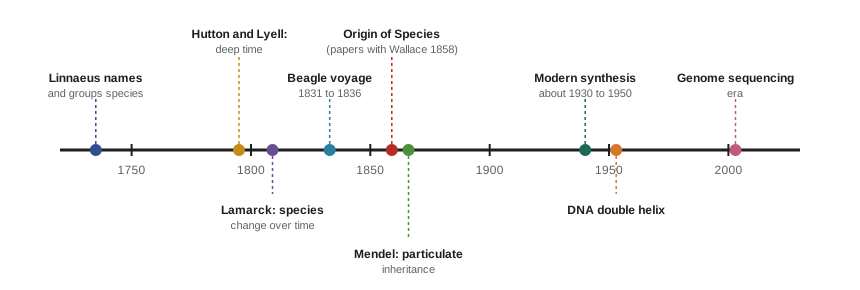
People noticed similarities between organisms long before anyone explained them. Aristotle arranged living things in a ladder from simple to complex. In the 1700s the Swedish botanist Carl Linnaeus built the system of naming still used today, giving each species a two-part Latin name such as Homo sapiens and grouping species into genera, orders and classes. Linnaeus thought he was cataloguing a fixed creation, but his nested groups were exactly what common descent would later explain.
Geology prepared the ground. In the late 1700s and early 1800s, James Hutton and then Charles Lyell argued that Earth's features were shaped by slow processes still at work today, such as erosion and sediment deposition, acting over immense spans of time. This idea, called uniformitarianism, implied an Earth far older than a few thousand years. Fossils were being described in growing numbers, and Georges Cuvier showed that many of them belonged to species that no longer existed: extinction was real.
Jean-Baptiste Lamarck proposed in 1809 that species change over time. He suggested that organisms change in response to need and that characteristics acquired during life, such as a muscle strengthened by use, are passed to offspring. The mechanism was wrong: acquired characteristics are not inherited in the way he imagined. But Lamarck deserves credit for treating species as changeable and for linking change to the environment.
Darwin and Wallace
Charles Darwin sailed as a naturalist on HMS Beagle from 1831 to 1836. In South America he found fossils of giant extinct mammals resembling living armadillos and sloths, and on the Galápagos Islands he collected mockingbirds and finches that differed from island to island. Back in England, reading Lyell and the economist Thomas Malthus, who argued that populations grow faster than their food supply, Darwin worked out the idea of natural selection by about 1838. He then spent twenty years gathering evidence, breeding pigeons and corresponding with naturalists around the world.
Alfred Russel Wallace, collecting specimens in the Malay Archipelago, reached the same idea independently and sent Darwin a manuscript in 1858. Their papers were presented together at the Linnean Society of London that year, and in 1859 Darwin published On the Origin of Species. Darwin's argument had two parts: descent with modification, meaning that all species are related through common ancestors; and natural selection, a mechanism for how populations become adapted to their environments. Lesson 2 examines natural selection in detail.
Darwin's main gap was inheritance. He did not know how traits were passed on, and the common belief of his day, that parents' traits blended in offspring, would have diluted any new variation. The Augustinian friar Gregor Mendel had in fact shown in 1866 that inheritance comes in discrete units, now called genes, but his work was not widely appreciated until 1900. BIOL-201 covers Mendelian genetics fully.
The modern synthesis and beyond
Between about 1930 and 1950, biologists combined Darwin's natural selection with Mendelian genetics and with new mathematics of populations. Ronald Fisher, J. B. S. Haldane and Sewall Wright showed how selection, mutation and chance change allele frequencies; Dobzhansky, Ernst Mayr, George Gaylord Simpson and G. Ledyard Stebbins applied these ideas to wild populations, species and fossils. The result, called the modern synthesis, defined evolution as changing allele frequencies and explained adaptation and speciation in genetic terms.
Since then, molecular biology has transformed the field. The discovery of DNA's structure in 1953, protein and DNA sequencing, and now cheap whole-genome sequencing let biologists compare organisms gene by gene. Evolutionary developmental biology (evo-devo) showed how changes in a small set of regulatory genes can reshape bodies. Biologists now also study horizontal gene transfer, in which genes move between unrelated organisms, especially bacteria (lesson 7), and epigenetic effects. These extend rather than overturn the core theory.
The evidence for evolution
The case for common descent does not rest on any single observation. It rests on many independent lines of evidence that agree with each other. If any one of them pointed somewhere else, the theory would be in trouble; instead they converge.
| Line of evidence | What is observed | Example |
|---|---|---|
| Fossil record | Fossils appear in a consistent order through rock layers, with transitional forms | Tiktaalik, a fish with limb-like fins found in Nunavut; early whales with hind legs |
| Comparative anatomy | Homologous structures share a basic plan despite different uses | The same bones in a human arm, bat wing, whale flipper and cat leg |
| Vestigial structures | Reduced remnants of structures that were functional in ancestors | Hip bones in whales; tiny wings in flightless birds; the human coccyx |
| Embryology | Related animals share embryonic features | Pharyngeal pouches in all vertebrate embryos, which become gills in fish and parts of the ear and throat in mammals |
| Molecular biology | All life uses DNA, the same genetic code and many shared genes; sequence similarity mirrors relatedness | Human and chimpanzee genomes are about 98 to 99 per cent identical in aligned regions |
| Biogeography | Species distributions reflect history and geography | Marsupials dominate Australia; island species resemble those of the nearest mainland |
| Direct observation | Evolution measured in real time | Antibiotic resistance; beak changes in Galápagos finches; Lenski’s 75,000-generation E. coli experiment |
Homologous structures are similar because of shared ancestry, even when their functions differ. Analogous structures are similar because of similar function, not shared ancestry: the wings of a bird and of a butterfly both fly, but they are built in completely different ways from different tissues. Distinguishing homology from analogy is a central skill in reading evolutionary relationships, and lesson 6 returns to it when building trees.
One of the most powerful kinds of evidence is prediction. In 2004, palaeontologists Neil Shubin, Ted Daeschler and Farish Jenkins went looking for a fossil intermediate between fish and four-limbed animals. Evolutionary theory told them roughly when such a creature should have lived, about 375 million years ago, and the kind of environment it would occupy, shallow streams. Searching rocks of that age and type on Ellesmere Island in Nunavut, they found Tiktaalik roseae, a fish with a neck, sturdy fin bones and lungs as well as gills. Its name comes from the Inuktitut word for a large freshwater fish, chosen with the Inuit elders of the region.
Worked problem
Using sequence differences as evidence
A 60-amino-acid stretch of a protein is compared across four species. Species A and B differ at 2 positions, A and C at 9, and A and D at 21. Which species is A most closely related to, and what does this pattern suggest?
Show solution
- Convert to proportion different: A–B 2/60 = 3.3 per cent, A–C 9/60 = 15 per cent, A–D 21/60 = 35 per cent.
- Fewer differences mean a more recent common ancestor, because differences accumulate over time after lineages split.
- So A shares its most recent common ancestor with B, then C, then D.
- If anatomy and fossils suggest the same order, two independent kinds of evidence agree.
Answer: A is most closely related to B. The nested pattern (B closest, then C, then D) is what common descent predicts.
# Percentage difference between aligned protein sequences
seqs = {
    "human":      "MVHLTPEEKSAVTALWGKVNVDEVGGEALGRLLVVYPWTQRFFESFGDLSTPDAVMGNPK",
    "chimpanzee": "MVHLTPEEKSAVTALWGKVNVDEVGGEALGRLLVVYPWTQRFFESFGDLSTPDAVMGNPK",
    "mouse":      "MVHLTDAEKAAVSCLWGKVNSDEVGGEALGRLLVVYPWTQRYFDSFGDLSSASAIMGNPK",
    "chicken":    "MVHWTAEEKQLITGLWGKVNVAECGAEALARLLIVYPWTQRFFASFGNLSSPTAILGNPM",
}
ref = seqs["human"]
for name, s in seqs.items():
    diffs = sum(a != b for a, b in zip(ref, s))
print(f"human vs {name:<10}: {diffs:2d} of {len(ref)} sites differ ({100*diffs/len(ref):.0f}%)")human vs human : 0 of 60 sites differ (0%) human vs chimpanzee: 0 of 60 sites differ (0%) human vs mouse : 12 of 60 sites differ (20%) human vs chicken : 18 of 60 sites differ (30%)
The pattern in the output, with chimpanzees closest to humans, then mice, then chickens, matches the order that comparative anatomy and the fossil record give for the same animals. That agreement between independent methods is what makes the conclusion strong.
Evolution, science and society
Evolution is the foundation of modern biology and medicine. It guides how doctors use antibiotics and antivirals, how public health agencies choose each year's influenza vaccine strains, how farmers manage pesticide resistance, and how conservation biologists protect genetic diversity. Every major scientific organization accepts it.
Public acceptance varies. Some people see evolution as conflicting with their religious beliefs, and in some places its teaching in schools has been contested. Many religious traditions and many scientists who are religious see no conflict, regarding science as answering questions about how the natural world works. This course treats evolution as established science, as biologists do, while recognizing that people come to it from different backgrounds. Understanding the evidence clearly is the best starting point for any discussion.
In Canadian schools, evolution is part of provincial science curricula, usually in senior high school biology, and Canadian research has contributed important evidence, from Tiktaalik in Nunavut to the Burgess Shale fossils of British Columbia that lesson 5 discusses.
How this course is organized
Lessons 2 to 4 explain the mechanisms of evolution: natural selection, the other forces that change allele frequencies, and how new species form. Lessons 5 and 6 cover the history of life and how biologists reconstruct family trees. Lessons 7 to 11 survey the diversity of life: microbes, protists and fungi, plants, invertebrate animals, and vertebrates including humans. Lesson 12 introduces ecology and brings the course together in a capstone on biodiversity and conservation. Later courses go deeper: BIOL-321 on evolutionary biology, BIOL-322 on population genetics, BIOL-208 on ecology and BIOL-367 on conservation biology.
Common mistakes
MistakeIndividual organisms evolve during their lifetimes.
InsteadPopulations evolve; individuals develop and may acclimatize, but evolution is a change in heritable traits across generations.
MistakeA scientific theory is just an educated guess.
InsteadA scientific theory is a broad, well-tested explanation supported by many lines of evidence, like germ theory or plate tectonics.
MistakeDarwin claimed humans descended from modern chimpanzees.
InsteadHumans and chimpanzees share a common ancestor that lived roughly 6 to 7 million years ago; neither descended from the other.
MistakeLamarck was wrong about everything.
InsteadLamarck’s mechanism of inherited acquired traits was wrong, but he was right that species change over time and are linked to their environments.
MistakeSimilar-looking structures always show close relationship.
InsteadHomologous structures reflect shared ancestry; analogous structures, like bird and insect wings, evolved separately for similar functions.
Summary and key terms
- Evolution is change in the heritable characteristics of populations over generations.
- Microevolution is change in allele frequencies within populations; macroevolution is the accumulated result above the species level.
- Linnaeus’s classification, Lyell’s deep time, Cuvier’s extinctions and Lamarck’s idea of changing species set the stage for Darwin and Wallace.
- Darwin and Wallace proposed descent with modification and natural selection in 1858 and 1859.
- The modern synthesis joined selection with Mendelian genetics; molecular biology has since added powerful evidence.
- Fossils, anatomy, vestigial structures, embryology, molecules, biogeography and direct observation independently support common descent.
- Evolution is the foundation of biology and medicine, and is treated as established science.
- evolution
- Change in the heritable characteristics of a population over generations.
- microevolution
- Change in allele frequencies within a population over a short span of generations.
- macroevolution
- Evolutionary change at or above the species level, including the origin of new groups.
- descent with modification
- Darwin’s idea that species descend from common ancestors and change over time.
- natural selection
- Differential survival and reproduction of individuals because of heritable differences in their traits.
- uniformitarianism
- The principle that processes operating today shaped Earth over long periods.
- homologous structure
- A feature shared by related species because it was inherited from a common ancestor.
- analogous structure
- A feature with similar function in different species that evolved independently.
- vestigial structure
- A reduced remnant of a feature that was functional in ancestors.
- modern synthesis
- The mid-twentieth-century union of natural selection, Mendelian genetics and population genetics.
Practice problems
Work each problem on paper first, then reveal the answer to check.
Give the three key parts of the biological definition of evolution.
Show answer
It is change in heritable characteristics, in populations, across generations.
Why can a single bacterium not evolve, though a bacterial population can?
Show answer
Evolution is a change in the genetic make-up of a population across generations; an individual’s genes are fixed (apart from rare mutation in its own lineage).
What did Lyell contribute to Darwin’s thinking?
Show answer
The idea that slow processes acting over immense time shape Earth, giving enough time for gradual biological change.
What was missing from Darwin’s theory, and who supplied it?
Show answer
A correct theory of inheritance; Mendel showed inheritance is particulate (genes), rediscovered in 1900.
Classify each as homologous or analogous: a bat wing and a human arm; a bat wing and a bee wing.
Show answer
Bat wing and human arm are homologous; bat wing and bee wing are analogous.
Why are vestigial structures evidence for evolution?
Show answer
They are best explained as remnants of structures that were functional in ancestors.
How did Tiktaalik test evolutionary theory?
Show answer
Researchers predicted the age and environment of a fish–tetrapod intermediate, searched rocks of that age and type, and found one.
Two proteins of 200 amino acids differ at 10 positions. What percentage differ?
Show answer
10/200 = 5 per cent.
Give an example of evolution observed directly.
Show answer
Antibiotic resistance in bacteria, or beak changes in Galápagos finches after droughts.
What did the modern synthesis combine?
Show answer
Darwinian natural selection, Mendelian genetics and the mathematics of population genetics.
Lesson quiz · 5 questions
Score 60% or more to complete this lesson.
Create a free account to save your progress, take quizzes and earn a certificate.