
BIOL-108 · Lesson 8 of 12 · 25 min
Protists and fungi
Eukaryotic cells evolved about 1.8 billion years ago, and for most of the time since then eukaryotes were single cells. Their descendants include the familiar multicellular kingdoms of plants, animals and fungi, but most of the evolutionary diversity of eukaryotes lies elsewhere, among the mostly microscopic organisms traditionally called protists. This lesson surveys protists and fungi: how eukaryotes arose, how they are now classified, and why these organisms matter for ecosystems, food, disease and the history of life.
How eukaryotes arose
BIOL-107 introduced the endosymbiotic theory: mitochondria and chloroplasts descend from bacteria that were engulfed by an ancestral cell and lived inside it. The evidence is strong. Both organelles have their own circular DNA, resembling bacterial chromosomes; their own ribosomes, which are bacterial in size and antibiotic sensitivity; double membranes; and they divide by a process similar to bacterial fission. Their DNA sequences place mitochondria among the alphaproteobacteria and chloroplasts among the cyanobacteria.
Genome studies now suggest the host cell was an archaeon related to the Asgard archaea, first described in 2015 from sediments near a hydrothermal vent field between Greenland and Norway called Loki's Castle. The merger with the mitochondrial ancestor supplied the extra energy that may have allowed larger, more complex cells, with nuclei, internal membranes and big genomes, to evolve. All known eukaryotes have, or once had, mitochondria.
Chloroplasts arose from a cyanobacterium in an ancestor of red algae, green algae and land plants; this is called primary endosymbiosis. Several other lineages acquired chloroplasts secondhand, by engulfing a eukaryotic alga and keeping its chloroplast. This secondary endosymbiosis explains why some protists have chloroplasts surrounded by three or four membranes, and why photosynthesis is scattered across distantly related branches of the eukaryotic tree.
Why protists are not a natural group
The word protist is a convenient label for any eukaryote that is not a plant, an animal or a fungus. Older textbooks placed them all in a kingdom Protista, but molecular phylogenies show that protists do not form a clade. Some are more closely related to animals than to other protists; brown algae such as kelp are more closely related to diatoms and to the water mould that caused the Irish potato famine than to green plants. Modern classification places eukaryotes in several large groups, often called supergroups, though their exact number and boundaries are still being revised.
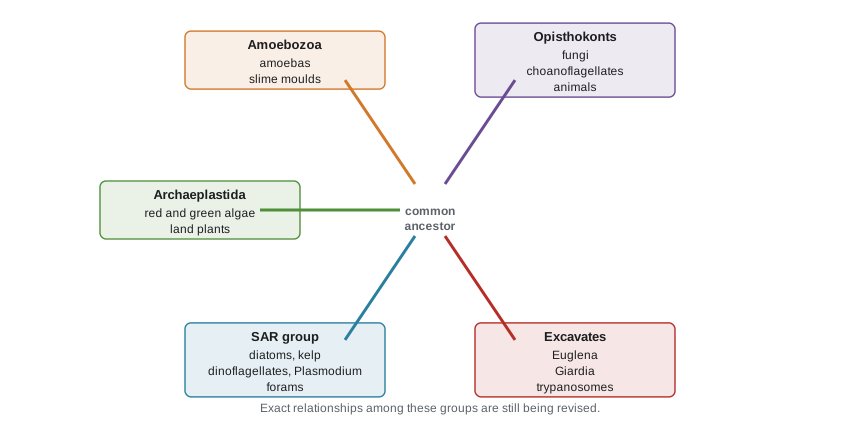
| Group | Examples | Notable features |
|---|---|---|
| Excavates | Euglena, Giardia, Trypanosoma | Often with a feeding groove; some lack typical mitochondria; include parasites causing beaver fever and sleeping sickness |
| Stramenopiles (SAR) | Diatoms, brown algae such as kelp, water moulds | Hairy and smooth flagella; diatoms have glassy silica walls |
| Alveolates (SAR) | Dinoflagellates, Plasmodium, ciliates such as Paramecium | Small sacs (alveoli) under the membrane; include red-tide organisms and the malaria parasite |
| Rhizarians (SAR) | Foraminiferans, radiolarians | Thread-like pseudopods; many build shells that form ocean sediments |
| Archaeplastida | Red algae, green algae, land plants | Chloroplasts from primary endosymbiosis |
| Amoebozoa | Amoebas, slime moulds | Lobe-shaped pseudopods; slime moulds aggregate into multicellular structures |
| Opisthokonts | Fungi, choanoflagellates, animals | A single rear flagellum in swimming cells; fungi and animals are each other’s closest major relatives |
Protists in ecosystems
Photosynthetic protists, mainly diatoms, dinoflagellates and coccolithophores, are a large part of the phytoplankton that drift in sunlit waters. Together with cyanobacteria, marine phytoplankton carry out roughly half of all photosynthesis on Earth and form the base of ocean food webs that support fish, seabirds and whales. When they die, some sink and carry carbon to the deep ocean; over millions of years, the shells of coccolithophores and foraminiferans have built chalk and limestone deposits, including the white cliffs of Dover.
Diatoms have a peculiar consequence of their glass walls. Each cell lives inside two overlapping halves, like a pillbox. When it divides, each daughter keeps one half and builds a new, smaller half inside it, so the average size of the population shrinks with each generation. When cells reach a minimum size, they restore their size through sexual reproduction.
import numpy as np
# Diatom size reduction: each daughter keeps one half-shell and builds a smaller one inside it
cells = np.array([60.0])                # starting cell length in micrometres
shrink = 1.2                            # the new half is about 1.2 micrometres smaller
for gen in range(1, 13):
    larger = cells                     # daughter keeping the larger half stays the same size
    smaller = cells - shrink           # daughter keeping the smaller half shrinks
    cells = np.concatenate([larger, smaller])
    if gen % 3 == 0:
print(f"generation {gen:2d}: {len(cells):5d} cells, mean length {cells.mean():.1f}, smallest {cells.min():.1f}")generation 3: 8 cells, mean length 58.2, smallest 56.4 generation 6: 64 cells, mean length 56.4, smallest 52.8 generation 9: 512 cells, mean length 54.6, smallest 49.2 generation 12: 4096 cells, mean length 52.8, smallest 45.6
Some protists cause harmful algal blooms. Certain dinoflagellates produce toxins that accumulate in shellfish such as mussels and clams, causing paralytic shellfish poisoning in people who eat them. Government agencies monitor shellfish beds and close harvesting when toxins rise.
In Canada, the Canadian Food Inspection Agency and Fisheries and Oceans Canada run the Canadian Shellfish Sanitation Program, testing shellfish for marine biotoxins on both coasts and closing areas such as parts of the Bay of Fundy and the British Columbia coast when levels are unsafe.
Protists and disease
A few protists are among humanity's most important pathogens. Plasmodium, spread by Anopheles mosquitoes, causes malaria, which the World Health Organization estimates caused around 600,000 deaths in 2023, mostly young children in sub-Saharan Africa. Plasmodium has a complex life cycle that alternates between mosquito and human hosts; in human red blood cells it multiplies in synchronized cycles, which cause the periodic fevers typical of the disease.
# Plasmodium blood-stage multiplication (illustrative values for P. falciparum)
merozoites_per_cell = 16      # new parasites released from each infected red blood cell
survival = 0.5                # fraction that successfully invade new red blood cells
cycle_hours = 48
parasites = 1e5               # parasites first released from the liver into the blood
red_cells = 2.5e13            # approximate red blood cells in an adult
for cycle in range(1, 9):
    parasites *= merozoites_per_cell * survival
    pct = 100 * parasites / red_cells
print(f"day {cycle * cycle_hours // 24:2d}: {parasites:.2e} parasites ({pct:.3f}% of red cells infected)")day 2: 8.00e+05 parasites (0.000% of red cells infected) day 4: 6.40e+06 parasites (0.000% of red cells infected) day 6: 5.12e+07 parasites (0.000% of red cells infected) day 8: 4.10e+08 parasites (0.002% of red cells infected) day 10: 3.28e+09 parasites (0.013% of red cells infected) day 12: 2.62e+10 parasites (0.105% of red cells infected) day 14: 2.10e+11 parasites (0.839% of red cells infected) day 16: 1.68e+12 parasites (6.711% of red cells infected)
Each cycle multiplies the parasite load about eightfold in this illustrative model, so the infected fraction of red cells climbs from almost nothing to several per cent in about 16 days. Parasite levels of a few per cent and above are associated with severe malaria, which is why prompt diagnosis and treatment matter so much. Drugs such as artemisinin combinations work by cutting the parasite load at each cycle. Resistance to artemisinin has emerged in Southeast Asia and parts of Africa, another example of evolution by natural selection in action.
Other protist pathogens include Giardia lamblia, which causes giardiasis, known in Canada and the northern United States as beaver fever and caught from untreated stream and lake water; Trypanosoma species, causing sleeping sickness in Africa and Chagas disease in Latin America; Toxoplasma gondii, carried by cats; and Phytophthora infestans, a water mould (an oomycete, related to diatoms, not a true fungus) that destroyed Irish potato crops in the 1840s, contributing to a famine that killed about a million people and drove large-scale emigration to North America.
Fungi: an overview
Fungi are heterotrophic eukaryotes that absorb their food. They secrete digestive enzymes into their surroundings and absorb the broken-down molecules through their cell walls, which are made of chitin, the same tough polysaccharide found in insect exoskeletons. Most fungi grow as networks of thin, branching filaments called hyphae, which together form a mycelium. A mushroom is only the reproductive structure of a much larger mycelium hidden in soil or wood. Yeasts are single-celled fungi.
Fungi are more closely related to animals than to plants. Both belong to the opisthokonts, both store carbohydrate as glycogen rather than starch, and both share chitin-related genes. This close relationship is one reason fungal infections can be hard to treat: drugs that harm fungal cells often harm human cells too.
A mycelium can spread over vast areas. A single individual of the honey fungus Armillaria ostoyae in the Blue Mountains of Oregon is estimated to cover nearly 10 square kilometres and to be thousands of years old, making it one of the largest organisms on Earth. Hyphae extend from their tips, and a mycelium growing outward from a point in uniform soil can form a ring of mushrooms, the fairy rings seen on lawns, whose radius grows each year.
import math
# A fairy ring: a mycelium spreading outward from one point at a steady rate
rate_cm_per_year = 25             # radial growth, within the range reported for lawn fungi
for years in (1, 10, 50, 200):
    r_m = rate_cm_per_year * years / 100
    area = math.pi * r_m ** 2
print(f"after {years:3d} years: ring radius {r_m:5.1f} m, area enclosed {area:9,.1f} m^2")after 1 years: ring radius 0.2 m, area enclosed 0.2 m^2 after 10 years: ring radius 2.5 m, area enclosed 19.6 m^2 after 50 years: ring radius 12.5 m, area enclosed 490.9 m^2 after 200 years: ring radius 50.0 m, area enclosed 7,854.0 m^2
Fungal diversity and life cycles
Fungi reproduce both asexually and sexually, usually by producing enormous numbers of spores that travel by air, water or animals. A single large puffball can release trillions. Fungi are classified largely by their sexual structures and, increasingly, by DNA.
| Group | Sexual structure | Examples |
|---|---|---|
| Chytrids | Swimming spores with a flagellum | Batrachochytrium dendrobatidis, which has devastated amphibian populations worldwide |
| Zygomycetes (now split into several groups) | Thick-walled zygosporangium | Black bread mould Rhizopus |
| Glomeromycetes | No known sexual stage | Arbuscular mycorrhizal fungi that partner with most plant roots |
| Ascomycetes (sac fungi) | Spores formed in sacs called asci | Yeasts, morels, truffles, Penicillium, the cause of Dutch elm disease |
| Basidiomycetes (club fungi) | Spores on club-shaped basidia | Mushrooms, puffballs, shelf fungi, rusts and smuts of crops |
Fungi in ecosystems and human life
Fungi are the principal decomposers of wood: they alone can efficiently break down lignin, the tough polymer in woody cell walls. Without them, dead trees and leaves would pile up and nutrients would stay locked away. Mycorrhizal fungi form partnerships with the roots of about 80 to 90 per cent of plant species, extending far into the soil and supplying water, phosphorus and nitrogen in exchange for sugars from the plant. Lichens are partnerships between a fungus and a photosynthetic alga or cyanobacterium. They colonize bare rock and tree bark, and lichens growing on trees and the ground are the main winter food of caribou across the boreal forest and tundra.
Fungi give us bread, beer, wine and cheese (through yeasts and moulds), antibiotics such as penicillin, discovered by Alexander Fleming in 1928, cholesterol-lowering statins and the immunosuppressant cyclosporine used in organ transplants. They also cause disease. Athlete's foot and yeast infections are common human fungal infections, and serious invasive infections threaten people with weakened immune systems; Candida auris, a drug-resistant yeast, has spread in hospitals worldwide since about 2009. Fungal plant diseases destroy significant shares of crops each year.
Two fungal diseases of wildlife show how introduced pathogens can devastate species. Chytridiomycosis, caused by a chytrid fungus spread through the global trade in amphibians, has contributed to the decline of at least 500 amphibian species and the extinction of dozens. White-nose syndrome, caused by Pseudogymnoascus destructans, was first detected in a cave near Albany, New York, in 2006 and has since killed millions of hibernating bats across eastern North America, including in Ontario, Quebec and the Maritime provinces; the little brown bat was listed as endangered in Canada in 2014 as a result.
Common mistakes
MistakeProtists form a single natural kingdom.
InsteadProtists are a convenience label for eukaryotes that are not plants, animals or fungi; they belong to many separate lineages.
MistakeFungi are a kind of plant.
InsteadFungi are heterotrophs with chitin walls, more closely related to animals than to plants.
MistakeA mushroom is the whole fungus.
InsteadA mushroom is only the spore-producing structure; the main body is a mycelium of hyphae.
MistakeThe Irish potato famine was caused by a fungus.
InsteadIt was caused by Phytophthora infestans, a water mould (oomycete) related to diatoms and brown algae.
MistakeAll algae are closely related plants.
InsteadAlgae are photosynthetic organisms from several distant lineages; brown algae are stramenopiles, while green and red algae are related to plants.
Summary and key terms
- Eukaryotes arose from an archaeal host and an engulfed alphaproteobacterium that became the mitochondrion.
- Chloroplasts came from a cyanobacterium by primary endosymbiosis and spread among protists by secondary endosymbiosis.
- Protists are not a clade; eukaryotes are grouped in several large lineages, including SAR, Archaeplastida, Excavates, Amoebozoa and Opisthokonts.
- Phytoplankton protists perform a large share of global photosynthesis; some cause harmful algal blooms.
- Protist pathogens include Plasmodium (malaria), Giardia, trypanosomes and the potato blight water mould.
- Fungi absorb food, have chitin walls, grow as hyphae and mycelia and are closely related to animals.
- Fungi decompose wood, form mycorrhizae and lichens, provide food and medicines, and cause human, crop and wildlife diseases.
- protist
- Any eukaryote that is not a plant, animal or fungus; not a natural group.
- endosymbiosis
- One organism living inside another; the origin of mitochondria and chloroplasts.
- secondary endosymbiosis
- The engulfment of a eukaryotic alga whose chloroplast is retained by the host.
- phytoplankton
- Photosynthetic microorganisms drifting in the sunlit surface waters of oceans and lakes.
- diatom
- A photosynthetic stramenopile protist with a two-part silica wall.
- hypha
- A thin, branching filament that makes up the body of most fungi.
- mycelium
- The network of hyphae forming the main body of a fungus.
- chitin
- A tough nitrogen-containing polysaccharide in fungal cell walls and arthropod exoskeletons.
- mycorrhiza
- A mutualistic association between fungi and plant roots.
- lichen
- A partnership between a fungus and a photosynthetic alga or cyanobacterium.
Practice problems
Work each problem on paper first, then reveal the answer to check.
List three lines of evidence that mitochondria descend from bacteria.
Show answer
Their own circular DNA, bacterial-type ribosomes and double membranes, and division by fission.
Why do some algal chloroplasts have more than two membranes?
Show answer
They came from secondary endosymbiosis, in which a eukaryotic alga was engulfed and its chloroplast kept.
Why is “kingdom Protista” no longer used as a formal group?
Show answer
Protists do not share a single common ancestor exclusive to them; they belong to many lineages.
A diatom population starts at 50 µm and each new half-shell is 1 µm smaller. What is the smallest cell after 10 generations?
Show answer
40 µm, after ten successive reductions.
With 16 merozoites per cell and 50 per cent invasion success, how much does the parasite load grow per cycle?
Show answer
About 8-fold per 48-hour cycle.
Name a protist that causes illness from drinking untreated lake water.
Show answer
Giardia lamblia, causing giardiasis or beaver fever.
Give two reasons fungi are considered closer to animals than to plants.
Show answer
Both are opisthokonts with related genes, both store glycogen, and fungi lack chloroplasts.
What is the role of mycorrhizal fungi?
Show answer
They help plant roots absorb water and nutrients such as phosphorus in exchange for sugars.
Why are fungi essential decomposers in forests?
Show answer
They can break down lignin in wood, recycling nutrients.
What caused the decline of little brown bats in eastern North America?
Show answer
White-nose syndrome, caused by the fungus Pseudogymnoascus destructans.
Lesson quiz · 5 questions
Score 60% or more to complete this lesson.
Create a free account to save your progress, take quizzes and earn a certificate.