
BAS-230 · Lesson 8 of 12 · 25 min
Cooling tower and condenser water control
▶ Video coming soon A video version of this lesson is on the way.
Two days after the chillers at Ninefield were swung over for the winter, Sophie's session on Wednesday, October 21 followed the heat the other way: out of the chillers' condensers and into the cooling tower on the roof. "The chilled water side gets all the attention," she said, "but every kilowatt the chillers take out of the building, plus the work the compressors do, has to be thrown away somewhere. At Ninefield that's the tower. If the condenser water side is wrong, the chillers work harder, trip on high pressure in summer or on low pressure in spring, and the tower can freeze." She put the condenser water pages of Ninefield's 1998 sequence on the table, and a page of notes from the tower's 2016 fan VFD retrofit.
The condenser water loop
A water-cooled chiller rejects heat from its condenser into a loop of condenser water. Pumps carry the warm water up to the cooling tower, where it is sprayed over fill while fans pull air through. A small part of the water evaporates, which cools the rest, and the cooled water collects in the tower's basin and returns to the chillers. Ninefield's tower has one cell with one fan on a VFD, a basin heater, a bypass valve that can send water straight back to the basin without passing over the fill, and a water treatment system that controls conductivity by bleeding off water and adds treatment chemicals.
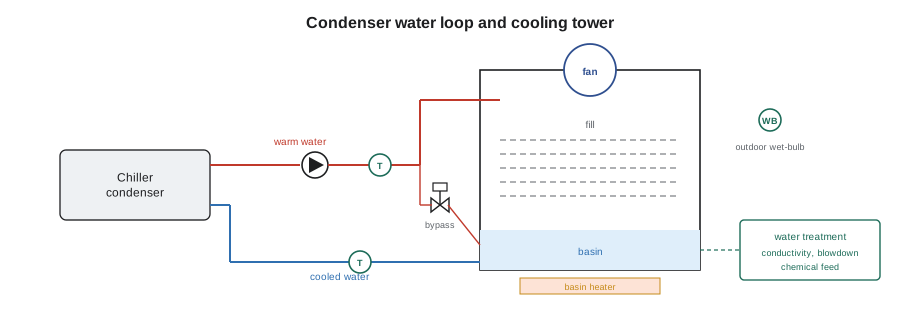
Two terms describe how a tower is working. The range is the drop in water temperature across the tower, from the water entering to the water leaving. The approach is how close the leaving water gets to the outdoor air's wet-bulb temperature, which is the lowest temperature evaporation can reach. A tower can never cool the water below the wet-bulb, and the closer the approach, the bigger and more expensive the tower or the harder its fans must work.
| Term | Meaning | Typical design value |
|---|---|---|
| Range | Entering water temperature minus leaving water temperature | About 5.5 K |
| Approach | Leaving water temperature minus outdoor wet-bulb | About 4 K |
| Design condenser water supply | Water leaving the tower at design conditions | About 29.5 °C |
| Minimum entering condenser water | Lowest temperature the chiller allows | Set by the chiller manufacturer |
Controlling the condenser water temperature
The older way to control a tower is to hold the condenser water supply at a fixed setpoint, often the design value, by staging or modulating the fans. That is safe but wasteful: colder condenser water lets the chiller's compressor work against a lower pressure and use less energy, and on most days the tower could supply much colder water than design. The better approach resets the condenser water setpoint to the outdoor wet-bulb plus the tower's approach, limited between a maximum and the chiller's minimum. The tower fans then run only as hard as needed to reach a temperature the weather actually allows.
Worked problem
An approach-based condenser water setpoint
Ninefield's draft sequence sets the condenser water supply setpoint to the outdoor wet-bulb plus 4 K, limited between 18 °C and 29.5 °C. What is the setpoint when the wet-bulb is 18 °C? When it is 11 °C?
Show solution
- At 18 °C wet-bulb: 18 + 4 = 22 °C, within the limits.
- At 11 °C wet-bulb: 11 + 4 = 15 °C, below the 18 °C minimum, so the setpoint is 18 °C.
Answer: On a muggy summer day the setpoint is 22 °C; in cool weather it stops at the chiller's 18 °C minimum. The fixed 1998 setpoint of 29.5 °C made the chillers work against warmer water than the weather required for most of the season.
Colder condenser water saves chiller energy but costs tower fan energy, and there is an optimum where the sum of the two is least. Plant optimization software and some high-performance sequences search for that optimum. A simple approach-based reset captures most of the benefit, and it is what Quillon's draft used, with the values marked as SAMPLE for the engineer to confirm against the chillers' data.
Fans, staging and the minimum temperature
Tower fans on VFDs modulate to hold the setpoint, usually with a minimum speed below which the fan cycles off, because very low speeds move little air and can be hard on gearboxes. Towers with several cells stage cells and fans together, and many sequences run as many cells as possible with water flowing over all of them, since spreading the water over more fill improves the approach at the same fan energy. With only one cell, Ninefield's sequence simply modulated its fan above a minimum speed and stopped it below.
In spring and autumn the tower can make water colder than the chiller allows. Chillers need a minimum entering condenser water temperature, set by the manufacturer, so that the refrigerant pressures stay in their working range; too cold, and the chiller can trip on low refrigerant pressure or have trouble returning oil. The sequence protects this limit first by stopping the fan, and then, if the water is still too cold, by opening the tower bypass valve so that warm water returns to the basin without passing over the fill. Some chillers also have their own head pressure control valve for the same purpose.
Freeze protection
A cooling tower holds a basin of water outdoors. When the plant runs in freezing weather, or when it stops with water in the basin, the water can freeze in the basin, in the fill and in exposed piping. Tower sequences protect against this with a basin heater controlled by a basin temperature and a low water level interlock, so that the heater never runs dry; with fans off and the bypass open in very cold weather; and, for towers that do not run in winter, with a procedure to drain the basin and exposed piping. Ninefield's plant normally stopped for the winter in mid-November, and its sequence included a winter mode in which the condenser water pumps and fan were locked out and the basin heater stayed on until the contractor drained the tower.
| Protection | Typical action |
|---|---|
| Basin heater | On below about 4 °C basin temperature, off above about 7 °C, never without water level |
| Fan control in cold weather | Fan off when the condenser water is below setpoint; never run fans that ice the fill |
| Bypass valve | Open to warm the basin when the fan is off and water is too cold |
| Winter lockout | Pumps and fan locked out once the tower is drained |
| Alarms | Low basin temperature, low water level, heater failure |
Water treatment and makeup
Evaporation removes pure water and leaves the dissolved minerals behind, so the concentration of minerals in the basin rises. To keep it in check, the water treatment controller bleeds off some water, called blowdown, whenever the conductivity rises above a setting, and fresh makeup water refills the basin through a float valve. The ratio between the mineral concentration in the basin and in the makeup water is called the cycles of concentration. Higher cycles save water but risk scale, and the water treatment contractor sets the target.
The water treatment system is usually provided and set up by the treatment contractor, not the controls contractor. The sequence's job is the interface: the treatment controller's chemical feed pumps should run only when condenser water is flowing, the automation system should monitor its alarms, and makeup and blowdown water meters, where fitted, should be trended so that the owner can see water use. Cooling towers are also a known source of Legionella bacteria, and BAS-110 noted that the Ontario code's ventilation part refers to ASHRAE Guideline 12 on managing that risk. The controls contribution is modest but real: no stagnant water in dead legs, and treatment running whenever the tower holds water.
Worked problem
Estimating evaporation and makeup
On a design day one Ninefield chiller removes 700 kW from the building and its compressor adds about 127 kW, so the tower rejects about 827 kW. Taking about 2,400 kJ to evaporate each kilogram of water, roughly how much water evaporates? At 4 cycles of concentration, how much makeup and blowdown is needed? (One kilogram of water is about one litre.)
Show solution
- Evaporation: 827 ÷ 2,400 = 0.34 kg/s, about 0.34 L/s.
- Makeup = evaporation × cycles ÷ (cycles − 1) = 0.34 × 4 ÷ 3 = 0.46 L/s.
- Blowdown = makeup − evaporation = 0.46 − 0.34 = 0.11 L/s.
Answer: Roughly 0.46 L/s of makeup, about 1,650 litres an hour, of which about a quarter is blowdown. Drift and leaks add a little more. A makeup meter that suddenly reads much higher than the load explains is worth an alarm.
Waterside economizers
In cool, dry weather the tower can make water colder than the chilled water the building needs. A waterside economizer uses that cold water to cool the chilled water directly through a plate heat exchanger, so the chillers can stay off. It suits buildings like Ninefield, where interior zones need cooling well into the cold months, but it needs a heat exchanger, valves, a sequence to switch between economizer and chiller operation, and freeze protection for a tower that would then run in cold weather. That is why BAS-110 listed it as a study for the retro-commissioning, not a decision.
Worked problem
When a waterside economizer can carry the load
Ninefield needs chilled water at 10 °C or colder to use the economizer for its winter interior load. The plate heat exchanger has an approach of 1.5 K and the tower an approach of 4 K. Below what outdoor wet-bulb can the economizer make 10 °C chilled water on its own?
Show solution
- Condenser water needed: 10 − 1.5 = 8.5 °C.
- Wet-bulb needed: 8.5 − 4 = 4.5 °C.
Answer: Below a wet-bulb of about 4.5 °C the economizer can carry the load alone. How many hours a year that occurs, and how much of the interior load the air handlers' own economizers already carry, is what the study had to work out.
Sensors and fallbacks at the tower
A tower sequence that resets condenser water from the outdoor wet-bulb depends on a reading that is hard to measure well. Wet-bulb is usually calculated from an outdoor temperature and a relative humidity sensor, and relative humidity sensors drift, especially outdoors near a tower's plume. A sensor reading too wet makes the sequence think the tower can do less than it can; a sensor reading too dry pushes the setpoint down toward a temperature the tower cannot reach, and the fans run flat out chasing it.
| Problem | Sequence response |
|---|---|
| Humidity sensor out of range or failed | Use a fixed condenser water setpoint at the design value, alarm |
| Setpoint not met for a long period | Raise the setpoint in steps toward the design value, alarm |
| Tower fan vibration switch trips | Stop that fan, alarm; other cells carry the load |
| Basin level low | Alarm; check the makeup valve and the float |
| Condenser water too cold for the chiller | Open the tower bypass or slow the fans to hold the chiller minimum |
Most of these responses are simple, and that is the point: a tower that is slightly less efficient while a sensor is replaced is far better than one that hunts or trips a chiller on low condenser pressure. Quillon's draft for Ninefield's retro-commissioning put the outdoor humidity sensor on the shaded north face of the penthouse, away from the tower plume, with an approach reset limited between fixed minimum and maximum setpoints so that a bad reading could only push the setpoint so far.
Testing the tower sequence follows the same pattern as the economizer. Override the wet-bulb input, watch the setpoint move, watch the fans stage and slow, then check the bypass valve and the basin heater by overriding the temperatures that enable them. Each override is released and recorded at the end.
Common mistakes
MistakeHolding condenser water at the design temperature all season.
InsteadReset it to wet-bulb plus approach within the chiller's limits.
MistakeLetting the tower make water colder than the chiller allows.
InsteadStop the fan first, then open the bypass, to hold the chiller's minimum entering temperature.
MistakeRunning a basin heater without a water level interlock.
InsteadInterlock the heater with basin level so it never runs dry.
MistakeRunning chemical feed with no condenser water flow.
InsteadInterlock treatment pumps with proven flow and monitor the treatment alarms.
MistakeTreating a waterside economizer as a simple add-on.
InsteadStudy the hours, the heat exchanger, the switchover sequence and winter freeze protection first.
Summary and key terms
- A water-cooled chiller rejects its load plus its compressor work to the condenser water and the cooling tower.
- Range is the drop across the tower; approach is how close the leaving water gets to the wet-bulb.
- Resetting condenser water to wet-bulb plus approach saves chiller energy, within the chiller's limits.
- In cool weather the sequence stops the fan, then opens the bypass, to protect the chiller's minimum temperature.
- Freeze protection uses basin heaters with level interlocks, fan control, the bypass and a winter lockout.
- Water treatment controls blowdown by conductivity; the controls interface interlocks feed with flow and monitors alarms.
- A waterside economizer cools chilled water with tower water when the wet-bulb is low enough.
- Condenser water
- Water that carries heat from a chiller's condenser to the cooling tower.
- Range
- The temperature drop of the water across a cooling tower.
- Approach
- The difference between a tower's leaving water temperature and the outdoor wet-bulb.
- Wet-bulb temperature
- The lowest temperature evaporation can cool water to in the current air.
- Tower bypass
- A valve that returns condenser water to the basin without passing over the fill.
- Basin heater
- A heater that keeps a tower's basin water from freezing.
- Blowdown
- Water bled from a tower to limit the concentration of dissolved minerals.
- Cycles of concentration
- The ratio of mineral concentration in the tower water to that in the makeup water.
- Waterside economizer
- A heat exchanger that cools chilled water with tower water so the chillers can stay off.
Practice problems
Work each problem on paper first, then reveal the answer to check.
Wet-bulb 20 °C, approach 4 K, limits 18 to 29.5 °C. Setpoint?
Show answer
24 °C.
Wet-bulb 9 °C, same rule. Setpoint?
Show answer
9 + 4 = 13, below 18, so 18 °C.
Evaporation 0.30 L/s at 5 cycles of concentration. Makeup and blowdown?
Show answer
Makeup 0.30 × 5 ÷ 4 = 0.375 L/s; blowdown 0.075 L/s.
In cool weather, what does the sequence do first when condenser water is below the chiller's minimum?
Show answer
Slow and then stop the tower fan, before opening the bypass.
Chilled water needed 9 °C, exchanger approach 1.5 K, tower approach 4 K. Wet-bulb for the economizer alone?
Show answer
9 − 1.5 − 4 = 3.5 °C.
Lesson quiz · 5 questions
Score 60% or more to complete this lesson.
Create a free account to save your progress, take quizzes and earn a certificate.